
Water Filters Market Size, Trends & Demand by 2034
Coverage: by Media Type (Cartridge, Single and Dual Phase, Multimedia); End User (Municipal, Industrial, Food and Beverages, Pharmaceuticals, Chemicals and Petrochemicals, Others) , and Geography (North America, Europe, Asia Pacific, and South and Central America)
- Status : Data Released
- Report Code : TIPRE00007077
- Category : Manufacturing and Construction
- No. of Pages : 150
- Available Report Formats :


- Last update date : September 28, 2026


2025 Market Size
US$ 16.43 Bn
Base year value
2034 Forecast
US$ 29.3 Bn
Projected by 2034
CAGR 2026-2034
6.64 %
Growth rate
Addressable Market
US$ 206.75 Bn
(2026-2034)
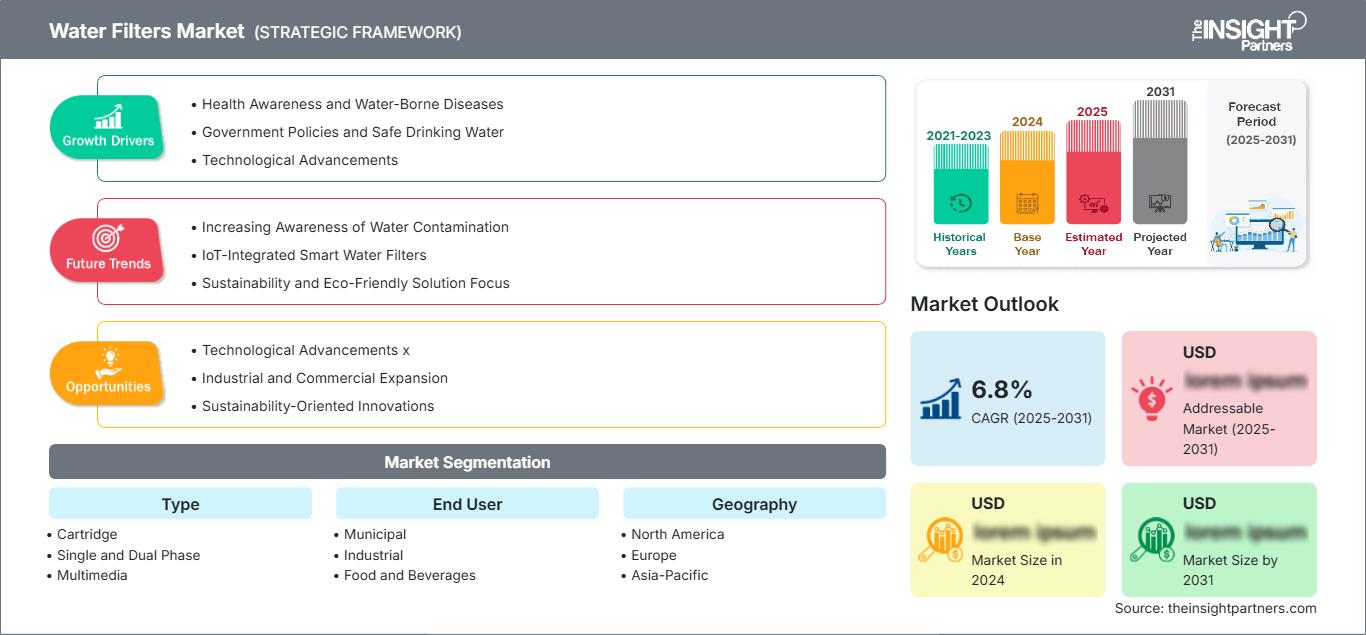
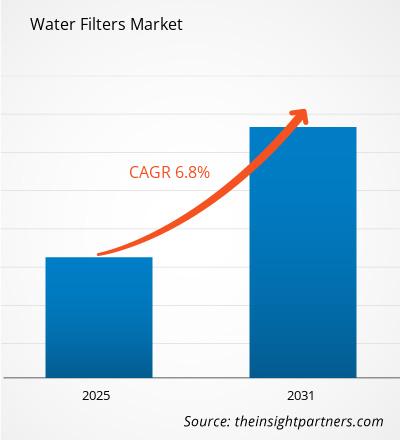
The water filters market was valued at US$ 16.43 Billion in 2025 and is projected to reach US$ 29.3 Billion by 2034, registering a CAGR of 6.64% during 2026–2034. Expansion is supported by rising water-quality requirements, replacement of aging treatment assets, industrial water reuse, and increasing demand for reliable filtration across municipal and process-water applications.
In North America, the water filters market size is expected to expand at an estimated CAGR of 7.2–8.0% during 2026–2034. Regulatory pressure on contaminants, including PFAS, combined with aging distribution infrastructure and growing industrial water-reuse requirements, is strengthening demand for higher-performance filtration, replacement cartridges, and integrated treatment systems.
Water Filters Market Assessment and Insights
- North America: North America is estimated to account for 28–30% share in 2025 and grow at a CAGR of 7.2–8.0% during 2026–2034, supported by regulatory upgrades, replacement demand, and advanced filtration adoption.
- US: The US represents 80–83% share of North America in 2025 and is projected to grow at a CAGR of 7.3–8.1%, led by municipal upgrades and industrial reuse.
- Europe: Europe is estimated at 21–23% share in 2025 and is expected to grow at a CAGR of 5.8–6.6%, with Germany, the UK, France, Italy, and Spain supporting demand through water-efficiency and treatment investments.
- Asia Pacific: Asia Pacific is estimated to hold 29–31% share in 2025 and grow at a CAGR of 8.0–9.0%, led by China, India, Japan, South Korea, and Australia as urbanization and industrialization increase treatment requirements.
- Largest Segment: Cartridge is estimated at 34–38% market share in 2025, with a CAGR of 6.8–7.4% during 2026–2034, reflecting recurring replacement and modular installation requirements.
- High Growth Segment: Municipal is estimated at 28–32% share in 2025 and is projected to expand at a CAGR of 7.1–7.8%, supported by infrastructure modernization and water-quality compliance.
- Key companies analyzed in detail: A. O. Smith Corporation; Atlas Filtri s.r.l.; DuPont de Nemours, Inc.; Eaton Corporation plc; Evoqua Water Technologies LLC; MANN+HUMMEL International GmbH & Co. KG; Pall Corporation; Pentair plc; SUEZ Water Technologies & Solutions USA, Inc.; Veolia Environnement SA.
Source: The Insight Partners' analysis based on proprietary research, government publications, company annual reports, investor presentations, industry databases, and expert interviews.
Filtration systems have evolved from basic particulate removal toward multi-stage treatment architectures combining physical separation, adsorption, membrane processes, and automated monitoring. Cartridge configurations remain important because they support modular installation and predictable replacement cycles, while multimedia systems address variable feedwater conditions. Production dynamics increasingly emphasize higher media utilization, longer service intervals, lower pressure loss, and compatibility with automated treatment trains.
The water filters market report indicates that the forward outlook is shaped by infrastructure investment, industrial water reuse, and tighter water-quality expectations. Emerging economies are expanding treatment capacity alongside urban development, while developed markets are replacing aging assets and adding advanced contaminant-removal stages. Digital design tools, lifecycle optimization, and energy-efficient filtration technologies are also becoming important procurement considerations as utilities and industrial operators increasingly evaluate the total cost of ownership rather than equipment price alone.
Water Filters Market Report Scope
| Report Attribute | Details |
|---|---|
| Market size in 2025 | US$ 16.43 Billion |
| Market Size by 2034 | US$ 29.3 Billion |
| Global CAGR (2026 - 2034) | 6.64% |
| Historical Data | 2021-2024 |
| Forecast period | 2026-2034 |
Water Filters Market Analysis
Water Filters Market forecast indicates that demand is generated across municipal drinking-water systems, industrial process lines, food and beverage production, pharmaceutical manufacturing, and chemical operations. The value chain comprises media suppliers, membrane and cartridge manufacturers, integrators, distributors, engineering companies, and service providers. The replacement demand creates recurring revenue from the necessity of periodic servicing of the cartridges and filtration media based on feedwater characteristics and process intensity.
Suppliers, which have the ability to deliver a standardized module by configuring filtration requirements for specific applications, gain an advantage within supply conditions. Municipal customers consider reliability, regulatory compliance, cost of life cycle, and serviceability, while industrial customers focus on capacity, selectivity of removal, availability, and water recovery. Industrial reuse improves the ecosystem since reclaimed water may be used for cooling, manufacturing, and other purposes without using fresh water sources.
The water filters market competitive landscape includes diversified water-technology groups and specialized filtration manufacturers. Pentair combines residential, commercial, and industrial water-treatment capabilities, while DuPont emphasizes membrane, separation, and digital treatment-design technologies. While Eaton offers extensive filtration solutions for industries, Pall Corporation provides its specific expertise in filtration in tough process settings. Veolia and SUEZ operate in treatment engineering and operations as well as in integrated water solutions.
Competitive position is more and more determined by the company’s technical depth, size of the installed base, breadth of distribution network, costs of replacement as well as capability to integrate filtration into comprehensive treatment solutions. A. O. Smith Corporation and Atlas Filtri s.r.l. help to improve companies’ positions from product-based perspective, while Evoqua Water Technologies LLC, MANN+HUMMEL International GmbH & Co. KG, and Veolia Environnement SA provide their products for industrial and municipal segments.
● REPORT CUSTOMIZATION
Tailor This Report To Align With Your Specific Business Requirements
This report can be customized to align precisely with your business objectives, scope, and target markets. Customization options include tailored segmentation, geography, competitive analysis, and strategic insights to support informed decision-making.
Customize This Report →WHAT YOU CAN ADJUST
- ● Segmentations
- ● Geography
- ● Competitive Analysis
- ● Language Preferences
Water Filters Market: Strategic Insights
Regional Insights
North America water filters market
North America is estimated to represent 28–30% share of the water filters market in 2025 and is projected to grow at a CAGR of 7.2–8.0% through 2034. The United States drives regional demand due to infrastructure upgrades for the cities, industrial wastewater reuse and contaminant control measures, as well as wide-scale adoption of point-of-use and process filtration. Canada also plays its role in infrastructure upgrades for the cities and industries.
There is increasing reliance on treatment efficiency and compliance with regulations as drivers of demand rather than capital expenditure. Industries utilize filtration to lower freshwater withdrawal and increase the process water quality. Municipalities upgrade their treatment processes to manage emerging contaminants. The United States Environmental Protection Agency (USEPA) continues to broaden its water reuse strategy.
U.S. water filters Market
The U.S. represents approximately 80–83% of North America's water filters market share in 2025 and is projected to grow at a CAGR of 7.3–8.1% during 2026–2034. Diverse application covers municipal water treatment, residential water filtration, food processing, pharmaceuticals, and industrial water applications.
Growth drivers include PFAS water treatment regulations, deteriorating infrastructure, and water reuse investments. Leading companies are well represented in filter media, membranes, cartridges, and system technologies. Industrial companies have been increasingly relying on filtration as an element of closed-loop water management systems, whereas municipalities are focusing on treatment effectiveness and contaminant reduction. The involvement of such industry players as Pentair plc, DuPont de Nemours, Inc., Pall Corporation, Eaton Corporation plc, and Evoqua Water Technologies LLC indicates the availability of the technology in several applications.
Europe water filters Market
Europe is estimated to account for 21–23% share of the water filters market in 2025 and is forecast to expand at a CAGR of 5.8–6.6%. Germany is a leading market, while the UK, France, Italy, and Spain contribute through industrial treatment, municipal modernization, and water-efficiency programs.
The United Kingdom has a demand for filters due to aging infrastructure, industrial water management, and growing environmental standards. Municipal plants are increasingly analyzing the efficiency of their filters along with energy usage and total costs over life cycle. Industrial users in food processing, pharmaceuticals, and advanced manufacturing are using filtration systems to keep process water quality stable and minimize discharge quantities.
Germany is one of the leading regional industries; filter demands in Germany arise due to chemical, manufacturing, food processing, and municipal water treatment. In France and Italy, there is demand due to the requirement of water treatment in industry and modernization projects, while in Spain, due to the scarcity of water resources, there is demand for advanced treatment technologies.
APAC water filters Market
APAC is estimated to account for 29–31% share of the Water Filters Market in 2025 and is projected to expand at a CAGR of 8.0–9.0%. China dominates regional demand, with India, Japan, South Korea, and Australia following behind. Urbanization, growth in industries, water shortage, and infrastructural development drive the use of membranes.
China and India represent large-volume opportunities because of the demand for treatment of waste from municipalities and industries, while Japan and South Korea focus on efficient and dependable treatment. Australia remains concerned about water efficiency and recycling. The need for filtration is growing in the industrial sector owing to its involvement in electronics, chemicals, food, and pharmaceuticals.
Middle East & Africa water filters Market
The Middle East and Africa Water Filters Market is expected to expand at a CAGR of 6.0–7.0% through 2034, supported by desalination, water reuse, municipal infrastructure, and industrial development. The top investors in advanced treatment technologies are Saudi Arabia and UAE, whereas South Africa focuses on broader municipal and industrial applications.
Due to the energy intensity of the water production process in the Gulf region, filtration efficiency is vital for the development of the area. Saudi Arabia and the UAE have invested in technologies that ensure water security, desalination, and water reuse. In South Africa and other countries of MEA, the demand for filtration systems is associated with municipalities, mining, food processing, and industries.
Segmentation Analysis
Type
Water Filters Market trends indicate that the Type segment comprises Cartridge, Single and Dual Phase, and Multimedia configurations. Cartridge filters are estimated to remain the largest segment, with a CAGR of 6.8–7.4% during 2026–2034. Demand benefits from modular deployment, straightforward replacement procedures, broad application compatibility, and recurring consumable demand across municipal and industrial treatment systems. Single and dual phase configurations remain important where compact treatment trains, operational simplicity, and space-efficient installations are preferred, while multimedia systems address diverse particulate loads, pretreatment requirements, and varying feedwater conditions across a wide range of water treatment applications.
- Cartridge: Cartridge filters maintain strong adoption where operators require modular replacement, controlled filtration stages, and predictable maintenance. Their compatibility with industrial, commercial, and municipal equipment supports recurring demand and simplifies system upgrades.
- Single and Dual Phase: Single and dual phase systems remain relevant for applications requiring compact filtration trains and defined treatment stages. Their practical configuration supports installations where space, maintenance access, and process simplicity influence procurement decisions.
- Multimedia: Multimedia filtration is strategically important where feedwater contains varied particulate loads. Layered media arrangements support broader contaminant capture and are frequently integrated as pretreatment stages within larger water-treatment systems.
End User
The End User segment of the Water Filters Market includes Municipal, Industrial, Food and Beverages, Pharmaceuticals, Chemicals and Petrochemicals, and Others. Municipal applications are identified as the high-growth segment, with a CAGR of 7.1–7.8% during 2026–2034. Infrastructure modernization, water reuse, and compliance requirements support investment, while industrial customers increasingly treat filtration as an operational reliability tool rather than a standalone utility expense.
- Municipal: Municipal systems prioritize dependable contaminant removal, scalable capacity, and compliance. Replacement of aging assets and expanded reuse programs make filtration increasingly central to drinking-water and non-potable treatment infrastructure.
- Industrial: Industrial demand centers on process consistency, equipment protection, water recovery, and reduced freshwater intake. Filtration is commonly integrated with pretreatment and polishing stages to protect downstream membranes and production equipment.
- Food and Beverages: Food and beverage producers require filtration that supports product quality, hygienic operation, and stable process water. Cartridge and staged systems are particularly relevant where frequent sanitation and predictable replacement are operational priorities.
- Pharmaceuticals: Pharmaceutical applications emphasize stringent water-quality control, validated processes, and repeatable performance. Filtration systems are selected according to process requirements, microbial-control strategies, and compatibility with downstream purification technologies.
- Chemicals and Petrochemicals: Chemical and petrochemical facilities use filtration to protect equipment, manage process-water quality, and support reuse. High solids loading and demanding operating conditions favor robust systems with controlled maintenance requirements.
Opportunity Snapshot
| End User | Revenue Contribution | Trend Tag | Adoption Stage |
| Municipal | High | Reuse Infrastructure | Scaling |
| Industrial | High | Process Recovery | Mature |
| Food and Beverages | Medium | Hygienic Filtration | Mature |
| Pharmaceuticals | Medium | Validated Water | Scaling |
| Chemicals and Petrochemicals | Medium | Process Protection | Mature |
| Others | Low | Specialized Treatment | Emerging |
Water Filters Market Growth Drivers and Impact Analysis
Industrial Water Reuse Expands Filtration Requirements
The adoption of water reuse practices within industry is changing the procurement process of filtration systems from one based on simple purification needs to an integrated approach to water management. Industrial facilities such as manufacturing plants, data centers, food processors, and chemical manufacturers are increasingly looking to recycle their water through process streams, cooling, and effluent water. The process of filtration is important in that pretreatment helps achieve high-quality feed water, which helps membranes work better and avoid operational disruptions. The current industrial water reuse literature provided by the US EPA deals with water reuse in cooling water, manufacturing processes, boilers, and other industrial uses. This broadens the scope of applicable equipment beyond the scope of simple potable water treatment systems.
Stricter Contaminant Management Raises Treatment Complexity
Concerns regarding emerging contaminants mean that water treatment is becoming more technically challenging from a regulatory perspective. Suppliers of filters face the challenge of evaluating them along with adsorption, membranes, and other treatment processes in order to comply with the changing demands on water quality. Such a tendency means that suppliers with wide portfolios of treatment processes will have an advantage since there is a tendency toward choosing integrated solutions over individual components. The regulatory roadmap of the WHO until 2025 for sanitation also stresses the importance of stronger regulatory frameworks when it comes to treatment and safe reuse. It will mean that in terms of specifications, buyers will be interested in validated removal ability, reliability, monitoring, and costs.
Aging Treatment Infrastructure Sustains Replacement Demand
Aging infrastructure in municipal and industrial applications generates a sustainable replacement opportunity for filter systems, housings, cartridges, and related parts. Instead of having to replace full water treatment facilities, many facilities will have the opportunity to boost efficiency by installing modernized filters in stages, through equipment upgrades, and using high-efficiency filtering units. This strategy enables the capital expenditure to be spread out while focusing on solving operational problems. In developed countries, replacement demand is additionally fueled by existing installed bases and scheduled maintenance programs. In developing countries, the opportunity to grow due to infrastructure development and construction of new water treatment facilities exists as well.
Water Filters Market Future Trends
Digital Filtration Design and Predictive Optimization
The field of digital engineering will continue to shape the choice, design, and lifecycle of filters. Treatment system designers will be able to test the properties of the source water, process parameters, pressure loss, treatment capacity, and economic tradeoffs prior to any installation of the equipment. For example, the introduction by DuPont of WAVE PRO technology for ultrafiltration in 2025 shows how digital modeling has found its way into treatment system design. In the forecast period, digital solutions will probably link design parameters to operational parameters, thus allowing optimization of cleaning frequency, replacement frequency, and energy consumption for water treatment plants. These solutions have the potential to minimize risks associated with commissioning and help determine the exact size of the equipment.
Longer-Life Media and Lower-Waste Filtration Architectures
Filtration technologies continue evolving towards increased life cycles, improved media efficiency, and reduced consumption of materials. The ecological impact of cartridge changing, the creation of wastewater, and the energy requirements of the treatment steps are becoming the subject of analysis by consumers. Filtration systems are being designed with deeper media structures and configurations that are meant to increase their capacity for retaining contaminants. In 2025, for instance, Eaton introduced the BECO Helix depth filter cartridges with increased particle holding capacity and extended life cycle in comparison with traditional pleated depth cartridges. With the growing prominence of sustainability criteria in purchasing, products that demonstrate improvements in terms of replacement cycle, waste generation, pressure drop, or energy use will have an advantage.
Water Filters Market Opportunities
Integrated Filtration for Industrial Reuse Projects
The reuse of industrial water presents an opportunity for the filtration providers to reach higher up in the process flow and offer comprehensive treatment solutions. Rather than simply selling cartridges or filtration units, suppliers may develop packages of pretreatment, membrane protection, polishing, monitoring, and cartridge replacement that address application-specific needs. The demand is especially important in the industries characterized by intensive use of water or stringent discharge standards, such as chemicals, food & beverage, pharmaceuticals, and high-tech manufacturing. Suppliers can add more commercial value through quantifying water reuse, cost savings in servicing and improved reliability. Collaboration with engineering firms and facilities' owners can further help to accelerate the adoption of filtration technology through its integration into comprehensive water reuse projects.
Advanced Filtration Solutions for Emerging Urban Systems
Urbanization in Asia Pacific, the Middle East, and some selected African countries presents opportunities in filtration platforms that are scalable in terms of varying levels of water quality and infrastructure. Suppliers may choose to go for modular systems capable of handling phased capacity increase and decentralization of treatment and maintenance processes. Cartridge and multimedia systems may be enhanced with higher levels of filtration as the need arises in line with varying water-quality standards. Reliability of equipment, parts supply, training of operators, and overall support during the lifecycle of projects may be emphasized in the business models due to their importance in the success of the projects post-launch.
Frequently Asked Questions

- Comprehensive Market Sizing and Forecast Analysis
- Detailed Segmentation Analysis
- In-Depth Market Dynamics Assessment
- Regional and Country-Level Insights
- Competitive Landscape and Company Benchmarking
- Strategic Business Intelligence
Recent Reports
Testimonials

The Insight Partners provided valuable market intelligence that supported our global go-to-market strategy. Their team was professional, responsive, and attentive to our feedback, providing thoughtful analysis and helpful methodological clarifications throughout the project.
Junmo Kim Chief Financial Officer (CFO), Enertech Co., Ltd.
The Insight Partners' SCADA System Market report is comprehensive, with valuable insights on current trends and future forecasts. The team was highly professional, responsive, and supportive throughout. We are very satisfied and highly recommend their services.
RAN KEDEM Partner, Reali Technologies LTDs
I requested a report on a very specific software market and the team produced the report in a few days. The information was very relevant and well presented. I then requested some changes and additions to the report. The team was again very responsive and I got the final report in less than a week.
JEAN-HERVE JENN Chairman, Future Analytica
We worked with The Insight Partners for an important market study and forecast. They gave us clear insights into opportunities and risks, which helped shape our plans. Their research was easy to use and based on solid data. It helped us make smart, confident decisions. We highly recommend them.
PIYUSH NAGPAL Sr. Vice President, High Beam Global
The Insight Partners delivered insightful, well-structured market research with strong domain expertise. Their team was professional and responsive throughout. The user-friendly website made accessing industry reports seamless. We highly recommend them for reliable, high-quality research services
YUKIHIKO ADACHI CEO, Deep Blue, LLC.
This is the first time I have purchased a market report from The Insight Partners.While I was unsure at first, I visited their web site and felt more comfortable to take the risk and purchase a market report.I am completely satisfied with the quality of the report and customer service. I had several questions and comments with the initial report, but after a couple of dialogs over email with their analyst I believe I have a report that I can use as input to our strategic planning process.Thank you so much for taking the extra time and making this a positive experience.I will definitely recommend your service to others and you will be my first call when we need further market data.
JOHN SUZUKI President and Chief Executive Officer, Board Director, BK Technologies
I wish to appreciate your support and the professionalism you displayed in the course of attending to my request for information regarding to infectious disease IVD market in Nigeria. I appreciate your patience, your guidance, and the fact that you were willing to offer a discount, which eventually made it possible for us to close a deal. I look forward to engaging The Insight Partners in the future, all thanks to the impression you have created in me as a result of this first encounter.
DR CHIJIOKE ONYIA MANAGING DIRECTOR, PineCrest Healthcare Ltd.Reason to Buy
- Informed Decision-Making
- Understanding Market Dynamics
- Competitive Analysis
- Identifying Emerging Markets
- Customer Insights
- Market Forecasts
- Risk Mitigation
- Boosting Operational Efficiency
- Strategic Planning
- Investment Justification
- Tracking Industry Innovations
- Aligning with Regulatory Trends





 Get Free Sample for