
Woodworking Machines Market Trends, Demand & Growth by 2034
Coverage: by Product (Saw Machines, Planers, Grinding Machines, Shapers, Routers, Others); End-user (Furniture Industry, Construction Industry) , and Geography (North America, Europe, Asia Pacific, and South and Central America)
- Status : Data Released
- Report Code : TIPRE00009695
- Category : Manufacturing and Construction
- No. of Pages : 150
- Available Report Formats :


- Last update date : September 28, 2026


2025 Market Size
US$ 5.85 Bn
Base year value
2034 Forecast
US$ 7.99 Bn
Projected by 2034
CAGR 2026-2034
3.52 %
Growth rate
Addressable Market
US$ 62.84 Bn
(2026-2034)
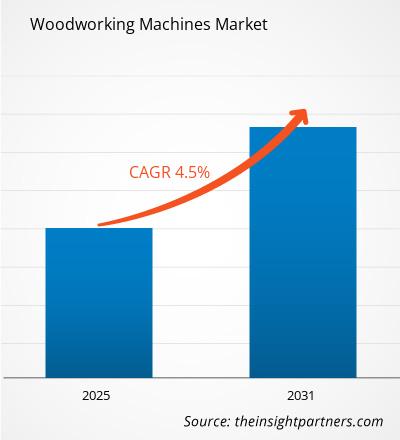
The woodworking machines market is valued at US$ 5.85 Billion in 2025 and is projected to reach US$ 7.99 Billion by 2034, registering a CAGR of 3.52% during 2026–2034. The market encompasses equipment used for cutting, planing, grinding, shaping, routing, and related wood-processing operations. Demand is supported by furniture manufacturing, construction activity, replacement of aging equipment, and gradual migration toward digitally controlled production systems.
North America presents a steady expansion outlook, with the market estimated to register a 3.1–3.8% CAGR during 2026–2034. The woodworking machines market size benefits from replacement demand across established manufacturing bases and increasing adoption of automated CNC equipment. Custom furniture, architectural millwork, remodeling, and residential construction also sustain equipment utilization, while labor availability encourages manufacturers to invest in productivity-enhancing machinery.
Woodworking Machines Market Assessment and Insights
- North America is estimated to account for 24–28% woodworking machines market share in 2025 and is projected to expand at a 3.1–3.8% CAGR between 2026–2034, supported by replacement cycles, custom manufacturing, automation, and demand for digitally controlled equipment.
- US represents approximately 70–75% of North America's 2025 market, with a 3.2–3.9% CAGR between 2026–2034, driven by furniture production, architectural millwork, remodeling, and investment in labor-saving machinery.
- Europe holds an estimated 28–32% share in 2025 and is expected to record a 2.8–3.5% CAGR between 2026–2034. Germany, Italy, and France remain important manufacturing centers, supported by engineering expertise, exports, and automation.
- Asia Pacific accounts for approximately 32–36% share in 2025 and is forecast to grow at a 4.1–4.9% CAGR between 2026–2034. China, Japan, India, and South Korea benefit from furniture manufacturing, construction, and industrial modernization.
- Largest Segment: Saw Machines represent an estimated 30–34% market share in 2025, expanding at a 3.2–3.9% CAGR from 2026–2034 because cutting remains fundamental across wood-processing workflows.
- High Growth Segment: Routers hold approximately 11–15% market share in 2025 and are projected to grow at a 4.4–5.2% CAGR during 2026–2034, supported by CNC-enabled customization and precision machining.
- Key companies analyzed in detail: Biesse S.p.A.; Felder Group; Gongyou Group Co., Ltd.; HOLYTEK INDUSTRIAL CORP.; HOUFEK a.s.; IMA Schelling Group GmbH; Michael Weinig AG; Oliver Machinery Company; Paolino Bacci S.r.l.; SCM Group S.p.A.; HOMAG Group AG.
Source: The Insight Partners' analysis based on proprietary research, government publications, company annual reports, investor presentations, industry databases, and expert interviews.
Production considerations are moving away from single machines and toward integrated cells that include cutting, machining, material handling, software, and quality assurance processes. CNC routing, nesting, automatic panel sizing, edge trimming, and digitally controlled maintenance become more common for shorter production cycles and custom orders. The manufacturers also try to optimize production in terms of throughput and at the same time minimize waste and optimize energy consumption, safety for operators, and setup times.
The future direction of development is defined by investments into new manufacturing facilities, especially in India and Southeast Asia, as well as upgrades of existing manufacturing plants in Europe and North America. Regulations in terms of safety for workers, dust collection, energy efficiency, and proper materials usage make the newer machines more attractive. Various financing schemes, service agreements, remote diagnostics, and upgrades of machines can also help overcome the adoption problems. Local technical support is increasingly important for small manufacturers assessing automation.
Woodworking Machines Market Report Scope
| Report Attribute | Details |
|---|---|
| Market size in 2025 | US$ 5.85 Billion |
| Market Size by 2034 | US$ 7.99 Billion |
| Global CAGR (2026 - 2034) | 3.52% |
| Historical Data | 2021-2024 |
| Forecast period | 2026-2034 |
Woodworking Machines Market Analysis
The demand for wood machinery is tied closely with production of furniture, construction, interior fit-up, remodeling, and use of engineered woods. The ecosystem for wood machinery supply chain comprises of machine manufacturers, tools, software providers, distributors, installers, maintenance suppliers, and furniture makers. Economic considerations for production continue to be increasingly focused on machinery which allows for easy changeovers, precise material movement, and machining especially when variety increases.
Value chain is also being software driven. Machine manufacturers are increasingly providing machinery with integrated CAD/CAM capabilities, monitoring of production process, scheduling and service diagnostic abilities. The supply side relies on motors, drives, control, cutting tools, sensors, and other precision parts which present opportunities to the suppliers who enhance the reliability and reduce lead time. Regional service network remains an important factor since downtime impacts manufacturing economics.
The competitive positioning in terms of production solution delivery is gaining more relevance compared to just one piece of machinery. The woodworking machines market report highlights the competitive environment comprised of proven European engineering companies, Asian manufacturers and regional players. Companies like Biesse S.p.A., SCM Group S.p.A., Felder Group, HOMAG Group AG, and Michael Weinig AG focus on integration and development of application-related solutions, whereas regional manufacturers offer customizing, lower prices and better service availability.
The focus of investments is gradually shifting towards CNC automation, robotics, connected production and aftermarket services. Digital development has been undertaken by Biesse S.p.A., while SCM Group S.p.A. continues to integrate machinery and factory management software. Automated production has become a priority for Felder Group and Michael Weinig AG. Gongyou Group Co., Ltd., HOLYTEK INDUSTRIAL CORP., HOUFEK a.s., IMA Schelling Group GmbH, Oliver Machinery Company, and Paolino Bacci S.r.l. represent regional and specialist competencies in particular applications.
● REPORT CUSTOMIZATION
Tailor This Report To Align With Your Specific Business Requirements
This report can be customized to align precisely with your business objectives, scope, and target markets. Customization options include tailored segmentation, geography, competitive analysis, and strategic insights to support informed decision-making.
Customize This Report →WHAT YOU CAN ADJUST
- ● Segmentations
- ● Geography
- ● Competitive Analysis
- ● Language Preferences
Woodworking Machines Market: Strategic Insights

Regional Insights
North America woodworking machines market
The woodworking machines market forecast shows that North America is estimated to hold 24–28% share in 2025, with a 3.1–3.8% CAGR during 2026–2034. The United States remains the principal demand center, supported by furniture, architectural millwork, remodeling, and construction-related woodworking. Equipment replacement is also important because established workshops increasingly require safer, more productive machinery.
Contribution to the market includes residential building, usage of engineered wood, and commercial interior design. The availability of labor and salary cost in the region promotes automation, as well as demand for customized furniture promotes CNC routing and flexible machining. Good distributors having installation and servicing expertise will have added value as small workshops will require assistance after purchasing complex machinery.
U.S. woodworking machines market
The US represents approximately 70–75% of North America's 2025 market, with a 3.2–3.9% CAGR through 2034. Demand is supported by furniture manufacturing, custom cabinetry, architectural millwork, and residential remodeling. The market also benefits from a broad installed base requiring replacement and modernization.
Wood processing machinery market trends support CNC, nesting, automated cutting, and digitally aided manufacturing since manufactures strive for increased volume and reduced manual input. There are several companies that stand out and they include Biesse S.p.A., Felder Group, HOMAG Group AG, and Oliver Machinery Company among others. Domestic manufacture is categorized into furniture and building joinery works, giving rise to a varied clientele for the equipment.
Europe woodworking machines market
Europe accounts for approximately 28–32% share in 2025 and is projected to grow at a 2.8–3.5% CAGR through 2034, with Germany serving as a leading manufacturing center. Germany enjoys a highly developed machinery environment, furniture industry, and export-oriented engineering. Italy holds its place due to machinery specialization and furniture manufacture, while France, Spain, and the UK promote their demand via interior construction, renovations, and furniture needs.
The German installed industrial base facilitates constant modernization, whereas the Italian concentration of woodworking technology providers contributes to innovation and exports. France and Spain are profiting from construction renovations and furniture demand, while the UK maintains its demand through residential renovations, tailor-made interiors, and commercial fit-outs. In Europe in general, energy efficiency, safety at workplaces, production flexibility, and automation become important purchase decision-making factors for the migration to digitalized equipment.
APAC woodworking machines market
APAC represents approximately 32–36% share in 2025 and is forecast to expand at a 4.1–4.9% CAGR through 2034. The market leader is China due to the large number of furniture manufacturers in the region and the ability to export their products. Japan and South Korea pay attention to accuracy, automation, and high technology in manufacturing.
India becomes more significant because of growth in the manufacture of furniture, housing construction, and organized manufacture. Australia makes its contribution through construction, reconstruction, and professional woodworking. The adoption rate in the region will depend on the use of CNC equipment, modern factories, and worker productivity.
Middle East & Africa woodworking machines market
Middle East and Africa is expected to register a 3.0–3.7% CAGR during 2026–2034, supported by construction, hospitality projects, interior fit-outs, and furniture manufacturing. The Saudi Arabian and UAE markets are the major centers of demand, whereas South Africa is a key woodworking and logistics center.
The infrastructure development and commercialization, along with diversification from oil and gas, create a need for equipment in the Middle Eastern countries. For Saudi Arabia, large development projects are characteristic, and in the case of the UAE, it is an excellent place to use expensive indoor design and hotel projects.
Segmentation Analysis
Product
The Product segment remains central to purchasing decisions because manufacturers select machinery according to material characteristics, production volume, precision requirements, and available floor space. The segment is expected to expand at a 3.3–4.0% CAGR during 2026–2034. Increasing integration of CNC controls, automated feeding, sensors, and production software supports replacement and upgrading.
- Saw Machines: Saw machines maintain the broadest application base because accurate cutting is required before most downstream processes. Demand spans panel processing, solid wood preparation, furniture components, and construction-related applications.
- Planers: Planers are important for dimensional accuracy and surface preparation in solid-wood operations. Demand is concentrated among furniture producers, joinery businesses, and manufacturers requiring consistent thickness across repeated production runs.
- Grinding Machines: Grinding machines support surface preparation and finishing requirements, particularly where smoothness, coating preparation, and dimensional consistency influence final product quality. Their relevance increases with higher finishing expectations.
- Shapers: Shapers remain valuable for profiling, edge formation, and repeatable component production. Their strategic role is strongest in applications requiring specialized profiles and consistent machining across medium-volume manufacturing.
- Routers: Routers support precision cutting, engraving, drilling, and three-dimensional machining. CNC-enabled systems are increasingly favored where manufacturers need rapid design changes, intricate components, nesting, and customized production.
- Others: Other equipment serves specialized processing requirements and complements primary cutting, machining, and finishing systems. Purchasing decisions typically depend on workflow configuration, product mix, plant capacity, and integration requirements.
End-user
The End-user segment in the woodworking machines market is projected to record a 3.2–3.9% CAGR during 2026–2034, reflecting continued machinery utilization across furniture and construction applications. Equipment selection increasingly considers throughput, flexibility, automation readiness, and total operating cost rather than purchase price alone.
- Furniture Industry: Furniture manufacturers require flexible machinery for panels, solid wood, cabinetry, and customized products. Demand increasingly favors CNC systems, nesting, automated material handling, and connected production for varied product configurations.
- Construction Industry: Construction-related woodworking supports demand for cutting, planing, routing, and shaping equipment used in doors, windows, flooring, interiors, structural components, and architectural millwork. Project schedules emphasize reliable throughput.
Opportunity Snapshot
| End-user | Revenue Contribution (High/Medium/Low) | Trend Tag (MAX 2 words) | Adoption Stage (Emerging/Scaling/Mature) |
|---|---|---|---|
| Furniture Industry | High | CNC Customization | Scaling |
| Construction Industry | Medium | Automated Joinery | Scaling |
Woodworking Machines Market Growth Drivers and Impact Analysis
Rising demand for customized furniture production
Consumer and commercial buyers in the woodworking machines market increasingly seek differentiated furniture, cabinetry, interiors, and architectural components, requiring manufacturers to produce smaller batches without sacrificing accuracy. This changes equipment economics because flexible CNC routers, nesting systems, automated saws, and programmable machining centers can reduce setup requirements across varied product designs. The impact extends beyond machine purchases to software, tooling, training, and service contracts. Manufacturers with connected equipment can improve scheduling and reduce material handling inefficiencies when product configurations change frequently. Suppliers that combine machinery with workflow software therefore gain an advantage over vendors offering isolated equipment. Customization also creates an avenue for smaller manufacturers to compete with larger producers by using flexible automation rather than relying solely on labor-intensive craftsmanship.
Automation addresses workforce and productivity constraints
Woodworking manufacturers face pressure to increase output while controlling dependence on highly experienced operators. Automation can transfer repetitive cutting, routing, material handling, and measurement activities from manual processes to programmable systems, improving consistency and reducing production interruptions. The impact is particularly significant for businesses operating multiple shifts or producing standardized components at scale. Automated equipment can also improve workplace ergonomics by reducing manual lifting and repetitive handling. Investment decisions increasingly incorporate total labor requirements, machine utilization, changeover time, and maintenance rather than initial acquisition cost alone. As these criteria become more prominent, suppliers capable of integrating robotics, sensors, software, and material handling into complete production cells are positioned to capture a larger share of capital expenditure.
Digital manufacturing improves equipment utilization
Connected machinery is changing how woodworking companies monitor production, diagnose failures, schedule maintenance, and evaluate machine utilization. Digital platforms can provide operational information that supports faster troubleshooting and better planning of preventive interventions. The market impact is strongest where downtime carries substantial costs, particularly in industrial furniture and panel-processing operations. Machine connectivity also supports remote assistance and service contracts, creating recurring revenue opportunities for equipment manufacturers and distributors. Over time, data from installed equipment can inform process optimization, tooling replacement, energy management, and production scheduling. This encourages customers to evaluate suppliers based on digital capabilities and service responsiveness alongside mechanical performance. Vendors with interoperable software architectures can therefore strengthen customer retention while creating additional aftermarket opportunities.
Woodworking Machines Market Future Trends
Connected production cells become standard
The next phase of development will move beyond individual smart machines toward connected production cells linking design software, cutting, routing, edge processing, handling, inspection, and scheduling. Manufacturers will increasingly expect equipment to exchange production data through interoperable systems rather than operate as isolated assets. This shift can improve traceability, production sequencing, and utilization visibility across factories. Smaller workshops may adopt modular systems that can be expanded as order volumes rise, reducing the need for large initial investments. Suppliers will increasingly differentiate through software compatibility, remote support, cybersecurity, and lifecycle services. As connected systems mature, machine purchasing will become more closely associated with factory architecture and information flow. The resulting transition should favor vendors capable of combining mechanical engineering with software, controls, automation, and long-term technical support.
AI-assisted machining and adaptive production
The woodworking machines market trends show that artificial intelligence is likely to influence woodworking through adaptive process control, predictive maintenance, automated nesting, defect recognition, and production planning rather than replacing core machining technologies. Algorithms can help optimize cutting patterns, identify maintenance anomalies, and recommend operating parameters based on historical production information. Vision systems may increasingly inspect surfaces and components before downstream processing, reducing rework. AI-enabled planning can also improve scheduling when manufacturers handle high product variety and short production runs. Adoption will depend on data quality, system interoperability, cybersecurity, and measurable return on investment. Equipment providers that embed practical AI functions within existing workflows are likely to gain greater acceptance than solutions requiring extensive infrastructure changes. The trend will therefore favor incremental intelligence integrated directly into machinery and manufacturing software.
Woodworking Machines Market Opportunities
Expansion of localized service and financing ecosystems
Equipment adoption in emerging manufacturing markets can be accelerated by stronger local service networks, spare-parts availability, operator training, and financing arrangements. Many small and medium-sized woodworking businesses evaluate machinery according to cash flow and operational risk rather than technical specifications alone. Suppliers can address these barriers through leasing, equipment-as-a-service structures, maintenance agreements, remote diagnostics, and localized training centers. India and Southeast Asia offer particularly relevant opportunities because furniture production and organized manufacturing are expanding while automation penetration remains uneven. Partnerships with distributors, technical institutes, and industrial clusters can reduce implementation risk and create broader customer access. Companies that combine equipment sales with reliable lifecycle support can strengthen installed bases and generate recurring aftermarket revenue while making sophisticated machinery more accessible to smaller manufacturers.
Automation opportunities in engineered-wood processing
Growing use of panels, engineered wood, laminated products, and other standardized materials creates opportunities for automated cutting, nesting, routing, drilling, and handling systems. These applications can benefit from high repeatability and software-controlled production because component dimensions and machining instructions can be standardized. Manufacturers can improve material utilization through optimized nesting while reducing manual transfer between processing stages. Suppliers can also develop modular cells suited to different factory sizes, allowing customers to add automation as production expands. Construction-related applications provide another opportunity because prefabricated components increasingly require accurate and repeatable processing before installation. Equipment providers that combine material handling, machining, dust extraction, and production software into scalable configurations can address both industrial customers and growing regional manufacturers.
Frequently Asked Questions

- Comprehensive Market Sizing and Forecast Analysis
- Detailed Segmentation Analysis
- In-Depth Market Dynamics Assessment
- Regional and Country-Level Insights
- Competitive Landscape and Company Benchmarking
- Strategic Business Intelligence
Recent Reports
Testimonials

The Insight Partners provided valuable market intelligence that supported our global go-to-market strategy. Their team was professional, responsive, and attentive to our feedback, providing thoughtful analysis and helpful methodological clarifications throughout the project.
Junmo Kim Chief Financial Officer (CFO), Enertech Co., Ltd.
The Insight Partners' SCADA System Market report is comprehensive, with valuable insights on current trends and future forecasts. The team was highly professional, responsive, and supportive throughout. We are very satisfied and highly recommend their services.
RAN KEDEM Partner, Reali Technologies LTDs
I requested a report on a very specific software market and the team produced the report in a few days. The information was very relevant and well presented. I then requested some changes and additions to the report. The team was again very responsive and I got the final report in less than a week.
JEAN-HERVE JENN Chairman, Future Analytica
We worked with The Insight Partners for an important market study and forecast. They gave us clear insights into opportunities and risks, which helped shape our plans. Their research was easy to use and based on solid data. It helped us make smart, confident decisions. We highly recommend them.
PIYUSH NAGPAL Sr. Vice President, High Beam Global
The Insight Partners delivered insightful, well-structured market research with strong domain expertise. Their team was professional and responsive throughout. The user-friendly website made accessing industry reports seamless. We highly recommend them for reliable, high-quality research services
YUKIHIKO ADACHI CEO, Deep Blue, LLC.
This is the first time I have purchased a market report from The Insight Partners.While I was unsure at first, I visited their web site and felt more comfortable to take the risk and purchase a market report.I am completely satisfied with the quality of the report and customer service. I had several questions and comments with the initial report, but after a couple of dialogs over email with their analyst I believe I have a report that I can use as input to our strategic planning process.Thank you so much for taking the extra time and making this a positive experience.I will definitely recommend your service to others and you will be my first call when we need further market data.
JOHN SUZUKI President and Chief Executive Officer, Board Director, BK Technologies
I wish to appreciate your support and the professionalism you displayed in the course of attending to my request for information regarding to infectious disease IVD market in Nigeria. I appreciate your patience, your guidance, and the fact that you were willing to offer a discount, which eventually made it possible for us to close a deal. I look forward to engaging The Insight Partners in the future, all thanks to the impression you have created in me as a result of this first encounter.
DR CHIJIOKE ONYIA MANAGING DIRECTOR, PineCrest Healthcare Ltd.Reason to Buy
- Informed Decision-Making
- Understanding Market Dynamics
- Competitive Analysis
- Identifying Emerging Markets
- Customer Insights
- Market Forecasts
- Risk Mitigation
- Boosting Operational Efficiency
- Strategic Planning
- Investment Justification
- Tracking Industry Innovations
- Aligning with Regulatory Trends





 Get Free Sample for