
Explosive Detectors Market Demand, Trends & Forecast by 2034
Coverage: by Product Type (Handheld, Portable, Fixed/Stationary); Technology (Bulk Detector, Trace Detector); End-Use (Military and Defense, Aviation, Law Enforcement, Public Places); Geography (North America, Europe, Asia Pacific, and South and Central America)
- Status : Data Released
- Report Code : TIPTE100000358
- Category : Electronics and Semiconductor
- No. of Pages : 150
- Available Report Formats :


- Last update date : September 09, 2026


2025 Market Size
US$ 12.37 Bn
Base year value
2034 Forecast
US$ 35.7 Bn
Projected by 2034
CAGR 2026-2034
12.50 %
Growth rate
Addressable Market
US$ 210.02 Bn
(2026-2034)
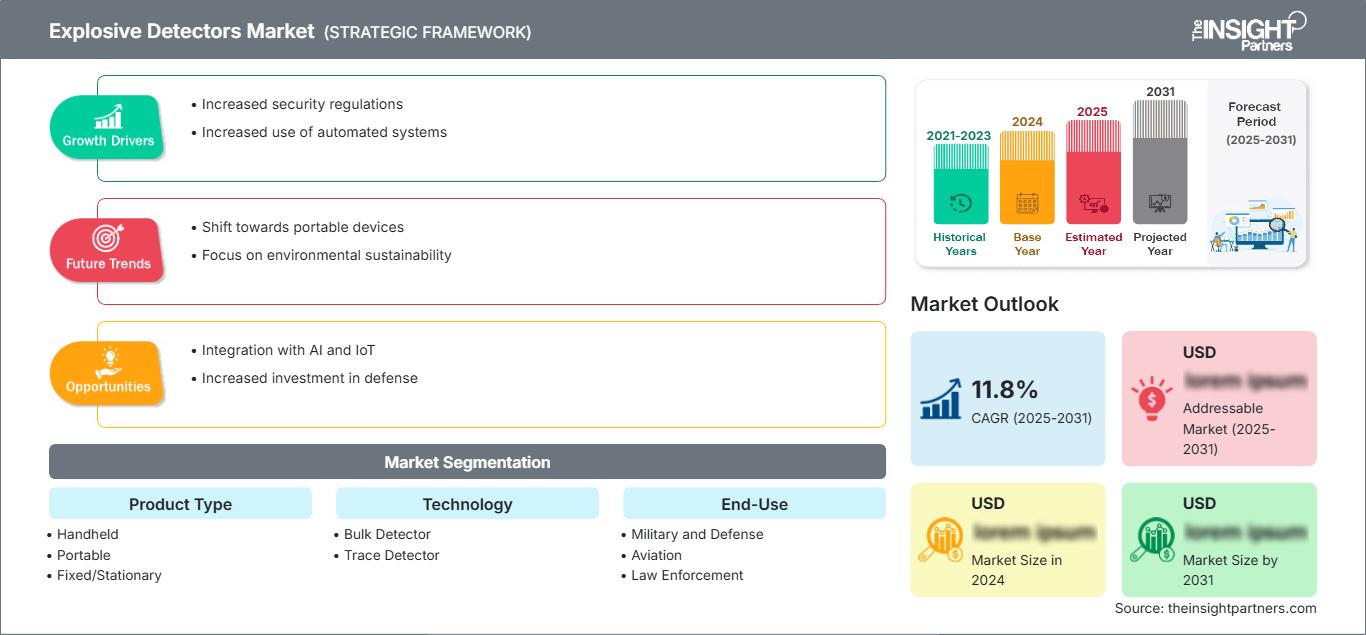
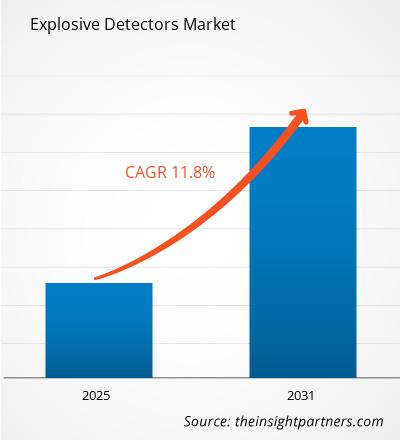
Explosive Detectors Market was valued at US$ 12.37 Billion in 2025 and is projected to reach US$ 35.7 Billion by 2034, registering a CAGR of 12.50% during 2026–2034. Growth drivers include increasing security needs in areas such as aviation, military facilities, borders, law enforcement activities, and public sites, along with increased use of automated scanning, trace detection, computed tomography and portable devices.
In North America, purchasing will be based on current aviation screening systems, military upgrades, and critical infrastructure protection. Explosive Detectors market prospects are further driven by the need to replace outdated screening equipment, automation in threat recognition, and portable technology that can be used in field environments.
Explosive Detectors Market Assessment and Insights
- North America: North America maintains a leading position, supported by mature aviation security, defense procurement, border protection, and public safety infrastructure, with a 34–38% share in 2025 and a 12.0–13.5% CAGR between 2026–2034.
- US: The US represents the principal North American demand center, with a 78–82% share of North America in 2025 and an 11.0–12.5% CAGR between 2026–2034, supported by federal security procurement.
- Europe: Europe benefits from rigorous aviation and infrastructure security standards, with a 24–28% share in 2025 and an 11.0–12.5% CAGR between 2026–2034. The UK, Germany, France, Italy, and Spain remain important national markets.
- Asia Pacific: Asia Pacific is positioned for accelerated deployment through airport expansion, defense modernization, urban security investment, and local manufacturing, representing a 23–26% share in 2025 and a 13.5–15.0% CAGR between 2026–2034.
- Largest Segment: Trace Detector is the largest segment, holding a 52–58% market share in 2025 and recording a 12.5–13.5% CAGR from 2026–2034, reflecting broad trace-screening applications.
- High Growth Segment: Handheld products represent a 38–42% market share in 2025 and are expected to expand at a 13.0–14.0% CAGR from 2026–2034, supported by field deployment.
- Key companies analyzed in detail: Smiths Detection Group Ltd., L3Harris Technologies, Inc., Rapiscan Systems, Inc., Leidos Holdings, Inc., Teledyne FLIR LLC, Thermo Fisher Scientific Inc., Chemring Group PLC, OSI Systems, Inc., RS DYNAMICS GmbH, Cobham Limited.
Source: The Insight Partners' analysis based on proprietary research, government publications, company annual reports, investor presentations, industry databases, and expert interviews.
From the point of view of the development of the market, it has already moved on from pure detection equipment to integrated solutions that include all elements – sensor, imaging, analytics, networking, alarm assessment. Trace detection still plays an important role in those cases where the fast sampling is needed, but computed tomography and advanced imaging are becoming more popular for screening of baggage and cargo. The production approach, therefore, has moved towards the modular hardware and software upgrades, serviceability and certification of equipment, which may be necessary for different security needs.
Prospects of further development will include not only aviation industry with its mature markets but also those new emerging transport corridors and defense systems, border control facilities and large public places. In emerging economies, there will be a need in scalable solutions, which would provide a good balance between detection performance and lifecycle cost, while in established markets – in interoperable and compliant equipment.
Explosive Detectors Market Report Scope
| Report Attribute | Details |
|---|---|
| Market size in 2025 | US$ 12.37 Billion |
| Market Size by 2034 | US$ 35.7 Billion |
| Global CAGR (2026 - 2034) | 12.50% |
| Historical Data | 2021-2024 |
| Forecast period | 2026-2034 |
Explosive Detectors Market Analysis
The development of Explosive Detectors technology is influenced by such aspects as the merging of security procurement, passenger traffic restoration, defense upgrades, and infrastructure protection. The demand for Explosive Detectors goes through an extensive chain of parties that include sensor producers, imaging experts, software engineers, system integrators, airport companies, defense departments, law enforcement agencies, and maintenance companies. Purchasers pay more attention to such factors as detection rate, false alarm handling, efficiency, interoperability, and lifecycle of equipment rather than its cost.
Such supply trends favor well-known suppliers whose products are certified and have corresponding service infrastructures because security solutions imply a lot of tests, training sessions, maintenance services, and software updates. Availability of components also affects the delivery schedule, especially sensors, imaging units, computers, and electronics. Thus, manufacturers tend to design more modular and standardized equipment that allows fast system adjustments and reduces disturbances caused by replacement of the entire screening solution.
Explosive Detectors Market Report reveals the competitive environment split between diversified defense and security companies and specialists in detection technology. Smiths Detection Group Ltd. and Leidos Holdings, Inc. focus on aviation scanning and trace detection, while OSI Systems, Inc. and Rapiscan Systems, Inc. cover imaging, checkpoints, cargo and trace detection. L3Harris Technologies, Inc. expands their positioning by robotics and explosive ordnance disposal technology, making them more attractive for defense segment customers.
Increasingly important strategic positioning factors become certification, installed base, software capabilities, and services offering. Companies involved in Explosive Detectors market include Teledyne FLIR LLC, Thermo Fisher Scientific Inc., Chemring Group PLC, RS DYNAMICS GmbH, and Cobham Limited due to sensing, analytics, defense or security capabilities. Investments are shifting towards miniaturization, artificial intelligence, multimodal sensing, automatic image processing, and platforms that provide integration capabilities for third parties without requiring customers to change whole infrastructure.
● REPORT CUSTOMIZATION
Tailor This Report To Align With Your Specific Business Requirements
This report can be customized to align precisely with your business objectives, scope, and target markets. Customization options include tailored segmentation, geography, competitive analysis, and strategic insights to support informed decision-making.
Customize This Report →WHAT YOU CAN ADJUST
- ● Segmentations
- ● Geography
- ● Competitive Analysis
- ● Language Preferences
Explosive Detectors Market: Strategic Insights
Regional Insights
North America Explosive Detectors Market
The North American region accounted for 34–38% of the Explosive Detectors Market Share in 2025 and will record 12.0–13.5% CAGR from 2026 to 2034. The region is mainly dominated by the US owing to factors such as airport screening, homeland security acquisitions, defense force upgradation, border inspection, and critical infrastructure protection. The Canada segment adds to the market due to aviation, border control, and public safety applications, whereas Mexico segment adds to the market through transportation and custom applications.
The region is witnessing growing demand for integrated systems that can integrate imaging technology, trace detection systems, networking, and automatic alarms assessment. Replacement cycles create opportunities for growth of the market as there is a need to replace aging equipment at airports and other governmental organizations. There is also a demand for portable and robotic equipment for use in hazardous conditions by the defense sector.
U.S. Explosive Detectors Market
The United States constitutes a 78%–82% share of North America in 2025 and is predicted to grow at an 11.0%–12.5% CAGR from 2026 to 2034. The demand drivers include aviation, security of the government, military, law enforcement, customs, and critical infrastructure. The necessity for checked baggage inspection leads to the establishment of a steady base for EDS deployment.
The presence of companies covers Smiths Detection Group Ltd., Leidos Holdings, Inc., OSI Systems, Inc., Rapiscan Systems, Inc., and L3Harris Technologies, Inc. The application trends include high throughput capabilities, automated image processing, portable trace detectors, and remote operation capabilities. In addition to the detection capabilities, the procurement process gives increasing attention to cost efficiency, software updating, and service response time.
Europe Explosive Detectors Market
Europe held a market share of 24-28% in 2025 and will experience an 11.0–12.5% CAGR over 2026–2034, with key demand nations being the UK, Germany, France, Italy, and Spain. Germany continues to be a dominant market due to its industrial landscape, airport security, border security, and existing security technology ecosystem.
The UK has been able to combine airport infrastructure and aviation security purchase initiatives along with security upgrades and modernizations. Germany has an emphasis on standards-compliant aviation, transport, and infrastructure screening needs. France derives its demand from airports, defense forces, and other events security needs, while Italy and Spain continue to upgrade their aviation, tourism, borders, and infrastructure screening facilities.
APAC Explosive Detectors Market
The APAC region holds an estimated 23–26% market share in 2025 and is predicted to post a 13.5–15.0% CAGR through 2026–2034. In order of significance, China, Japan, South Korea, India, and Australia are leading this region in terms of size. Expansion in airport construction, defense upgrades, border protection, and urban infrastructure is driving demand for both stationary and portable screening solutions.
India and China have been recognized as potential areas where there can be high growth opportunities, while Japan and South Korea focus on technology and reliability. There is going to be a lot of growth in the Australian market owing to the demands coming from the areas of border, airport, and defense screening.
Middle East & Africa Explosive Detectors Market
Demand in the Middle East and Africa region is driven by growth in aviation, infrastructure projects, border control, and military expenditure. Leading countries in the region are Saudi Arabia and UAE, whereas South Africa leads the demand in Southern Africa. The region is projected to witness a 9.0-10.5% CAGR between 2026 and 2034 based on project procurement.
In Saudi Arabia and UAE, key applications include airports, seaports, critical infrastructure and large venues. Applications in South Africa include aviation security, customs, law enforcement, and public safety. Demand in RoMEA will be centered on strategic transport routes and government facilities. Energy infrastructure generates demands for perimeter screening and protection of critical industrial installations.
Segmentation Analysis
Product Type
The Product Type segment in the Explosive Detectors Market is expected to register a 12.8–14.0% CAGR during 2026–2034. The Explosive Detectors scope across handheld, portable, and fixed/stationary systems reflects distinct operational requirements. Handheld platforms support rapid field response, portable systems bridge mobility and throughput, while fixed installations provide continuous checkpoint coverage and integration with broader security infrastructure.
- Handheld: Handheld detectors support rapid screening by law enforcement, military, EOD teams, and security personnel, making portability, ruggedness, battery endurance, and rapid alarm response strategically important.
- Portable: Portable systems provide flexible deployment across temporary checkpoints, transport hubs, public events, and field operations, supporting buyers that require mobility without sacrificing analytical capability.
- Fixed/Stationary: Fixed or stationary platforms remain important for airports, government facilities, logistics sites, and critical infrastructure where continuous screening, throughput, and system integration are priorities.
Technology
The Technology segment in the Explosive Detectors Market is projected to grow at a 12.5–13.5% CAGR during 2026–2034. Bulk Detector and Trace Detector technologies address different threat-screening scenarios. Trace systems are particularly valuable where microscopic residues must be identified rapidly, whereas bulk approaches support screening of larger quantities or concealed materials through integrated inspection workflows.
- Bulk Detector: Bulk detection supports inspection where security teams need to identify concealed explosive materials without relying solely on surface residue sampling, strengthening cargo and baggage screening capabilities.
- Trace Detector: Trace detection provides rapid identification of minute explosive residues and remains strategically important for aviation, law enforcement, military, border, and public-place screening.
End-Use
The End-Use segment in the Explosive Detectors Market is forecast to expand at a 12.3–13.4% CAGR during 2026–2034. Military and Defense, Aviation, Law Enforcement, and Public Places require different combinations of mobility, throughput, detection sensitivity, and integration. Procurement increasingly favors systems that can operate across multiple security scenarios and connect with existing command, screening, and data-management architectures.
- Military and Defense: Military users prioritize ruggedized detection, EOD support, perimeter security, and remote operation, particularly where personnel safety and rapid threat characterization are essential.
- Aviation: Aviation remains a major application because passenger, baggage, cargo, and checkpoint screening require standardized detection performance, high throughput, automated assessment, and regulatory compliance.
- Law Enforcement: Law enforcement agencies use portable and trace technologies for suspicious-package assessment, border control, investigations, public events, and rapid response where mobility is critical.
- Public Places: Public-place deployments address airports, stations, government buildings, venues, and critical infrastructure, with buyers emphasizing discreet screening, operational flexibility, and integration with broader security systems.
Opportunity Snapshot
| End-Use | Revenue Contribution (High/Medium/Low) | Trend Tag | Adoption Stage |
| Military and Defense | High | Remote EOD | Scaling |
| Aviation | High | CT Screening | Mature |
| Law Enforcement | Medium | Field Trace | Scaling |
| Public Places | Medium | Venue Security | Scaling |
Explosive Detectors Market Growth Drivers and Impact Analysis
Expansion of Automated Aviation and Baggage Screening
Airports are now progressively moving away from old screening infrastructure towards newer technology like computed tomography, automated threat recognition, and trace detection technology which is able to run in high throughput passenger scenarios. Such moves increase the market opportunities for vendors because not only do these new installations need new scanning machines but other technologies such as trace detection technology and software, networking, and support services along with the ability to integrate are needed. Regulations also have an important effect on replacement cycles since minimum performance standards for explosives detection systems and other screening systems have to be met. The biggest benefit will be felt by vendors who have certification and installations in place since airports want less risks in their implementations.
Defense Modernization and Remote Threat Response
Defense procurement is growing in need for equipment capable of investigating explosive threats without endangering personnel in dangerous situations. This leads to demand for handheld detection systems, robots, remote sensors, and integration of command system that combines detection with identification and reaction. Market effects will go beyond military procurement as the same equipment can also be used by bomb squads, border authorities, critical infrastructure companies, and emergency services. Companies that have capabilities in developing rugged electronics and robotics will thus be able to cover several procurement sources with the same technologies. Competitive advantage in the area is moving to interoperability of sensors, remote capability, fast deployment, and effective functioning in tough field conditions. With increased importance of survivability and personnel safety for defense buyers, detection equipment will be an element of mission systems.
Protection of Critical Infrastructure and Public Venues
Governments and infrastructure operators are broadening security programs beyond airports to include rail networks, ports, energy facilities, government buildings, stadiums, and large public gatherings. These environments require flexible screening architectures because threat profiles, visitor volumes, and physical layouts vary significantly between sites. The resulting demand favors portable and modular systems that can be deployed temporarily or repositioned as operational conditions change. Fixed systems remain important where continuous monitoring is necessary, while handheld trace detectors provide a secondary layer for suspicious objects and targeted inspections. Suppliers can benefit by combining detection hardware with training, maintenance, software, and data-management services. The commercial effect is a broader customer base and a more diversified revenue mix, reducing reliance on aviation procurement cycles while encouraging technology platforms that can be adapted across multiple security environments.
Explosive Detectors Market Future Trends
AI-Assisted Multimodal Threat Recognition
Explosive Detectors Market trends are increasingly moving toward artificial intelligence that combines image interpretation, trace signatures, contextual information, and operator inputs to improve alarm assessment. Future platforms are likely to use software as a continuously upgradeable detection layer rather than treating analytics as a fixed component of the hardware. This model can reduce dependence on manual interpretation, improve consistency between operators, and support faster decision-making in high-throughput environments. Open architecture will become more important because customers want to integrate specialized algorithms without replacing certified hardware. Vendors that establish controlled interfaces and robust validation processes should gain an advantage as buyers balance innovation with security assurance. Over time, detection systems are expected to evolve into connected analytical platforms capable of coordinating multiple sensors and presenting prioritized threats to security personnel.
Miniaturized Sensors and Distributed Detection Networks
Future systems are expected to become smaller, lighter, and more energy efficient as sensor components, computing modules, and analytical algorithms advance. Miniaturization will enable broader use of portable detectors in border patrol, law enforcement, military operations, public events, and infrastructure inspection. Distributed architectures may also allow multiple compact sensors to feed information into centralized command platforms, extending detection coverage without installing large fixed systems at every location. This approach can support temporary security configurations and rapidly changing operational requirements. Battery efficiency, ruggedization, secure communications, and remote diagnostics will become important purchasing criteria alongside analytical performance. The resulting market opportunity will favor suppliers that can combine reliable sensing with software connectivity, enabling customers to scale detection coverage incrementally rather than committing to large single-site deployments.
Explosive Detectors Market Opportunities
Localized Manufacturing and Regional Service Hubs
Manufacturers have an opportunity to establish regional production, assembly, calibration, and service capabilities in Asia Pacific and other high-growth markets where airport, defense, and infrastructure investment is accelerating. Localized operations can shorten lead times, improve after-sales support, and help suppliers respond to public procurement requirements emphasizing domestic participation. Partnerships with local integrators can further strengthen access to government tenders and provide knowledge of national certification procedures. The Explosive Detectors Market Forecast opportunity is particularly relevant for companies offering modular platforms because localized assembly can occur without duplicating every stage of sensor development. Investors should assess markets where recurring replacement demand accompanies new infrastructure projects, as these environments can support both initial equipment sales and longer-term maintenance, software, calibration, training, and consumables revenue.
Integrated Detection-as-a-Service Models
Security operators increasingly need predictable lifecycle costs rather than isolated equipment purchases, creating an opportunity for service-led commercial models. Suppliers can combine hardware, software updates, calibration, maintenance, analytics, training, and performance monitoring into multiyear contracts. Such arrangements can reduce the financial barrier to adopting advanced detection systems while providing manufacturers with recurring revenue and stronger visibility into installed equipment. The model is especially relevant to airports, transport authorities, large venues, and infrastructure operators managing multiple sites with different security requirements. Companies with broad product portfolios can use service contracts to cross-sell complementary technologies, while specialized suppliers can partner with integrators that already manage security operations. Commercial success will depend on measurable uptime, clear service-level agreements, cybersecurity controls, and transparent upgrade pathways.
Recent Developments
- December 2025: Smiths Group agreed to sell its Smiths Detection unit, a major provider of airport baggage-screening systems and explosive detectors, to CVC Capital Partners for £2 billion ($2.65 billion), including debt. The transaction comes as airports globally upgrade security screening technologies, including government-mandated deployments of computed tomography (CT) scanners that provide 3D imaging for enhanced baggage inspection, highlighting continued demand for advanced explosives and security detection systems in the aviation sector. The deal is expected to close in the second half of 2026, subject to regulatory approvals.
- March 2025: OSI Systems received an approximately $76 million order to provide airport screening solutions for a major international airport, including its RTT® 110 Real Time Tomography explosive detection system for hold baggage and Itemiser® 5X for detecting trace amounts of explosives and narcotics. The deployment of these advanced computed tomography and trace detection technologies is expected to enhance the rapid identification of concealed threats in passenger baggage, supporting the growing adoption of advanced explosive detection systems in aviation security.
- August 2026: OSI Systems received an approximately $11 million order from a North American customer to supply additional Rapiscan® security inspection systems and provide ongoing maintenance and support services under a multi-year agreement. The order expands the customer's installed base of mission-critical screening equipment and highlights continued investment in advanced security inspection infrastructure, although the announcement does not specifically identify explosive detection systems.
Frequently Asked Questions

- Comprehensive Market Sizing and Forecast Analysis
- Detailed Segmentation Analysis
- In-Depth Market Dynamics Assessment
- Regional and Country-Level Insights
- Competitive Landscape and Company Benchmarking
- Strategic Business Intelligence
Recent Reports
Testimonials

The Insight Partners' SCADA System Market report is comprehensive, with valuable insights on current trends and future forecasts. The team was highly professional, responsive, and supportive throughout. We are very satisfied and highly recommend their services.
RAN KEDEM Partner, Reali Technologies LTDs
I requested a report on a very specific software market and the team produced the report in a few days. The information was very relevant and well presented. I then requested some changes and additions to the report. The team was again very responsive and I got the final report in less than a week.
JEAN-HERVE JENN Chairman, Future Analytica
We worked with The Insight Partners for an important market study and forecast. They gave us clear insights into opportunities and risks, which helped shape our plans. Their research was easy to use and based on solid data. It helped us make smart, confident decisions. We highly recommend them.
PIYUSH NAGPAL Sr. Vice President, High Beam Global
The Insight Partners delivered insightful, well-structured market research with strong domain expertise. Their team was professional and responsive throughout. The user-friendly website made accessing industry reports seamless. We highly recommend them for reliable, high-quality research services
YUKIHIKO ADACHI CEO, Deep Blue, LLC.
This is the first time I have purchased a market report from The Insight Partners.While I was unsure at first, I visited their web site and felt more comfortable to take the risk and purchase a market report.I am completely satisfied with the quality of the report and customer service. I had several questions and comments with the initial report, but after a couple of dialogs over email with their analyst I believe I have a report that I can use as input to our strategic planning process.Thank you so much for taking the extra time and making this a positive experience.I will definitely recommend your service to others and you will be my first call when we need further market data.
JOHN SUZUKI President and Chief Executive Officer, Board Director, BK Technologies
I wish to appreciate your support and the professionalism you displayed in the course of attending to my request for information regarding to infectious disease IVD market in Nigeria. I appreciate your patience, your guidance, and the fact that you were willing to offer a discount, which eventually made it possible for us to close a deal. I look forward to engaging The Insight Partners in the future, all thanks to the impression you have created in me as a result of this first encounter.
DR CHIJIOKE ONYIA MANAGING DIRECTOR, PineCrest Healthcare Ltd.Reason to Buy
- Informed Decision-Making
- Understanding Market Dynamics
- Competitive Analysis
- Identifying Emerging Markets
- Customer Insights
- Market Forecasts
- Risk Mitigation
- Boosting Operational Efficiency
- Strategic Planning
- Investment Justification
- Tracking Industry Innovations
- Aligning with Regulatory Trends





 Get Free Sample for