The global transition toward electric mobility, renewable energy, and intelligent energy storage has placed battery technology at the center of modern innovation. While battery cells often receive the most attention, the technology responsible for maximizing their performance, safety, and lifespan is the Battery Management Module (BMM). As battery systems become larger, more complex, and increasingly connected, artificial intelligence (AI) is transforming battery management modules from simple monitoring devices into intelligent decision-making platforms.
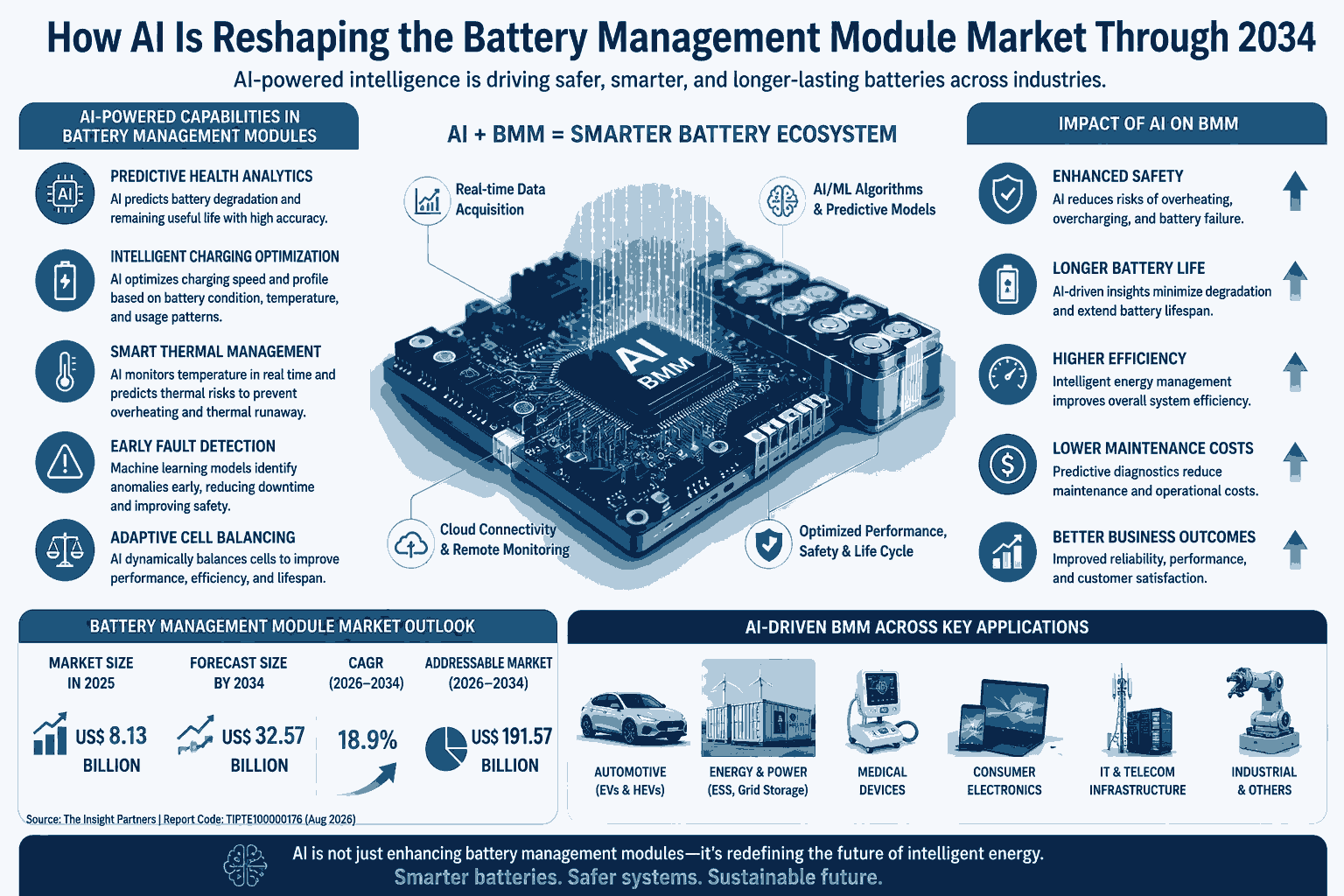
According to The Insight Partners, the Battery Management Module Market is projected to grow from US$ 8.13 billion in 2025 to US$ 32.57 billion by 2034, registering a robust CAGR of 18.9% during 2026-2034. This remarkable growth reflects increasing demand across electric vehicles (EVs), renewable energy storage systems, consumer electronics, medical devices, and industrial applications. AI is expected to become one of the most influential technologies driving this transformation over the next decade.
Why Battery Management Modules Matter More Than Ever
Modern batteries are significantly more sophisticated than those used just a few years ago. High-energy lithium-ion batteries, emerging solid-state technologies, and fast-charging systems require continuous monitoring of hundreds—or even thousands—of battery cells.
A battery management module performs several critical functions, including:
- Monitoring voltage, current, and temperature
- Maintaining cell balancing
- Preventing overcharging and deep discharge
- Managing thermal performance
- Estimating battery health and remaining lifespan
- Ensuring safe charging and discharging operations
Traditionally, these functions relied on predefined algorithms. AI now enables battery management modules to analyze enormous volumes of real-time operational data, making battery systems significantly smarter and more adaptive.
AI Is Transforming Battery Intelligence
Artificial intelligence is fundamentally changing how battery management systems operate. Instead of simply responding to battery conditions, AI allows battery management modules to anticipate problems before they occur.
Machine learning models continuously analyze battery behavior under varying temperatures, charging cycles, driving conditions, and usage patterns. These systems learn from historical and real-time data to optimize battery performance automatically.
Some of the most important AI capabilities include:
- Predictive battery health analysis
- Intelligent charging optimization
- Early fault detection
- Dynamic thermal management
- Real-time energy optimization
- Adaptive cell balancing
These capabilities improve battery efficiency while extending battery lifespan and reducing maintenance costs.
Predictive Analytics Is Becoming a Competitive Advantage
Predictive analytics represents one of the biggest advancements in AI-enabled battery management.
Instead of identifying failures after they occur, AI predicts potential degradation months before it becomes critical. This enables manufacturers, fleet operators, and energy providers to perform preventive maintenance rather than costly emergency replacements.
For electric vehicle manufacturers, predictive battery analytics helps reduce warranty expenses while improving customer satisfaction.
For energy storage operators, predictive maintenance minimizes system downtime and improves grid reliability.
This shift from reactive maintenance to predictive intelligence is becoming a major competitive differentiator across the Battery Management Module Market.
AI Improves Fast Charging Without Compromising Battery Life
Consumers increasingly expect electric vehicles to charge within minutes rather than hours. However, ultra-fast charging generates additional heat that can accelerate battery degradation.
AI-powered battery management modules continuously evaluate charging conditions, battery chemistry, and temperature to determine the safest charging profile.
Instead of applying one charging strategy to every battery, AI customizes charging parameters for each battery pack based on its age, health, and operating environment.
The result includes:
- Faster charging speeds
- Lower thermal stress
- Improved battery longevity
- Enhanced charging safety
As fast-charging infrastructure expands globally, AI-driven battery optimization will become increasingly valuable.
Smarter Thermal Management Enhances Battery Safety
Battery safety remains one of the industry's highest priorities.
Thermal runaway remains a critical concern in high-capacity lithium-ion batteries used in electric vehicles and grid-scale energy storage systems.
AI enables battery management modules to continuously monitor temperature distribution throughout the battery pack. Instead of reacting after overheating begins, AI predicts abnormal thermal behavior and initiates corrective actions before dangerous conditions develop.
Advanced thermal management includes:
- Intelligent cooling adjustments
- Load balancing
- Early anomaly detection
- Automated emergency protection
These capabilities significantly improve safety while meeting increasingly stringent regulatory requirements worldwide.
Software Is Becoming as Important as Hardware
Historically, battery management modules were primarily hardware-focused, consisting of sensors, controllers, and communication interfaces.
Today, software is becoming the primary source of innovation.
AI algorithms continuously improve battery performance through software updates without requiring hardware replacement.
This evolution is shifting the market toward software-defined battery management systems that offer:
- Remote diagnostics
- Cloud connectivity
- Over-the-air software updates
- Digital twins
- Real-time fleet monitoring
The growing importance of software is encouraging stronger collaboration between semiconductor manufacturers, software developers, automotive OEMs, and cloud technology providers.
AI Is Expanding Beyond Electric Vehicles
Although automotive remains the largest end-user segment, AI-powered battery management modules are rapidly expanding into multiple industries.
Renewable Energy Storage
Large-scale battery storage systems supporting solar and wind power require intelligent battery management to maximize efficiency and maintain grid stability.
AI helps optimize charging cycles based on renewable power generation, electricity demand, and weather forecasts.
Medical Devices
Portable healthcare equipment requires reliable battery performance.
AI enhances battery reliability while extending operating time for wearable devices, portable diagnostic equipment, and emergency medical systems.
Consumer Electronics
Smartphones, laptops, drones, and wearable devices increasingly rely on AI-enabled battery management to improve battery life while reducing charging time.
IT and Telecom
Data centers and telecom infrastructure depend on backup battery systems for uninterrupted operations. AI improves battery reliability through continuous health monitoring and predictive maintenance.
Regional Innovation Continues to Accelerate
Asia Pacific remains the largest regional market, accounting for approximately 40%–45% of global demand. Strong electric vehicle manufacturing, battery production capacity, and supportive government policies continue to drive rapid adoption of AI-enabled battery technologies.
North America is expected to maintain strong growth through 2034, supported by expanding EV production, domestic battery manufacturing, and increasing investments in grid modernization. The United States continues to play a central role in semiconductor innovation and intelligent battery management technologies.
Europe also remains a key innovation hub due to strict emission regulations, battery recycling initiatives, and aggressive electrification targets encouraging advanced battery monitoring solutions.
The Road Ahead
Artificial intelligence is no longer an optional enhancement for battery management modules—it is becoming an essential technology for the future of electrification.
As batteries become larger, faster charging, and more intelligent, AI will continue improving safety, efficiency, and lifecycle management across industries. Future battery management modules will increasingly leverage machine learning, cloud analytics, edge computing, and predictive diagnostics to deliver higher performance with lower operational costs.
The next generation of battery innovation will not be defined solely by better batteries—it will be defined by smarter battery management. AI is leading that transformation, making battery systems more reliable, efficient, and sustainable for the connected energy ecosystem of the future.
.jpg)
.png)
.png)
.png)