
Smart Wearable devices Market Size, Growth & Trends by 2034
Coverage: By Product (Wristwear, Headwear, Bodywear, Others); Application (Consumer, Industrial) , and Geography (North America, Europe, Asia Pacific, and South and Central America)
- Status : Data Released
- Report Code : TIPRE00022396
- Category : Electronics and Semiconductor
- No. of Pages : 150
- Available Report Formats :


- Last update date : September 07, 2026


2025 Market Size
US$ 64.81 Bn
Base year value
2034 Forecast
US$ 132.3 Bn
Projected by 2034
CAGR 2026-2034
8.25 %
Growth rate
Addressable Market
US$ 885.28 Bn
(2026-2034)
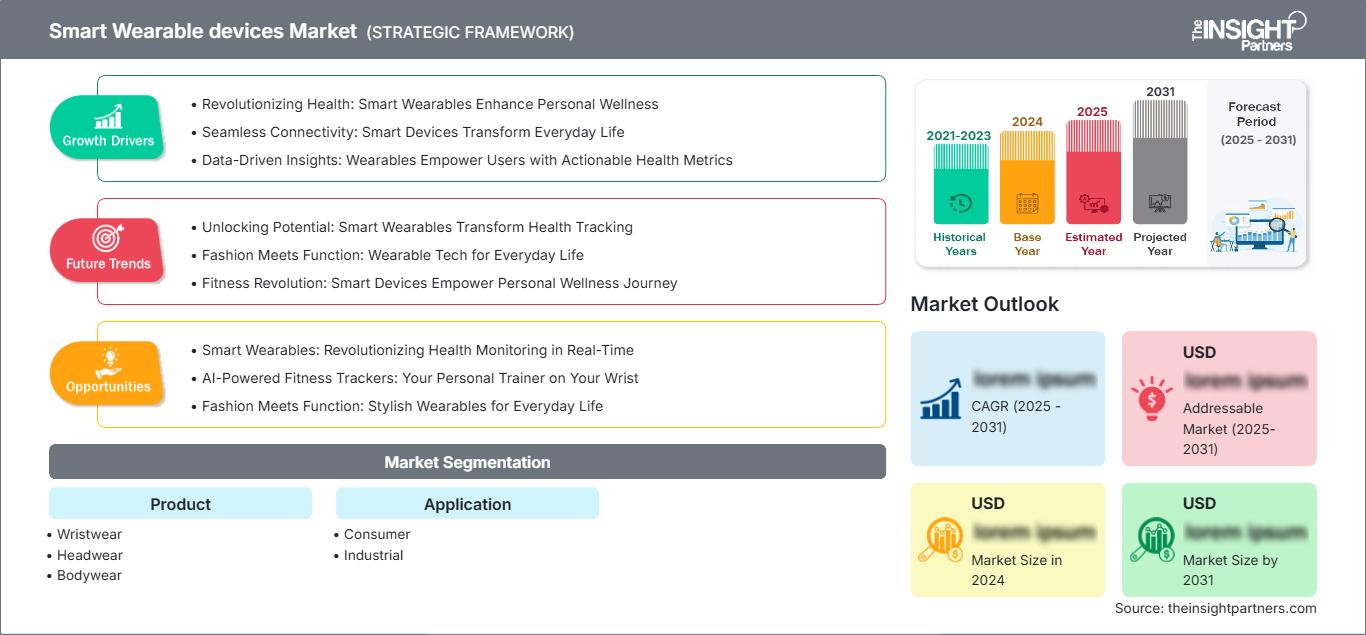
The Smart Wearable Devices Market size was valued at US$ 64.81 Billion in 2025 and is projected to reach US$ 132.3 Billion by 2034, registering a CAGR of 8.25% during 2026–2034. Expansion is being shaped by health monitoring, fitness tracking, mobile connectivity, artificial intelligence, and increasingly compact sensors. Wrist-based products remain central, while headwear and bodywear are widening the technology's relevance across consumer lifestyles and selected industrial workflows.
North America is expected to remain a major regional contributor, supported by high smartphone penetration, established digital-health ecosystems, and strong consumer acceptance of connected electronics. The region is estimated to expand at a 7.8–9.0% CAGR through 2034. Replacement cycles, premium health features, and enterprise interest in worker monitoring provide structural support for continued adoption.
Smart Wearable devices Market Assessment and Insights
- North America: North America is expected to retain a substantial position, supported by mature consumer electronics channels and healthcare-oriented adoption, with a 34–38% Smart Wearable Devices Market share in 2025 and a 7.8–9.0% CAGR between 2026–2034.
- US: The US remains the principal North American market, benefiting from strong smartwatch and fitness-device adoption, with a 78–82% share of North America in 2025 and a 8.0–9.2% CAGR between 2026–2034.
- Europe: Europe is supported by health-conscious consumers and advanced industrial applications across Germany, the UK, France, Italy, and Spain, with a 23–27% share in 2025 and a 7.2–8.5% CAGR between 2026–2034.
- Asia Pacific: Asia Pacific is positioned for faster expansion, led by China, Japan, South Korea, and India, with a 27–31% share in 2025 and a 9.2–10.5% CAGR between 2026–2034.
- Largest Segment: Wristwear is the largest segment, reflecting smartwatch and fitness-tracker penetration, with a 67–72% market share in 2025 and a 7.5–8.5% CAGR from 2026–2034.
- High Growth Segment: Bodywear is the high-growth segment as sensor-enabled apparel and occupational monitoring mature, representing a 10–14% market share in 2025 and a 9.5–11.0% CAGR from 2026–2034.
- Key companies analyzed in detail: Apple Inc.; Fitbit, Inc.; Google LLC; Samsung Electronics Co., Ltd.; Garmin Ltd.; LG Electronics Inc.; Huawei Technologies Co., Ltd.; Sony Corporation; Xiaomi Corporation; Microsoft Corporation; Meta Platforms, Inc.
Source: The Insight Partners' analysis based on proprietary research, government publications, company annual reports, investor presentations, industry databases, and expert interviews.
Product development has moved from simple activity tracking through continuous sensing, contextual analytics, and software-based analysis of health signals. There is a trend for wrist wear makers to use optical sensors, temperature sensors, GPS, sleep tracking features, cellular technology, and artificial intelligence. There is also a shift on production fronts as makers of wearable devices seek smaller parts, more battery life, tougher material, and processors that can process more intelligence at the edge.
Growth prospects going forward in the Smart Wearable Devices Market will be based on penetration into emerging Asian markets, industrial settings, and health-related use cases. Capital spending will go towards developing smaller sensors, edge AI, battery performance, and compatibility with digital health platforms. Regulation in areas such as accuracy of biometric sensors, privacy, cybersecurity, and health claims will affect development roadmaps.
Smart Wearable devices Market Report Scope
| Report Attribute | Details |
|---|---|
| Market size in 2025 | US$ 64.81 Billion |
| Market Size by 2034 | US$ 132.3 Billion |
| Global CAGR (2026 - 2034) | 8.25% |
| Historical Data | 2021-2024 |
| Forecast period | 2026-2034 |
Smart Wearable devices Market Analysis
Influence on demand comes through the emergence of health awareness, mobile computing, and personalization of digital solutions. Growth of the Smart Wearable Devices Market is driven by value chain that includes semiconductor vendors, sensor manufacturers, display & battery suppliers, operating system providers, device assemblers, applications developers, resellers & distributors, and enterprise integrators. Availability of components and power saving become important supply factors as capabilities are growing and the size stays unchanged.
Moreover, the ecosystem becomes more and more focused on services. The hardware starts to act as the collection point for software platforms, subscriptions, digital coaching, and analytics of health information. Demand of consumers stays high for products with obvious practical usage while companies consider reliability, longevity, acceptability by employees, and security of information. Improvement of Bluetooth technology, cellular connectivity, GPS, and low-power processors makes continuous usage possible for any environment.
Positioning depends on the following factors: control of ecosystem, sensors, software, brand, and compatibility with other devices. Analysis of the Smart Wearable Devices Market shows that Apple Inc. and Samsung Electronics Co., Ltd. have strong platform advantages; Garmin Ltd. positions itself as a producer of high performance wearables; Google LLC and Fitbit, Inc. offer hardware with health & software capabilities, while Huawei Technologies Co., Ltd. and Xiaomi Corporation are active competitors thanks to variety of devices and price segments.
The Smart Wearable Devices Market report indicates that investments will be made into artificial intelligence, proprietary health algorithms, components' energy efficiency, and vertical integration of experience. Electronics capabilities of Sony Corporation and LG Electronics Inc. will help to develop adjacent form factors, while Microsoft Corporation provides the company with enterprise and productivity know-how. Positioning of Meta Platforms, Inc. helps to improve the headwear segment with connected eyewear. Therefore, competitive advantage is shifting from step counting to insights, compatibility, and specialization.
● REPORT CUSTOMIZATION
Tailor This Report To Align With Your Specific Business Requirements
This report can be customized to align precisely with your business objectives, scope, and target markets. Customization options include tailored segmentation, geography, competitive analysis, and strategic insights to support informed decision-making.
Customize This Report →WHAT YOU CAN ADJUST
- ● Segmentations
- ● Geography
- ● Competitive Analysis
- ● Language Preferences
Smart Wearable devices Market: Strategic Insights
Regional Insights
North America Smart Wearable Devices Market
North America is estimated to hold a 34–38% share in 2025 and is projected to grow at a 7.8–9.0% CAGR from 2026–2034. The strong ecosystems on smartphones, distribution through retail channels, buying power of consumers, and the focus on health and fitness ensure that the demand continues. The United States is the leading region in terms of contribution, with Canada offering further growth potential through connected health and outdoor fitness.
Adoption in the enterprise segment is also growing outside consumer electronic devices. Wearables can help in worker safety, location tracking, productivity enhancement, and occupational monitoring, provided that the privacy issues are addressed. Apple Inc., Google LLC, Garmin Ltd., Fitbit, Inc., and Samsung Electronics Co., Ltd. remain relevant in terms of regions, while Meta Platforms, Inc. continues to build up its offerings for headwear.
U.S. Smart Wearable Devices Market
The U.S. accounts for 78–82% of North America's 2025 market and is expected to grow at a 8.0–9.2% CAGR from 2026–2034. Adoption is facilitated by high smartphone penetration, existing digital health framework, fitness, and high replacement rate for smart watches and other wireless connected devices. High-end products can be aided by the willingness of the customers to spend on advanced sensors and connectivity and other features.
App usage has widened to cover applications such as sleep, cardiovascular monitoring, safety and wellness. Apple Inc. has strong ecosystem offerings, while Google LLC, Fitbit Inc., Samsung Electronics Co. Ltd. and Garmin Ltd. cater to different consumer groups. Enterprise applications cover areas such as logistics, field services, sports and work safety. Data security, reliability of devices and proof of health-related claims are key decision drivers.
Europe Smart Wearable Devices Market
Europe is estimated to account for a 23–27% share in 2025 and is projected to expand at a 7.2–8.5% CAGR from 2026–2034, with Germany representing a leading market. Mature digital health and consumer electronics adoption is prevalent in the UK, while the combination of robust industrial requirements and advanced engineering is seen in Germany. Other countries contributing to the demand for bodywear include France, Italy, and Spain through wellness, lifestyle, healthcare-related, and high-end consumer goods applications.
Germany's industrial sector can be tapped for use in bodywear for worker safety and interaction, and process monitoring. The UK still plays an important role in health and fitness and digitally-based consumer services. There is a need in France, Italy, and Spain across wellness, sports, tourism, and connected lifestyles applications. Competitive players in Europe include Apple Inc., Samsung Electronics Co., Ltd., Garmin Ltd., Huawei Technologies Co., Ltd., and Xiaomi Corporation.
APAC Smart Wearable Devices Market
APAC is estimated to represent a 27–31% share in 2025 and is projected to grow at a 9.2–10.5% CAGR from 2026–2034. China ranks at the top of regional markets, followed by Japan, South Korea, India, and Australia. The reasons for this include large consumer bases, manufacturing capabilities, use of smartphones, and the rise of middle-class consumers.
China has advantages in its electronics manufacturing base and homegrown brands, while Japan and South Korea focus on health, electronics, and components. India provides opportunities for consumer adoption and manufacturing. Australia is focused on sports and health. The additional opportunities come from digitizing industry, smart devices, and connectivity infrastructure.
Middle East & Africa Smart Wearable Devices Market
Middle East & Africa is expected to expand at a 7.0–8.5% CAGR from 2026–2034. Opportunities are being provided by the Gulf region by means of investments in smart cities, high-end consumer electronics, sports, and healthcare digitization. The country of South Africa presents an important market of Africa, whereas the Rest of MEA offers opportunities selectively via telecom and enterprise channels.
The operations in the energy sector, construction, logistics, tourism, and healthcare offer applications other than those for consumer fitness. Connected devices could enable the communication of workers under suitable governance and network conditions. Saudi Arabia stands out as the foremost market, whereas the needs of UAE are driven by high-income individuals and technological infrastructural developments.
Segmentation Analysis
Product
Product is projected to expand at a 8.0–9.0% CAGR from 2026–2034. Wristwear remains the core revenue contributor because smartwatches and fitness trackers combine established consumer behavior with increasingly sophisticated sensors. Headwear and bodywear broaden the addressable market by extending connected computing into audio, augmented experiences, sports equipment, and occupational applications. Product diversification should reduce dependence on any single form factor.
- Wristwear: Wristwear retains the strongest market position because users are familiar with continuous wrist-based tracking. Demand is supported by health monitoring, notifications, fitness analytics, cellular connectivity, and increasingly sophisticated software ecosystems.
- Headwear: Headwear is gaining strategic importance through smart glasses, connected audio, and emerging augmented-reality experiences. Demand is increasingly linked to hands-free interaction, cameras, AI assistants, navigation, communication, and contextual information.
- Bodywear: Bodywear extends sensing into garments and accessories, supporting sports performance, occupational monitoring, rehabilitation, and specialized healthcare applications. Its strategic potential depends on washable electronics, sensor durability, comfort, and reliable data transmission.
Application
Application is expected to grow at a 8.5–9.5% CAGR from 2026–2034. Consumer applications provide scale through established fitness and lifestyle use cases, while industrial deployment offers opportunities for higher-value specialized devices. The Smart Wearable Devices Market scope is consequently widening as manufacturers adapt sensors, software, and form factors for operational environments where durability and data governance are critical.
- Consumer: Consumer applications remain the largest demand base, spanning fitness, wellness, communication, entertainment, navigation, and personal safety. Adoption increasingly depends on battery endurance, ecosystem compatibility, comfort, health functionality, and perceived value from software services.
- Industrial: Industrial applications emphasize worker safety, communication, location awareness, productivity, training, and operational visibility. Demand is strategically important where hands-free interaction can reduce workflow interruptions or improve situational awareness in complex environments.
Opportunity Snapshot
| Application | Revenue Contribution (High/Medium/Low) | Trend Tag (MAX 2 words) | Adoption Stage (Emerging/Scaling/Mature) |
|---|---|---|---|
| Consumer | High | Health AI | Mature |
| Industrial | Medium | Worker Safety | Scaling |
Smart Wearable devices Market Growth Drivers and Impact Analysis
Expansion of continuous health and wellness monitoring
Wearables are increasingly moving from episodic fitness measurement toward continuous monitoring of sleep, activity, heart-related signals, temperature, recovery, and other physiological indicators. This shift increases the frequency of device interaction and strengthens replacement demand because users increasingly associate hardware upgrades with additional sensing capabilities. It also expands the commercial ecosystem into coaching, subscriptions, healthcare partnerships, and research. Device manufacturers can therefore capture value beyond one-time hardware sales when platforms convert collected information into useful recommendations. The commercial impact is strongest for wristwear because the form factor already supports all-day usage. However, headwear and bodywear can extend monitoring into specialized situations where wrist measurements are insufficient. Greater health functionality also raises validation and regulatory requirements, making sensor accuracy, algorithm transparency, privacy, and clinical evidence increasingly important competitive considerations.
Artificial intelligence is increasing the utility of wearable data
Artificial intelligence is changing the value proposition of wearable devices by converting streams of sensor information into contextual recommendations rather than merely displaying measurements. Users can increasingly receive summaries of activity, sleep, training, recovery, or other signals without interpreting individual data points themselves. This creates opportunities for differentiated software experiences and recurring services. AI also supports more efficient processing through personalized models and increasingly capable on-device computation, potentially reducing dependence on continuous cloud connectivity. For manufacturers, the commercial effect is a stronger connection between hardware specifications and proprietary software ecosystems. The competitive barrier consequently shifts toward data quality, model performance, user trust, and platform integration. As AI becomes embedded in watches, glasses, and other form factors, suppliers that combine reliable sensing with intuitive interpretation can strengthen retention and reduce direct comparison based solely on device specifications.
Industrial digitization broadens wearable deployment
Industrial use is expanding as enterprises seek hands-free communication, worker safety, location awareness, training support, and operational visibility. Wearables can provide instructions or alerts without requiring employees to repeatedly access smartphones or fixed terminals, which can be valuable in warehouses, manufacturing plants, construction sites, logistics operations, and field services. The impact varies by environment because industrial devices require stronger durability, battery performance, security, and integration than many consumer products. Procurement decisions therefore involve information-technology, operations, safety, and human-resources stakeholders rather than individual consumers alone. This broadens the addressable customer base and can support larger deployments once a successful pilot demonstrates measurable productivity or safety benefits. Suppliers that provide device management, secure data handling, replacement programs, and enterprise software integration can improve adoption prospects. Industrial demand also encourages development of specialized bodywear and rugged wristwear.
Smart Wearable devices Market Future Trends
AI-native wearable experiences and contextual computing
The Smart Wearable Devices Market trends are likely to move toward AI-native experiences in which devices anticipate user needs rather than waiting for explicit commands. Future products may combine continuous sensing, location, environmental information, personal preferences, and conversational interfaces to provide context-aware assistance. Smart glasses and advanced wristwear could increasingly divide computing tasks between device processors, smartphones, and cloud platforms according to latency, privacy, and energy requirements. This evolution will encourage manufacturers to design around interaction quality rather than hardware specifications alone. Battery optimization, low-power inference, and privacy-preserving processing will become increasingly important because useful AI requires sustained sensing. The strongest products may therefore be those that reduce cognitive effort while remaining unobtrusive. As AI capabilities mature, differentiated user experiences could become a more durable source of competitive advantage than incremental display or processor improvements.
Convergence of wearables, digital health, and personal computing
Wearables are likely to become increasingly integrated with broader personal-computing and digital-health ecosystems. Future platforms can connect watches, glasses, earbuds, phones, home devices, and health applications, creating continuous information flows across daily activities. Such convergence could allow users to begin an interaction on one device and complete it on another according to context. Healthcare-adjacent functions may also become more prominent as sensors improve and regulatory pathways evolve. This does not imply that consumer devices will replace clinical equipment, but it can strengthen their role in screening, monitoring, adherence, and patient engagement. Manufacturers will consequently compete on interoperability, identity management, data portability, and long-term software support. Standardized interfaces and stronger cybersecurity will become increasingly important as more personal information is generated across interconnected wearable endpoints.
Smart Wearable devices Market Opportunities
Premium health platforms and subscription-based services
Smart Wearable Devices Market Forecasts indicate an opportunity to build recurring revenue around premium health, fitness, safety, and analytics services rather than relying exclusively on hardware replacement. Manufacturers can package advanced insights, personalized coaching, extended cloud storage, family safety functions, or specialized training capabilities into subscription models. The opportunity is strongest where software delivers continuing value after purchase and where users accumulate meaningful longitudinal data. Companies can also use tiered offerings to preserve broad hardware accessibility while monetizing advanced functionality among higher-value customers. Successful strategies will require clear differentiation between general wellness information and regulated medical functions, alongside transparent privacy practices. Partnerships with insurers, employers, sports organizations, and healthcare providers could create additional channels, provided data-sharing arrangements are appropriately governed. This approach can increase customer lifetime value while strengthening ecosystem stickiness.
Enterprise wearable ecosystems for specialized workflows
Enterprise deployments provide an opportunity to develop specialized wearable ecosystems tailored to defined workflows rather than adapting consumer products without modification. Manufacturers can combine rugged hardware, device management, secure communications, location services, analytics, and support contracts for logistics, manufacturing, healthcare, utilities, construction, and field service. A solution-based approach can increase switching costs because customers integrate devices into training, operating procedures, software platforms, and safety programs. Vendors should prioritize pilot projects with measurable operational objectives such as reduced task time, improved compliance, fewer communication delays, or faster incident response. Strategic partnerships with systems integrators and enterprise software providers can accelerate implementation and broaden distribution. Long-term contracts covering hardware refreshes, software updates, maintenance, and analytics can also create more predictable revenue streams. The opportunity is particularly attractive for suppliers capable of adapting consumer-grade sensing to demanding operational environments.
Recent Developments
- August 2026: Samsung Electronics Co., Ltd. — Samsung began worldwide rollout of Galaxy Watch Ultra2 and Galaxy Watch9, with sales starting August 7 in selected markets. The new watches emphasize deeper health insights, continuous monitoring, AI-powered guidance, improved battery capacity, and enhanced display performance. The launch extends Samsung's strategy of positioning wristwear as an always-on digital-health companion within its connected device ecosystem.
- August 2025: Google LLC — Google introduced Pixel Watch 4 with a redesigned Actua 360 display, expanded fitness functionality, Gemini access, and health-oriented capabilities including loss-of-pulse detection. The launch strengthened Google's integration of wearable hardware, artificial intelligence, and health services within the Pixel ecosystem and demonstrated continued movement toward proactive rather than purely descriptive wearable experiences.
- July 2025: Samsung Electronics Co., Ltd. — Samsung introduced Galaxy Watch8 and Galaxy Watch8 Classic, emphasizing personalized wellness insights, sleep guidance, running coaching, and AI-supported experiences. The company also highlighted a thinner 8.6-millimeter profile and continuous health tracking. The launch illustrated increasing competition around comfort, sensor-enabled wellness, and software intelligence in mainstream smartwatch products.
Frequently Asked Questions

- Comprehensive Market Sizing and Forecast Analysis
- Detailed Segmentation Analysis
- In-Depth Market Dynamics Assessment
- Regional and Country-Level Insights
- Competitive Landscape and Company Benchmarking
- Strategic Business Intelligence
Recent Reports
Testimonials

The Insight Partners' SCADA System Market report is comprehensive, with valuable insights on current trends and future forecasts. The team was highly professional, responsive, and supportive throughout. We are very satisfied and highly recommend their services.
RAN KEDEM Partner, Reali Technologies LTDs
I requested a report on a very specific software market and the team produced the report in a few days. The information was very relevant and well presented. I then requested some changes and additions to the report. The team was again very responsive and I got the final report in less than a week.
JEAN-HERVE JENN Chairman, Future Analytica
We worked with The Insight Partners for an important market study and forecast. They gave us clear insights into opportunities and risks, which helped shape our plans. Their research was easy to use and based on solid data. It helped us make smart, confident decisions. We highly recommend them.
PIYUSH NAGPAL Sr. Vice President, High Beam Global
The Insight Partners delivered insightful, well-structured market research with strong domain expertise. Their team was professional and responsive throughout. The user-friendly website made accessing industry reports seamless. We highly recommend them for reliable, high-quality research services
YUKIHIKO ADACHI CEO, Deep Blue, LLC.
This is the first time I have purchased a market report from The Insight Partners.While I was unsure at first, I visited their web site and felt more comfortable to take the risk and purchase a market report.I am completely satisfied with the quality of the report and customer service. I had several questions and comments with the initial report, but after a couple of dialogs over email with their analyst I believe I have a report that I can use as input to our strategic planning process.Thank you so much for taking the extra time and making this a positive experience.I will definitely recommend your service to others and you will be my first call when we need further market data.
JOHN SUZUKI President and Chief Executive Officer, Board Director, BK Technologies
I wish to appreciate your support and the professionalism you displayed in the course of attending to my request for information regarding to infectious disease IVD market in Nigeria. I appreciate your patience, your guidance, and the fact that you were willing to offer a discount, which eventually made it possible for us to close a deal. I look forward to engaging The Insight Partners in the future, all thanks to the impression you have created in me as a result of this first encounter.
DR CHIJIOKE ONYIA MANAGING DIRECTOR, PineCrest Healthcare Ltd.Reason to Buy
- Informed Decision-Making
- Understanding Market Dynamics
- Competitive Analysis
- Identifying Emerging Markets
- Customer Insights
- Market Forecasts
- Risk Mitigation
- Boosting Operational Efficiency
- Strategic Planning
- Investment Justification
- Tracking Industry Innovations
- Aligning with Regulatory Trends





 Get Free Sample for