Urban transportation is approaching one of its most significant transformations since the introduction of commercial aviation. Electric Vertical Takeoff and Landing (eVTOL) aircraft, once viewed as futuristic concepts, are steadily progressing toward commercial deployment. While advances in battery technology, electric propulsion, and autonomous flight systems have attracted considerable attention, one factor is emerging as the true catalyst for industry growth—eVTOL certification.
Certification is far more than a regulatory requirement. It serves as the bridge between innovative prototypes and commercially viable aircraft capable of transporting passengers and cargo safely. As aviation authorities establish certification frameworks and manufacturers move closer to regulatory approval, confidence among investors, operators, infrastructure developers, and governments continues to strengthen.
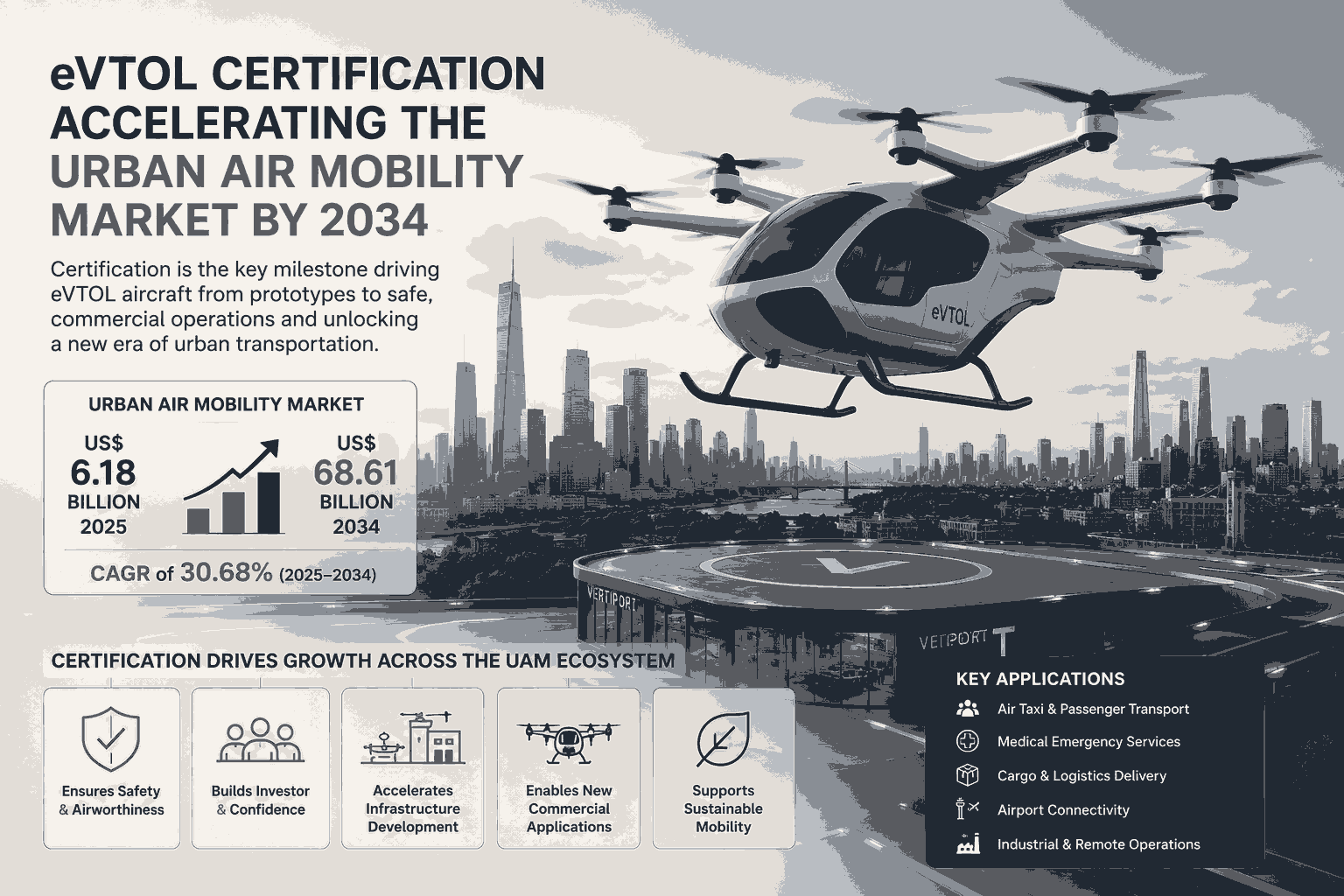
According to The Insight Partners, the Urban Air Mobility Market was valued at US$ 6.18 billion in 2025 and is projected to reach US$ 68.61 billion by 2034, expanding at a remarkable CAGR of 30.68% during the forecast period. This rapid growth is fueled by rising urban congestion, sustainability initiatives, advancements in battery technology, and increasing investments in next-generation transportation infrastructure.
Why eVTOL Certification Matters
Unlike traditional aircraft, eVTOLs combine electric propulsion, distributed motors, advanced flight control software, lightweight materials, and in many cases, autonomous capabilities. These innovations require entirely new regulatory approaches that ensure operational safety while supporting technological advancement.
Certification verifies that an aircraft satisfies strict standards for:
- Airworthiness and structural integrity
- Flight safety and operational reliability
- Battery and propulsion system performance
- Emergency response capabilities
- Software and avionics reliability
- Noise and environmental compliance
Without certification, manufacturers cannot begin commercial passenger operations. Consequently, certification has become the industry's most important milestone, determining when urban air mobility services can transition from demonstrations to revenue-generating operations.
Regulatory Progress Is Building Industry Confidence
Over the past few years, aviation regulators have significantly accelerated work on Advanced Air Mobility (AAM) frameworks. Authorities are collaborating with manufacturers throughout aircraft development instead of waiting until prototypes are complete.
This collaborative certification model offers several benefits:
- Faster regulatory approvals
- Lower development risks
- Standardized safety requirements
- Improved investor confidence
- Clear commercialization timelines
Rather than acting as a bottleneck, regulators are increasingly becoming strategic partners in developing the future of urban aviation.
From Demonstration Flights to Commercial Air Taxi Services
The first generation of eVTOL aircraft is expected to serve short-distance urban routes connecting airports, business districts, hospitals, and suburban communities.
Several manufacturers have already completed thousands of successful test flights while progressing through various certification phases. Companies including Joby Aviation, Archer Aviation, EHang, Vertical Aerospace, and BETA Technologies continue advancing commercial readiness through extensive flight testing and regulatory collaboration.
Each certification milestone reduces uncertainty for:
- Fleet operators
- Infrastructure developers
- Insurance providers
- Government agencies
- Private investors
As a result, capital continues flowing into aircraft manufacturing, vertiport construction, charging infrastructure, and air traffic management systems.
Certification Is Accelerating Infrastructure Development
Aircraft alone cannot establish an urban air mobility ecosystem.
Cities must simultaneously develop:
- Vertiports
- Fast-charging stations
- Digital traffic management systems
- Passenger terminals
- Maintenance facilities
- Emergency response infrastructure
Infrastructure investors are more willing to commit funding when aircraft certification appears achievable within defined timelines.
Recent projects across North America, Europe, the Middle East, and Asia demonstrate growing momentum for commercial vertiport development as the industry prepares for certified eVTOL operations.
New Commercial Opportunities Beyond Passenger Transport
Although air taxis receive most media attention, certification is unlocking several high-value commercial applications.
Medical Emergency Services
Certified eVTOL aircraft can dramatically reduce emergency response times by transporting patients, medical personnel, organs, vaccines, and critical healthcare supplies across congested cities.
Urban Cargo Delivery
The rapid expansion of e-commerce is increasing demand for faster last-mile and middle-mile logistics. Certified cargo eVTOLs can transport time-sensitive shipments while avoiding road congestion.
Airport Connectivity
Many international airports are exploring eVTOL shuttle services that connect passengers directly to city centers, reducing travel times from hours to minutes during peak traffic.
Industrial Transportation
Large industrial campuses, offshore facilities, and remote infrastructure projects can also benefit from certified electric aircraft capable of short-distance transportation.
These diversified applications significantly expand the addressable market for Urban Air Mobility.
Sustainability Strengthens the Business Case
Governments worldwide continue introducing aggressive carbon reduction targets for transportation.
Compared with conventional helicopters, electric vertical takeoff and landing aircraft offer several environmental advantages:
- Zero direct tailpipe emissions
- Reduced operational noise
- Lower energy consumption
- Improved urban air quality
- Support for renewable energy integration
As certification validates aircraft safety and operational performance, sustainability becomes an additional competitive advantage for operators seeking government partnerships and public acceptance.
Challenges Still Remain
Despite encouraging progress, widespread commercialization depends on solving several important challenges.
Battery Performance
Current battery technology limits flight range and payload capacity. Continued improvements in energy density will expand commercial applications.
Public Acceptance
Passengers must develop confidence in electric aircraft operating over densely populated urban environments.
Air Traffic Integration
Managing thousands of low-altitude aircraft requires sophisticated digital air traffic management systems capable of coordinating autonomous and piloted flights.
Cost Reduction
Although early operations will likely target premium transportation services, long-term market expansion depends on lowering manufacturing and operational costs.
Certification alone does not solve these issues, but it provides the regulatory foundation upon which these challenges can be addressed.
Regional Outlook Through 2034
North America currently leads Urban Air Mobility development due to strong private investment, advanced aerospace capabilities, and supportive regulatory initiatives.
Europe continues investing heavily in sustainable aviation and smart city transportation, while Asia-Pacific is witnessing rapid adoption driven by urbanization, government support, and increasing demand for advanced mobility solutions.
India is also emerging as a promising future market. Recent discussions around air taxi corridors and Advanced Air Mobility initiatives indicate growing interest in integrating eVTOL transportation into major metropolitan regions.
The Road Ahead
The next decade will determine how quickly Urban Air Mobility transitions from innovation to everyday transportation.
Certification represents the industry's turning point. It enables manufacturers to commercialize aircraft, encourages infrastructure investment, attracts institutional funding, and builds public trust. Every successful certification milestone moves the industry closer to making air taxis, emergency aerial services, cargo transport, and sustainable urban aviation part of everyday life.
With increasing regulatory collaboration, technological innovation, and infrastructure investment, Urban Air Mobility is evolving into one of the fastest-growing segments of the global transportation industry. As forecasted by The Insight Partners, the market's rapid expansion toward US$ 68.61 billion by 2034 reflects not only technological progress but also the growing confidence that certified eVTOL aircraft will redefine urban transportation in the years ahead.