Artificial intelligence (AI) is rapidly transforming healthcare, and dermatology is emerging as one of the specialties benefiting the most from digital innovation. From AI-assisted skin lesion analysis to personalized treatment recommendations, intelligent technologies are helping clinicians deliver faster, safer, and more effective care. One area experiencing significant advancement is the use of AI-powered phototherapy devices for treating chronic skin disorders.
Phototherapy has long been a trusted, non-invasive treatment option for conditions such as psoriasis, vitiligo, eczema, and acne. Today, manufacturers are integrating AI, smart sensors, digital monitoring, and connected healthcare technologies into dermatological phototherapy lamps to improve treatment precision and patient outcomes. As healthcare systems increasingly adopt personalized medicine and remote patient management, AI-enabled phototherapy solutions are expected to play a vital role in the evolution of dermatological care through 2034.
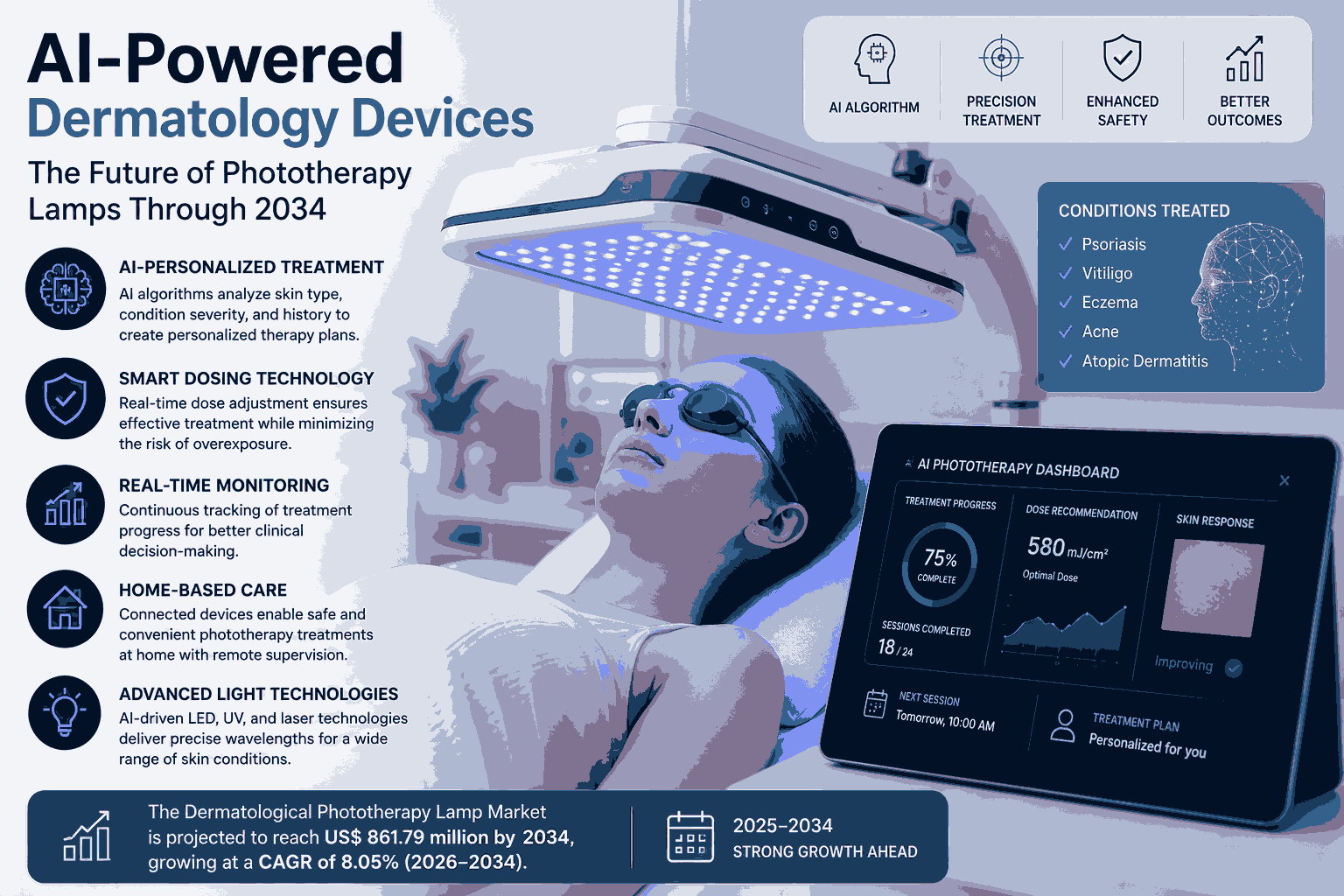
The Dermatological Phototherapy Lamp Market is expected to witness steady growth over the next decade, increasing from US$ 463.98 million in 2025 to US$ 861.79 million by 2034, at a CAGR of 8.05% during 2026 to 2034. Market expansion is being fueled by the rising prevalence of chronic skin disorders such as psoriasis, vitiligo, eczema, and acne, coupled with growing demand for safe, non-invasive treatment options. Continuous advancements in AI-powered phototherapy systems, smart dosing technologies, LED-based light therapy, and home-use phototherapy devices are further enhancing treatment precision and patient convenience. As healthcare providers increasingly adopt personalized medicine and digital health solutions, intelligent phototherapy platforms are expected to play a central role in improving dermatological care and driving sustained market growth through 2034.
Understanding Dermatological Phototherapy
Dermatological phototherapy uses carefully controlled wavelengths of ultraviolet, visible light, infrared light, or laser technology to treat a variety of skin diseases. Depending on the condition, clinicians may recommend narrowband UVB therapy, excimer laser treatment, or visible light therapy to reduce inflammation, stimulate skin repair, or encourage repigmentation.
Phototherapy offers several advantages over long-term systemic medications, including fewer systemic side effects, targeted treatment, and strong clinical evidence supporting its effectiveness. Hospitals, specialty dermatology clinics, and home healthcare settings continue to expand their use of phototherapy systems as patient demand for non-invasive treatment options grows.
How AI Is Transforming Phototherapy Devices
Artificial intelligence is helping modern phototherapy lamps become smarter, more adaptive, and increasingly patient focused. Rather than relying solely on preset treatment protocols, AI-powered systems can analyze patient-specific information to optimize therapy sessions.
Some of the key capabilities include:
- Personalized treatment planning based on skin type and medical history
- Automated dose recommendations that minimize the risk of overexposure
- Real-time monitoring of treatment progress
- Intelligent scheduling of therapy sessions
- Predictive analytics that help clinicians evaluate treatment effectiveness
- Digital reminders to improve patient adherence
These capabilities allow dermatologists to deliver more consistent treatment while reducing manual adjustments and improving overall clinical efficiency.
Smart Dosing Improves Safety and Accuracy
One of the most significant innovations in phototherapy technology is AI-assisted smart dosing.
Traditional phototherapy often requires physicians to manually adjust ultraviolet exposure based on previous treatment responses and patient skin sensitivity. AI algorithms can analyze historical treatment data, patient characteristics, and clinical progress to recommend more accurate dosage levels.
This personalized approach helps reduce the likelihood of excessive UV exposure while maximizing therapeutic effectiveness. Smart dosing systems also improve confidence for both clinicians and patients, particularly during long-term treatment programs. Recent product innovations featuring personalized UVB dosing further demonstrate how manufacturers are moving toward individualized phototherapy solutions that improve both safety and treatment outcomes.
Home Based Phototherapy Is Becoming More Intelligent
Healthcare delivery is steadily shifting beyond hospitals, and dermatology is following this trend.
AI-enabled home phototherapy devices allow patients with chronic skin conditions to receive treatment from home while remaining under physician supervision. Connected devices can securely transmit treatment information, allowing healthcare professionals to monitor adherence, evaluate progress, and modify therapy plans remotely.
Benefits of AI-supported home phototherapy include:
- Greater convenience for patients
- Reduced travel to healthcare facilities
- Better adherence to prescribed treatment schedules
- Lower healthcare resource utilization
- Improved access for patients living in remote areas
As telemedicine continues to expand worldwide, intelligent home phototherapy platforms are expected to become an important part of long-term dermatological care.
Digital Monitoring Is Improving Clinical Decision Making
Modern phototherapy systems are increasingly incorporating digital health features that simplify treatment management.
Cloud connectivity, mobile applications, and integrated treatment dashboards allow physicians to review patient progress between appointments. Some systems automatically record treatment duration, ultraviolet dosage, session frequency, and patient compliance.
Artificial intelligence analyzes this information to identify treatment patterns that may not be immediately visible during routine consultations. Physicians can make evidence-based decisions regarding treatment adjustments, improving both safety and clinical outcomes. Digital monitoring also strengthens communication between patients and healthcare providers, creating a more collaborative treatment experience.
LED Technology and AI Create New Opportunities
LED-based phototherapy is gaining popularity because it offers several advantages over traditional light sources.
Modern LED systems provide:
- Higher energy efficiency
- Longer operating life
- Better wavelength precision
- Lower maintenance requirements
- Compact device designs
- Enhanced patient comfort
When combined with artificial intelligence, LED phototherapy systems become even more powerful. AI can automatically select appropriate wavelengths, optimize treatment duration, and customize therapy according to individual patient needs. This combination is expected to accelerate adoption across dermatology clinics, outpatient centers, and home care environments.
Expanding Applications Across Skin Disorders
Although psoriasis remains the largest application area, AI-enabled phototherapy devices are supporting treatment across a growing range of dermatological conditions.
These include:
- Psoriasis
- Vitiligo
- Eczema
- Acne
- Atopic dermatitis
- Inflammatory skin disorders
As clinical evidence continues to expand, physicians are becoming more confident in incorporating intelligent phototherapy into broader treatment protocols.
The flexibility of multi indication phototherapy platforms also improves equipment utilization for healthcare providers while expanding patient access to specialized dermatological care. Manufacturers are developing systems capable of treating multiple conditions through configurable wavelengths and customizable treatment protocols, making these platforms increasingly attractive for hospitals and specialty clinics.
Opportunities for Manufacturers
Manufacturers are investing heavily in innovation to differentiate their products in an increasingly competitive marketplace.
Key investment areas include:
- AI-powered treatment algorithms
- Smart UV sensors
- Precision wavelength control
- Portable phototherapy devices
- Remote physician monitoring platforms
- Cloud-based patient management software
- Energy-efficient lighting systems
- Multi-indication treatment platforms
Strategic collaborations between medical device companies, dermatology clinics, software developers, and digital health providers are expected to accelerate commercialization of next generation phototherapy technologies. As patient expectations continue to evolve, companies that combine intelligent software with advanced light therapy hardware will be well positioned to strengthen their competitive advantage.
Regional Outlook
North America continues to lead the Dermatological Phototherapy Lamp Market due to advanced healthcare infrastructure, high awareness of chronic skin disorders, and widespread adoption of innovative medical technologies. Strong physician acceptance, favorable reimbursement policies for selected treatments, and increasing availability of home phototherapy programs further support regional growth.
Europe remains an important market, supported by established dermatology research, advanced healthcare systems, and continuous investment in medical technology. Countries such as Germany, the United Kingdom, France, Italy, and Spain continue to expand the adoption of modern phototherapy solutions across hospitals and specialty dermatology centers.
Asia Pacific is expected to register the fastest growth through 2034. Expanding healthcare infrastructure, rising diagnosis rates, increasing healthcare expenditure, and growing adoption of advanced dermatology equipment are creating significant opportunities for AI-enabled phototherapy devices across China, Japan, India, South Korea, and Australia.
Meanwhile, emerging economies in the Middle East, Africa, and South and Central America are steadily improving access to specialized dermatology services, creating additional opportunities for manufacturers of intelligent phototherapy systems.
Future Outlook
The future of dermatological phototherapy extends beyond light therapy alone. Artificial intelligence, machine learning, digital health platforms, cloud connectivity, and personalized medicine are converging to create highly intelligent treatment ecosystems. Future phototherapy devices are expected to incorporate automated skin analysis, adaptive treatment recommendations, predictive maintenance, and seamless integration with electronic health records.
Growing investment in precision medicine, wearable health technologies, and remote patient monitoring will continue to accelerate innovation. As regulatory approvals expand and clinical evidence supporting AI-assisted phototherapy grows, these intelligent systems are likely to become standard tools for managing chronic dermatological conditions.
Artificial intelligence is reshaping the future of dermatological phototherapy by making treatment safer, more personalized, and more accessible. Smart dosing technologies, connected home care devices, digital treatment monitoring, and AI-driven clinical decision support are helping improve patient outcomes while enhancing healthcare efficiency.
As healthcare providers continue embracing precision medicine and remote care models, intelligent phototherapy lamps are expected to become an essential component of modern dermatology. Continuous advancements in AI, LED technology, cloud connectivity, and personalized treatment planning will strengthen the role of phototherapy in managing chronic skin diseases over the coming decade.
.jpg)
.png)
.png)