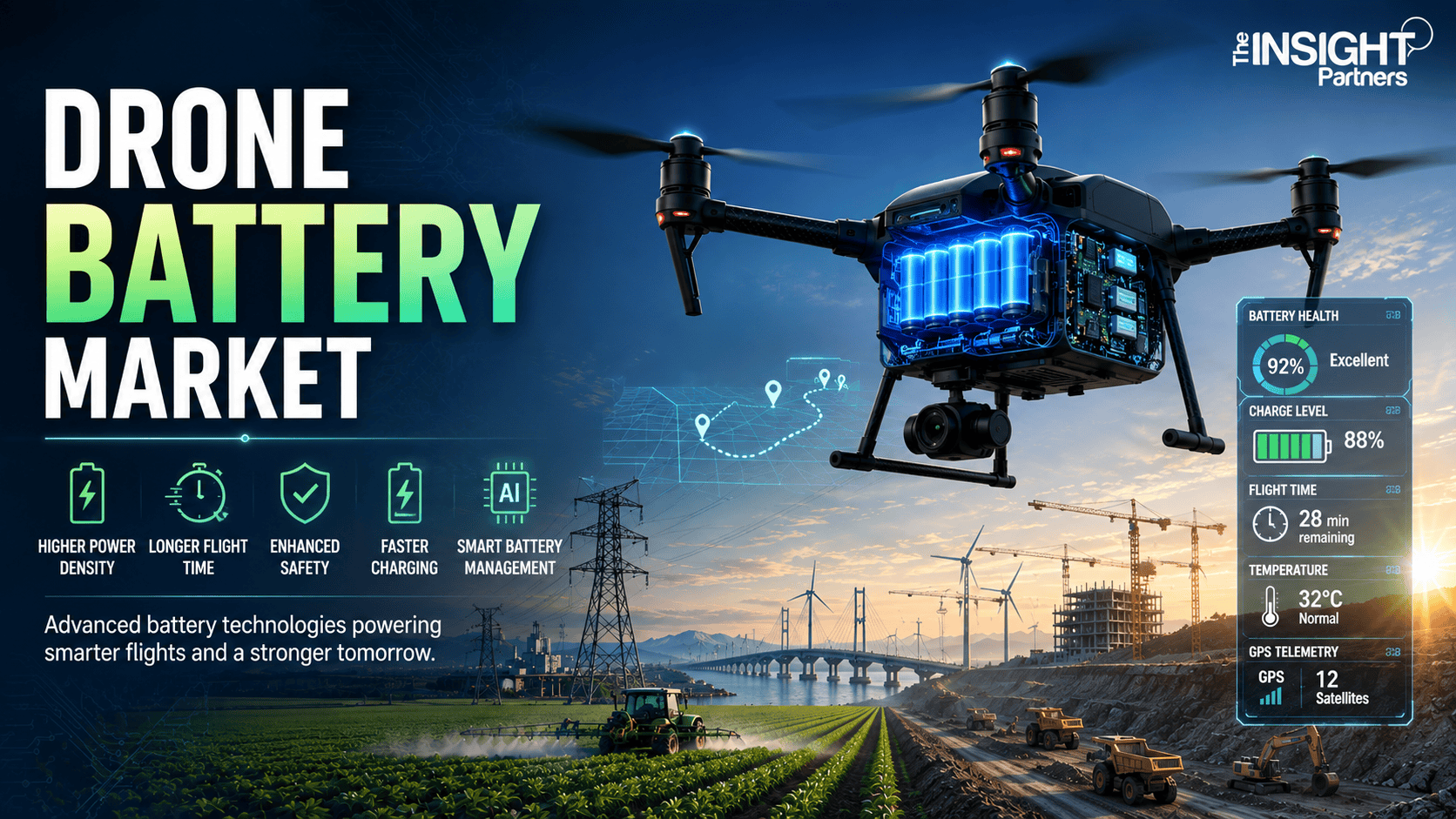
The rapid evolution of unmanned aerial vehicles (UAVs) is transforming industries ranging from agriculture and infrastructure inspection to utilities, mining, and construction. As drones become more intelligent and capable of carrying sophisticated sensors, cameras, LiDAR systems, and spraying equipment, battery technology has emerged as the cornerstone of their performance. Flight endurance, charging speed, payload capacity, operational safety, and mission reliability all depend on continuous advancements in battery innovation.
According to The Insight Partners, the Drone Battery Market was valued at US$ 1.62 billion in 2025 and is projected to reach US$ 6.26 billion by 2034, expanding at a robust CAGR of 16.2% during 2026-2034. This impressive growth is fueled by increasing adoption of commercial and industrial drones, growing investments in advanced battery chemistries, and rising demand for longer flight durations across critical applications.
Why Battery Technology Is Becoming the Competitive Advantage
While drone manufacturers continue to improve airframes, autonomous navigation, and AI-powered flight control, battery technology remains the biggest factor limiting operational efficiency. Enterprises deploying drone fleets seek solutions that maximize flight time while minimizing charging intervals and operational downtime.
Modern drone operators require batteries that offer:
- Higher energy density
- Lightweight construction
- Faster charging capability
- Improved thermal stability
- Intelligent battery monitoring
- Longer cycle life
- Enhanced safety during transportation and operation
These requirements are driving significant investments in advanced lithium battery technologies, battery management systems (BMS), and AI-enabled power analytics.
LiPo Batteries Continue to Lead the Market
Among battery technologies, Lithium Polymer (LiPo) batteries dominate the drone battery market because they provide the ideal balance between lightweight construction and high power output.
Compared with traditional NiCad and NiMH batteries, LiPo batteries deliver:
- Higher energy-to-weight ratio
- Superior discharge rates
- Flexible battery pack designs
- Better payload support
- Longer flight endurance
- Faster acceleration for professional UAVs
Although NiCad batteries continue to serve specialized rugged environments and NiMH batteries remain suitable for entry-level or training drones, commercial UAV operators increasingly prefer LiPo technology due to its superior performance characteristics.
Looking ahead, semi-solid-state batteries and next-generation lithium cell technologies are expected to further increase energy density while reducing charging times and improving safety.
Smart Batteries Are Redefining Drone Fleet Management
Battery technology is no longer limited to energy storage. Modern drone batteries have evolved into intelligent power systems equipped with advanced Battery Management Systems (BMS).
Smart batteries now provide real-time information including:
- Cell balancing
- Temperature monitoring
- Remaining flight time
- Battery health status
- Charge cycle tracking
- Fault detection
- Voltage monitoring
These intelligent capabilities significantly reduce mission failures while improving maintenance planning.
As enterprise drone fleets continue expanding, predictive battery analytics powered by artificial intelligence will help operators replace batteries before failures occur, reducing operational risks and extending fleet reliability.
High-Capacity Batteries Are Enabling Industrial UAV Applications
Commercial drones are carrying increasingly heavier payloads, including:
- LiDAR scanners
- Thermal imaging cameras
- Multispectral sensors
- Gas detection systems
- Agricultural spraying equipment
- Communication modules
These applications require batteries with greater capacity and stable power delivery.
Battery capacity segments are becoming more application-specific:
Below 3,000 mAh
Ideal for:
- Micro quad drones
- Indoor inspections
- Educational drones
- Pilot training
These batteries prioritize lightweight performance and affordability.
3,000-5,000 mAh
This segment supports:
- Infrastructure inspections
- Mapping
- Surveying
- Photography
- Small commercial UAVs
It offers an excellent balance between endurance and portability.
5,000-10,000 mAh
Widely used in professional operations requiring:
- Longer flight missions
- Higher payload capacity
- Industrial inspections
- Commercial aerial imaging
Above 10,000 mAh
High-capacity batteries power demanding missions including:
- Agricultural spraying
- Mining surveys
- Utility inspections
- Construction mapping
- Heavy sensor integration
These batteries significantly reduce battery swaps during long-duration operations.
Commercial Industries Are Accelerating Battery Demand
The expansion of commercial UAV deployment is creating unprecedented demand for advanced drone batteries.
Agriculture & Forestry
Precision agriculture has become one of the fastest-growing drone applications.
Farmers increasingly rely on drones for:
- Crop monitoring
- Precision spraying
- Irrigation analysis
- Forest health assessment
- Fire-risk monitoring
Long-endurance batteries enable drones to cover larger agricultural areas while reducing interruptions caused by frequent battery replacement.
Infrastructure Inspection
Governments and private enterprises increasingly deploy drones for inspecting:
- Bridges
- Highways
- Industrial facilities
- Cell towers
- Rail infrastructure
Reliable batteries ensure uninterrupted data collection while improving inspection accuracy.
Utilities
Power companies use drones for inspecting:
- Transmission lines
- Wind farms
- Solar installations
- Pipelines
Since many inspection sites are located in remote areas, batteries with longer flight duration and rugged performance have become mission-critical.
Construction
Construction companies leverage drones for:
- Site mapping
- Progress monitoring
- Volumetric measurements
- Safety inspections
Frequent daily flights require durable batteries capable of fast charging and extended lifecycle performance.
Mining
Mining operators depend on drones for:
- Pit surveying
- Stockpile measurement
- Hazard detection
- Environmental monitoring
These demanding environments require batteries capable of operating under harsh temperatures, dust, and extended operational hours.
Regional Markets Continue Expanding
North America remains a major contributor to market growth due to increasing deployment of enterprise drones across utilities, emergency response, agriculture, and public safety. FAA modernization initiatives and Beyond Visual Line of Sight (BVLOS) programs continue supporting widespread commercial drone adoption.
Asia Pacific is expected to witness the fastest growth through 2034. China's strong drone manufacturing ecosystem, combined with growing UAV adoption across Japan, India, South Korea, and Australia, continues driving significant battery demand. The region also benefits from proximity to lithium cell manufacturers and drone OEM production facilities.
Europe continues investing heavily in industrial drone applications supported by stringent safety regulations and expanding use of UAVs across infrastructure inspection, renewable energy, agriculture, and public services.
Meanwhile, the Middle East & Africa is experiencing increasing adoption of drones for oil & gas inspection, mining, smart city projects, and border surveillance, creating new opportunities for rugged, heat-resistant battery solutions.
Emerging Trends Shaping the Future
Several technology trends are expected to redefine the Drone Battery Market over the next decade.
Artificial intelligence is enabling predictive battery health monitoring that can forecast degradation before battery failure occurs. This reduces maintenance costs while improving fleet availability.
Battery-as-a-Service (BaaS) models are gaining momentum as enterprises seek subscription-based battery management solutions that include charging infrastructure, maintenance, analytics, replacement scheduling, and lifecycle management.
Localized battery manufacturing and certified supply chains are also becoming strategic priorities, particularly for government agencies and critical infrastructure operators seeking greater supply chain resilience.
At the same time, innovations in semi-solid-state batteries, AI-discovered battery materials, and intelligent charging systems promise to deliver safer, faster-charging, and higher-capacity energy solutions for next-generation UAVs.
Looking Ahead
The future of commercial drones depends heavily on continued advancements in battery technology. As UAV missions become more complex and industries demand longer flight endurance, higher payload capacities, and safer operations, battery innovation will remain at the center of market growth.
Manufacturers are moving beyond simply increasing battery capacity toward developing intelligent energy systems that combine advanced lithium chemistries, AI-powered battery management, predictive analytics, and rapid charging capabilities. These innovations will allow drones to perform longer, safer, and more efficiently across industries such as agriculture, utilities, construction, infrastructure inspection, and mining.
.png)