Air quality has become one of the defining environmental and public health challenges of the modern era. As governments, industries, and communities face increasing pressure to reduce pollution and improve environmental transparency, intelligent air quality monitoring systems have emerged as a critical solution. These advanced systems combine high-precision sensors, cloud connectivity, data analytics, and automation to provide real-time visibility into airborne pollutants, enabling faster and more informed decision-making.
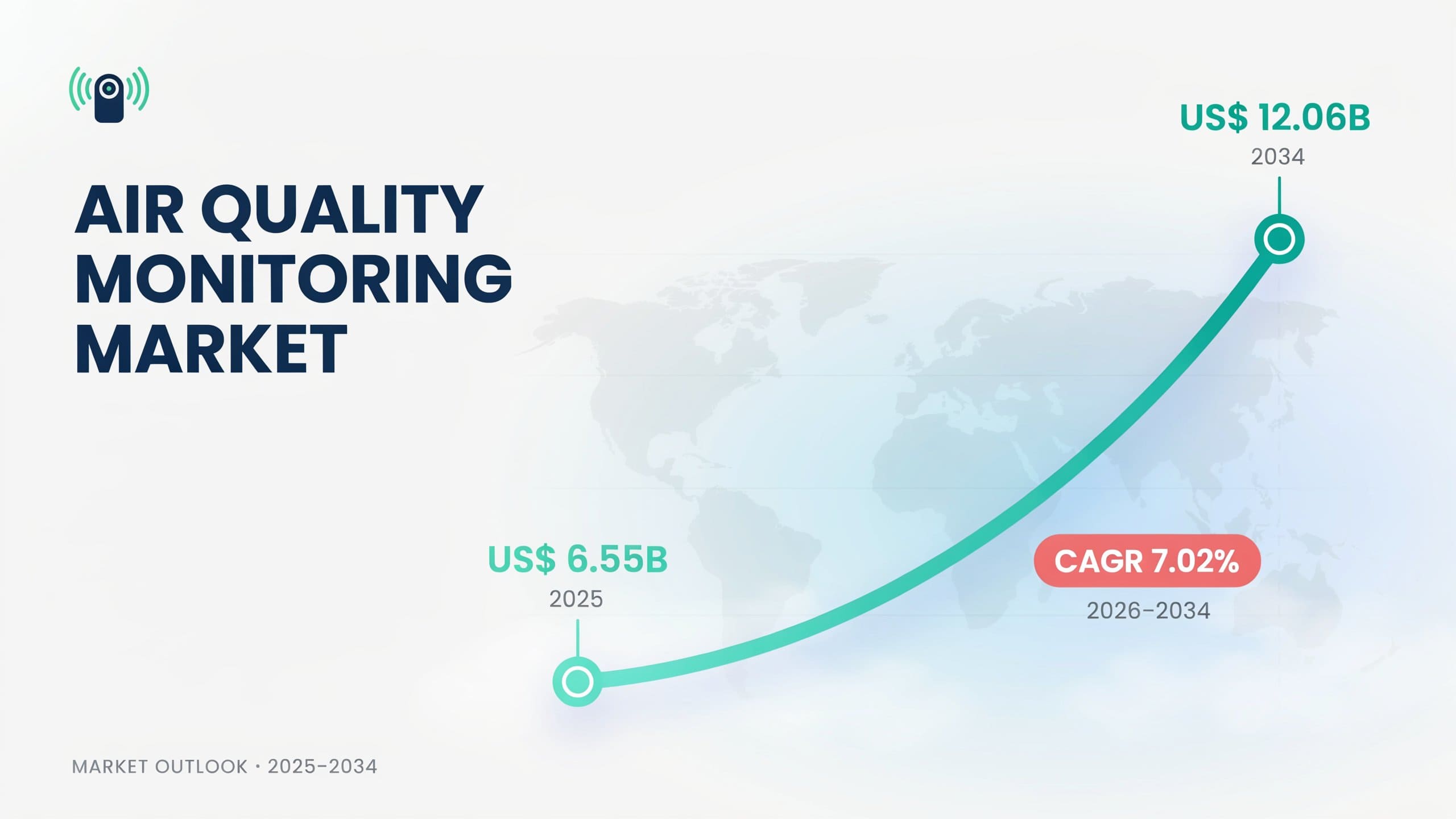
According to The Insight Partners, the Air Quality Monitoring Market was valued at US$ 6.55 billion in 2025 and is projected to reach US$ 12.06 billion by 2034, expanding at a CAGR of 7.02% during 2026–2034. The market is growing as governments strengthen environmental regulations, industries invest in emissions monitoring, and commercial facilities prioritize healthier indoor environments. While Asia Pacific is expected to witness the fastest growth, North America and Europe continue to lead the global transition toward intelligent air quality monitoring, setting benchmarks for technology adoption, regulatory compliance, and environmental management.
Why Intelligent Air Quality Monitoring Is Becoming Essential
Traditional air quality monitoring primarily relied on fixed monitoring stations that collected pollution data periodically. Although these systems remain important for regulatory compliance, they often provide limited geographic coverage and delayed insights.
Modern intelligent monitoring systems integrate:
- IoT-enabled sensors
- Cloud-based monitoring platforms
- AI-powered analytics
- Real-time dashboards
- Automated alerts
- Edge computing capabilities
- Building management integration
These technologies allow organizations to continuously monitor pollutants such as particulate matter (PM2.5 and PM10), carbon dioxide, nitrogen oxides, ozone, sulfur dioxide, volatile organic compounds (VOCs), and other harmful gases.
Instead of simply measuring pollution levels, intelligent monitoring systems now support predictive maintenance, automated ventilation control, industrial emissions management, and public health planning.
North America Sets the Standard for Intelligent Air Monitoring
North America remains the largest regional market for air quality monitoring, accounting for 30% to 34% of global market share in 2025. The region is projected to grow at a CAGR of 6.3% to 6.8% through 2034.
Several factors contribute to this leadership.
Strong Environmental Regulations
Government agencies across the United States and Canada continue expanding nationwide monitoring programs to improve environmental visibility and regulatory compliance.
Updated PM2.5 standards, stricter industrial permitting requirements, and increasing emphasis on environmental justice have encouraged broader deployment of intelligent monitoring infrastructure.
Federal, state, and local agencies increasingly rely on continuous monitoring networks instead of periodic measurements, creating sustained demand for advanced monitoring technologies.
Wildfire Smoke Monitoring
Wildfires have become a recurring environmental challenge across North America.
Smoke events can affect communities hundreds of miles away, making traditional monitoring networks insufficient for delivering timely public health alerts.
As a result, governments are investing heavily in:
- Distributed sensor networks
- Mobile monitoring units
- Community-based monitoring programs
- Public air quality dashboards
- Emergency response systems
These investments are accelerating the deployment of intelligent monitoring platforms capable of delivering hyperlocal pollution insights.
Commercial Building Health
North American organizations increasingly recognize indoor air quality as a key component of employee wellness and operational efficiency.
Schools, airports, hospitals, offices, universities, and commercial buildings now integrate air quality sensors directly into HVAC systems to optimize ventilation, reduce energy consumption, and improve occupant comfort.
Rather than operating ventilation systems on fixed schedules, intelligent building platforms adjust airflow dynamically based on real-time pollutant measurements.
The United States Continues Driving Innovation
The United States represents approximately 82% to 86% of the North American market, making it the largest national market globally.
The country has witnessed growing adoption of intelligent monitoring across multiple sectors, including:
- Industrial facilities
- Chemical plants
- Refineries
- Smart campuses
- Transportation corridors
- Near-road pollution monitoring
- Fence-line emissions monitoring
- Healthcare facilities
Organizations increasingly require monitoring systems that deliver highly accurate, reliable, and legally defensible environmental data.
Since monitoring results directly influence environmental permits, compliance reporting, worker safety, and public health advisories, demand for precision instrumentation continues to rise.
Europe Combines Regulation with Sustainability
Europe accounts for approximately 24% to 28% of the global air quality monitoring market and remains one of the world's most technologically advanced environmental monitoring regions.
Unlike many emerging markets where monitoring primarily supports compliance, European countries increasingly use intelligent monitoring to advance broader sustainability goals.
Urban Air Quality Management
Many European cities have introduced:
- Low-emission zones
- Traffic management programs
- Sustainable transportation initiatives
- Climate adaptation strategies
Accurate environmental data enables city planners to identify pollution hotspots, evaluate policy effectiveness, and improve urban planning.
Countries including Germany, the United Kingdom, France, Italy, and Spain continue expanding both regulatory monitoring stations and low-cost sensor networks to create comprehensive pollution maps.
Germany Leads Industrial Adoption
Germany remains Europe's leading adopter of intelligent air quality monitoring technologies.
Several factors support this leadership:
- Strict industrial emissions regulations
- Advanced manufacturing sector
- High environmental standards
- Smart city investments
- Digital infrastructure
Industrial organizations increasingly deploy integrated monitoring systems capable of measuring emissions while automatically transmitting compliance data to centralized management platforms.
This combination of automation and regulatory reporting significantly reduces manual effort while improving environmental transparency.
Smart Buildings Are Driving New Opportunities
One of the fastest-growing applications for intelligent monitoring is commercial indoor air quality management.
Modern buildings increasingly monitor:
- Carbon dioxide
- PM2.5
- VOCs
- Humidity
- Temperature
- Ventilation performance
These measurements allow facility managers to automatically adjust ventilation rates, improve occupant comfort, and reduce unnecessary energy consumption.
The growing emphasis on healthy buildings has accelerated adoption across:
- Corporate offices
- Schools
- Hospitals
- Hotels
- Universities
- Laboratories
- Retail facilities
As building automation becomes more sophisticated, air quality monitoring is evolving from a standalone system into an integrated component of smart building management.
Technology Is Redefining Environmental Monitoring
The latest generation of air quality monitoring solutions extends far beyond traditional hardware.
Manufacturers increasingly offer complete environmental intelligence platforms that combine:
- Hardware sensors
- Wireless connectivity
- Cloud software
- Mobile applications
- AI-driven analytics
- Predictive maintenance
- Remote diagnostics
- Automated reporting
These integrated ecosystems help organizations monitor multiple facilities simultaneously while simplifying maintenance and regulatory reporting.
The market is also witnessing increased investment in:
- Sensor fusion
- Edge computing
- Calibration algorithms
- Cloud-based data validation
- Cybersecure connectivity
These innovations improve measurement accuracy while making intelligent monitoring more scalable and cost effective.
Beyond Compliance: A New Era of Environmental Intelligence
Organizations no longer view air quality monitoring solely as a compliance requirement.
Instead, environmental data has become a strategic business asset that supports:
- Workplace safety
- ESG reporting
- Sustainability initiatives
- Operational efficiency
- Community engagement
- Energy optimization
- Risk management
Industrial companies increasingly adopt continuous monitoring systems because real-time visibility allows faster responses to emissions events while minimizing operational disruptions.
Commercial organizations similarly use air quality data to enhance occupant well-being and demonstrate environmental responsibility.
Future Outlook
North America and Europe have established themselves as global leaders in intelligent air quality monitoring through strong environmental regulations, advanced digital infrastructure, widespread industrial adoption, and continuous technological innovation. Their investments demonstrate how accurate environmental intelligence can support healthier communities, smarter buildings, improved industrial compliance, and more sustainable urban development.
As air pollution, climate challenges, and public health concerns continue to shape global priorities, intelligent monitoring solutions will become an essential component of environmental management worldwide. While emerging regions are expected to experience faster growth over the coming decade, North America and Europe will continue setting the standards for innovation, data quality, and intelligent environmental monitoring, driving the global air quality monitoring market toward a more connected and sustainable future.