Global transportation infrastructure is undergoing a rapid transformation as airports and marine ports become smarter, more connected, and increasingly digital. These facilities are no longer just transit hubs; they are critical national infrastructure responsible for enabling global trade, tourism, logistics, and economic growth. As passenger traffic, cargo volumes, and cross-border trade continue to increase, security challenges are also becoming more sophisticated. Threats ranging from cyberattacks and unauthorized access to cargo tampering, drone intrusions, and organized smuggling require security solutions that go far beyond traditional surveillance cameras and physical barriers.
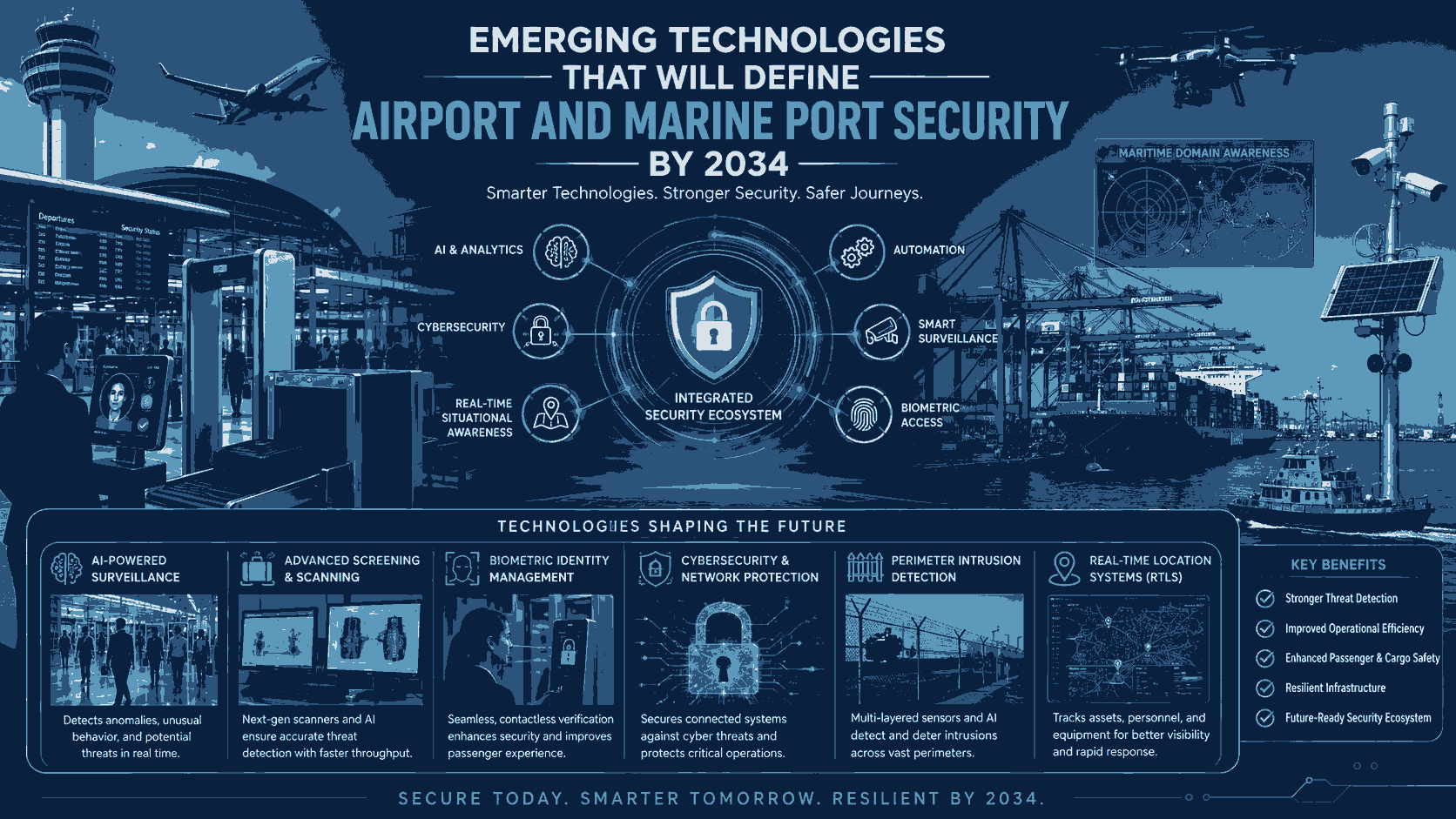
According to The Insight Partners, the Airport and Marine Port Security Market was valued at US$ 14.44 billion in 2025 and is projected to reach US$ 26.58 billion by 2034, expanding at a CAGR of 7.93% during 2026-2034. The market's growth is being driven by increasing investments in smart security infrastructure, AI-enabled surveillance, cybersecurity, automated screening technologies, and integrated command systems across airports and marine ports worldwide.
Why Security Modernization Is Becoming Essential
Modern airports and seaports process millions of passengers, cargo shipments, and vehicles every day. While operational efficiency remains a priority, ensuring safety without disrupting the movement of people and goods has become equally important.
Traditional standalone security equipment is gradually giving way to integrated security ecosystems that combine physical security, digital intelligence, and cybersecurity. Governments and infrastructure operators are increasingly investing in technologies capable of detecting threats earlier, reducing false alarms, and improving emergency response times.
As aviation and maritime industries continue embracing digital transformation, emerging technologies will redefine how transportation infrastructure is protected through 2034.
Artificial Intelligence Will Transform Surveillance Operations
Artificial intelligence (AI) has become one of the most influential technologies in transportation security.
Conventional surveillance systems primarily record events for later investigation. AI-powered surveillance, however, enables continuous real-time analysis capable of identifying suspicious behavior, unattended baggage, perimeter breaches, abnormal crowd movement, vessel anomalies, and restricted-area intrusions.
Rather than overwhelming operators with thousands of camera feeds, AI prioritizes critical incidents and automatically alerts security teams.
Key advantages include:
- Real-time threat detection
- Faster incident response
- Reduced false alarms
- Automated video analytics
- Improved operational efficiency
As airports and ports continue expanding, AI-assisted monitoring will become essential for managing increasingly complex security environments.
Advanced Screening and Scanning Technologies
Passenger expectations continue to rise, while airports must maintain strict security standards.
By 2034, next-generation screening technologies will significantly improve both detection accuracy and passenger throughput.
Emerging innovations include:
- AI-assisted baggage screening
- Automated container inspection
- Computed tomography (CT) scanners
- Intelligent cargo scanning
- Multi-layer object detection
- Automated threat recognition
Instead of relying solely on manual inspection, these systems will automatically identify prohibited items while minimizing delays.
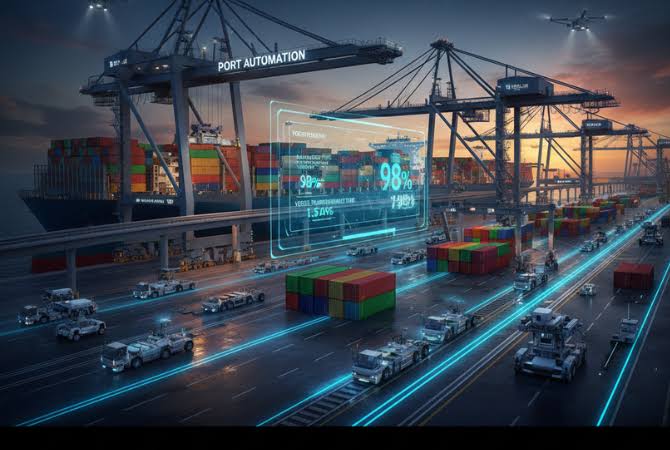
Marine ports will similarly adopt automated cargo inspection technologies capable of scanning large shipping containers with greater precision while accelerating customs clearance processes.
Biometric Identity Verification Will Strengthen Access Control
Identity verification is evolving rapidly across transportation infrastructure.
Future airport terminals and marine ports will increasingly deploy biometric authentication technologies such as:
- Facial recognition
- Iris recognition
- Fingerprint authentication
- Contactless identity verification
- Digital credentials
These technologies enhance security while reducing waiting times at security checkpoints.
Physical access control systems will also protect sensitive operational areas including:
- Air traffic control facilities
- Cargo warehouses
- Fuel storage locations
- Port operations centers
- Restricted maintenance zones
Biometric access management minimizes insider threats while ensuring that only authorized personnel gain access to critical infrastructure.
Cybersecurity Will Become a Core Security Requirement
One of the biggest shifts occurring across airport and marine port security is the convergence of physical security and cybersecurity.
Modern transportation hubs rely heavily on interconnected systems, including:
- Surveillance cameras
- Access control systems
- Cargo management platforms
- Baggage handling systems
- Vessel tracking solutions
- Operational technology (OT)
- Command center software
As these systems become increasingly connected, they also become attractive targets for cybercriminals.
Network Access Control and Security represents one of the fastest-growing technology segments within the market because organizations recognize that digital attacks can disrupt entire transportation ecosystems.
Future cybersecurity investments will focus on:
- Zero-trust network architecture
- Identity-based authentication
- Endpoint protection
- Continuous vulnerability monitoring
- Secure cloud connectivity
- AI-powered cyber threat detection
Protecting operational networks will become just as important as securing physical infrastructure.
Real-Time Location Systems Improve Situational Awareness
Real-Time Location Systems (RTLS) are expected to play an increasingly important role in airport and marine port operations.
Using wireless sensors and intelligent tracking technologies, RTLS enables operators to monitor:
- Passenger baggage
- Emergency response equipment
- Ground vehicles
- Cargo assets
- Airport personnel
- Port workers
- High-value shipments
These systems improve operational visibility while enabling faster emergency response and better coordination during security incidents.
Real-time situational awareness also helps reduce operational disruptions and improves resource allocation across large transportation facilities.
Intelligent Perimeter Protection Expands Beyond Physical Fencing
Traditional perimeter fencing alone is no longer sufficient to protect critical infrastructure.
Emerging perimeter intrusion detection systems integrate multiple technologies, including:
- Smart sensors
- Thermal cameras
- Radar
- AI-enabled video analytics
- Motion detection
- Intelligent alarm systems
These technologies create multiple security layers capable of detecting unauthorized movement around:
- Airport runways
- Cargo terminals
- Marine berths
- Storage facilities
- Coastal access points
AI-driven perimeter monitoring significantly improves detection accuracy while reducing unnecessary alarms caused by wildlife or weather conditions.
Integrated Command Centers Will Drive Faster Decision-Making
One of the most significant trends shaping the industry is the integration of multiple security systems into centralized command centers.
Instead of operating separate surveillance, screening, access control, and cybersecurity platforms, future security operations will combine all information into a unified operational dashboard.
Integrated command centers enable security personnel to:
- Monitor live incidents
- Coordinate emergency response
- Share information across agencies
- Manage multiple facilities simultaneously
- Improve operational decision-making
This holistic approach enhances both efficiency and resilience during critical events.
Smart Maritime Surveillance Is Expanding Beyond Port Boundaries
Marine port security is extending beyond dockyards into broader maritime environments.
Future smart ports will deploy technologies such as:
- Coastal radar systems
- Thermal imaging
- Vessel tracking platforms
- Drone detection systems
- AI-powered maritime analytics
- Weather-resistant surveillance sensors
These technologies provide continuous monitoring of surrounding waterways, allowing authorities to detect suspicious vessels before they approach port facilities.
As global shipping volumes continue increasing, maritime domain awareness will become an essential component of national security strategies.
Regional Investment Continues to Accelerate
Security modernization is taking place across every major region, although investment priorities differ.
North America continues investing heavily in airport modernization, cybersecurity, AI-enabled surveillance, and cargo security. The US remains the region's largest market due to ongoing investments in transportation infrastructure and integrated security technologies.
Europe is strengthening regulatory compliance, privacy-conscious surveillance solutions, certified screening technologies, and interoperable security systems to support growing passenger and freight movement.
Asia Pacific is expected to witness the fastest growth through 2034, driven by airport expansion projects, smart city initiatives, automated ports, and increasing investments in digital infrastructure across China, India, and Japan.
Emerging markets in the Middle East and Africa are also investing in airport mega-projects, energy-export terminals, coastal surveillance, and border security technologies to strengthen critical infrastructure protection.
Future Outlook
The future of airport and marine port security extends far beyond installing additional cameras or scanners. By 2034, transportation hubs will operate intelligent, fully integrated security ecosystems that combine artificial intelligence, advanced screening technologies, biometric identity management, cybersecurity, real-time location tracking, smart perimeter protection, and centralized command platforms.
As governments continue prioritizing infrastructure resilience, national security, and operational efficiency, technology providers are shifting toward comprehensive security solutions that integrate surveillance, cyber protection, access control, and operational intelligence into a single connected framework.
With the market projected to nearly double in value by 2034, organizations that embrace these emerging technologies will be better positioned to safeguard passengers, cargo, critical assets, and global supply chains while delivering safer, more efficient, and more resilient airport and marine port operations for the future.