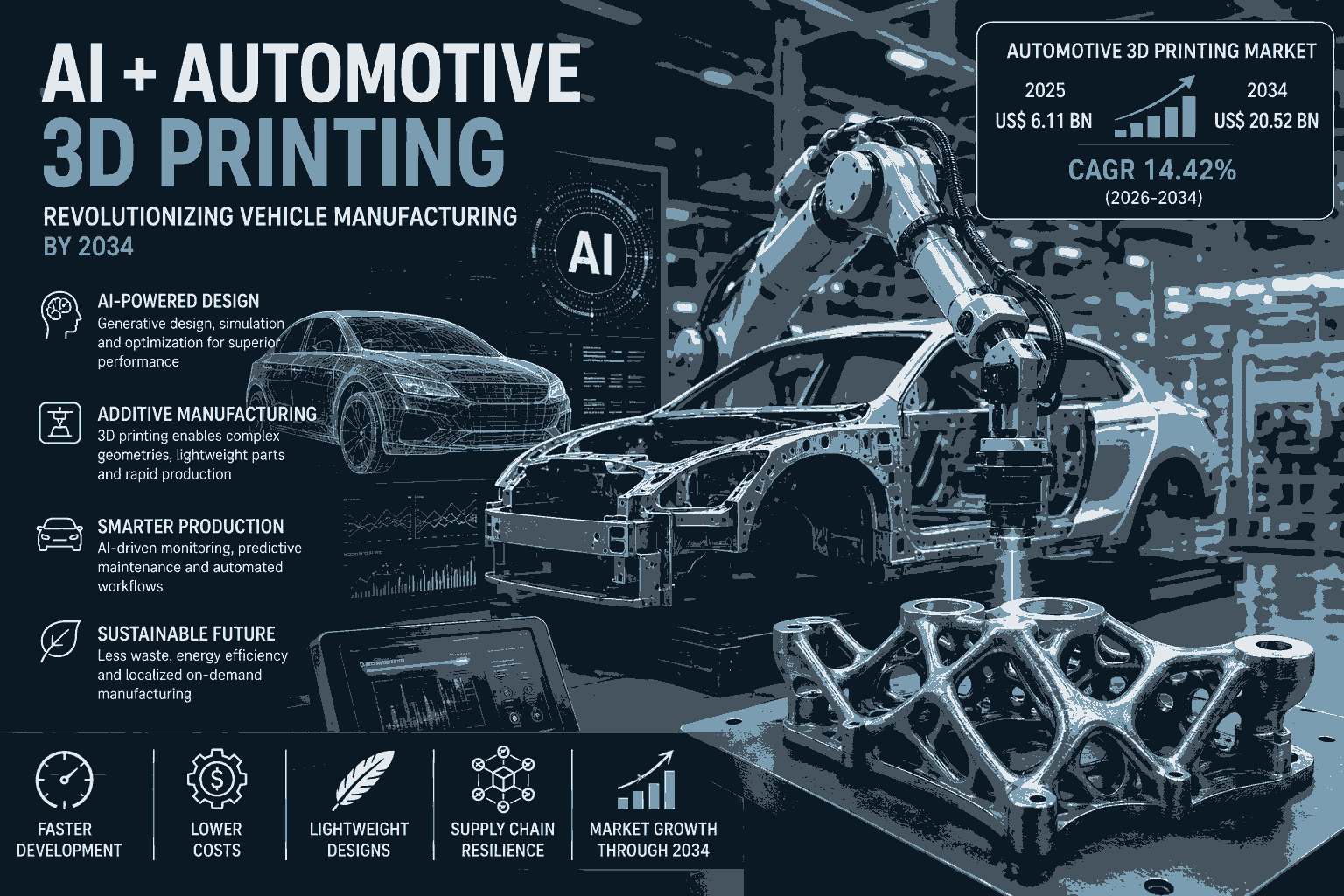
The automotive industry is undergoing one of the most significant technological transformations in its history. Artificial intelligence (AI) and automotive 3D printing are redefining how vehicles are designed, developed, tested, and manufactured. As manufacturers strive to produce lighter, safer, and more sustainable vehicles while shortening production cycles, the combination of AI-powered engineering and additive manufacturing is becoming a strategic advantage.
According to The Insight Partners, the Automotive 3D Printing Market is projected to grow from US$ 6.11 billion in 2025 to US$ 20.52 billion by 2034, registering a CAGR of 14.42% during 2026 to 2034. This remarkable growth is driven by increasing adoption of additive manufacturing for rapid prototyping, tooling, lightweight component production, complex geometries, and electric vehicle (EV) development. As AI continues to enhance design automation, predictive analytics, and manufacturing intelligence, automotive 3D printing is expected to become a core pillar of next-generation vehicle production.
AI Is Transforming the Automotive Design Process
Vehicle development has traditionally required multiple design iterations, expensive prototypes, and lengthy validation processes. AI significantly reduces these challenges by enabling engineers to analyze millions of design possibilities within hours.
Modern AI algorithms can optimize vehicle components based on strength, weight, aerodynamics, thermal performance, and manufacturing feasibility. When integrated with automotive 3D printing, these AI-generated designs can be produced immediately without the tooling constraints associated with conventional manufacturing methods.
Generative design software powered by AI allows automotive engineers to create components with organic, lightweight structures that would be nearly impossible to manufacture using traditional machining. These optimized parts reduce vehicle weight while maintaining structural integrity, improving fuel efficiency and extending the driving range of electric vehicles.
Accelerating EV Manufacturing Through AI and Additive Manufacturing
Electric vehicles are one of the biggest growth drivers for automotive 3D printing. EV manufacturers frequently redesign battery systems, cooling channels, lightweight brackets, cable routing systems, and powertrain components to improve efficiency and performance.
AI enables engineers to simulate battery performance, thermal behavior, and structural durability before production begins. Automotive 3D printing complements these capabilities by rapidly producing functional prototypes and production-ready components for testing.
Instead of waiting weeks for conventional tooling, manufacturers can print prototype parts within days, significantly reducing development cycles. Faster validation means EV manufacturers can introduce new models to market more quickly while minimizing engineering costs.
As battery technologies continue evolving through 2034, AI-assisted additive manufacturing will play an increasingly important role in accelerating EV innovation.
Rapid Prototyping Is Becoming Smarter
Rapid prototyping remains the largest application segment within the automotive 3D printing market. Manufacturers use additive manufacturing to validate designs, improve ergonomics, optimize aerodynamics, and evaluate functional performance before committing to expensive production tooling.
AI further enhances this process by identifying potential design weaknesses before physical prototypes are created. Machine learning models analyze historical engineering data to recommend design improvements, reducing the number of prototype iterations required.
This intelligent workflow enables automotive companies to:
- Reduce product development time
- Lower engineering costs
- Improve design accuracy
- Accelerate regulatory testing
- Increase manufacturing efficiency
The result is faster product launches without compromising quality or safety.
AI Enables Production of Complex Automotive Components
Traditional manufacturing often limits engineers because complex geometries can be difficult or impossible to machine.
Automotive 3D printing eliminates many of these limitations by allowing intricate lattice structures, internal cooling channels, lightweight supports, and topology-optimized components.
AI strengthens this capability by automatically generating designs optimized for additive manufacturing.
Examples include:
- Lightweight structural brackets
- Battery cooling plates
- Heat exchangers
- Airflow ducts
- Customized interior components
- Powertrain components
- Performance vehicle parts
As production-grade additive manufacturing technologies mature, these complex components are moving beyond prototypes into commercial vehicle production.
Intelligent Manufacturing with Industry 4.0
The convergence of AI, Industry 4.0, and automotive 3D printing is creating highly intelligent manufacturing environments.
Modern production facilities increasingly utilize AI to monitor printer performance, predict maintenance requirements, optimize print parameters, and improve production scheduling.
Instead of relying on manual inspections, AI-powered vision systems can detect manufacturing defects during the printing process, ensuring higher quality while reducing material waste.
Digital twins further enhance production by creating virtual replicas of manufacturing operations, allowing engineers to simulate production scenarios before implementation.
These technologies contribute to:
- Higher production consistency
- Lower operational costs
- Improved product quality
- Reduced downtime
- Better resource utilization
Advanced Materials Expand Automotive Applications
Material innovation continues to expand the capabilities of automotive additive manufacturing.
Today's automotive manufacturers increasingly use:
- Metal powders
- Engineering polymers
- Carbon fiber reinforced polymers
- Ceramic materials
- High-temperature composites
AI assists material selection by analyzing performance requirements, environmental conditions, manufacturing costs, and lifecycle performance.
This intelligent material optimization helps manufacturers select the ideal material for each application, improving durability while minimizing weight and production costs.
Metal additive manufacturing, particularly Selective Laser Melting (SLM) and Electron Beam Melting (EBM), is becoming increasingly important for high-performance automotive applications such as thermal management systems, structural components, and motorsport engineering.
AI Improves Supply Chain Efficiency
Global automotive supply chains continue facing challenges related to logistics, inventory management, and component availability.
Automotive 3D printing enables decentralized manufacturing by allowing qualified components to be produced closer to assembly plants or service centers.
AI enhances this approach through predictive demand forecasting and digital inventory management.
Rather than maintaining large inventories of slow-moving spare parts, manufacturers can store certified digital designs and produce components on demand when needed.
This strategy delivers several advantages:
- Lower inventory costs
- Reduced transportation expenses
- Faster spare parts availability
- Improved production flexibility
- Greater supply chain resilience
Distributed manufacturing networks are expected to become increasingly common through 2034.
Regional Markets Continue Expanding
North America currently leads the automotive 3D printing market, accounting for approximately 34% to 37% of global revenue in 2025.
The region benefits from:
- Strong EV engineering programs
- Advanced manufacturing infrastructure
- Extensive automotive R&D investment
- On-demand tooling adoption
- Motorsports innovation
Europe remains another major innovation hub, supported by Germany's automotive engineering ecosystem, advanced materials expertise, and widespread additive manufacturing adoption among leading OEMs.
Meanwhile, Asia Pacific is projected to register the fastest growth through 2034. China, Japan, South Korea, and India are investing heavily in EV manufacturing, localized production, industrial automation, and advanced manufacturing technologies.
Government initiatives supporting domestic manufacturing and sustainable mobility continue accelerating regional adoption.
Software Is Becoming the Competitive Differentiator
While printers and materials remain important, software is increasingly becoming the foundation of successful automotive additive manufacturing.
AI-powered software platforms now provide:
- Automated build preparation
- CAD optimization
- Process simulation
- Quality monitoring
- Digital traceability
- Production analytics
- Workflow automation
These capabilities improve repeatability while helping manufacturers meet strict automotive qualification standards.
Companies are also investing heavily in digital thread technologies that connect design, manufacturing, inspection, and post-processing into a unified workflow.
This software-driven ecosystem will be one of the defining trends shaping the automotive 3D printing industry over the coming decade.
Looking Ahead to 2034
The future of vehicle manufacturing will be increasingly digital, intelligent, and decentralized. AI and automotive 3D printing together are transforming every stage of the automotive value chain, from concept development and rapid prototyping to full-scale production and aftermarket services.
As additive manufacturing technologies become faster, more accurate, and more cost-effective, automotive manufacturers will continue expanding production beyond prototypes toward certified end-use components. Simultaneously, AI will improve design optimization, predictive quality control, material selection, and manufacturing automation.
With the global Automotive 3D Printing Market expected to surpass US$ 20.52 billion by 2034, companies investing in AI-enabled additive manufacturing today will be better positioned to meet future demands for lightweight vehicles, electric mobility, customized production, and sustainable manufacturing. The integration of intelligent software, advanced materials, and digital manufacturing workflows is not simply improving existing processes; it is fundamentally redefining how the next generation of vehicles will be designed and built.