The retail industry is undergoing a significant digital transformation as businesses seek innovative ways to bridge the gap between online convenience and the personalized experience of physical stores. Among the technologies driving this evolution, Artificial Intelligence (AI) and Augmented Reality (AR) have emerged as a powerful combination that is redefining how consumers discover, evaluate, and purchase products. Together, these technologies are creating immersive, personalized, and data-driven shopping experiences that improve customer satisfaction while helping retailers increase sales and reduce operational costs.
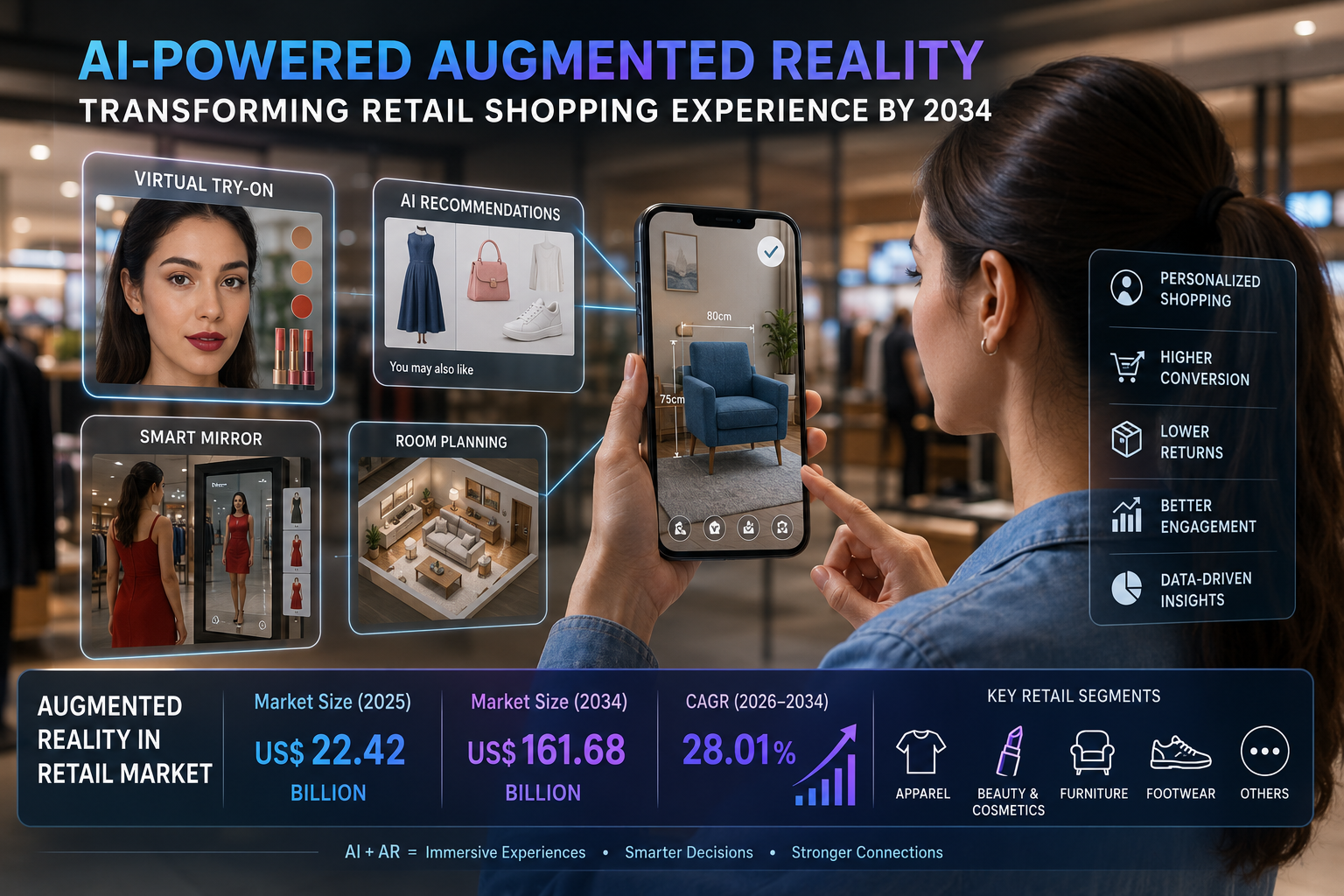
According to The Insight Partners, the Augmented Reality in Retail Market is projected to grow from US$ 22.42 billion in 2025 to US$ 161.68 billion by 2034, registering a remarkable CAGR of 28.01% during 2026 to 2034. This rapid expansion is fueled by increasing adoption of AI-powered virtual try-on solutions, spatial planning tools, intelligent product recommendations, and omnichannel retail strategies that seamlessly connect digital and physical shopping experiences.
The Growing Role of AI in Retail Augmented Reality
Traditional AR applications primarily focused on displaying virtual objects in real-world environments. While this significantly improved customer engagement, AI has elevated these experiences by making them intelligent, adaptive, and highly personalized.
AI enhances AR by analyzing customer preferences, shopping history, body measurements, facial features, room dimensions, and purchasing behavior in real time. This enables retailers to deliver highly relevant recommendations while creating shopping journeys that closely resemble personalized in-store assistance.
For example, AI can recommend clothing sizes based on previous purchases, suggest complementary products during virtual try-on sessions, or automatically adjust furniture dimensions to fit a customer's living room. These intelligent capabilities increase purchase confidence while minimizing decision fatigue.
Virtual Try-On Solutions Are Becoming the New Standard
One of the most successful applications of AI-powered AR is the rapid adoption of virtual try-on technology.
Consumers increasingly expect to see how products look before making a purchase. AI-powered AR allows shoppers to virtually try apparel, footwear, cosmetics, eyewear, and accessories using only a smartphone camera.
These solutions provide several advantages:
- Higher customer confidence before purchase
- Reduced product return rates
- Improved online conversion rates
- Better product personalization
- Increased customer engagement
Beauty retailers now use facial recognition and AI algorithms to recommend foundation shades, lipsticks, skincare products, and makeup combinations based on individual skin tones. Similarly, fashion brands enable customers to visualize complete outfits before adding products to their shopping carts.
As AI models become increasingly sophisticated, virtual fitting rooms will continue delivering highly realistic simulations that closely replicate real-world experiences.
AI Is Making Furniture Shopping More Interactive
Furniture purchases have traditionally involved uncertainty regarding size, color, layout, and compatibility with existing home décor. AI-powered AR addresses these challenges through room visualization and planning applications.
Customers can scan their living rooms using smartphones and instantly place life-sized virtual furniture inside their homes. AI further enhances this process by automatically suggesting furniture arrangements, matching interior design styles, and recommending products that complement existing décor.
Retailers benefit from:
- Lower return rates
- Higher average order values
- Increased customer confidence
- Faster purchasing decisions
Planning and designing tools are expected to become one of the fastest-growing application areas throughout the forecast period.
AI-Powered Personalization Is Reshaping Customer Experiences
Modern consumers expect shopping experiences tailored specifically to their preferences.
AI continuously analyzes browsing patterns, purchase history, demographic information, seasonal behavior, and product interactions to create individualized shopping journeys.
When integrated with AR, personalization becomes far more engaging.
Examples include:
- Personalized outfit recommendations during virtual fitting
- AI-generated room layouts based on customer preferences
- Customized beauty product suggestions
- Dynamic promotions based on virtual interactions
- Personalized product bundles displayed through AR
Rather than simply showing products, retailers now deliver contextual shopping experiences that improve customer satisfaction and increase purchasing intent.
Omnichannel Retail Is Becoming Truly Connected
Today's shoppers frequently switch between physical stores, mobile applications, websites, and social media before completing purchases.
AI-powered AR acts as a common digital layer across every customer touchpoint.
Retailers now create reusable 3D product libraries that power:
- E-commerce websites
- Mobile shopping apps
- Social commerce platforms
- Smart mirrors
- In-store kiosks
- Sales associate tablets
This unified approach ensures product consistency across every shopping channel while significantly reducing content creation costs.
Consumers enjoy seamless transitions between online browsing and physical shopping without losing product information or personalization.
AI Helps Retailers Reduce Product Returns
Product returns remain one of the largest financial challenges for online retailers.
Many returns occur because customers receive products that differ from their expectations regarding fit, size, color, or appearance.
AI-powered AR significantly minimizes these issues by allowing customers to visualize products before purchasing.
Virtual fitting, room placement, and intelligent sizing recommendations help shoppers make informed decisions while increasing confidence in their purchases.
Retailers also gain valuable behavioral insights by analyzing customer interactions with AR experiences. This data helps improve product design, merchandising strategies, inventory planning, and marketing campaigns.
Hardware and Software Continue to Evolve
Hardware currently represents the largest share of the Augmented Reality in Retail Market, supported by increasing adoption of smart mirrors, AR-capable smartphones, sensors, wearable devices, and spatial computing technologies.
However, software is expected to witness the fastest growth during the forecast period.
Retailers increasingly require:
- AI recommendation engines
- 3D asset management platforms
- Cloud-based rendering
- Customer analytics dashboards
- Commerce system integration
- Content management solutions
Rather than purchasing standalone AR applications, retailers now seek comprehensive ecosystems that integrate with inventory management, CRM platforms, payment systems, and digital commerce infrastructure.
Regional Markets Driving Global Growth
North America Leads Market Adoption
North America accounted for approximately 36% to 38% of the global market in 2025 and continues to lead adoption through strong omnichannel retail infrastructure, high smartphone penetration, and advanced AI capabilities.
Major retailers across apparel, beauty, furniture, and footwear continue investing heavily in virtual shopping technologies to improve customer engagement while lowering operational costs.
The United States remains the largest regional contributor, supported by major technology companies including Google, Apple, Microsoft, Qualcomm, and several specialized AR solution providers.
Asia Pacific Emerges as the Fastest-Growing Region
Asia Pacific is expected to register the highest growth rate through 2034.
Countries including China, Japan, South Korea, India, and Australia are rapidly adopting mobile-first shopping experiences supported by expanding 5G infrastructure and digital payment ecosystems.
Social commerce, livestream shopping, and AI-driven product recommendations continue accelerating AR adoption throughout the region.
Europe Focuses on Privacy-Centric Innovation
European retailers increasingly combine immersive shopping experiences with strict data privacy standards.
On-device AI processing, consent-based personalization, and secure customer analytics are becoming essential design principles for AR applications, particularly in luxury retail, cosmetics, and fashion industries.
Emerging Trends Shaping the Future
Several technological innovations will continue transforming AI-powered retail AR over the coming decade.
AI-Generated 3D Content
Generative AI is dramatically reducing the time required to create high-quality 3D product models.
Instead of manually designing thousands of assets, retailers can automate content creation using AI-assisted modeling, photogrammetry, and image generation technologies.
This lowers deployment costs while making AR accessible to small and medium-sized retailers.
Privacy-First Personalization
Future AR platforms will increasingly rely on local device processing rather than cloud-based data collection.
Retailers are investing in privacy-centric personalization that balances customer convenience with regulatory compliance and consumer trust.
Advanced Retail Analytics
Every virtual interaction generates valuable business intelligence.
Retailers can analyze:
- Most viewed products
- Frequently tried-on items
- Popular colors and styles
- Customer engagement duration
- Purchase conversion rates
- Product abandonment behavior
These insights help optimize merchandising strategies, inventory allocation, and product development.
Industry Innovations Accelerating Market Growth
Recent developments highlight the industry's rapid momentum.
Chinese Wok introduced WokVerse, an immersive AR engagement platform designed to enhance customer experiences through gaming and interactive mobile content.
FittingBox expanded its AI-powered virtual eyewear capabilities by acquiring Ditto, strengthening its portfolio with advanced virtual try-on technologies and one of the world's largest digital eyewear catalogs.
Snap also accelerated its spatial computing strategy through the acquisition of Illumix, enhancing persistent AR capabilities for future smart glasses and wearable retail experiences.
These strategic investments demonstrate growing confidence in AI-powered immersive commerce.
Looking Ahead
The future of retail will no longer revolve solely around products. It will focus on experiences that combine intelligence, personalization, and immersive visualization.
By 2034, AI-powered Augmented Reality is expected to become a standard component of digital commerce rather than a premium feature. Virtual try-on, intelligent shopping assistants, spatial planning, reusable 3D content, AI-generated recommendations, and privacy-first personalization will fundamentally reshape how consumers interact with brands.
As retailers continue integrating AI, AR, cloud computing, and spatial technologies into unified commerce ecosystems, shopping will become faster, more personalized, and significantly more engaging. Businesses that invest early in AI-powered Augmented Reality solutions will be better positioned to improve customer loyalty, reduce operational costs, increase conversion rates, and remain competitive in an increasingly digital retail landscape.
The remarkable growth projected for the Augmented Reality in Retail Market reflects more than technological advancement. It signals a long-term transformation in consumer expectations, where immersive and intelligent shopping experiences become the foundation of retail success by 2034.