
3D Printing Market Size, Share & Forecast by 2034
Coverage: By Technology [Fused Deposition Modeling (FDM), Stereolithography (SLA), Digital Light Processing (DLP), Selective Laser Sintering (SLS), Electron Beam Melting (EBM), Laminated Object Manufacturing (LOM), and Others], Component (Hardware, Software, and Services), and End User (Industrial, Consumer Products, Aerospace and Defense, Automotive, Healthcare, Construction, Research and Education, and Others), and Geography
- Status : Data Released
- Report Code : TIPTE100000133
- Category : Electronics and Semiconductor
- No. of Pages : 150
- Available Report Formats :


- Last update date : July 16, 2026


2025 Market Size
US$ 16.67 Bn
Base year value
2034 Forecast
US$ 78.74 Bn
Projected by 2034
CAGR 2026-2034
18.83 %
Growth rate
Addressable Market
US$ 391.79 Bn
(2026-2034)
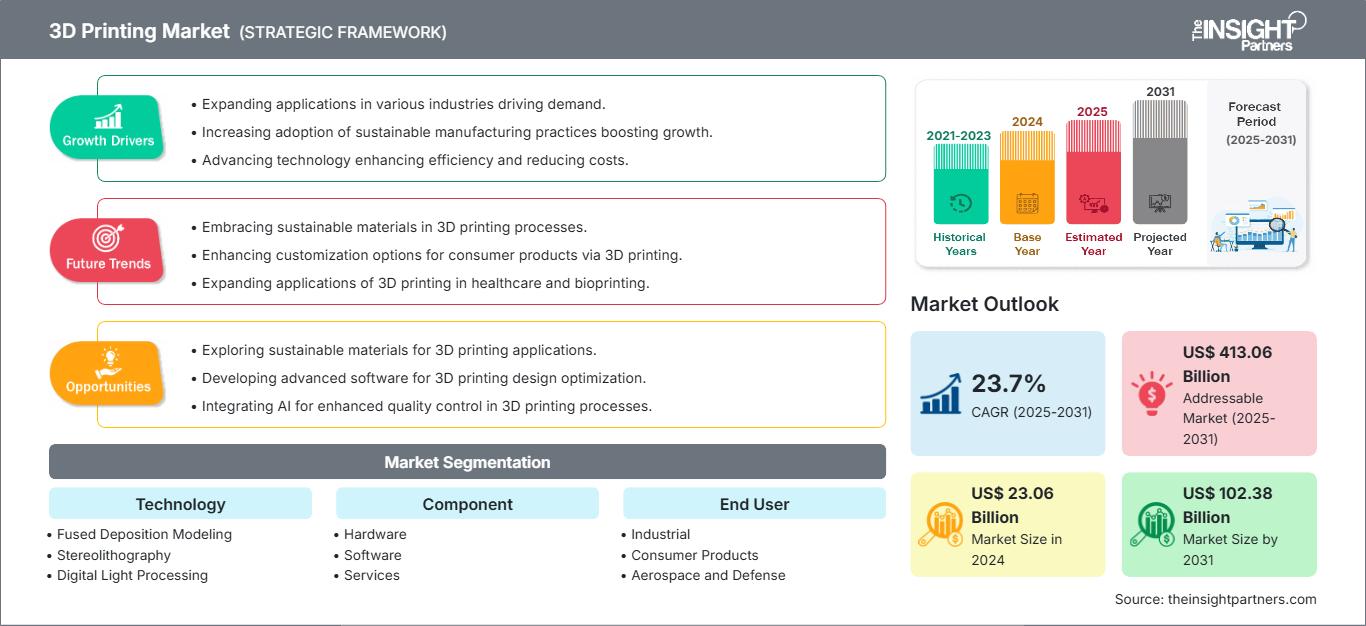
The 3D Printing Market was valued at US$ 16.67 Billion in 2025 and is projected to reach US$ 78.74 Billion by 2034, expanding at a CAGR of 18.83% during 2026–2034. The 3D Printing Market is moving from prototype support into production workflows as manufacturers use additive technologies to reduce tooling dependence, improve design flexibility, and manufacture complex parts for industrial, healthcare, aerospace, automotive, construction, consumer, and education applications.
North America remains a structurally important 3D Printing Market, with an estimated 17.6%–18.4% CAGR during 2026–2034. Regional growth is supported by aerospace certification activity, defense modernization, medical device personalization, and stronger adoption of production-grade metal systems. ASTM International’s 2025 Wohlers release reported global additive manufacturing industry growth of 9.1% to US$ 21.9 billion, with service, software, and materials activity strengthening industrial adoption.
3D Printing Market Assessment and Insights
- North America: Share in 2025 is estimated at 36%–39%, growing at a CAGR range of 17.6%–18.4% during 2026–2034, supported by aerospace qualification, defense procurement, medical customization, and established printer, software, and service ecosystems.
- US: Share in 2025 is estimated at 79%–83% of North America, growing at a CAGR range of 17.8%–18.6% during 2026–2034, driven by aerospace, dental, defense, and industrial tooling applications.
- Europe: Share in 2025 is estimated at 24%–27%, growing at a CAGR range of 16.7%–17.9% during 2026–2034, led by Germany, the UK, France, Italy, and Spain across automotive, precision machinery, aerospace, and healthcare.
- Asia Pacific: Share in 2025 is estimated at 30%–34%, growing at a CAGR range of 20.2%–21.7% during 2026–2034, with China, Japan, South Korea, India, and Australia expanding industrial, electronics, medical, and policy-backed adoption.
- Largest Segment: Hardware holds an estimated 3D printing market share of 49%–53% in 2025, with a CAGR range of 17.2%–18.5% during 2026–2034 as production systems replace basic prototyping units.
- High Growth Segment: Healthcare holds an estimated of the 3D printing market share of 13%–16% in 2025, with a CAGR range of 21.4%–22.8% during 2026–2034 as dental implants, guides, and anatomical models scale.
- Key companies analyzed in detail: 3D Systems Corporation, Autodesk, Inc., General Electric Company, Materialise NV, ExOne Global Holdings, Stratasys Ltd., voxeljet AG, Agile Manufacturing, Inc., Slant 3D, JuggerBot 3D LLC, Fusion3 Design LLC, NEMATX AG, Markforged Holding Corporation, JawsTec, LLC, Optomec, Inc., EOS GmbH, Nikon SLM Solutions AG, Ensinger GmbH, Renishaw plc, Velo3D, Inc.
Source: The Insight Partners' analysis based on proprietary research, government publications, company annual reports, investor presentations, industry databases, and expert interviews.
The 3D Printing Market report has progressed from design-room prototyping to controlled production for tooling, implants, aerospace components, automotive development, and industrial spares. Advances in fused deposition modeling, stereolithography, laser sintering, electron beam melting, binder jetting, and software-led build preparation have improved repeatability. Production dynamics now depend on qualified materials, post-processing, inspection, and part economics rather than printer installation alone, making market growth more application-specific and workflow-driven.
Future expansion will be shaped by Asia-based manufacturing capacity, U.S. defense and aerospace localization, European industrial standards, and healthcare regulatory pathways. Investment is shifting toward certified production cells, printable metals, biocompatible resins, factory software, and service networks. The 3D Printing Market scope is widening as companies use additive workflows for digital inventory, mass customization, lightweighting, and localized production where lead-time reduction creates measurable value.
3D Printing Market Report Scope
| Report Attribute | Details |
|---|---|
| Market size in 2025 | US$ 16.67 Billion |
| Market Size by 2034 | US$ 78.74 Billion |
| Global CAGR (2026 - 2034) | 18.83% |
| Historical Data | 2021-2024 |
| Forecast period | 2026-2034 |
3D Printing Market Analysis
Demand in the 3D Printing Market is strongest where complexity, customization, lightweighting, and short production runs outweigh traditional tooling economics. Aerospace users apply additive methods to brackets and propulsion parts, healthcare users scale dental and surgical workflows, and industrial buyers print jigs, fixtures, and spares. The value chain links design software, printer hardware, materials, service bureaus, inspection, and post-processing.
Supply dynamics are becoming more disciplined as machine sales soften while materials, software, and printing services expand. ASTM International’s Wohlers Report 2025 announcement highlighted 9.1% industry growth and stronger materials momentum, indicating deeper usage by installed customers. This supports 3D Printing Market trends tied to recurring production, process control, and qualified material libraries.
The competitive landscape is scattered, although more specialized than ever before. 3D Systems Corporation and Stratasys Ltd. operate in different areas, ranging from hardware, materials, and healthcare/industrial workflows to design/build preparations enabled by software from Autodesk, Inc. and Materialize NV. EOS GmbH, Nikon SLM Solutions AG, Renishaw plc, Optomec, Inc., and Velo3D, Inc. focus on metal additive manufacturing and production.
Competitive positioning involves more certified platforms, application engineering, and access to solutions through services. ExOne Global Holdings and voxeljet AG promote binder jetting technology for casting processes, and Markforged Holding Corporation, JuggerBot 3D LLC, Fusion3 Design LLC, Slant 3D, Agile Manufacturing, Inc., JawsTec, LLC, Ensinger GmbH, and NEMATX AG offer production solutions, materials, or outsourcing capabilities. It is important for increasing the 3D Printing Market share of companies that demonstrate repeatability.
● REPORT CUSTOMIZATION
Tailor This Report To Align With Your Specific Business Requirements
This report can be customized to align precisely with your business objectives, scope, and target markets. Customization options include tailored segmentation, geography, competitive analysis, and strategic insights to support informed decision-making.
Customize This Report →WHAT YOU CAN ADJUST
- ● Segmentations
- ● Geography
- ● Competitive Analysis
- ● Language Preferences
3D Printing Market: Strategic Insights
Regional Insights
North America 3D Printing Market
North America holds an estimated 36%–39% share in 2025 and is projected to expand at a 17.6%–18.4% CAGR during 2026-2034. The region benefits from aerospace certification, defense manufacturing localization, medical device customization, and a mature ecosystem of software, materials, printer makers, service bureaus, and engineering users. The U.S. remains the main demand center, while Canada supports research, tooling, and services.
Adoption by region is based on the 3D Printing Market analysis for applications requiring lightweight components, rapid design changes, secure supply, and reduced dependence on tooling. The companies involved include 3D Systems Corporation, Stratasys Ltd., General Electric Company, Markforged Holding Corporation, Optomec, Inc., Velo3D, Inc., Slant 3D, JuggerBot 3D LLC, Fusion3 Design LLC, and JawsTec, LLC. The need is more prominent in sectors such as aerospace, dental, orthopedics, industrial automation, and defense maintenance.
U.S. 3D Printing Market
The U.S. 3D printing market accounts for an estimated 79%–83% share of North America in 2025 and is forecast to grow at a 17.8%–18.6% CAGR during 2026–2034. Demand is anchored in aerospace and defense, dental production, orthopedic planning, motorsports, industrial tooling, and metal parts that need performance, speed, and traceability.
The company's presence spans printers, software, materials, and services. In January 2026, 3D Systems Corporation reported momentum in the aerospace and defense sector, including the expansion of its facilities and anticipated production printing revenues exceeding US$ 35 million in 2026. Applications include dental labs, defense spare parts, factory tooling, semiconductor equipment support, and polymer manufacturing for consumer and industrial parts.
Europe 3D Printing Market
Europe market holds an estimated 24%–27% share in 2025 and is projected to grow at a 16.7%–17.9% CAGR during 2026–2034. Germany is the leading country because of machinery, automotive engineering, aerospace suppliers, and industrial metal printing expertise from EOS GmbH, Nikon SLM Solutions AG, Ensinger GmbH, Materialise NV, and Renishaw plc.
The UK 3D printing market is influenced by aerospace development, the medical industry, motorsports engineering, and the additive manufacturing research at universities. High adoption rates are seen in lightweight structural applications, tooling, dental models, orthopedic surgery planning, and polymer prototype creation. Certification, consistency, and software traceability matter most for customers in the aerospace and healthcare sectors, who need documentation before switching from prototypes to actual parts.
France, Italy, and Spain support the market through aerospace parts production, automotive industry development, design-driven industrial goods, and healthcare equipment needs. The aerospace industry and healthcare are strong in France, machinery and product design in Italy, and automotive development and distributed manufacturing in Spain. Market development in Europe relies on standards, material certification, and automation.
APAC 3D Printing Market
APAC holds an estimated 30%–34% share in 2025 and is projected to grow at a 20.2%–21.7% CAGR during 2026–2034. China is the leading country, supported by electronics manufacturing, industrial policy, automotive electrification, and domestic additive capacity.
Japan and South Korea use additive manufacturing for applications such as precision electronics, robotics, automotive chassis, medical simulation, and semiconductor machinery. The region is more focused on engineering capabilities than on the number of printers deployed.
In India and Australia, development is occurring through military repair and refurbishment, mining, education, medical devices, and services driven by start-ups. APAC's strength in additive manufacturing stems from the integration of large manufacturing ecosystems with advanced materials and software.
Middle East & Africa 3D Printing Market
Middle East & Africa market is projected to grow at a 15.5%–17.0% CAGR during 2026–2034. The UAE is the leading country, supported by construction innovation, healthcare modernization, smart city programs, and government-backed digital manufacturing initiatives.
Saudi Arabia is driven by energy, infrastructure, and industrial diversification. Additive processes can be used for maintenance, manufacturing, replacement parts, equipment repair, and remote environment operation.
MEA region, excluding South Africa, is showing selected usage in mining, education, health care, and repair applications. The future success will depend on training, service bureaus, material availability, and application engineering.
Segmentation Analysis
Technology
Technology is expected to register a 18.6%–19.6% CAGR during 2026–2034 as users select processes based on material compatibility, surface finish, part strength, production speed, and cost. The 3D Printing Market size expansion depends on matching FDM, SLA, DLP, SLS, EBM, and LOM to validated industrial, medical, consumer, and research applications.
- Fused Deposition Modeling remains widely used because of cost-effective printers, material availability, and simple operation, supporting prototypes, fixtures, education, consumer products, and low-volume functional parts.
- Stereolithography serves precision requirements where smooth finishes, fine features, and dimensional accuracy matter, especially in dental models, surgical planning, jewelry, product design, and visual prototypes.
- Digital Light Processing supports resin-based production that needs speed and accuracy, making it useful for dental parts, medical models, electronics housings, and detailed customized components.
- Selective Laser Sintering enables durable polymer parts without support structures, strengthening adoption in aerospace, automotive, industrial tooling, consumer products, and functional prototypes requiring complex geometries.
- Electron Beam Melting is strategically important for high-performance metal parts where strength, lightweighting, and material efficiency are critical, particularly in aerospace, defense, and medical implants.
- Laminated Object Manufacturing supports large models, visual concepts, and cost-sensitive layered production, remaining relevant for architecture, industrial design, education, and early-stage product visualization.
Component
Component demand is projected to grow at a 18.2%–19.4% CAGR during 2026–2034 as hardware, software, and services become interdependent. Hardware remains the largest revenue contributor, but software and services are gaining strategic importance because customers need design automation, simulation, print management, post-processing, qualification support, and outsourced production capacity.
- Hardware includes printers, build platforms, lasers, extrusion systems, resin systems, powder-handling units, and production cells, making it essential for capacity expansion and process-specific adoption.
- Software supports modeling, slicing, simulation, nesting, build monitoring, traceability, and workflow automation, helping users improve part accuracy, machine utilization, and production repeatability.
- Services provide design assistance, printing, post-processing, inspection, and application support, allowing customers to access additive manufacturing without immediate capital expenditure or specialized staffing.
End User
End users are projected to grow at a 18.9%–20.1% CAGR during 2026–2034 because adoption is moving deeper into regulated and production-focused industries. Industrial users lead current demand, while healthcare is the high-growth end user as patient-specific devices, dental production, surgical guides, and anatomical models expand across clinical and laboratory workflows.
- Industrial users apply additive manufacturing to jigs, fixtures, tooling, spares, robotic grippers, and production aids, where customization, reduced downtime, and fast iteration create measurable operational value.
- Consumer Products use 3D printing for prototypes, accessories, personalized goods, packaging concepts, and design validation, supporting shorter development cycles and more flexible product customization.
- Aerospace and Defense adoption focuses on lightweight structures, replacement parts, propulsion components, brackets, and secure supply chains, where performance, traceability, and certification determine commercial viability.
- Automotive users rely on additive manufacturing for prototypes, tooling, lightweight components, interior parts, and motorsport applications, improving design speed and reducing conventional tooling delays.
- Healthcare applications include implants, prosthetics, dental devices, surgical guides, anatomical models, and patient-specific planning tools, where precision and customization are central to adoption.
- Construction uses additive methods for building components, architectural models, formwork, and experimental structures, supporting design freedom, reduced waste, and faster concept-to-site workflows.
- Research and Education users deploy 3D printing for engineering projects, laboratory models, teaching, experimentation, and technology development, building future skills and early-stage application knowledge.
Opportunity Snapshot
| End User | Revenue Contribution | Trend Tag | Adoption Stage |
| Industrial | High | Factory Tooling | Mature |
| Consumer Products | Medium | Custom Goods | Scaling |
| Aerospace and Defense | High | Certified Parts | Scaling |
| Automotive | Medium | Lightweight Parts | Scaling |
| Healthcare | High | Patient Specific | Scaling |
| Construction | Low | Printed Structures | Emerging |
| Research and Education | Medium | Lab Prototypes | Mature |
3D Printing Market Growth Drivers and Impact Analysis
Shift from Prototyping to Qualified End-Use Production
The most powerful motivator is the switch from design validation to qualified production. Companies are using their machines to print tooling, dental products, surgical guides, aircraft brackets, robotic end effectors, and even spare parts, where traditional processes are slower or less adaptable. This shifts the criteria for machine acquisition from cost to availability, consistency, material traceability, inspection, and workflow economics. It also facilitates greater use of existing installations, which in turn increases demand for materials and services. As increasing numbers of applications begin production, companies that can provide validation, application engineering, and documentation have an advantage.
Supply Chain Resilience and Digital Inventory
Disruption in the supply chain has increased relevance in additive manufacturing for spare parts with low production volumes, obsolescence, and location-based maintenance. Rather than maintaining extensive physical inventories, firms can certify their digital models and then print the parts nearer to the point of consumption. This helps especially in the defense, energy, transportation, industrial automation, and telecommunications industries, where downtime is costly, and parts might not be readily available. This has led to reduced lead time, less inventory pressure, and increased maintenance flexibility. Service bureaus benefit as clients experiment with digital inventories before establishing internal capabilities.
Material Innovation Across Metals, Polymers, and Composites
Innovation in materials science expands the 3D Printing Market by enabling the printing of parts that meet criteria such as temperature, strength, sterility, chemical resistance, and electrical performance. High-performance plastics, metal powders, composites, elastomers, ceramics, and biocompatible resins enable users to progress from visual representations to functional parts for applications in medical devices, aircraft, automobiles, household goods, and manufacturing. The result is increased qualification, performance predictability, and user confidence in the process for regulated users. Companies that combine materials with process and usage data will see faster adoption and fewer failures.
3D Printing Market Future Trends
AI-Enabled Design Automation and Build Optimization
AI-enabled design and build optimization will affect future competitiveness because additive manufacturing works best when parts are designed for the process. There are software solutions available to help with topology optimization, support reduction, nesting, orientation, thermal simulation, build monitoring, and print quality prediction. This way, fewer errors can occur, and engineers can move their work from concept to production more quickly. With growing fleets of printers, AI-based solutions might assist in better machine management, parameter control, and inspection planning. Providers that connect design intent, material behavior, printer settings, and quality data will influence the next phase of scalable 3D Printing Market growth.
Distributed Manufacturing Service Networks
Networks of distributed manufacturing services will gain importance as customers seek additive components without having to purchase equipment or hire operators immediately. Certified manufacturing networks can offer their services in design, printing, post-processing, inspection, and documentation from various facilities. All these additive manufacturing trends show how the market is leaning toward localized production, spare parts delivery, and the ability to test demand before making investments. Customers will prefer networks that offer consistent product quality, secure file storage, and production traceability. In the long run, these networks could become strategic partners.
3D Printing Market Opportunities
Medical Equipment Personalization and Point-of-Care Manufacturing
This is a significant opportunity because personalization offers clinical and process advantages. Examples of personalized devices include aligners, crowns, surgical guides, anatomical models, prosthetics, implants, and procedure planning devices. Based on the 3D printing market forecast, investors need to focus on verified material solutions, regulatory compliance documents, patient data security processes, and forming strategic alliances with dental labs, hospitals, and med-tech companies. Companies with capabilities in software, materials, training, printer reliability, and quality control will benefit from the more challenging regulatory environment. What makes this opportunity unique is that adoption in the clinical space will require trust and documentation.
Industrial Automation Tooling and Spare-Part Programs
Industrial automation offers a scalable approach due to the ongoing need for jigs, fixtures, robotic arms, mounting hardware, ergonomic devices, and spare parts in factories. These items may be frequently customized and redesigned in response to changes in the production lines. The use of additive manufacturing technology could reduce tooling time and increase production line responsiveness while enabling the development of lighter end effectors. Money needs to be allocated towards the creation of high-quality materials, software libraries, engineering assistance, and maintenance system integration. Programs that demonstrate reduced downtime, increased operator safety, and consistent part behavior would be preferable for buyers.
Recent Developments
- June 2026: EOS GmbH — Beehive Industries committed more than US$ 50 million to EOS technology to support demand for 3D printed jet engines. The investment highlights growing aerospace confidence in metal additive manufacturing, production qualification, and high-performance propulsion components, strengthening EOS’s position in industrial metal systems.
- April 2026: 3D Systems Corporation — The company introduced a high-throughput additive manufacturing platform and next-generation factory software to accelerate production-scale workflows. The launch supports customers seeking higher productivity, automated process control, and broader use of additive manufacturing for recurring industrial and healthcare production rather than only prototype applications.
- October 2025: ExOne Global Holdings — Anzu Partners combined ExOne and voxeljet under ExOne Global Holdings, creating a unified industrial binder-jet and large-format additive manufacturing platform. The integration aims to strengthen sand casting, aftermarket support, global services, and industrial printer coverage across regional subsidiaries.
Frequently Asked Questions

- Comprehensive Market Sizing and Forecast Analysis
- Detailed Segmentation Analysis
- In-Depth Market Dynamics Assessment
- Regional and Country-Level Insights
- Competitive Landscape and Company Benchmarking
- Strategic Business Intelligence
Recent Reports
Testimonials

The Insight Partners' SCADA System Market report is comprehensive, with valuable insights on current trends and future forecasts. The team was highly professional, responsive, and supportive throughout. We are very satisfied and highly recommend their services.
RAN KEDEM Partner, Reali Technologies LTDs
I requested a report on a very specific software market and the team produced the report in a few days. The information was very relevant and well presented. I then requested some changes and additions to the report. The team was again very responsive and I got the final report in less than a week.
JEAN-HERVE JENN Chairman, Future Analytica
We worked with The Insight Partners for an important market study and forecast. They gave us clear insights into opportunities and risks, which helped shape our plans. Their research was easy to use and based on solid data. It helped us make smart, confident decisions. We highly recommend them.
PIYUSH NAGPAL Sr. Vice President, High Beam Global
The Insight Partners delivered insightful, well-structured market research with strong domain expertise. Their team was professional and responsive throughout. The user-friendly website made accessing industry reports seamless. We highly recommend them for reliable, high-quality research services
YUKIHIKO ADACHI CEO, Deep Blue, LLC.
This is the first time I have purchased a market report from The Insight Partners.While I was unsure at first, I visited their web site and felt more comfortable to take the risk and purchase a market report.I am completely satisfied with the quality of the report and customer service. I had several questions and comments with the initial report, but after a couple of dialogs over email with their analyst I believe I have a report that I can use as input to our strategic planning process.Thank you so much for taking the extra time and making this a positive experience.I will definitely recommend your service to others and you will be my first call when we need further market data.
JOHN SUZUKI President and Chief Executive Officer, Board Director, BK Technologies
I wish to appreciate your support and the professionalism you displayed in the course of attending to my request for information regarding to infectious disease IVD market in Nigeria. I appreciate your patience, your guidance, and the fact that you were willing to offer a discount, which eventually made it possible for us to close a deal. I look forward to engaging The Insight Partners in the future, all thanks to the impression you have created in me as a result of this first encounter.
DR CHIJIOKE ONYIA MANAGING DIRECTOR, PineCrest Healthcare Ltd.Reason to Buy
- Informed Decision-Making
- Understanding Market Dynamics
- Competitive Analysis
- Identifying Emerging Markets
- Customer Insights
- Market Forecasts
- Risk Mitigation
- Boosting Operational Efficiency
- Strategic Planning
- Investment Justification
- Tracking Industry Innovations
- Aligning with Regulatory Trends





 Get Free Sample for