
Artificial Intelligence in Marketing Market Size, Trends & Demand by 2034
Coverage: By Offering (Solutions and Services), Application (Social Media Advertising, Search Advertising, Dynamic Pricing, Virtual Assistant, Content Curation, Sales & Marketing Automation, Analytics Platform, and Others), End-Use Industry (BFSI, Retail, Consumer Goods, Media and Entertainment, and Others), and Geography
- Status : Data Released
- Report Code : TIPRE00002954
- Category : Technology, Media and Telecommunications
- No. of Pages : 150
- Available Report Formats :


- Last update date : September 01, 2026


2025 Market Size
US$ 799.07 Bn
Base year value
2034 Forecast
US$ 3,735.68 Bn
Projected by 2034
CAGR 2026-2034
18.69 %
Growth rate
Addressable Market
US$ 18,645.66 Bn
(2026-2034)
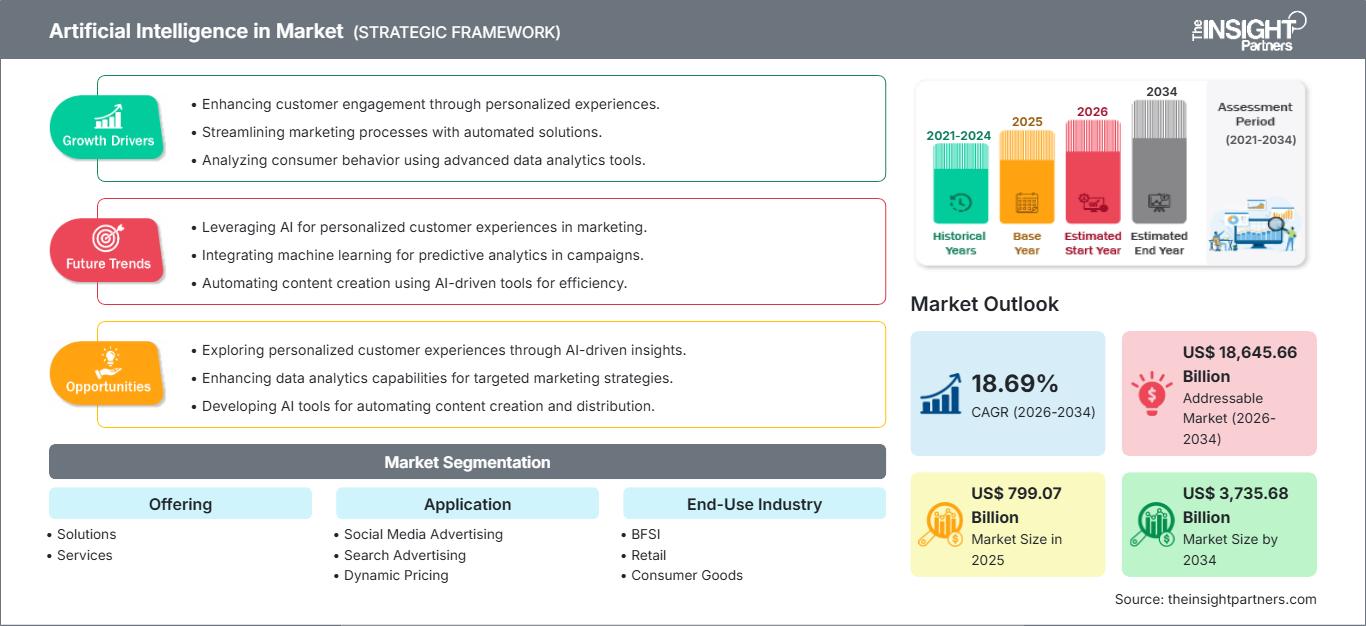
The artificial intelligence in marketing market was valued at US$ 799.07 Billion in 2025 and is projected to reach US$ 3735.68 Billion by 2034, growing at a CAGR of 18.69% during 2026–2034. Enterprise deployment is expanding across advertising, pricing, virtual assistants, sales automation, analytics, and content curation as companies convert large data assets into faster commercial decisions.
North America remains the leading adoption hub as hyperscale cloud infrastructure, large advertising budgets, advanced analytics teams, and strong enterprise software spending support scaled deployment. The artificial intelligence in marketing market size is also supported by high generative AI experimentation, data center investment, and demand for measurable productivity improvement across BFSI, retail, media, entertainment, and consumer goods.
Artificial Intelligence in Marketing Market Assessment and Insights
- North America held a 35–38% share in 2025 and is growing at a CAGR range of 17.5–19.5% during 2026–2034, supported by cloud AI platforms, digital advertising depth, and strong enterprise automation spending.
- US represented 78–82% of North America in 2025 and is growing at a CAGR range of 18.0–20.0%, led by hyperscalers, analytics vendors, and AI-enabled marketing technology adoption.
- Europe accounted for a 24–27% share in 2025 and is growing at a CAGR range of 16.0–18.0%, with the UK, Germany, France, Italy, and Spain advancing regulated enterprise AI use.
- Asia Pacific captured a 29–32% share in 2025 and is growing at a CAGR range of 20.0–22.5%, led by China, Japan, South Korea, India, and Australia.
- Largest Segment: Solutions held a 61–64% market share in 2025 and is growing at a CAGR range of 18.0–20.0%, reflecting demand for packaged AI platforms and business applications.
- High Growth Segment: Virtual Assistant held a 14–17% market share in 2025 and is growing at a CAGR range of 22.5–25.0%, supported by conversational commerce and service automation.
- Key companies analyzed in detail: Affectiva, Appier Inc., Bidalgo, Amplero Inc., CognitiveScale, SAS Institute Inc., SAP SE, Salesforce, Inc., Oracle Corporation, IBM Corporation, Amazon Web Services, Inc., Adobe Inc., Accenture plc, Microsoft Corporation, and Xilinx, Inc.
Source: The Insight Partners' analysis based on proprietary research, government publications, company annual reports, investor presentations, industry databases, and expert interviews.
The current approach of adoption has moved away from rule-based automation to systems that utilize machine learning, natural language processing, recommendation algorithms, and generative interfaces. The change is seen in marketing, finance, content management, customer service, and analytics processes. Organizations are viewing AI as infrastructure technology since models are used to optimize campaigns, demand prediction, automated customer service, and content personalization.
Future demand will depend on ethical AI governance, model explainability, data privacy, and cloud costs. Emerging markets are increasing their adoption of digital commerce, mobile payments, and analytics, whereas mature markets are scaling AI agents for knowledge work. Investments will keep flowing into platforms that are integrated with corporate data, advertising, customer records, and decision-making processes without developing isolated AI enclaves.
Artificial Intelligence in Marketing Market Report Scope
| Report Attribute | Details |
|---|---|
| Market size in 2025 | US$ 799.07 Billion |
| Market Size by 2034 | US$ 3,735.68 Billion |
| Global CAGR (2026 - 2034) | 18.69% |
| Historical Data | 2021-2024 |
| Forecast period | 2026-2034 |
Artificial Intelligence in Marketing Market Analysis
Demand is increasing because enterprises need faster ways to interpret customer, transaction, media, and operational data. Artificial intelligence in marketing market growth is supported by advertising optimization, customer segmentation, dynamic pricing, and predictive analytics. Stanford HAI’s 2025 AI Index reported that business use of AI rose sharply in 2024, reinforcing a structural shift from experimentation to operational deployment.
The value chain includes AI infrastructure providers, cloud platforms, enterprise software vendors, analytics specialists, agencies, and industry users. Artificial intelligence in marketing market analysis shows that value is moving toward integrated platforms that combine data ingestion, model development, deployment, monitoring, and workflow automation. Buyers want measurable outcomes such as higher conversion, lower service cost, faster content cycles, better credit insights, and reduced manual decision effort.
Competition depends on global cloud and enterprise software providers, as well as artificial intelligence companies. Microsoft Corporation, Amazon Web Services, Inc., IBM Corporation, Oracle Corporation, SAP SE, Salesforce, Inc., Adobe Inc., and Accenture plc provide solutions for comprehensive enterprise transformation, whereas Appier Inc., Affectiva, Bidalgo, Amplero Inc., CognitiveScale, SAS Institute Inc., and Xilinx, Inc. offer analytics services, emotional AI, advertising intelligence, and fast computing capabilities.
Current focus areas include AI agents, tools for responsible AI, domain analytics, and retail media automation. The companies are aligning around themes of trust, integration, performance, and vertical specialization. Moreover, enterprises also employ the help of the service partner to redesign processes since AI success depends on data quality, user adoption, governance, and alignment with business goals instead of model performance alone.
● REPORT CUSTOMIZATION
Tailor This Report To Align With Your Specific Business Requirements
This report can be customized to align precisely with your business objectives, scope, and target markets. Customization options include tailored segmentation, geography, competitive analysis, and strategic insights to support informed decision-making.
Customize This Report →WHAT YOU CAN ADJUST
- ● Segmentations
- ● Geography
- ● Competitive Analysis
- ● Language Preferences
Artificial Intelligence in Marketing Market: Strategic Insights
Regional Insights
North America artificial intelligence in marketing market
North America held a 35–38% share in 2025 and is projected to grow at a CAGR range of 17.5–19.5% during 2026–2034. The artificial intelligence in marketing market share is supported by high cloud spending, strong venture capital activity, advanced marketing technology use, and early enterprise adoption of generative models. BFSI, retail, consumer goods, media, and entertainment companies use AI to improve pricing, customer targeting, campaign efficiency, and service automation.
Regional growth also benefits from a concentration of hyperscalers, semiconductor suppliers, analytics vendors, and consulting firms. The U.S. and Canada are investing in data centers, model governance, and sector-specific AI applications. Buyers are prioritizing measurable productivity savings, better personalization, fraud reduction, and faster content workflows while facing scrutiny over privacy, bias, and model transparency.
U.S. artificial intelligence in marketing market
The U.S. represented 78–82% of North America in 2025 and is expected to grow at a CAGR range of 18.0–20.0%. Large technology organizations deliver the most robust platform foundation, with advertisers, banks, retailers, and media companies sponsoring extensive deployments. Microsoft Corporation, Amazon Web Services, Inc., Oracle Corporation, IBM Corporation, Adobe Inc., Salesforce, Inc., and Accenture plc help enterprises deploy by means of cloud-based AI, analytics, CRM, and implementation.
The areas which have seen the highest momentum include search advertising, social media advertising, dynamic pricing, virtual assistants, and sales automation. Another factor in favor of this country is its high private AI spending and rapid deployment of AI assistants for knowledge work. Nevertheless, procurement departments require proof of security, cost management, data lineage, and regulatory compliance to advance pilots to critical business processes.
Europe artificial intelligence in marketing market
Europe held a 24–27% share of the artificial intelligence in marketing market in 2025 and is growing at a CAGR range of 16.0–18.0%. The UK is ahead in media, advertising technologies, fintech, and analytics applications, while Germany focuses more on industrial software, enterprise automation, and governed usage of data. Public investments in AI development in France are backed by digital services and modernized retail. Italy and Spain are increasing usage in consumer goods, marketing automation, banking analytics, and customer support.
European consumers give more importance to explainability, privacy, and compliance of AI technologies, which influences the vendor selection process. SAP SE, Oracle Corporation, IBM Corporation, Microsoft Corporation, Salesforce, Inc., and Accenture plc continue to be relevant due to enterprises' interest in controlled integration with their systems.
APAC artificial intelligence in marketing market
Asia Pacific accounted for a 29–32% share in 2025 and is expected to grow at a CAGR range of 20.0–22.5%. China leads regional deployment through digital platforms, mobile commerce, and algorithmic advertising, while Japan and South Korea focus on customer analytics, content automation, and AI-enabled consumer services. India is scaling AI in BFSI, retail, IT services, and media operations.
Australia contributes through cloud adoption, financial services modernization, and responsible AI programs. Regional growth is supported by large digital populations, payment data, social commerce, and rising enterprise software spending. Local language models, mobile-first engagement, and cost-efficient cloud services are improving adoption across both large enterprises and high-growth digital-native companies.
Middle East & Africa artificial intelligence in marketing market
The Middle East & Africa artificial intelligence in marketing market is projected to grow at a CAGR range of 15.0–17.5% during 2026–2034. The UAE and Saudi Arabia lead demand through digital government, smart cities, retail modernization, and financial sector AI programs. South Africa contributes through banking analytics, telecom data use, and customer service automation.
Growth is developing from infrastructure investment, cloud region expansion, and rising demand for Arabic-language customer engagement tools. Adoption remains uneven because data readiness, skills availability, and integration maturity vary across countries. Managed services, consulting support, and cloud-based solutions are therefore important for scaling AI adoption beyond early flagship programs.
Segmentation Analysis
Offering
Offering is expected to grow at a CAGR range of 18.0–20.0% during 2026–2034. Artificial intelligence in marketing market scope across offerings is expanding as companies combine ready-to-deploy platforms with advisory, integration, governance, and managed services to operationalize AI across marketing, analytics, pricing, and customer functions.
- Solutions dominate because enterprises need software platforms for campaign optimization, virtual assistance, analytics, pricing, personalization, and content workflows that can be embedded into existing systems.
- Services support adoption by helping firms prepare data, configure models, redesign workflows, monitor performance, train users, and manage responsible AI requirements across regulated sectors.
Application
Application is projected to grow at a CAGR range of 18.5–20.5% during 2026–2034. The strongest use cases are linked to revenue optimization, marketing efficiency, customer service, and analytics productivity, where AI can deliver measurable improvements across digital and omnichannel businesses.
- Social Media Advertising uses AI to segment audiences, optimize creative, predict engagement, and manage bidding strategies across platforms with rapidly changing consumer attention patterns.
- Search Advertising applies AI to keyword strategy, bidding, conversion prediction, and ad relevance, helping marketers improve return on spend in competitive search environments.
- Dynamic Pricing uses demand signals, inventory, competitor pricing, and customer behavior to adjust prices more responsively while protecting margin and conversion performance.
- Virtual Assistant adoption is rising as businesses automate service, product discovery, onboarding, internal support, and sales assistance through conversational AI and increasingly capable agentic workflows.
- Content Curation helps media, entertainment, retail, and consumer brands recommend relevant assets, personalize feeds, and organize large content libraries for higher engagement.
- Sales & Marketing Automation uses AI to score leads, personalize outreach, trigger campaigns, draft content, and prioritize sales actions based on customer intent data.
- Analytics Platform solutions convert structured and unstructured data into forecasts, dashboards, anomaly alerts, and decision support for business teams without extensive manual analysis.
End-Use Industry
End-Use Industry is expected to grow at a CAGR range of 17.5–19.5% during 2026–2034. Adoption is broad because AI supports both revenue growth and operating efficiency across banking, retail, consumer brands, media, and entertainment companies facing intense digital competition.
- BFSI uses AI for fraud detection, risk scoring, customer service, personalized offers, regulatory workflows, and analytics that improve speed and consistency in financial decision-making.
- Retail applies AI to demand forecasting, personalization, inventory decisions, pricing, loyalty engagement, and virtual assistance across online and store-linked shopping journeys.
- Consumer Goods companies use AI for brand analytics, promotion planning, consumer insight generation, supply-demand coordination, and personalized digital marketing.
- Media organizations rely on AI for content recommendation, audience segmentation, advertising optimization, newsroom support, and subscription retention across fragmented digital channels.
- Entertainment uses AI for content discovery, fan engagement, production support, audience prediction, and personalized experiences across streaming, gaming, and live-event ecosystems.
Opportunity Snapshot
| Application | Revenue Contribution | Trend Tag | Adoption Stage |
| Social Media Advertising | High | Creative AI | Mature |
| Search Advertising | High | Bid Intelligence | Mature |
| Dynamic Pricing | Medium | Margin Signals | Scaling |
| Virtual Assistant | High | Agentic Service | Scaling |
| Content Curation | Medium | Feed Personalization | Scaling |
| Sales & Marketing Automation | High | Pipeline AI | Mature |
| Analytics Platform | High | Decision Intelligence | Mature |
Artificial Intelligence in Marketing Market Growth Drivers and Impact Analysis
Enterprise Shift Toward AI-Driven Decision Automation
Organizations are employing AI to make decision-making a process not bound by reporting cycles but rather continuous and data-driven. The marketing department applies models for testing audiences, tuning campaigns, and suggesting different creatives, whereas the finance and retail departments employ AI for fraud detection, pricing, and changes in demand. This speeds up the decision-making process and requires less manual analysis. The biggest effect of AI adoption comes with data already existing in sufficient amounts for its employment.
Expansion of Cloud AI Infrastructure
Lowering Deployment Barriers: Cloud Platforms Offer Model Building Tools, Data Pipelines, Security Controls, and AI Services
This is important since many organizations cannot develop their own AI infrastructure. There is a shift towards bundling features such as virtual assistants, analytics, content generation, and sales automation by hyperscalers and enterprise software companies. The importance of this trend lies in expanding AI adoption to organizations that are not tech-savvy and do not have large specialist teams.
Rising Pressure to Personalize Digital Engagement
Consumers and business buyers seek relevance, speed, and consistency through digital marketing interactions. In this respect, AI comes to the rescue because it analyzes consumer behaviors and predicts intent much better than humans can do manually. This has been seen in areas like social media marketing, search engine marketing, loyalty programs, recommendations on streaming services, and service bots. Personalization done right helps businesses get higher conversion and retention rates; but if not, it might turn into a privacy issue for consumers.
Artificial Intelligence in Marketing Market Future Trends
Agentic AI Across Commercial Workflows
Artificial intelligence in marketing market trends are moving toward agents that complete multi-step business tasks rather than simply answering questions. These systems will brief marketers, recommend pricing actions, prepare campaign drafts, analyze customer churn, and create follow-up tasks within CRM and analytics platforms. Human approval will remain essential, but routine execution is expected to become increasingly automated. Vendors that combine permissions, audit trails, workflow integration, and domain-specific logic will be better positioned than solutions that offer only standalone generative interfaces, making agentic AI a key focus area within evolving market trends.
Governed AI Platforms for Regulated Industries
The regulated industries would look for more explainable, secure, monitorable and documented AI platforms. BFSI, consumer goods, and media enterprises would be looking for solutions that would be capable of handling personalization and automation, while maintaining documentation about data usage and avoiding any kind of bias. Such a trend would compel the vendors to integrate governance features in their analytics, advertisement and virtual assistants solutions.
Artificial Intelligence in Marketing Market Opportunities
AI Modernization for Marketing and Revenue Teams
Artificial intelligence in marketing market forecasts indicate expanding opportunities as marketing and sales teams modernize fragmented technology ecosystems. Many organizations continue to manage search advertising, social media campaigns, content planning, CRM-based lead scoring, and performance analytics across disconnected platforms. Vendors can capture demand by offering unified AI workflows that connect audience insight, content generation, campaign optimization, and performance reporting. The opportunity is strongest where companies need faster experimentation but must also maintain brand control, privacy compliance, and measurable return on marketing spend.
Vertical AI Solutions for BFSI and Retail
BFSI and retail create strong opportunities because both sectors combine large data volumes with measurable commercial outcomes. Banks need fraud detection, advisory support, customer analytics, and compliance automation. Retailers need pricing, inventory forecasting, personalization, and service automation. Vendors that package industry-specific models, connectors, dashboards, and governance controls can shorten implementation cycles. This approach reduces buyer risk because solutions arrive closer to operational requirements than generic AI platforms.
Frequently Asked Questions

- Comprehensive Market Sizing and Forecast Analysis
- Detailed Segmentation Analysis
- In-Depth Market Dynamics Assessment
- Regional and Country-Level Insights
- Competitive Landscape and Company Benchmarking
- Strategic Business Intelligence
Recent Reports
Testimonials

The Insight Partners' SCADA System Market report is comprehensive, with valuable insights on current trends and future forecasts. The team was highly professional, responsive, and supportive throughout. We are very satisfied and highly recommend their services.
RAN KEDEM Partner, Reali Technologies LTDs
I requested a report on a very specific software market and the team produced the report in a few days. The information was very relevant and well presented. I then requested some changes and additions to the report. The team was again very responsive and I got the final report in less than a week.
JEAN-HERVE JENN Chairman, Future Analytica
We worked with The Insight Partners for an important market study and forecast. They gave us clear insights into opportunities and risks, which helped shape our plans. Their research was easy to use and based on solid data. It helped us make smart, confident decisions. We highly recommend them.
PIYUSH NAGPAL Sr. Vice President, High Beam Global
The Insight Partners delivered insightful, well-structured market research with strong domain expertise. Their team was professional and responsive throughout. The user-friendly website made accessing industry reports seamless. We highly recommend them for reliable, high-quality research services
YUKIHIKO ADACHI CEO, Deep Blue, LLC.
This is the first time I have purchased a market report from The Insight Partners.While I was unsure at first, I visited their web site and felt more comfortable to take the risk and purchase a market report.I am completely satisfied with the quality of the report and customer service. I had several questions and comments with the initial report, but after a couple of dialogs over email with their analyst I believe I have a report that I can use as input to our strategic planning process.Thank you so much for taking the extra time and making this a positive experience.I will definitely recommend your service to others and you will be my first call when we need further market data.
JOHN SUZUKI President and Chief Executive Officer, Board Director, BK Technologies
I wish to appreciate your support and the professionalism you displayed in the course of attending to my request for information regarding to infectious disease IVD market in Nigeria. I appreciate your patience, your guidance, and the fact that you were willing to offer a discount, which eventually made it possible for us to close a deal. I look forward to engaging The Insight Partners in the future, all thanks to the impression you have created in me as a result of this first encounter.
DR CHIJIOKE ONYIA MANAGING DIRECTOR, PineCrest Healthcare Ltd.Reason to Buy
- Informed Decision-Making
- Understanding Market Dynamics
- Competitive Analysis
- Identifying Emerging Markets
- Customer Insights
- Market Forecasts
- Risk Mitigation
- Boosting Operational Efficiency
- Strategic Planning
- Investment Justification
- Tracking Industry Innovations
- Aligning with Regulatory Trends





 Get Free Sample for