Automotive Chassis Market Size & Overview
The automotive chassis market was valued at US$ 52.27 billion in 2025 and is projected to reach US$ 68.94 billion by 2034, registering a CAGR of 3.12% during 2026–2034. The market is supported by increasing vehicle production, continuous advancements in lightweight structural engineering, and rising integration of high-strength materials that improve vehicle safety, handling, and fuel efficiency. Growing investments in electric and hybrid vehicle platforms are further influencing chassis design and manufacturing technologies.
North America continues to represent a technologically advanced market driven by established automotive manufacturing capabilities and increasing investments in electric mobility platforms. The region is expected to record a CAGR of 2.8–3.3% during 2026–2034, supported by demand for lightweight vehicle structures, stricter fuel-efficiency regulations, and growing adoption of modular chassis architectures across passenger and commercial vehicles. The automotive chassis market size in North America also benefits from continuous innovation in advanced materials and precision manufacturing technologies.
Growing global vehicle production and rising consumer preference for safer, lighter, and more fuel-efficient vehicles remain key contributors to industry expansion. Manufacturers continue investing in advanced structural engineering solutions capable of reducing vehicle weight while maintaining crash performance and durability. Consequently, the automotive chassis market growth is supported by increasing electric vehicle production, stricter emission regulations, and higher adoption of modular vehicle architectures that simplify manufacturing while improving design flexibility. The demand sector also stands to gain due to the growth in the number of commercial vehicle and premium passenger car fleets being produced in both developed and developing nations. On the supply side, there is constant evolution in the form of increased localization, automation, and cooperation between raw material suppliers and original equipment manufacturers. The use of high-strength steel, aluminum alloys, and composites increases efficiency and supports sustainability efforts.
Competition remains intense as leading manufacturers pursue product innovation, strategic partnerships, and manufacturing expansion to strengthen market positioning. The automotive chassis market analysis highlights the continued leadership of Magna International Inc., ZF Friedrichshafen AG, Continental AG, BENTELER International AG, Schaeffler AG, CIE Automotive S.A., and Aisin Corporation in developing lightweight chassis technologies, integrated suspension systems, and modular vehicle platforms. Their investments in advanced manufacturing capabilities continue shaping competitive differentiation across global automotive markets. The investment strategies will be centered on issues such as electrification, lightweight construction, intelligent manufacturing, and sustainable manufacturing. There is a partnership between automotive manufacturers and technology and parts suppliers in the development of scalable chassis systems for different types of vehicles, but at reduced manufacturing costs. Such strategic plans are likely to bring increased operational efficiency and growth in the market over time.
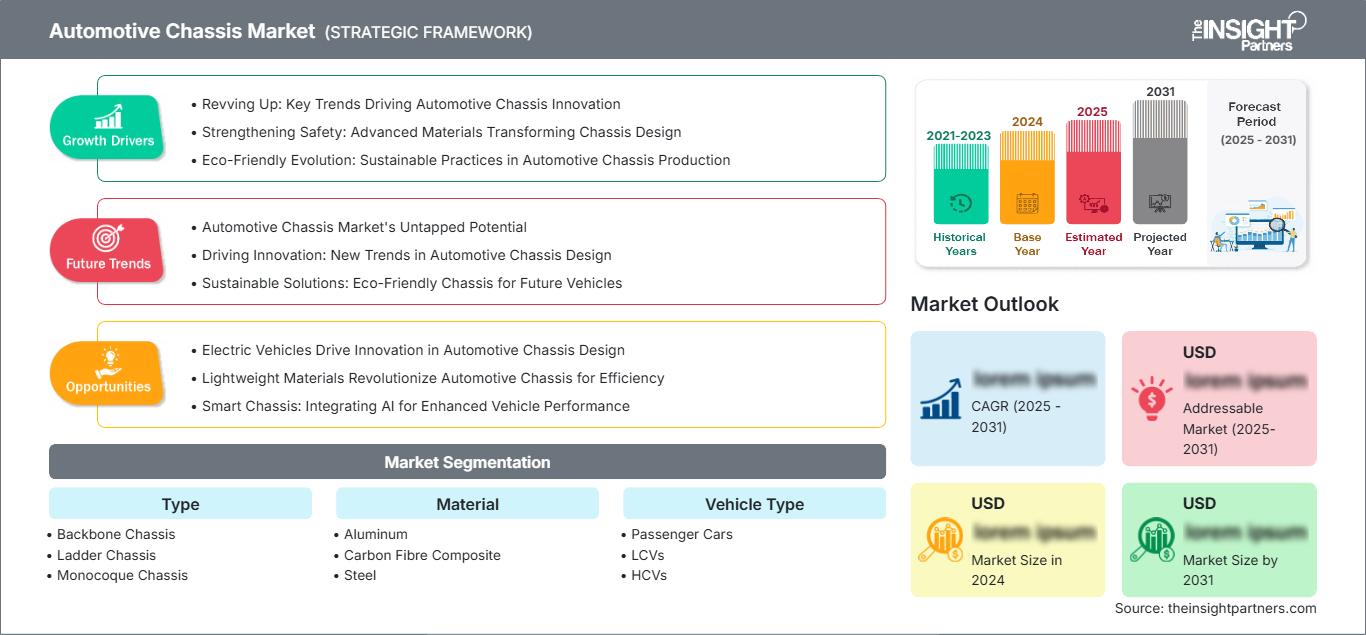
Automotive Chassis Market Assessment and Insights
- North America: North America accounted for 31–35% share in 2025 and is anticipated to expand at a CAGR of 2.8–3.3% during 2026–2034. Strong automotive manufacturing capacity, high adoption of advanced vehicle platforms, and investments in lightweight structural technologies continue supporting regional market development.
- US: The U.S. represented 76–80% of the North American market in 2025 and is forecast to grow at a CAGR of 2.9–3.4% during 2026–2034, driven by increasing production of electric vehicles, technological innovation, and expansion of domestic manufacturing facilities.
- Europe: Europe held 27–31% share in 2025 and is expected to register a CAGR of 2.7–3.2% during 2026–2034. Germany, France, Italy, and the UK remain leading contributors owing to advanced automotive engineering, premium vehicle production, and stringent safety regulations.
- Asia Pacific: Asia Pacific captured 33–37% share in 2025 and is projected to record the fastest growth with a CAGR of 3.8–4.3% during 2026–2034. China, Japan, South Korea, and India continue expanding vehicle production while accelerating investments in electric vehicle manufacturing.
- Largest Segment: Monocoque Chassis accounted for a market share of 58–62% in 2025 and is projected to expand at a CAGR of 3.3–3.8% during 2026–2034, supported by widespread adoption in passenger vehicles because of superior structural rigidity and weight reduction.
- High Growth Segment: Aluminum represented 22–26% market share in 2025 and is expected to grow at a CAGR of 4.6–5.1% during 2026–2034, driven by vehicle lightweighting initiatives and increasing adoption across electric vehicle platforms.
- Key companies analyzed in detail: Aisin Corporation, AL-KO Vehicle Technology Group, BENTELER International AG, CIE Automotive S.A., Continental AG, Hyundai Motor Company, Magna International Inc., Schaeffler AG, Tower International, ZF Friedrichshafen AG.
Source: The Insight Partners' analysis based on proprietary research, government publications, company annual reports, investor presentations, industry databases, and expert interviews.
Automotive Chassis Market Trends
Adoption of Intelligent Modular Chassis Platforms
Vehicle manufacturers are increasingly developing intelligent modular chassis platforms capable of supporting conventional, hybrid, and battery-electric powertrains within a single architecture. The automotive chassis market trends indicate growing emphasis on scalable vehicle platforms that simplify manufacturing, improve production flexibility, and accelerate new model launches. Integration of digital engineering, structural optimization software, and advanced manufacturing automation will further improve chassis performance while reducing development costs. These innovations are expected to reshape global automotive production throughout the forecast period.
Advanced Material Integration Across Vehicle Platforms
Manufacturers are progressively integrating aluminum alloys, ultra-high-strength steel, and composite materials into chassis production to improve crash performance, reduce vehicle mass, and increase energy efficiency. Hybrid material construction methods enable engineers to optimize structural strength while minimizing manufacturing complexity. Continued advances in joining technologies, material processing, and digital simulation are expected to expand the commercial adoption of multi-material chassis systems across passenger cars, commercial vehicles, and electric mobility platforms.
Automotive Chassis Market Growth Factors
Increasing Production of Electric and Hybrid Vehicles
The world's shift towards the development of electric and hybrid cars is having a substantial impact on chassis development and production approaches. For battery electric vehicles, specific chassis platforms are needed that can accommodate the batteries without sacrificing structural strength and crash performance. Companies have been making efforts to use skateboard chassis platforms, modularity, and lightweight structural parts in order to optimize the range and energy efficiency. The governments of North America, Europe, and the Asia Pacific regions continue supporting the development of electric cars via emission policies, incentive programs, and the building of charging infrastructure. As automobile companies continue growing their lineups of electrically driven cars, there will be an increasing demand for chassis platforms using aluminum alloys, advanced high-strength steels, and composite materials.
Growing Demand for Lightweight Materials and Fuel-Efficient Vehicles
Vehicle manufacturers keep emphasizing the importance of lightweight automobile design to meet fuel economy and carbon emissions standards. Automotive chassis systems made from aluminum, high-strength steel, and carbon fiber composites enable manufacturers to produce lightweight vehicles without compromising structural strength and passenger safety. Lightweight design enables better acceleration, brake performance, and improved battery life in electric vehicles, thereby providing value to manufacturers and customers in the long run. Material providers are developing processes that not only enhance the ease of manufacturing but also cut down on costs. At the same time, vehicle platforms are being designed to incorporate various types of propulsion systems without making any changes to the basic structure.
Expansion of Modular Vehicle Platform Manufacturing
Global automotive manufacturers increasingly utilize modular chassis architectures capable of supporting multiple vehicle models across different body styles and propulsion systems. Platform standardization reduces engineering complexity, shortens product development cycles, and lowers manufacturing costs through greater component commonality. Flexible chassis designs also enable faster adaptation to changing consumer preferences and regulatory requirements. Investments in automated welding, digital engineering, robotic manufacturing, and simulation-based design continue improving production efficiency while enhancing product quality. Suppliers are strengthening collaboration with original equipment manufacturers to deliver scalable structural solutions that improve manufacturing flexibility and optimize lifecycle costs. Continued expansion of modular vehicle platforms is expected to remain a fundamental driver supporting long-term market development.
________________________________________
Automotive Chassis Market Opportunities
Expansion of Localized Manufacturing for Electric Vehicle Platforms
Increasing regional investment in electric vehicle production presents substantial opportunities for chassis manufacturers to establish localized engineering and manufacturing facilities. The automotive chassis market Forecasts suggest that Asia Pacific, North America, and selected European countries will continue expanding dedicated electric vehicle production capacity during the forecast period. Suppliers capable of delivering lightweight modular chassis systems, integrated battery support structures, and scalable manufacturing solutions will strengthen long-term competitive positioning. Strategic partnerships with automakers, investments in advanced manufacturing technologies, and localized supply chains are expected to improve production efficiency while reducing logistics costs and supporting regional industrial development.
Development of Sustainable High-Performance Structural Materials
Growing environmental expectations are creating opportunities for manufacturers to develop recyclable, lightweight, and high-strength structural materials suitable for next-generation vehicle platforms. Continued innovation in aluminum processing, advanced steel manufacturing, and composite material technologies enables chassis suppliers to improve structural performance while reducing environmental impact. Companies investing in sustainable production methods, closed-loop recycling systems, and energy-efficient manufacturing facilities can strengthen relationships with automotive manufacturers seeking to achieve carbon reduction targets. These technological advancements are expected to create new revenue opportunities while supporting long-term competitiveness across the global automotive industry.
Segmentation Analysis
Type
The Type segment of the automotive chassis market is expected to expand at a CAGR of 3.3–3.8% during 2026–2034. Vehicle manufacturers continue prioritizing chassis architectures that improve structural rigidity, occupant safety, manufacturing flexibility, and compatibility with electrified powertrains. Continuous advancements in modular engineering and lightweight construction technologies are accelerating adoption across passenger and commercial vehicles. The automotive chassis market scope continues to widen as manufacturers develop scalable platforms capable of supporting multiple vehicle models while reducing production complexity and development costs.
- Backbone Chassis – Backbone chassis continue serving niche passenger cars and specialty vehicles where torsional rigidity and simplified structural design are advantageous. Their compact configuration enables efficient drivetrain integration while maintaining adequate structural performance.
- Ladder Chassis – Ladder chassis remain widely utilized in heavy commercial vehicles, pickup trucks, buses, and off-road vehicles because of superior load-carrying capability, durability, and ease of repair under demanding operating conditions.
- Monocoque Chassis – Monocoque chassis dominate passenger vehicle manufacturing due to excellent strength-to-weight characteristics, enhanced crash performance, improved fuel efficiency, and greater flexibility for integrating electric vehicle battery systems.
- Modular Chassis – Modular chassis are increasingly adopted by global automakers to support multiple vehicle platforms using standardized components, reducing manufacturing costs while improving production efficiency and accelerating new model development.
Material
The Material segment of the automotive chassis market is anticipated to register a CAGR of 3.7–4.2% during 2026–2034. Increasing regulatory focus on emission reduction and vehicle efficiency is encouraging manufacturers to replace conventional materials with lightweight alternatives. Material selection has become a strategic factor influencing crash safety, manufacturing efficiency, durability, corrosion resistance, and electric vehicle driving range.
- Aluminum – Aluminum continues gaining significant adoption owing to its lightweight properties, corrosion resistance, and ability to improve fuel economy and battery efficiency. Premium vehicles and electric vehicle platforms increasingly incorporate aluminum-intensive chassis structures.
- Carbon Fibre Composite – Carbon fiber composite materials are primarily utilized in high-performance, luxury, and premium electric vehicles where exceptional strength-to-weight ratios justify higher manufacturing costs and deliver improved vehicle dynamics.
- Steel – Advanced high-strength steel remains the most extensively used chassis material because of its affordability, proven manufacturing processes, high structural integrity, and excellent crash energy absorption characteristics across multiple vehicle categories.
Vehicle Type
The Vehicle Type segment is projected to grow at a CAGR of 3.1–3.6% during 2026–2034. Expanding global vehicle production, increasing electrification, and evolving safety regulations continue driving demand for advanced chassis systems across passenger and commercial transportation. Manufacturers are developing application-specific chassis platforms to satisfy varying performance, payload, and efficiency requirements.
- Passenger Cars – Passenger cars represent the largest demand category due to high global production volumes, continuous lightweighting initiatives, and increasing adoption of modular chassis architectures designed for conventional, hybrid, and battery-electric vehicles.
- LCVs – Light commercial vehicles increasingly utilize lightweight yet durable chassis designs to improve payload capacity, fuel efficiency, and operational reliability for logistics, e-commerce delivery, and urban transportation applications.
- HCVs – Heavy commercial vehicles require reinforced chassis structures capable of supporting substantial payloads under demanding operating conditions while meeting evolving safety, durability, and emission compliance requirements.
Opportunity Snapshot
| Vehicle Type | Revenue Contribution | Trend Tag | Adoption Stage |
|---|---|---|---|
| Passenger Cars | High | EV Platforms | Mature |
| LCVs | Medium | Urban Logistics | Scaling |
| HCVs | Medium | Fleet Modernization | Scaling |
Regional Insights
North America Automotive Chassis Market
North America accounted for 31–35% of the automotive chassis market share in 2025 and is projected to expand at a CAGR of 2.8–3.3% during 2026–2034. The area also enjoys a highly developed industry of car manufacturing, large-scale production of electric cars, and frequent utilization of new lightweight chassis. The growing number of regulations in terms of fuel efficiency and safety requires manufacturers to introduce modular chassis designs based on aluminum and steel. The growing volume of electric trucks, SUVs, and commercial vehicles is also stimulating a rise in demand for new chassis design solutions to integrate batteries into car structures.
Together, the United States, Canada, and Mexico reinforce the region’s manufacturing by implementing the automobile manufacturing chain and having well-established production lines of parts. Investments in automation in the area of welding, assembly and application of digital manufacturing technologies constantly contribute to improvements in productivity and product quality. The main suppliers in the region have engineering design centers in this part of the world and can quickly develop the latest generation chassis solutions.
U.S. Automotive Chassis Market
The U.S. represented 76–80% of the North American automotive chassis market in 2025 and is expected to register a CAGR of 2.9–3.4% during 2026–2034. Rising production of electric vehicles, premium passenger cars, and light commercial vehicles continues driving investments in lightweight chassis technologies. Automotive manufacturers increasingly adopt modular vehicle platforms capable of supporting multiple vehicle configurations while reducing manufacturing complexity and improving cost efficiency. Demand is further strengthened by federal initiatives promoting domestic manufacturing and advanced transportation technologies.
Major firms such as Magna International Inc., ZF Friedrichshafen AG, Continental AG, and Aisin Corporation keep on enhancing their engineering capacity and manufacturing footprint in the United States. The use of high-strength steel, aluminum alloys, and automated manufacturing systems enhances the structure’s performance but reduces its weight. Cooperation among automobile manufacturers and suppliers drives innovations in the development of integrated chassis systems for conventional and electric cars.
Europe Automotive Chassis Market
Europe accounted for 27–31% of the global automotive chassis market in 2025 and is anticipated to expand at a CAGR of 2.7–3.2% during 2026–2034. Germany remains the regional leader owing to its advanced automotive manufacturing ecosystem, premium vehicle production, and strong engineering expertise. The region continues benefiting from stringent vehicle safety standards, carbon emission reduction targets, and increasing investment in electric mobility platforms that require lightweight chassis architectures.
UK has been making continuous efforts toward the development of production in electric vehicles, engineering research, and lightweight structure technologies. Cooperation between automotive manufacturers and suppliers promotes innovation in modular chassis designs that are suitable for use in passenger cars and commercial vehicles.
German region retains its leading position thanks to the highest engineering capacity, manufacturing technology, and presence of global automotive suppliers. Investment in the manufacturing of aluminum-based chassis and the use of intelligent manufacturing systems improve the competitiveness of the region and help produce luxury cars and electric mobility vehicles.
France, Italy, and Spain contribute together to regional development through vehicle manufacturing, modernization of production facilities, and increasing demand for fuel-efficient vehicles. Government policies promoting low-emission vehicles and innovation in the industry continue to stimulate the usage of advanced chassis technologies in domestic automotive manufacturers.
APAC Automotive Chassis Market
Asia Pacific captured 33–37% of the global automotive chassis market in 2025 and is projected to register the highest regional growth at a CAGR of 3.8–4.3% during 2026–2034. China remains the largest regional market because of its extensive vehicle manufacturing capacity, rapid electric vehicle adoption, and continuous expansion of automotive production facilities.
Japan, South Korea, India, and Australia continue supporting regional expansion through investments in advanced manufacturing, lightweight material adoption, and vehicle platform innovation. Favorable industrial policies, expanding domestic demand, and increasing exports of passenger and commercial vehicles further reinforce long-term market development.
Middle East & Africa Automotive Chassis Market
The Middle East & Africa automotive chassis market is expected to register a CAGR of 3.0–3.5% during 2026–2034, supported by increasing vehicle assembly activities, infrastructure investments, and expanding automotive component manufacturing. Saudi Arabia continues to be the leading market, while the UAE and South Africa follow behind, with their industrial diversification strategies still supporting the growth of the automotive industry.
Increased investment in transportation systems, logistics, and industrial zones boosts the demand for commercial and passenger cars in the region. Increased local assembly of vehicles and industrial localization policies are anticipated to increase the production of chassis during the forecast period.
Automotive Chassis Market Report Scope
| Report Attribute | Details |
|---|---|
| Market size in 2025 | US$ 52.27 Billion |
| Market Size by 2034 | US$ 68.94 Billion |
| Global CAGR (2026 - 2034) | 3.12% |
| Historical Data | 2021-2024 |
| Forecast period | 2026-2034 |
| Segments Covered | Type, Material, Vehicle Type |
| Region scope | North America, Europe, Asia-Pacific, South and Central America, Middle East and Africa |
Frequently Asked Questions

Recent Reports






