
Industrial Coatings Market Size, Trends & Demand by 2034
Coverage: By Resin (Acrylic, Alkyd, Polyurethane, Epoxy, Polyester, and Others), Technology (Solvent-Borne, Water-Borne, Powder, and Others), End-User Industry (Aerospace, Automotive and Transportation, Consumer Durables, General Industrial, Marine, and Others)
- Status : Data Released
- Report Code : TIPRE00003682
- Category : Chemicals and Materials
- No. of Pages : 150
- Available Report Formats :


- Last update date : August 27, 2026


2025 Market Size
US$ 119.52 Bn
Base year value
2034 Forecast
US$ 145.91 Bn
Projected by 2034
CAGR 2026-2034
2.53 %
Growth rate
Addressable Market
US$ 1,221.35 Bn
(2026-2034)
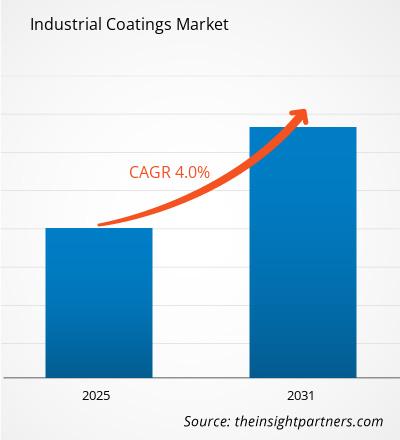
The industrial coatings market was valued at US$ 119.52 Billion in 2025 and is projected to reach US$ 145.91 Billion by 2034, expanding at a CAGR of 2.53% during 2026–2034. The growth is attributed to the continuous demand for protection from corrosion, durability, process efficiencies, and appearance in industrial manufacturing, transportation, energy, and infrastructure applications, while the trend toward the adoption of low-emission technology is becoming a driving factor in product selection, production processes, and investments.
North America industrial coatings market size continues to be the key regional target for industrial coatings, driven by existing manufacturing capacity, energy infrastructure, aerospace manufacturing, and automotive manufacturing. It is projected that North America will grow at the rate of about 2.2% – 2.6% during 2034.
Industrial Coatings Market Assessment and Insights
- North America: North America is estimated to represent 23–27% share in 2025 and is expected to grow at a CAGR of 2.2–2.6% between 2026–2034, supported by manufacturing modernization, energy infrastructure, aerospace, and transportation applications.
- US: The US accounts for approximately 80–85% of North American demand in 2025 and is expected to grow at a CAGR of 2.1–2.5% through 2034, supported by industrial investment and infrastructure maintenance.
- Europe: Europe represents approximately 24–28% share in 2025 and is projected to expand at a CAGR of 2.0–2.4% through 2034, led by Germany, Italy, France, the UK, and Spain, with sustainability requirements influencing formulation choices.
- Asia Pacific: Asia Pacific holds approximately 42–46% share in 2025 and is expected to grow at a CAGR of 3.0–3.4%, led by China, India, Japan, and South Korea through manufacturing expansion and infrastructure investment.
- Largest Segment: Polyurethane is estimated to hold a 25–29% market share in 2025 and grow at a CAGR of 2.8–3.2%, supported by durability and broad industrial applicability.
- High Growth Segment: Powder coatings are estimated to hold a 12–16% market share in 2025 and grow at a CAGR of 4.0–4.5%, driven by low-emission processing and application efficiency.
- Key companies analyzed in detail: Akzo Nobel N.V., Asian Paints Limited, Axalta Coating Systems, LLC, BASF SE, Hempel A/S, Jotun A/S, Kansai Paint Co., Ltd., Nippon Paint Holdings Co., Ltd., PPG Industries, Inc., The Sherwin-Williams Company
Source: The Insight Partners' analysis based on proprietary research, government publications, company annual reports, investor presentations, industry databases, and expert interviews.
Industrial coatings market have matured into systems that focus on corrosion inhibition, curing rates, substrate compatibility, aesthetics, and lifecycle economics. Choice of resin now incorporates properties of polyurethane, epoxy, acrylic, polyester, and fluoropolymer along with applicability considerations. Dynamics of manufacturing have also begun to move towards solvent-free and powder-based systems balancing performance with the need for VOC control, energy efficiency, worker safety, and higher environmental standards.
The future growth of industrial coatings market is going to be characterized by geographical diversification. Growth in the Asia Pacific region will derive from the development of manufacturing capabilities and infrastructure, whereas modernization and maintenance will be the drivers of growth in North America and Europe. Investment will probably flow into formulation facilities, application equipment, local manufacturing capabilities, and specialty coatings which can comply with strict regulations and high performance standards without significantly increasing lifecycle cost.
Industrial Coatings Market Report Scope
| Report Attribute | Details |
|---|---|
| Market size in 2025 | US$ 119.52 Billion |
| Market Size by 2034 | US$ 145.91 Billion |
| Global CAGR (2026 - 2034) | 2.53% |
| Historical Data | 2021-2024 |
| Forecast period | 2026-2034 |
Industrial Coatings Market Analysis
The industrial coatings market growth is directly related to the state and development of physical assets. Physical assets such as steel structures, machines, vehicles, pipes, tanks, appliances, aircraft parts, and industrial equipment need to be coated for corrosion protection, abrasion resistance, chemical and heat resistance, and weathering protection. This industry includes many stages such as raw material providers, resin, pigment, additive, and solvent providers; formulators, applicators, equipment suppliers, OEMs, contractors, and physical asset owners.
Demand depends on production and maintenance cycle activities. OEMs provide regular specification-driven volumes, while protective coatings are positively affected by infrastructure renewal and asset life extension. Manufacturers are increasingly controlling their supply chains using regional manufacturing facilities, dual sourcing, inventory management, and technical services. Application efficiency is important since efficiency in coating application, curing time, rework, and downtime may significantly impact the cost of the total coat for the customer.
The competing firms in the industrial coatings market report comprise global coating companies as well as regional companies competing based on formulation portfolio, technical services, distribution system, approvals, and application know-how. Akzo Nobel N.V., PPG Industries, Inc., The Sherwin-Williams Company, Axalta Coating Systems, LLC, and BASF SE are characterized by diversified technology portfolio, while Hempel A/S and Jotun A/S dominate the protective coatings segment and marine coatings segments, respectively. Asian Paints Limited, Kansai Paint Co., Ltd., and Nippon Paint Holdings Co., Ltd. have extensive manufacturing and distribution network in Asia.
Focus on investments is moving to differentiated formulation range, capacity localization, digital color and application solutions, as well as technologies that cut down the amount of energy or solvents needed for curing. Competitive positioning is gradually evolving from volume-based to performance-based approach. Finally, recent corporate actions indicate ongoing restructuring of portfolio as well as selective investment into high-value industrial, automotive OEM, packaging, aerospace, powder, and protective coatings applications.
● REPORT CUSTOMIZATION
Tailor This Report To Align With Your Specific Business Requirements
This report can be customized to align precisely with your business objectives, scope, and target markets. Customization options include tailored segmentation, geography, competitive analysis, and strategic insights to support informed decision-making.
Customize This Report →WHAT YOU CAN ADJUST
- ● Segmentations
- ● Geography
- ● Competitive Analysis
- ● Language Preferences
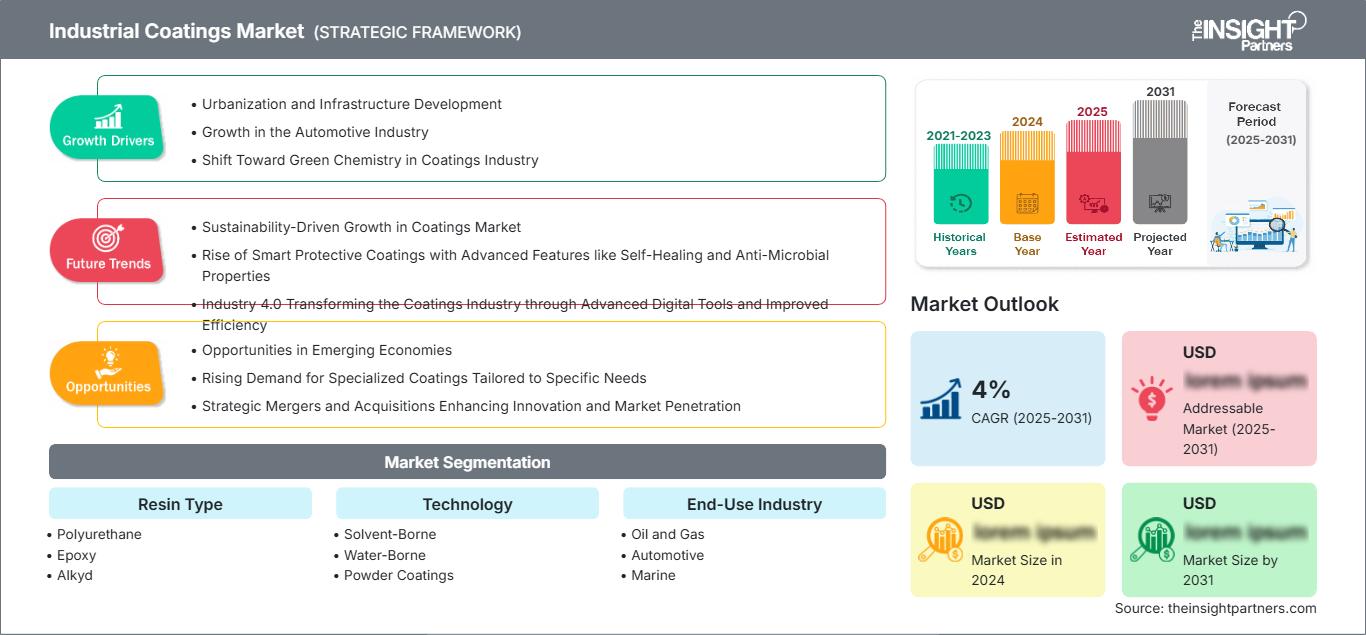
Industrial Coatings Market: Strategic Insights
Regional Insights
North America Industrial Coatings Market
North America is estimated to account for 23–27% of the industrial coatings market share in 2025 and is projected to expand at a CAGR of 2.2–2.6% through 2034. The US represents the dominant regional market, while Canada and Mexico contribute through energy, automotive, machinery, construction equipment, and manufacturing applications. Industrial maintenance remains an important source of recurring demand.
Growth in the region is facilitated through the reshoring and modernizing of manufacturing, the continued production of aircraft, energy infrastructure investments, and the refurbishment of older assets. Environmental compliance is driving the development of low VOC, water borne, powder, high solids, and faster curing technologies. Technical service capabilities and local manufacture will allow suppliers to meet specification, fast turn-around, and performance challenges for diverse industrial end-users.
U.S. Industrial Coatings Market
North American industrial coatings demand from the US constitutes 80–85% of total demand in 2025 and is projected to have a CAGR of 2.1–2.5% up to 2034. Industrial machinery, automotive original equipment manufacturing, aerospace, energy, appliance, and infrastructure maintenance continue to be important end markets, with increased focus on corrosion prevention and process optimization among manufacturers.
PPG Industries, Inc., The Sherwin-Williams Company, Axalta Coating Systems, LLC, and several other global providers have strong market penetration in OEM and industrial end markets. The demand for coatings will be driven by manufacturing investments made by manufacturers locally, replacement of obsolete equipment, and increasing emissions regulations. Industrial users will make decisions based on lifecycle performance, application effectiveness, curing needs, and regulatory issues rather than just cost alone.
Europe Industrial Coatings Market
Europe comprises 24-28% share in 2025, and is expected to grow at a CAGR of 2.0-2.4% until 2034. Germany, Italy, France, the UK, and Spain are the major countries. The industrial demand is driven by automotive manufacturing, machinery, engineering, marine applications, renewable energy equipment, and infrastructure renovation despite mature industrial production constraining growth in volumes.
The UK is a matured market, driven by applications in aerospace, automotive, energy, marine, and infrastructure segments, where increasingly, the need for meeting environmental standards and performance is driving the demand. Germany's strengths are in machinery, automotive, chemicals, and engineering sectors, enabling advanced OEM and protective coating applications. France, Italy, and Spain also generate demand for transportation, industrial equipment, energy, manufacturing of construction applications, and marine applications, with Spain having better growth potential.
APAC Industrial Coatings Market
The APAC region has 42–46% share in 2025, and the region is estimated to experience a CAGR of 3.0–3.4%, making it the largest market geographically. China is still the largest country, whereas India has a higher growth opportunity due to manufacturing localization, infrastructure investments, automotive manufacture, and capacity increases.
Japanese and South Korean regions make their contributions through the automotive, electronics, machinery, shipbuilding, and high-performance manufacturing sectors. Australia's contribution lies in mining, infrastructure, energy, and equipment maintenance sectors. Policy measures by regional governments in favor of local manufacturing and infrastructure development have improved coating consumption, whereas environmental regulations are driving innovations such as water-borne, powder, high-solids, and energy-efficient coatings.
Middle East & Africa Industrial Coatings Market
Middle East & Africa represents a smaller but increasingly specialized opportunity, with the region expected to expand at a CAGR of 3.1–3.6% through 2034. Saudi Arabia is the leading country, followed by the UAE and South Africa, with energy, infrastructure, transportation, desalination, and industrial projects creating protective coating demand.
Saudi Arabia enjoys the advantages of industrial diversification on a big scale and infrastructure projects, whereas UAE is still backed up by energy, maritime, construction, and logistics resources. South Africa is making its contribution in terms of mining industry, manufacturing, transport, and infrastructure maintenance. The rest of the region has to deal with severe climate and corrosion, which makes high-performance coatings, including epoxy, polyurethane, and fluoropolymer paints, valuable.
Segmentation Analysis
Resin Type
Resin Type segment in the industrial coatings market is expected to grow at a CAGR of 2.4–2.8% during 2026–2034. Resin selection is determined by substrate, exposure conditions, curing requirements, durability, appearance, chemical resistance, and application economics. Polyurethane and epoxy remain important for performance-intensive applications, while acrylic, polyester, alkyd, and fluoropolymer systems serve differentiated requirements across OEM and protective markets.
- Polyurethane: Widely selected for durable topcoats where weatherability, appearance, abrasion resistance, and chemical resistance are important. Its broad compatibility supports automotive, machinery, infrastructure, and protective applications requiring long service life.
- Epoxy: Maintains strong industrial relevance because of adhesion, corrosion resistance, chemical resistance, and mechanical durability. Demand remains concentrated in primers, tank linings, flooring, pipelines, machinery, and heavy-duty protective applications.
- Alkyd: Retains a cost-sensitive position in maintenance and general industrial applications because of ease of application, established processing practices, and broad availability, particularly where extreme performance is not required.
- Acrylic: Supports applications requiring fast drying, color retention, weatherability, and aesthetic performance. Its versatility makes it relevant for machinery, transportation, equipment, and selected protective coating systems.
- Polyester: Provides an important platform for powder coatings and industrial finishes where productivity, appearance, and durability are required. Its use is particularly relevant to fabricated metal products, appliances, and equipment.
- Fluoropolymers: Occupy a premium position where exceptional weatherability, chemical resistance, and long-term appearance retention justify higher formulation and application costs, especially for demanding industrial and architectural-adjacent applications.
Technology
Technology segment in the industrial coatings market is projected to expand at a CAGR of 2.8–3.2% during 2026–2034. Technology selection increasingly reflects VOC requirements, application productivity, energy consumption, substrate compatibility, and customer sustainability targets. Water-borne and powder systems are gaining strategic importance, while solvent-borne coatings remain necessary where performance, process conditions, or substrate requirements constrain substitution.
- Solvent-Borne: Remains important for demanding industrial environments because of established application processes, substrate compatibility, film formation, and performance consistency, particularly in protective, machinery, marine, and heavy-duty applications.
- Water-Borne: Gains adoption as manufacturers seek lower VOC emissions and improved workplace conditions. Technology development increasingly addresses drying speed, corrosion protection, substrate adhesion, and performance gaps versus conventional solvent-borne systems.
- Powder Coatings: Represents the fastest-growing technology category because of high transfer efficiency, minimal solvent emissions, strong durability, and suitability for automated manufacturing. Its application base continues expanding across equipment, appliances, automotive components, and fabricated metals.
End-Use Industry
End-Use Industry segment in the industrial coatings market is expected to grow at a CAGR of 2.3–2.7% during 2026–2034. Demand differs considerably by asset intensity, production volumes, maintenance cycles, specification requirements, and regulatory exposure. Automotive and industrial machinery provide large recurring OEM demand, while oil and gas, marine, aerospace, wind turbines, and packaging require specialized performance characteristics.
- Oil and Gas: Requires corrosion, chemical, temperature, and abrasion resistance across pipelines, tanks, processing equipment, offshore assets, and refineries, making protective coating performance central to maintenance economics.
- Automotive: Generates substantial OEM coating demand through vehicle bodies, components, wheels, batteries, and related equipment, with increasing emphasis on efficient curing, durability, appearance, and compatibility with evolving vehicle architectures.
- Marine: Depends heavily on corrosion protection for vessels, ballast tanks, offshore structures, and marine equipment. Long service intervals and difficult maintenance environments increase the importance of high-performance coating systems.
- Wind Turbine: Requires durable systems capable of resisting UV exposure, moisture, erosion, and cyclic mechanical stresses. Expanding renewable-energy assets create demand for specialized blade, tower, and component protection.
- Industrial Machinery: Represents a diversified demand base spanning agricultural equipment, construction machinery, factory equipment, appliances, and fabricated components, with specifications centered on durability, appearance, and efficient production.
- Aerospace: Requires highly engineered coatings meeting stringent performance, weight, corrosion, chemical, and appearance requirements. Qualification cycles and technical specifications create relatively high entry barriers for suppliers.
- Packaging: Uses coatings for metal protection, appearance, functionality, and product compatibility. Demand is increasingly influenced by food-contact requirements, material efficiency, sustainability objectives, and conversion-line productivity.
Opportunity Snapshot
| End-Use Industry | Revenue Contribution | Trend Tag | Adoption Stage |
| Oil and Gas | High | Asset Protection | Mature |
| Automotive | High | EV Platforms | Mature |
| Marine | Medium | Corrosion Control | Mature |
| Wind Turbine | Medium | Erosion Shielding | Scaling |
| Industrial Machinery | High | Smart Manufacturing | Mature |
| Aerospace | Medium | Lightweight Systems | Scaling |
| Packaging | Medium | Low-Migration | Scaling |
Industrial Coatings Market Growth Drivers and Impact Analysis
Longer Asset Life and Corrosion-Control Requirements
The increasing consideration of coatings as part of a lifecycle cost management exercise by asset owners in the industrial space is a trend on the rise. Deterioration caused by corrosion, abrasion, chemicals, and environmental exposure can affect equipment uptime and result in increased frequency of maintenance, leading to an economic motive to develop more durable coating systems. This results in demand for epoxy primers, polyurethanes topcoats, high solids systems, and protective linings among other industrial assets. This effect is particularly strong for industries that have high shutdown costs, such as refineries, offshore structures, processing plants, and large factories. For coating manufacturers able to showcase extended maintenance periods, fast return to service, and substrate flexibility, there are better chances of capturing more market share.
Expansion of Automated and High-Efficiency Manufacturing
Manufacturing industries have started to optimize finishing operations in terms of throughput, labor usage, transfer efficiency, curing times, and defect minimization. Automation of spraying operations, electrocoating, powdering operations, and control of curing process make it possible for the consumption of coating and its application parameters to be better controlled. There is a scope created for formulators who can design formulations depending on the needs of customers' production lines and not simply sell standard products. Automated application of powder coatings and high transfer efficiency are beneficial for powder coatings, and low temperature curing systems can save on energy costs as well as widen the application of powder coatings on sensitive substrates. This is the reason why automotive, appliances, machinery, fabricated metal, and equipment industries are analyzing coatings in terms of process economics.
Industrial Localization and Regional Manufacturing Investment
Manufacturing localization is reshaping coating supply chains by increasing the value of regional production, technical service, and shorter delivery cycles. Automotive, machinery, electronics, energy equipment, and infrastructure-related manufacturing investments create localized demand for coatings that meet customer specifications without relying exclusively on distant production facilities. Regional capacity also helps suppliers manage currency volatility, logistics disruptions, raw-material availability, and customer inventory requirements. Asia Pacific is particularly important because industrial expansion is occurring alongside domestic manufacturing initiatives and infrastructure development. North America and Europe are simultaneously emphasizing supply resilience and modernization. The market impact extends beyond coating volumes because localized production encourages suppliers to establish application laboratories, technical centers, warehouses, and customer support teams near major manufacturing clusters, strengthening long-term customer relationships and specification positions.
Industrial Coatings Market Future Trends
Low-Energy Curing and Reduced-Emission Formulations
Product development in the industrial coatings market trends is expected to focus increasingly on formulations that reduce both direct emissions and energy consumed during application. Low-temperature powder curing, high-solids systems, water-borne technologies, and advanced electrocoats can reduce solvent use or shorten processing requirements without sacrificing durability. Manufacturers are also expected to improve cure response, film formation, substrate adhesion, and corrosion resistance to expand these technologies into applications previously dominated by conventional systems. The competitive advantage will increasingly depend on demonstrated production-line benefits rather than environmental positioning alone. Coating suppliers that can reduce oven temperatures, accelerate line speeds, minimize rework, or improve transfer efficiency will have stronger opportunities with industrial customers seeking measurable operating savings. This trend should encourage greater collaboration among resin developers, equipment manufacturers, applicators, and OEM engineering teams.
Data-Enabled Coating Specification and Application Management
Digitalization is likely to move beyond color management into coating selection, process monitoring, predictive maintenance, and application quality control. Industrial customers increasingly have access to production data covering film thickness, curing temperature, humidity, application speed, defect rates, and equipment performance. Integrating these parameters can help identify process deviations before they generate large volumes of rejected products or premature coating failure. Suppliers may therefore differentiate through digital technical services that connect formulation recommendations with application conditions and lifecycle outcomes. In protective applications, digital inspection tools can support asset-condition monitoring and maintenance planning, while OEM customers can use process data to optimize coating consumption. Over time, this could shift supplier relationships toward performance-based technical partnerships, particularly among large manufacturing customers with standardized global production systems.
Industrial Coatings Market Opportunities
Localized Specialty Coating Capacity in High-Growth Manufacturing Clusters
A significant opportunity exists for suppliers to establish localized specialty coating capacity near rapidly expanding manufacturing clusters in India, Southeast Asia, the Middle East, and selected Latin American markets. Rather than competing primarily on commodity volume, producers can target high-value systems for automotive components, industrial machinery, energy equipment, electronics, wind turbines, and infrastructure assets. Local technical centers can shorten qualification cycles, customize formulations for climatic conditions, and provide application support directly at customer facilities. Investment decisions should prioritize markets where industrial output, infrastructure spending, and imported coating substitution are increasing simultaneously. Partnerships with local applicators and OEMs can accelerate qualification while reducing distribution complexity. Such strategies can also improve supply resilience and create stronger positions in customer specifications before demand becomes fully established.
Performance-Based Coatings for Renewable Energy and Energy Infrastructure
Renewable-energy installations and energy infrastructure create an opportunity for suppliers to develop coating systems around asset lifetime rather than initial application cost. Wind turbines, electrical equipment, pipelines, storage facilities, hydrogen-related infrastructure, and energy-transition projects require protection from corrosion, moisture, chemicals, temperature fluctuations, and mechanical wear. Suppliers can differentiate through systems that combine longer service intervals with easier inspection, repair, and application. The opportunity in the industrial coatings market forecast is strongest where maintenance access is difficult or downtime has significant financial consequences. Product development can focus on specialized primers, high-durability topcoats, erosion-resistant systems, tank linings, and low-temperature curing solutions. Strategic collaboration with equipment manufacturers, engineering contractors, and asset owners can help suppliers secure specifications during project design, creating recurring demand through construction, commissioning, maintenance, and refurbishment cycles.
Recent Developments
- July 2026: BASF SE — BASF and Carlyle completed the transaction separating BASF Coatings into an independent business, now operating as Surventis. The move materially changes the ownership and operating structure of a major global coatings platform.
- April 2026: Axalta Coating Systems Ltd launched Zencore, a cabinet coating system for high-volume North American manufacturers. The system combines primer and enamel functionality and is designed to reduce the number of finishing steps from three to two while maintaining durability and finish quality, emphasizing throughput and process simplification.
- September 2025: Microban International, Ltd. announced a partnership with Curie Co to advance preservation solutions for household, industrial, and institutional cleaners, paints, and coatings. The collaboration combines Curie's organic-acid preservation technology with Microban's Additive GS platform and targets water-soluble antimicrobial solutions designed to meet stringent regulatory requirements.
Frequently Asked Questions

- Comprehensive Market Sizing and Forecast Analysis
- Detailed Segmentation Analysis
- In-Depth Market Dynamics Assessment
- Regional and Country-Level Insights
- Competitive Landscape and Company Benchmarking
- Strategic Business Intelligence
Recent Reports
Testimonials

The Insight Partners' SCADA System Market report is comprehensive, with valuable insights on current trends and future forecasts. The team was highly professional, responsive, and supportive throughout. We are very satisfied and highly recommend their services.
RAN KEDEM Partner, Reali Technologies LTDs
I requested a report on a very specific software market and the team produced the report in a few days. The information was very relevant and well presented. I then requested some changes and additions to the report. The team was again very responsive and I got the final report in less than a week.
JEAN-HERVE JENN Chairman, Future Analytica
We worked with The Insight Partners for an important market study and forecast. They gave us clear insights into opportunities and risks, which helped shape our plans. Their research was easy to use and based on solid data. It helped us make smart, confident decisions. We highly recommend them.
PIYUSH NAGPAL Sr. Vice President, High Beam Global
The Insight Partners delivered insightful, well-structured market research with strong domain expertise. Their team was professional and responsive throughout. The user-friendly website made accessing industry reports seamless. We highly recommend them for reliable, high-quality research services
YUKIHIKO ADACHI CEO, Deep Blue, LLC.
This is the first time I have purchased a market report from The Insight Partners.While I was unsure at first, I visited their web site and felt more comfortable to take the risk and purchase a market report.I am completely satisfied with the quality of the report and customer service. I had several questions and comments with the initial report, but after a couple of dialogs over email with their analyst I believe I have a report that I can use as input to our strategic planning process.Thank you so much for taking the extra time and making this a positive experience.I will definitely recommend your service to others and you will be my first call when we need further market data.
JOHN SUZUKI President and Chief Executive Officer, Board Director, BK Technologies
I wish to appreciate your support and the professionalism you displayed in the course of attending to my request for information regarding to infectious disease IVD market in Nigeria. I appreciate your patience, your guidance, and the fact that you were willing to offer a discount, which eventually made it possible for us to close a deal. I look forward to engaging The Insight Partners in the future, all thanks to the impression you have created in me as a result of this first encounter.
DR CHIJIOKE ONYIA MANAGING DIRECTOR, PineCrest Healthcare Ltd.Reason to Buy
- Informed Decision-Making
- Understanding Market Dynamics
- Competitive Analysis
- Identifying Emerging Markets
- Customer Insights
- Market Forecasts
- Risk Mitigation
- Boosting Operational Efficiency
- Strategic Planning
- Investment Justification
- Tracking Industry Innovations
- Aligning with Regulatory Trends





 Get Free Sample for