
Remote Patient Monitoring Market Size, Share & Forecast 2034
Coverage: By Type (Software, Devices, and Services) and End User (Providers, Payers, Patients, and Others) and Geography
- Status : Data Released
- Report Code : TIPRE00022440
- Category : Life Sciences
- No. of Pages : 150
- Available Report Formats :


- Last update date : December 15, 2025


2025 Market Size
US$ 109.13 Bn
Base year value
2034 Forecast
US$ 1,181.17 Bn
Projected by 2034
CAGR 2026-2034
30.30 %
Growth rate
Addressable Market
US$ 4,611.66 Bn
(2026-2034)
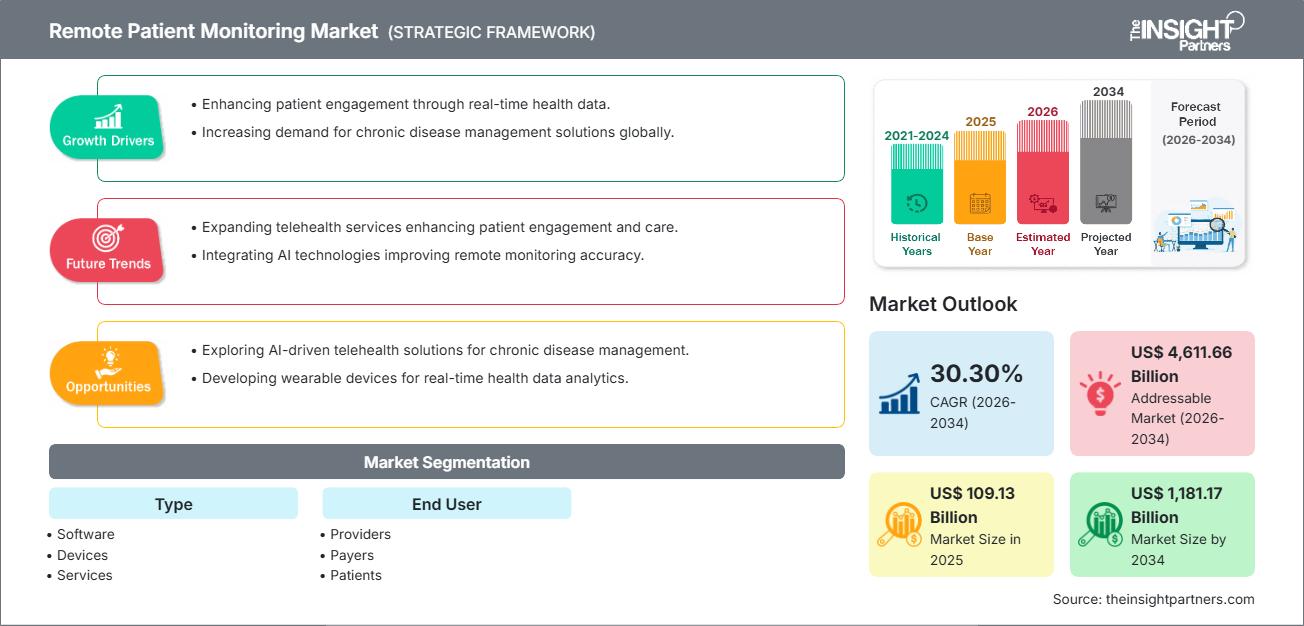
The Remote Patient Monitoring Market size is projected to witness explosive growth, expected to reach a massive US$ 1,181.17 billion by 2034, soaring from US$ 109.13 billion in 2025. The market is anticipated to register a robust Compound Annual Growth Rate (CAGR) of 30.30% during the forecast period of 2026–2034.
Remote Patient Monitoring Market Analysis
The global remote patient monitoring (RPM) market forecast indicates sustained exponential expansion, primarily fueled by the significant rise in the global burden of chronic diseases, such as diabetes, hypertension, and cardiovascular disorders. This growth is synergistically amplified by the increasing mainstream adoption of telehealth and digital health solutions, which were significantly accelerated during and after the COVID-19 pandemic. The rapid advancement and proliferation of Internet of Things (IoT)-enabled medical devices allow for seamless, real-time data collection from the patient's home environment. Healthcare providers and payers are increasingly capitalizing on RPM systems to achieve critical institutional goals: improving patient outcomes, reducing costly hospital readmission rates, and optimizing the utilization of clinical resources by shifting routine monitoring away from clinic visits.
Remote Patient Monitoring Market Overview
Remote Patient Monitoring (RPM) utilizes sophisticated digital technologies to facilitate the collection of vital physiological data and other health metrics from patients outside of traditional clinical settings. This data is then electronically transmitted to healthcare providers who can assess the patient's status, intervene promptly, and provide personalized treatment recommendations. RPM solutions are comprehensive systems encompassing connected medical devices (e.g., blood pressure cuffs, continuous glucose monitors, wearable sensors), specialized software platforms for data aggregation and alerting, and the associated services required for implementation and patient support. The market is dynamic and characterized by continuous technological innovation, favorable regulatory support (particularly in North America and Europe concerning reimbursement), and substantial global investments in robust digital health infrastructure.
Market Assessment and Insights
- Global market for Remote Patient Monitoring was valued at US$ 109.13 Billion in 2025
- Annual market size is expected to reach US$ 1,181.17 Billion by 2034
- Total addressable market (TAM) during 2026-2034 is projected to reach approximately US$ 4,611.66 Billion
- Market is anticipated to register a CAGR of 30.3% during the forecast period
- The United States represents a key market, supported by Enhancing patient engagement through real-time health data., Increasing demand for chronic disease management solutions globally., as well as evolving industry dynamics
- Market analysis covers North America, Europe, Asia-Pacific, South and Central America, Middle East and Africa, with growth evaluated across the forecast period
- Market opportunities such as Exploring AI-driven telehealth solutions for chronic disease management., Developing wearable devices for real-time health data analytics. are expected to influence market dynamics and addressable market
- Report profiles industry participants, including Cerner Corporation, Medtronic, Koninklijke Philips N.V., VitalConnect, Boston Scientific Corporation, Siemens Healthineers AG, GE Healthcare, Abbott, Nihon Kohden Corporation, OMRON Corporation, while analyzing competitive strategies and innovation developments
-
Source: The Insight Partners' analysis based on proprietary research, government publications, company annual reports, investor presentations, industry databases, and expert interviews.
● REPORT CUSTOMIZATION
Tailor This Report To Align With Your Specific Business Requirements
This report can be customized to align precisely with your business objectives, scope, and target markets. Customization options include tailored segmentation, geography, competitive analysis, and strategic insights to support informed decision-making.
Customize This Report →WHAT YOU CAN ADJUST
- ● Segmentations
- ● Geography
- ● Competitive Analysis
- ● Language Preferences
Remote Patient Monitoring Market: Strategic Insights
-
Get Top Key Market Trends of this report.This FREE sample will include data analysis, ranging from market trends to estimates and forecasts.
Remote Patient Monitoring Market Drivers and Opportunities
Market Drivers:
- Rising Prevalence of Chronic Diseases: The growing incidence and extended management periods for chronic conditions necessitate continuous oversight, making RPM an indispensable tool for proactive disease management and complication prevention in large patient populations.
- Growing Adoption of Telehealth and Digital Health Solutions: The increasing acceptance and infrastructure readiness for virtual care models have made the implementation of RPM systems smoother, positioning remote monitoring as a foundational element of integrated digital healthcare delivery.
- Increasing Focus on Reducing Healthcare Costs and Improving Patient Outcomes: Payers and providers are incentivized to adopt RPM as it demonstrably lowers expenditure by preventing acute episodes, reducing unnecessary emergency department visits, and cutting down on expensive hospital stays and readmissions.
Market Opportunities:
- Integration of AI and Predictive Analytics into RPM Platforms: Implementing sophisticated Artificial Intelligence (AI) and machine learning algorithms allows platforms to process massive amounts of patient data, identify subtle changes in health status, predict potential critical events, and generate prioritized alerts for clinical intervention.
- Expansion in Emerging Markets with Improving Connectivity: Emerging markets across Asia-Pacific and Latin America present vast, untapped opportunities as internet connectivity improves and government bodies prioritize digital transformation initiatives to enhance access to care in remote or underserved areas.
- Strategic Partnerships Between Technology Providers and Healthcare Organizations: Collaborations between pure-play RPM technology companies, established medical device manufacturers, and large hospital networks or insurance companies are crucial for scaling solutions, ensuring interoperability, and driving clinical validation and deployment.
Remote Patient Monitoring Market Report Segmentation Analysis
The Remote Patient Monitoring Market share is analyzed across various segments to provide a clearer understanding of the market structure, technology components, and end-user adoption patterns. Below is the standard segmentation approach used in most industry reports:
By Type:
- Devices
- Software
- Services
By End-User:
- Providers (Hospitals, Clinics, Physicians)
- Payers (Insurance Companies)
- Patients (Direct-to-Consumer)
By Geography:
- North America
- Europe
- Asia Pacific
- South & Central America
- Middle East & Africa
Remote Patient Monitoring Market Report Scope
| Report Attribute | Details |
|---|---|
| Market size in 2025 | US$ 109.13 Billion |
| Market Size by 2034 | US$ 1,181.17 Billion |
| Global CAGR (2026 - 2034) | 30.30% |
| Historical Data | 2021-2024 |
| Forecast period | 2026-2034 |
| Segments Covered |
By Type
|
| Regions and Countries Covered |
North America
|
| Market leaders and key company profiles |
|
Remote Patient Monitoring Market Players Density: Understanding Its Impact on Business Dynamics
The Remote Patient Monitoring Market is growing rapidly, driven by increasing end-user demand due to factors such as evolving consumer preferences, technological advancements, and greater awareness of the product's benefits. As demand rises, businesses are expanding their offerings, innovating to meet consumer needs, and capitalizing on emerging trends, which further fuels market growth.
Remote Patient Monitoring Market Share Analysis by Geography
North America holds the largest market share, with the Asia-Pacific region exhibiting the highest CAGR during the forecast period.
The RPM market's growth trajectory differs significantly by region due to variations in reimbursement policies, digital health maturity, and regulatory frameworks. Below is a summary of market share and trends by region:
North America
- Market Share: Dominates the global market due to highly advanced healthcare infrastructure, significant early investment in digital health technologies, and favorable reimbursement codes (e.g., in the US) that incentivize providers to offer RPM services.
- Key Drivers: Strong presence and early adoption by leading technology and healthcare companies.
- Trends: Increasing sophistication in reimbursement for chronic care management via RPM and a move toward integrating RPM data directly into Electronic Health Records (EHR) systems.
Europe
- Market Share: Holds a significant share, driven by supportive government policies promoting digital health integration, especially within public healthcare systems (like the NHS).
- Key Drivers: Strict data governance policies (GDPR) driving demand for highly secure RPM solutions.
- Trends: Strong growth in hybrid care models that combine in-person visits with continuous remote monitoring, particularly for cardiac and respiratory patients.
Asia-Pacific
- Market Share: Fastest-growing region globally, fueled by vast opportunities arising from rapid healthcare digitization, a significant chronic disease burden across large populations (China, India), and expanding telemedicine services in rural areas.
- Key Drivers: Rising consumer willingness to adopt connected health devices and wearables.
- Trends: Focus on developing localized, cost-effective RPM solutions and using mobile platforms as the primary interface for patient engagement and data transmission.
South and Central America
- Market Share: Emerging market with significant potential, characterized by improving internet connectivity and government efforts to bridge gaps in healthcare access.
- Key Drivers: Growing awareness among medical professionals regarding the efficiency and scalability of RPM.
- Trends: Adoption concentrated in cloud-based and scalable platforms to serve geographically dispersed populations and address disparities in urban vs. rural care.
Middle East and Africa
- Market Share: Developing market exhibiting strong potential, supported by major government strategies focused on economic diversification and enhancing the quality of healthcare delivery through technology.
- Key Drivers: Demand for advanced, connected health solutions from high-net-worth individuals and expatriate populations.
- Trends: Implementation of RPM as part of large-scale, integrated Health Information Systems (HIS) to optimize resource allocation in new and expanding medical cities.
Remote Patient Monitoring Market Players Density: Understanding Its Impact on Business Dynamics
The competitive landscape is highly fragmented and characterized by the co-existence of diversified multinational healthcare conglomerates and focused, innovative technology start-ups. Major vendors prioritize technology leadership and seamless integration across the care continuum.
This competitive environment pushes vendors to differentiate through:
- Integration with Clinical Workflows: Developing platforms that integrate seamlessly with all major EHR/EMR systems (Epic, Cerner, etc.) to ensure that RPM data is actionable within the provider's native workflow.
- Device Portability and Accuracy: Continuous innovation in sensor technology to create smaller, less invasive, and more clinically accurate wearable devices that enhance patient adherence and comfort.
- Cybersecurity and Compliance: Offering enterprise-grade security architecture that meets stringent global data privacy and security regulations (HIPAA, GDPR) to build trust with large healthcare systems and payers.
Major Companies operating in the Remote Patient Monitoring Market are:
- Medtronic
- Koninklijke Philips N.V.
- Cerner Corporation (Oracle)
- GE Healthcare
- Abbott
- Boston Scientific Corporation
- Siemens Healthineers AG
- VitalConnect
- Nihon Kohden Corporation
Disclaimer: The companies listed above are not ranked in any particular order.
Remote Patient Monitoring Market News and Recent Developments
- Medtronic introduced the HealthCast™ Vital Sync™ RPM platform, enabling near real-time tracking of SpO₂, respiratory rate, pulse, EtCO₂, and ventilator data across devices and EMRs. This solution enhances hospital monitoring workflows and supports early detection of patient deterioration.
- Philips partnered with smartQare to integrate viQtor wearable biosensors with Philips clinical monitoring platforms, enabling continuous monitoring inside and outside hospitals. Additionally, Philips collaborated with Medtronic in a multi-year agreement to bundle Philips monitors with Medtronic sensors and consumables, ensuring validated and cyber-secure integrations.
- Oracle Health developed a comprehensive RPM solution embedded into its EHR and population health systems. The framework includes device connectivity, patient portals, consumer experience tools, video visits, and cloud-based RPM capabilities to support chronic condition management and remote clinical trials.
Remote Patient Monitoring Market Report Coverage and Deliverables
The "Remote Patient Monitoring Market Size and Forecast (2021–2034)" report provides a detailed analysis of the market covering below areas:
- Remote Patient Monitoring Market size and forecast at global, regional, and country levels for all the key market segments covered under the scope.
- Remote Patient Monitoring Market trends, as well as market dynamics such as drivers, restraints, and key opportunities.
- Detailed PEST and SWOT analysis.
- Remote Patient Monitoring Market analysis covering key market trends, global and regional framework, major players, regulations, and recent market developments.
- Industry landscape and competition analysis covering market concentration, heat map analysis, prominent players, and recent developments in the Remote Patient Monitoring Market.
- Detailed company profiles.
Frequently Asked Questions

- Comprehensive Market Sizing and Forecast Analysis
- Detailed Segmentation Analysis
- In-Depth Market Dynamics Assessment
- Regional and Country-Level Insights
- Competitive Landscape and Company Benchmarking
- Strategic Business Intelligence
Recent Reports
Testimonials

The Insight Partners' SCADA System Market report is comprehensive, with valuable insights on current trends and future forecasts. The team was highly professional, responsive, and supportive throughout. We are very satisfied and highly recommend their services.
RAN KEDEM Partner, Reali Technologies LTDs
I requested a report on a very specific software market and the team produced the report in a few days. The information was very relevant and well presented. I then requested some changes and additions to the report. The team was again very responsive and I got the final report in less than a week.
JEAN-HERVE JENN Chairman, Future Analytica
We worked with The Insight Partners for an important market study and forecast. They gave us clear insights into opportunities and risks, which helped shape our plans. Their research was easy to use and based on solid data. It helped us make smart, confident decisions. We highly recommend them.
PIYUSH NAGPAL Sr. Vice President, High Beam Global
The Insight Partners delivered insightful, well-structured market research with strong domain expertise. Their team was professional and responsive throughout. The user-friendly website made accessing industry reports seamless. We highly recommend them for reliable, high-quality research services
YUKIHIKO ADACHI CEO, Deep Blue, LLC.
This is the first time I have purchased a market report from The Insight Partners.While I was unsure at first, I visited their web site and felt more comfortable to take the risk and purchase a market report.I am completely satisfied with the quality of the report and customer service. I had several questions and comments with the initial report, but after a couple of dialogs over email with their analyst I believe I have a report that I can use as input to our strategic planning process.Thank you so much for taking the extra time and making this a positive experience.I will definitely recommend your service to others and you will be my first call when we need further market data.
JOHN SUZUKI President and Chief Executive Officer, Board Director, BK Technologies
I wish to appreciate your support and the professionalism you displayed in the course of attending to my request for information regarding to infectious disease IVD market in Nigeria. I appreciate your patience, your guidance, and the fact that you were willing to offer a discount, which eventually made it possible for us to close a deal. I look forward to engaging The Insight Partners in the future, all thanks to the impression you have created in me as a result of this first encounter.
DR CHIJIOKE ONYIA MANAGING DIRECTOR, PineCrest Healthcare Ltd.Reason to Buy
- Informed Decision-Making
- Understanding Market Dynamics
- Competitive Analysis
- Identifying Emerging Markets
- Customer Insights
- Market Forecasts
- Risk Mitigation
- Boosting Operational Efficiency
- Strategic Planning
- Investment Justification
- Tracking Industry Innovations
- Aligning with Regulatory Trends





 Get Free Sample for