
3D and 4D Market Demand, Share & Growth by 2034
Coverage: by Component (Solution, Services); Application (Gaming, Navigation, Animation, Gesture Recognition, Others); Industry Vertical (Automotive, Aerospace and Defense, Healthcare, Building and Construction, Consumer Electronics, Media and Entertainment, Others) , and Geography (North America, Europe, Asia Pacific, and South and Central America)
- Status : Data Released
- Report Code : TIPRE00009557
- Category : Technology, Media and Telecommunications
- No. of Pages : 150
- Available Report Formats :


- Last update date : August 04, 2026


2025 Market Size
US$ 462.56 Bn
Base year value
2034 Forecast
US$ 1,796.09 Bn
Projected by 2034
CAGR 2026-2034
16.27 %
Growth rate
Addressable Market
US$ 9,531.23 Bn
(2026-2034)
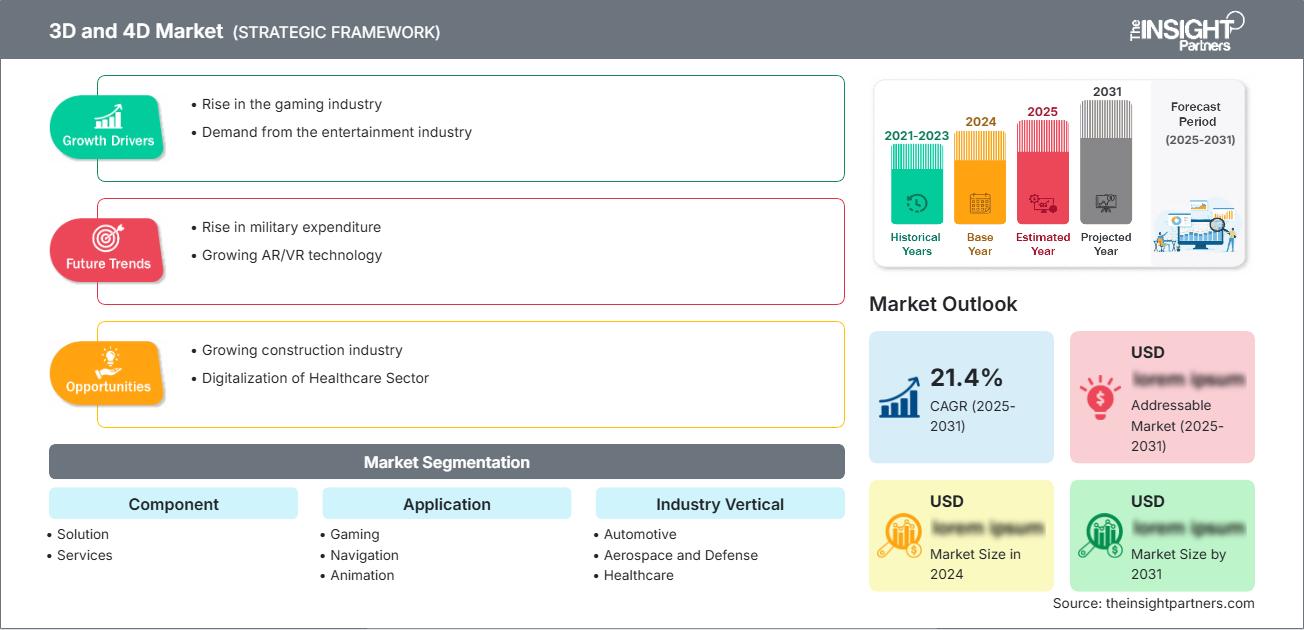
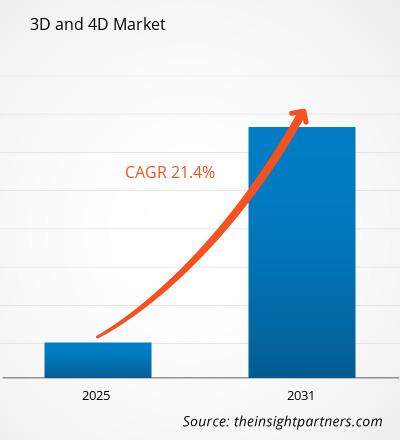
The 3D and 4D market was valued at US$ 462.56 Billion in 2025 and is projected to reach US$ 1,796.09 Billion by 2034; it is expected to register a CAGR of 16.27% from 2026 to 2034. Expansion is being shaped by demand for immersive visualization, additive design, real-time spatial data, and interactive media workflows across industrial, consumer, and mission-critical applications.
North America remains a high-value adoption center, with the 3D and 4D market size supported by an estimated 15.2–16.8% CAGR from 2026 to 2034. Growth is anchored in digital content pipelines, aerospace simulation, automotive visualization, advanced medical imaging, and enterprise spatial computing, while regional cloud infrastructure and AI-enabled design platforms shorten development cycles.
3D and 4D Market Assessment and Insights
- North America accounted for 35–38% share in 2025 and is expected to grow at a CAGR between 2026–2034 of 15.2–16.8%, driven by enterprise visualization, aerospace simulation, gaming, and healthcare adoption.
- US represented 78–82% of North America in 2025 and is projected to grow at a CAGR between 2026–2034 of 15.4–16.9%.
- Europe held 24–27% share in 2025 and is forecast to grow at a CAGR between 2026–2034 of 14.2–15.8%, led by Germany, the UK, France, Italy, and Spain.
- Asia Pacific captured 27–30% share in 2025 and is set to grow at a CAGR between 2026–2034 of 17.4–18.9%, with China, Japan, South Korea, and India leading demand.
- Largest Segment Solution held 64–68% market share in 2025, with a CAGR range of 15.7–16.9% from 2026–2034, reflecting software-heavy visualization adoption.
- High Growth Segment Healthcare held 10–13% market share in 2025, with a CAGR range of 18.1–19.6% from 2026–2034, supported by imaging and surgical planning.
- Key companies analyzed in detail: 3D Systems Corporation, Autodesk, Inc., Dassault Systèmes SE, Dolby Laboratories, Inc., Panasonic Holdings Corporation, FARO Technologies, Inc., Hexagon AB, Samsung Electronics Co., Ltd., Stratasys Ltd., and Basler AG.
Source: The Insight Partners' analysis based on proprietary research, government publications, company annual reports, investor presentations, industry databases, and expert interviews.
Technology migration has moved the 3D and 4D market from isolated computer-aided design and animation tools toward connected ecosystems combining real-time rendering, spatial capture, additive manufacturing, digital twins, and immersive interfaces. Production economics are also changing as studios, manufacturers, and hospitals replace linear workflows with reusable 3D assets, automated motion pipelines, and simulation-led validation. As sensor costs decline and AI-assisted modeling improves throughput, adoption is expanding beyond specialist design teams into operations, training, field service, and product lifecycle management.
Over the forecast period, investment is expected to concentrate in emerging manufacturing hubs, smart infrastructure programs, connected vehicles, and clinical visualization networks. Regulatory emphasis on safer medical imaging, energy-efficient buildings, and aviation reliability strengthens enterprise justification for spatial simulation and validation tools. Asia Pacific and the Middle East are likely to add demand through digital government programs, while North America and Europe continue to shape standards, software architecture, and premium content workflows.
3D and 4D Market Report Scope
| Report Attribute | Details |
|---|---|
| Market size in 2025 | US$ 462.56 Billion |
| Market Size by 2034 | US$ 1,796.09 Billion |
| Global CAGR (2026 - 2034) | 16.27% |
| Historical Data | 2021-2024 |
| Forecast period | 2026-2034 |
3D and 4D Market Analysis
The 3D and 4D market growth is being propelled by richer digital content, shorter product cycles, and rising need for simulation before physical deployment. Gaming and animation demand high-fidelity assets, while automotive and aerospace buyers use 4D simulation to test movement, stress, and environmental behavior before prototyping.
Supply dynamics are shifting toward integrated hardware, software, and services. Camera systems, scanners, rendering engines, additive manufacturing platforms, and cloud collaboration tools increasingly operate as a value chain. This improves utilization, but buyers still face interoperability, file governance, and skills constraints across departments.
The 3D and 4D market analysis indicates a competitive field where platform depth matters more than single-product specialization. Autodesk, Inc. and Dassault Systèmes SE compete through design and simulation ecosystems, while 3D Systems Corporation, Stratasys Ltd., FARO Technologies, Inc., Hexagon AB, and Basler AG reinforce industrial capture, inspection, and production workflows.
Immersive media and device ecosystems also shape strategic positioning. Dolby Laboratories, Inc., Samsung Electronics Co., Ltd., and Panasonic Holdings Corporation influence entertainment, display, and consumer electronics adoption. Investment is flowing into AI-assisted authoring, factory software, in-vehicle experiences, and medical visualization where measurable productivity gains justify premium deployments.
● REPORT CUSTOMIZATION
Tailor This Report To Align With Your Specific Business Requirements
This report can be customized to align precisely with your business objectives, scope, and target markets. Customization options include tailored segmentation, geography, competitive analysis, and strategic insights to support informed decision-making.
Customize This Report →WHAT YOU CAN ADJUST
- ● Segmentations
- ● Geography
- ● Competitive Analysis
- ● Language Preferences
3D and 4D Market: Strategic Insights
Regional Insights
North America 3D and 4D market
North America held 35–38% of global revenue in 2025, giving the region the leading 3D and 4D market share position. Demand is supported by cloud rendering, defense simulation, high-value gaming studios, advanced manufacturing, and medical imaging modernization. The regional CAGR is estimated at 15.2–16.8% during 2026–2034, reflecting mature enterprise spending and steady workflow replacement.
The US anchors regional scale through software vendors, semiconductor-enabled imaging, additive manufacturing providers, and entertainment technology clusters. Canada contributes through animation, VFX, engineering design, and healthcare digitization. IATA reported 2025 passenger demand growth of 5.3%, reinforcing aerospace maintenance and cabin experience investment, while WHO imaging priorities support clinical visualization modernization.
U.S. 3D and 4D Market
The US accounted for 78–82% of North America in 2025 and is expected to grow at a 15.4–16.9% CAGR from 2026 to 2034. Company presence is broad across design software, additive manufacturing, spatial measurement, immersive audio, and consumer electronics. Enterprise buyers are prioritizing validated digital workflows to reduce rework and accelerate asset reuse.
Application trends are strongest in gaming, cinematic production, autonomous navigation, surgical visualization, and industrial inspection. FAA modernization priorities and strong aerospace supply chain needs support 4D modeling for reliability, while private hospitals and academic medical centers use 3D planning to improve procedure preparation. Media studios also scale AI-assisted animation pipelines.
Europe 3D and 4D Market
Europe represented 24–27% share in 2025 and is projected to expand at a 14.2–15.8% CAGR during 2026–2034. Germany is the leading country, supported by automotive engineering, industrial automation, metrology, and additive production. The UK contributes through gaming, animation, digital construction, and defense simulation clusters.
France maintains strength in aerospace, luxury visualization, and media production, while Italy and Spain expand through construction digitization, cultural visualization, and advanced manufacturing services. EU energy-efficiency and building renovation objectives support 3D building information modeling, particularly as IEA data show buildings account for around 30% of global energy demand.
APAC 3D and 4D Market
Asia Pacific held 27–30% share in 2025 and is forecast to grow at a 17.4–18.9% CAGR, making it the fastest regional growth engine. China leads through electronics, manufacturing automation, gaming, and smart city visualization, while Japan and South Korea advance display, robotics, automotive, and entertainment technologies.
India and Australia add demand through digital infrastructure, healthcare imaging, construction technology, and media outsourcing. Policy-led manufacturing incentives, 5G deployment, and industrial digitization accelerate adoption. The region also benefits from consumer electronics scale, which lowers hardware costs and supports broader enterprise access to immersive 3D and temporal simulation tools.
Middle East & Africa 3D and 4D Market
The Middle East and Africa are expected to grow at a CAGR of 13.8% to 15.3%, with Saudi Arabia driving usage through mega projects, tourism facilities, energy infrastructure, and digital construction. In second place is the UAE, with its smart-city visualizations, media productions, aviation services, and immersive retail experiences.
South Africa and the rest of the MEA region are much choosier, focusing on mining, healthcare imaging, and infrastructure planning. In the energy sector, asset models are used for maintenance and safety planning, and in the construction sector, programs generate the need for spatial mapping. Adoption depends on skilled integrators and public project pipelines.
Segmentation Analysis
Component
The Component segment is forecast to expand at a CAGR of 15.9% to 17.1% over 2026 to 2034. The 3D and 4D market scope and potential in terms of components are expanding as purchasers incorporate authoring tools, rendering software, scanners, printers, and implementation services. Solutions dominate the spend as platforms set the workflow standard.
- Solutions dominate component demand through modeling, rendering, simulation, scanning, and visualization platforms that standardize digital asset creation across manufacturing, media, construction, and healthcare environments.
- Services support adoption through consulting, customization, system integration, workflow design, managed content pipelines, and user training, particularly when enterprises migrate from fragmented legacy tools.
Application
Application growth is projected to grow at a CAGR of 16.2-17.6% during 2026-2034. Application demand is varied, covering entertainment, navigation, animation, and gesture recognition. These applications use spatial data in different ways. In gaming and animation applications, revenue is generated through immersive content. In navigation and gesture recognition, revenue is generated by making 3D perception useful.
- Gaming remains a major demand pool as studios require high-resolution characters, environments, physics engines, and immersive rendering pipelines for console, mobile, cloud, and virtual reality formats.
- Navigation gains strategic importance in autonomous vehicles, robotics, drones, warehouses, and smart infrastructure, where spatial mapping improves route planning, obstacle recognition, and operational safety.
- Animation benefits from AI-assisted motion capture, reusable 3D assets, virtual production, and faster rendering, helping studios manage shorter release cycles and rising content complexity.
- Gesture Recognition supports touchless control in vehicles, healthcare, consumer devices, retail, and industrial settings, where intuitive human-machine interaction improves accessibility, hygiene, and operational efficiency.
Industry Vertical
Industry Vertical is expected to grow at a rate between 16.5% and 17.9% during 2026-2034. The uptake will be determined by individual use cases, but there are increasing deployments of 3D and 4D technologies in the industry sector for design validation, inspection, training, and simulation throughout the product life cycle.
- * Automotive employs spatial design, crash simulation, cabin experience simulation, decentralized parts distribution, and in-car entertainment systems, allowing for fewer prototypes and facilitating software-defined vehicle initiatives.
- Aerospace and Defense uses 4D simulation, additive tooling, maintenance simulation, pilot training, mission planning, and digital twins to enhance reliability, readiness, and lifecycle cost management.
- Healthcare utilizes 3D imaging, surgery planning, dental production, anatomical models, and rehabilitation simulation, with demand driven by focus on imaging availability and precision in care within institutions.
- Building and Construction uses digital building models, construction planning, energy modeling, clash detection, and facility management solutions as owners strive for safe delivery and reduced lifecycle operating costs
- Consumer Electronics incorporates displays, cameras, sensors, immersive interfaces, and mobile creation of spatial media content, bridging device innovation and access to spatial media and visualization.
- Media and Entertainment provides real-time rendering, immersive audio, virtual production, animation, game assets, and volumetric experiences to deliver differentiating content in cinema, streaming, sports, and live events.
Opportunity Snapshot
| Industry Vertical | Revenue Contribution | Trend Tag | Adoption Stage |
| Automotive | High | Cabin UX | Scaling |
| Aerospace and Defense | High | Mission Twins | Scaling |
| Healthcare | Medium | Surgical Maps | Scaling |
| Building and Construction | Medium | Sequenced BIM | Scaling |
| Consumer Electronics | High | Spatial Capture | Mature |
| Media and Entertainment | High | Virtual Sets | Mature |
3D and 4D Market Growth Drivers and Impact Analysis
Rising Need for Simulation-Led Product Development
Manufacturers are replacing sequential design and testing with simulation-led workflows to reduce material waste, prototype expense, and launch risk. The impact of this factor is felt most acutely in automotive, aerospace, electronics, and construction because geometries, motion, stresses, and time-based sequences must be validated before making investments in tooling and site preparation. The data from IATA for 2025 indicate the highest passenger demand ever recorded, and pressure on the supply chain underscores why the aerospace industry needs to validate its assets with digital technology to ensure their longevity.
Expansion of Immersive Media and Real-Time Content Pipelines
Entertainment, gaming, sports broadcasting, and brand content are increasingly calling for immersive materials that can adapt across platforms, including movies, video games, streaming services, advertisements, and even live events. Autodesk, Inc. has expanded its reach into AI-based visual effects and animation, whereas Dolby Laboratories, Inc. has focused on developing immersive sound technologies for automotive, sports, and film applications. The inference drawn from this is that the future will be characterized by increased automation, interactivity, and immersion in content creation. In business, there will be increased demand for 3D modeling, 4D animation, real-time rendering, and production technologies that enable asset reuse.
Healthcare Imaging Modernization and Precision Planning
The adoption rate of imaging, planning, implants, and modeling by hospitals has been rising because the WHO’s 2025 resolution on medical imaging capability highlighted the need for imaging in the diagnosis and treatment of diseases such as cancer, neurology, and trauma. It acts as an institutional driver for uses of 3D visualization, surgery, dental fabrication, and anatomical simulation. The impact is greatest when it reduces operational uncertainty, educates, and offers customized solutions to companies.
3D and 4D Market Future Trends
AI-Native Authoring Becomes Standard
The next phase of 3D and 4D market trends will be defined by AI-native authoring, which is going to set the trend for the future, as natural language, generative motion, scene setup automation, and smart repair solutions eliminate technical barriers. Instead of eliminating experts, such technologies will shift effort from purely technical tasks to design validation and oversight. Studios, engineers, and hospitals will be able to receive quick drafts, but will require proper data and permissions, as well as quality control. Vendors that merge their AI solutions with design files and simulation engines will demand premium pricing.
Temporal Digital Twins Move from Pilots to Operations
The development of 4D digital twins is set to move from pilot programs to regular operations by integrating spatial models with time-series data for infrastructure owners, airlines, factories, and hospitals. This trend will make it possible for models to become even more valuable for maintenance planning, capacity management, safety rehearsal, and energy efficiency. According to the IEA, which reports that buildings account for around 30% of global energy consumption, there will be a greater need for operational building twins. Buyers will evaluate platforms by their ability to ingest sensor feeds, preserve geometric accuracy, and translate time-based changes into decisions that reduce downtime or operating costs.
3D and 4D Market Opportunities
Localized Industrial 3D Production Networks
Localized production networks offer a tangible way to translate 3D and 4D market forecasts into earnings, particularly in industries such as automotive, aerospace, medical devices, and spares logistics. In the demonstration project by 3D Systems Corporation and Daimler Truck, the benefits of having remotely printed parts in a certificate-of-origin format have proven themselves, with up to a 75% decrease in delivery times. These kinds of solutions can be scaled by bringing together certified files, intellectual property management, materials qualification, and service provider distribution.
Clinical Visualization Platforms for Mid-Tier Hospitals
Mid-range hospitals offer scalable opportunities, as there is high demand for improved imaging interpretation, surgical preparation, and patient interaction, yet they lack a team of engineering specialists to deliver these services. This can be done by vendors via cloud segmentation, modeling libraries, workflow guidance, and compliance management. There is a great opportunity as governments increase the provision of cancer, trauma, orthopedic, and dental services. Commercial success will come from simplifying the acquisition process, demonstrating clinical value, and aligning with reimbursement goals. An alliance with companies providing imaging equipment and medical institutions would make it easier to learn and use repeatedly.
Frequently Asked Questions

- Comprehensive Market Sizing and Forecast Analysis
- Detailed Segmentation Analysis
- In-Depth Market Dynamics Assessment
- Regional and Country-Level Insights
- Competitive Landscape and Company Benchmarking
- Strategic Business Intelligence
Recent Reports
Testimonials

The Insight Partners provided valuable market intelligence that supported our global go-to-market strategy. Their team was professional, responsive, and attentive to our feedback, providing thoughtful analysis and helpful methodological clarifications throughout the project.
Junmo Kim Chief Financial Officer (CFO), Enertech Co., Ltd.
The Insight Partners' SCADA System Market report is comprehensive, with valuable insights on current trends and future forecasts. The team was highly professional, responsive, and supportive throughout. We are very satisfied and highly recommend their services.
RAN KEDEM Partner, Reali Technologies LTDs
I requested a report on a very specific software market and the team produced the report in a few days. The information was very relevant and well presented. I then requested some changes and additions to the report. The team was again very responsive and I got the final report in less than a week.
JEAN-HERVE JENN Chairman, Future Analytica
We worked with The Insight Partners for an important market study and forecast. They gave us clear insights into opportunities and risks, which helped shape our plans. Their research was easy to use and based on solid data. It helped us make smart, confident decisions. We highly recommend them.
PIYUSH NAGPAL Sr. Vice President, High Beam Global
The Insight Partners delivered insightful, well-structured market research with strong domain expertise. Their team was professional and responsive throughout. The user-friendly website made accessing industry reports seamless. We highly recommend them for reliable, high-quality research services
YUKIHIKO ADACHI CEO, Deep Blue, LLC.
This is the first time I have purchased a market report from The Insight Partners.While I was unsure at first, I visited their web site and felt more comfortable to take the risk and purchase a market report.I am completely satisfied with the quality of the report and customer service. I had several questions and comments with the initial report, but after a couple of dialogs over email with their analyst I believe I have a report that I can use as input to our strategic planning process.Thank you so much for taking the extra time and making this a positive experience.I will definitely recommend your service to others and you will be my first call when we need further market data.
JOHN SUZUKI President and Chief Executive Officer, Board Director, BK Technologies
I wish to appreciate your support and the professionalism you displayed in the course of attending to my request for information regarding to infectious disease IVD market in Nigeria. I appreciate your patience, your guidance, and the fact that you were willing to offer a discount, which eventually made it possible for us to close a deal. I look forward to engaging The Insight Partners in the future, all thanks to the impression you have created in me as a result of this first encounter.
DR CHIJIOKE ONYIA MANAGING DIRECTOR, PineCrest Healthcare Ltd.Reason to Buy
- Informed Decision-Making
- Understanding Market Dynamics
- Competitive Analysis
- Identifying Emerging Markets
- Customer Insights
- Market Forecasts
- Risk Mitigation
- Boosting Operational Efficiency
- Strategic Planning
- Investment Justification
- Tracking Industry Innovations
- Aligning with Regulatory Trends





 Get Free Sample for