
3D and 4D Technology Market Growth, Demand & Size by 2034
Coverage: by Technology (3D Imaging Solutions, 3D Input Devices, 3D Output Devices, 3D Applications); End-User Industry (Military and Defense, Automotive, Construction, Consumer, Entertainment, Healthcare, Others), and Geography (North America, Europe, Asia Pacific, and South and Central America)
- Status : Data Released
- Report Code : TIPRE00013176
- Category : Technology, Media and Telecommunications
- No. of Pages : 150
- Available Report Formats :


- Last update date : August 05, 2026


2025 Market Size
US$ 225.84 Bn
Base year value
2034 Forecast
US$ 1,062.27 Bn
Projected by 2034
CAGR 2026-2034
18.77 %
Growth rate
Addressable Market
US$ 5,291.50 Bn
(2026-2034)
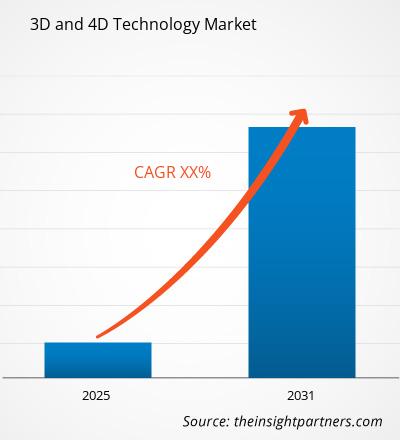
The 3D and 4D technology market was valued at US$ 225.84 Billion in 2025 and is projected to reach US$ 1,062.27 Billion by 2034, registering a CAGR of 18.77% during 2026–2034. Market expansion is being driven by increasing adoption of advanced visualization systems, digital twins, immersive simulation platforms, and real-time rendering technologies across healthcare, defense, automotive, construction, and media sectors. The growing convergence of artificial intelligence, cloud computing, extended reality, and advanced imaging technologies is further expanding commercial applications worldwide.
Supported by strong technology infrastructure and high enterprise digitalization rates, North America continues to represent the most established regional marketplace. The 3D and 4D technology market size across the region is supported by substantial investments in industrial automation, advanced medical imaging, military simulation systems, and digital engineering platforms. Continued deployment of cloud-native visualization environments and spatial computing solutions is expected to support a regional CAGR ranging between 16–19% through 2034.
3D and 4D Technology Market Assessment and Insights
- North America: Accounted for 35–39% share in 2025 and is expected to expand at a 16–19% CAGR during 2026–2034. Strong enterprise technology spending, healthcare innovation, and defense modernization continue supporting growth.
- US: Represented approximately 73–77% of North American revenue in 2025 and is projected to record a 16–19% CAGR through 2034, supported by robust software development and industrial digital transformation.
- Europe: Captured 24–28% share in 2025 and is expected to grow at a 17–20% CAGR. Germany, the UK, and France remain key markets due to automotive, manufacturing, and engineering demand.
- Asia Pacific: Held 25–29% share in 2025 and is expected to expand at a 20–23% CAGR, making it the fastest-growing region. China, Japan, South Korea, and India lead adoption.
- Largest Segment: 3D Imaging Solutions accounted for approximately 31–35% market share in 2025 and is forecast to grow at a 18–21% CAGR through the forecast period.
- High Growth Segment: Healthcare represented 14–18% market share in 2025 and is projected to expand at a 21–24% CAGR through 2034 due to increasing imaging and surgical planning applications.
- Key companies analyzed in detail: Adobe Inc., Autodesk, Inc., AutoDesSys, Inc., Corel Corporation, Daz Productions, Inc., Maxon Computer GmbH, Vizrt Group, Reallusion Inc., SideFX, Trimble Inc.
Source: The Insight Partners' analysis based on proprietary research, government publications, company annual reports, investor presentations, industry databases, and expert interviews.
3D and 4D technology Market development has accelerated as computing capabilities, graphics processing efficiency, and cloud-based rendering platforms have become more accessible. Organizations increasingly rely on sophisticated visualization technologies to improve engineering precision, operational planning, and decision-making. What was previously concentrated within entertainment and design applications has expanded into healthcare diagnostics, industrial manufacturing, defense simulation, infrastructure planning, and enterprise collaboration environments. This diversification has significantly broadened the addressable demand base for technology providers.
Future market progression is expected to be supported by increasing investment across Asia Pacific, the Middle East, and selected European economies. Governments continue allocating capital toward smart infrastructure, digital healthcare, defense modernization, and industrial automation programs. Expanding adoption of digital twins, immersive workspaces, and AI-enabled visualization systems is anticipated to create new growth avenues throughout multiple industry verticals while attracting long-term technology investment.
3D and 4D Technology Market Report Scope
| Report Attribute | Details |
|---|---|
| Market size in 2025 | US$ 225.84 Billion |
| Market Size by 2034 | US$ 1,062.27 Billion |
| Global CAGR (2026 - 2034) | 18.77% |
| Historical Data | 2021-2024 |
| Forecast period | 2026-2034 |
3D and 4D Technology Market Analysis
The 3D and 4D technology market growth outlook remains strong as enterprises prioritize digital transformation and visualization-driven decision support systems. Organizations are increasingly implementing advanced modeling and simulation platforms to reduce operational risks, improve product development timelines, and optimize asset management processes. Demand is particularly notable across healthcare, automotive manufacturing, construction planning, defense training, and media production. As the cost of high-performance computing continues to decline, adoption barriers are diminishing across both large enterprises and mid-sized organizations.
The market ecosystem involves software developers, hardware manufacturers, imaging companies, cloud infrastructure providers, content creators, and system integration specialists. Continuous advances in sensors, photogrammetry systems, mixed-reality devices, and artificial intelligence tools are strengthening overall solution capabilities. Increasing interoperability among enterprise applications is also improving deployment flexibility and accelerating implementation across diverse industries.
The 3D and 4D technology market analysis reveals a competitive landscape shaped by continuous innovation, strategic partnerships, and platform integration strategies. Major solution providers are focused on delivering scalable products capable of supporting enterprise workloads while improving visualization quality and user productivity. Adobe Inc. continues strengthening its creative ecosystem through advanced 3D content creation capabilities, while Autodesk, Inc. remains influential in design, engineering, and construction workflows.
At the same time, companies such as SideFX, Reallusion Inc., Maxon Computer GmbH, and Daz Productions, Inc. continue enhancing specialized visualization capabilities. Trimble Inc. is expanding applications across construction and reality capture environments, while Vizrt Group supports visualization requirements within media production. Strategic investments increasingly target artificial intelligence integration, cloud-native deployment models, and digital twin technologies capable of supporting long-term enterprise digitalization initiatives.
● REPORT CUSTOMIZATION
Tailor This Report To Align With Your Specific Business Requirements
This report can be customized to align precisely with your business objectives, scope, and target markets. Customization options include tailored segmentation, geography, competitive analysis, and strategic insights to support informed decision-making.
Customize This Report →WHAT YOU CAN ADJUST
- ● Segmentations
- ● Geography
- ● Competitive Analysis
- ● Language Preferences
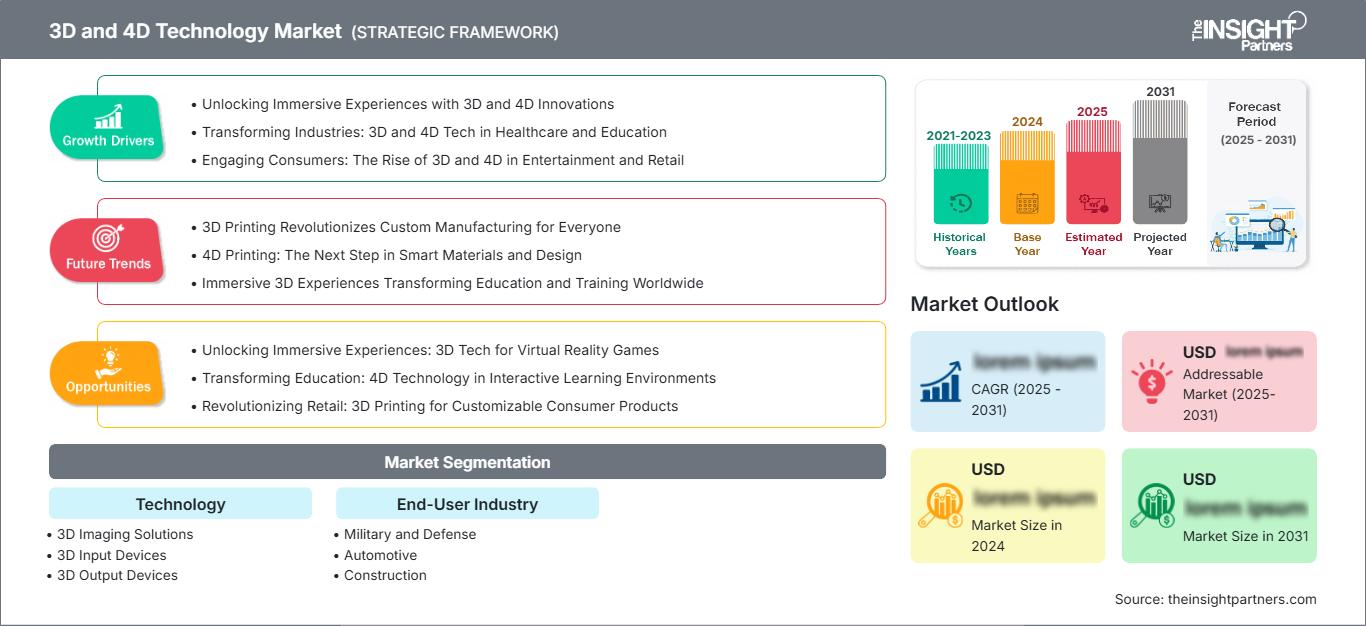
3D and 4D Technology Market: Strategic Insights
Regional Insights
North America 3D and 4D technology market
North America accounted for approximately 35–39% of global market revenue in 2025 and is projected to expand at a 16–19% CAGR through 2034. Regional demand is strongly supported by advanced technology infrastructure, high enterprise software spending, and substantial research and development activity across both public and private organizations. Healthcare institutions continue investing in advanced imaging platforms, while manufacturing companies increasingly adopt digital twin technologies to improve operational efficiency and asset management.
The region also benefits from established software ecosystems and widespread adoption of cloud computing. Defense agencies continue deploying simulation systems to improve training effectiveness and mission preparedness. Construction organizations increasingly utilize digital visualization technologies to support infrastructure planning and project lifecycle management. The 3D and 4D technology market share remains concentrated within the United States, although Canada is experiencing increased adoption across healthcare, industrial automation, and engineering environments.
U.S. 3D and 4D technology Market
The United States represented approximately 73–77% of North American revenue in 2025 and is forecast to record a 16–19% CAGR through 2034. Market demand is supported by extensive software development capabilities, advanced manufacturing environments, and strong investment in emerging digital technologies. Healthcare organizations continue implementing sophisticated visualization systems to improve diagnostics, treatment planning, and medical education programs.
The country hosts many leading software and visualization vendors, creating a favorable environment for innovation and commercialization. Demand continues increasing across automotive engineering, defense simulation, infrastructure planning, and media production sectors. Industrial organizations are also investing heavily in digital transformation programs that rely on advanced visualization capabilities to optimize performance, reduce development costs, and improve operational outcomes.
Europe 3D and 4D technology Market
Europe captured 24–28% of global revenue during 2025 and is expected to expand at a 17–20% CAGR through 2034. Regional growth is underpinned by strong manufacturing industries, engineering excellence, and rising investment in industrial digitalization programs. Automotive, aerospace, and healthcare industries remain among the largest adopters of advanced visualization technologies across the region.
Germany represents the largest European market due to its strong industrial base and leadership in automotive manufacturing. The UK benefits from advanced media production capabilities, software innovation, and engineering expertise. Both countries continue investing in digital transformation initiatives that support visualization technology adoption across public and private sectors.
France, Italy, and Spain continue expanding adoption across healthcare, infrastructure development, and construction planning applications. Building information modeling, digital twins, and advanced imaging technologies are increasingly incorporated into national modernization initiatives. These developments are contributing to sustained growth opportunities throughout the broader European marketplace.
APAC 3D and 4D technology Market
Asia Pacific held approximately 25–29% share of global demand in 2025 and is expected to register the fastest regional growth at a 20–23% CAGR through 2034. China remains the leading market because of large-scale manufacturing modernization initiatives and increasing investments in digital industrial technologies.
Japan and South Korea continue driving innovation across robotics, electronics, and entertainment industries, while India benefits from expanding technology investments and digital infrastructure programs. Australia is also witnessing increased adoption within healthcare and engineering sectors, supporting broader regional expansion.
Middle East & Africa 3D and 4D technology Market
The Middle East & Africa market is expected to advance at a 15–18% CAGR during the forecast period. Saudi Arabia and the UAE are leading adoption through smart city programs, infrastructure modernization projects, and digital construction initiatives requiring extensive visualization capabilities.
South Africa continues to strengthen utilization across healthcare, mining, and industrial applications. Growing investment in energy infrastructure, transportation networks, and urban development projects is expected to create additional opportunities for technology providers operating throughout the region.
Segmentation Analysis
Technology
The Technology segment is anticipated to expand at a 19–22% CAGR during 2026–2034. Growth is primarily supported by increasing adoption of intelligent visualization systems, digital twins, mixed reality environments, and cloud-based simulation platforms. Organizations across industrial, healthcare, and commercial sectors continue investing in advanced visualization technologies to improve planning accuracy, accelerate product development cycles, and enhance operational decision-making. Continuous advances in computing capabilities, image processing technologies, and artificial intelligence integration are expected to strengthen adoption throughout the forecast period.
- 3D Imaging Solutions: This sub-segment represents the largest share of technology revenue due to widespread utilization in medical diagnostics, industrial design validation, infrastructure planning, scientific visualization, and digital twin development initiatives.
- 3D Input Devices: Growing use of spatial scanners, motion capture systems, depth sensors, and digital acquisition equipment is supporting demand across engineering, healthcare, construction, animation, and defense applications.
- 3D Output Devices: Includes advanced displays, additive manufacturing systems, visualization workstations, and projection technologies that enable detailed representation of digital assets for industrial and commercial users.
- 3D Applications: Software applications continue expanding across modeling, simulation, animation, rendering, engineering design, infrastructure management, and medical visualization use cases within multiple industry sectors.
End-User Industry
The End-User Industry segment is expected to witness a CAGR of 18%-21% from 2026-2034. The growing focus on efficiency, process optimization, process visibility, and technology-driven collaboration is driving technology adoption across various industries. Visualization-based decision support technologies have become crucial for organizations seeking to enhance productivity while simplifying processes. Improved availability of cloud-based solutions is facilitating adoption by both large companies and mid-size organizations.
- Military and Defense: Advanced modeling and simulation technologies are extensively utilized for training environments, mission planning, battlefield visualization, and equipment lifecycle optimization across defense organizations.
- Automotive: Vehicle manufacturers increasingly deploy visualization platforms for virtual prototyping, aerodynamic testing, collaborative engineering, design validation, and accelerated product development programs.
- Construction: Demand is supported by building information modeling, infrastructure visualization, digital twins, project lifecycle management, and intelligent planning solutions.
- Consumer: Consumer applications continue expanding through gaming, personalized digital experiences, interactive visualization platforms, and enhanced online engagement tools.
- Entertainment: The segment remains highly dependent on sophisticated rendering technologies, animation software, virtual production environments, and immersive storytelling capabilities.
- Healthcare: Advanced imaging, surgical planning, diagnostic support, patient communication, medical education, and precision healthcare applications continue driving robust demand within this segment.
Opportunity Snapshot
| Segment Name | Revenue Contribution | Trend Tag | Adoption Stage |
| Military and Defense | High | Mission Simulation | Mature |
| Automotive | High | Virtual Prototyping | Scaling |
| Construction | Medium | Digital Twins | Scaling |
| Consumer | Medium | Spatial Content | Scaling |
| Entertainment | High | Virtual Production | Mature |
| Healthcare | High | Surgical Planning | Scaling |
3D and 4D Technology Market Growth Drivers and Impact Analysis
Expansion of Digital Twin Technology Across Industries
The adoption of digital twin technology continues to grow rapidly across the manufacturing, energy, transport, utilities, and infrastructure industries. The creation of digital twins is becoming necessary for companies to perform predictive maintenance and optimize processes. Visualization tools help users better understand sensor data as industrial facilities become more interconnected. Moreover, digital twins are helping companies collaborate more effectively within engineering teams through real-time asset monitoring. Governments and corporations continue to spend large sums on smart infrastructure solutions based on advanced models. This creates a growing need for visualization technologies and associated hardware tools in the market environment.
Growing Adoption of Advanced Healthcare Visualization Solutions
Healthcare experts have begun to recognize the potential of advanced imaging and visualization tools to improve patient outcomes. 3-Dimensional anatomical modeling allows the surgeon to examine different surgical approaches before carrying out the surgery. Additionally, there is an increasing need for visualization technologies in medical training and patient education initiatives. Increased healthcare spending, whether in developed or developing countries, continues to encourage investments in sophisticated imaging systems. The rising incidence of cardiovascular diseases, cancers, orthopedic surgeries, and neurological diseases has also boosted demand for accurate diagnostic imaging systems.
Rapid Industrial Automation and Smart Manufacturing Deployment
The expansion of industrial automation programs worldwide continues to strengthen demand for advanced modeling and simulation capabilities. Visualization technology has been adopted by manufacturing firms to enhance production activities, optimize layout designs, and avoid design errors. Digital asset and operations visualization is central to smart manufacturing, as it supports data-driven decision-making. Moreover, visualization tools help with employee training, machine monitoring, and collaborative engineering tasks. With the ongoing expansion of Industry 4.0 investments worldwide, demand for immersive visualization tools will grow. Businesses interested in efficiency gains and differentiation are investing in technologies oriented toward digital transformation.
3D and 4D Technology Market Future Trends
AI-Enabled Content Generation and Intelligent Visualization
The 3D and 4D technology market trends are increasingly influenced by the integration of artificial intelligence across design, modeling, rendering, and simulation workflows. Next-generation software will be capable of automating repetitive design tasks, enhancing image reconstruction quality, and accelerating complex visualization processes. By utilizing artificial intelligence, it is possible to reduce the time required for the production process while enabling users to produce highly detailed visual content without manual input. Businesses in the healthcare, entertainment, engineering, and manufacturing industries will employ intelligent visualization systems to enhance productivity and streamline content creation. With further development of AI technology, companies will compete on automation, predictive analytics, and usability.
Emergence of Persistent Spatial Computing Ecosystems
Spatial computing technologies are likely to be used more extensively for business collaboration tools and industrial applications. Future environments are likely to enable users to engage with digital content through immersive technologies such as augmented reality, virtual reality, and visualization. Organizations will utilize persistent digital workspaces that include engineering reviews, infrastructure inspections, training programs, and remote collaboration. Improvements in connectivity, cloud computing, and graphics processing capabilities will also help create a high-fidelity visualization environment. Over time, companies are expected to adopt spatial computing technologies as an integral part of their workflows, thereby offering new possibilities for developers and other stakeholders.
3D and 4D Technology Market Opportunities
Expansion of Healthcare Imaging and Visualization Platforms
Healthcare remains one of the most attractive investment areas for market participants due to increasing demand for advanced imaging, surgical planning, and precision medicine technologies. The 3D and 4D technology market forecasts indicate a growing need for medical visualization applications in hospitals, specialty centers, academic research institutions, and diagnostic centers. Vendors that can develop interoperable solutions leveraging artificial intelligence and advanced imaging processes might benefit from initiatives to digitize healthcare. With telemedicine, minimally invasive procedures, and personalized medicine, there will be an increased demand for visualization systems. The partnership between software companies, healthcare institutions, and medical device manufacturers can help accelerate the process and generate income from this technology.
Infrastructure Modernization and Smart City Development Projects
Large-scale infrastructure modernization programs are creating substantial opportunities for vendors offering advanced visualization and digital planning solutions. Developed and developing country governments are investing in transport facilities, urban development, energy infrastructure, and the modernization of public services. Visualizations aid in enhancing accuracy in the planning process, tracking progress, and streamlining lifecycle management. The increased use of digital twins in infrastructure development projects is driving demand for modeling solutions. Companies capable of delivering integrated solutions will be able to leverage the benefits of the investment cycles involved in implementing smart cities. With an increased focus on sustainability goals, the demand for better planning and simulation solutions is expected to rise.
Frequently Asked Questions

- Comprehensive Market Sizing and Forecast Analysis
- Detailed Segmentation Analysis
- In-Depth Market Dynamics Assessment
- Regional and Country-Level Insights
- Competitive Landscape and Company Benchmarking
- Strategic Business Intelligence
Recent Reports
Testimonials

The Insight Partners provided valuable market intelligence that supported our global go-to-market strategy. Their team was professional, responsive, and attentive to our feedback, providing thoughtful analysis and helpful methodological clarifications throughout the project.
Junmo Kim Chief Financial Officer (CFO), Enertech Co., Ltd.
The Insight Partners' SCADA System Market report is comprehensive, with valuable insights on current trends and future forecasts. The team was highly professional, responsive, and supportive throughout. We are very satisfied and highly recommend their services.
RAN KEDEM Partner, Reali Technologies LTDs
I requested a report on a very specific software market and the team produced the report in a few days. The information was very relevant and well presented. I then requested some changes and additions to the report. The team was again very responsive and I got the final report in less than a week.
JEAN-HERVE JENN Chairman, Future Analytica
We worked with The Insight Partners for an important market study and forecast. They gave us clear insights into opportunities and risks, which helped shape our plans. Their research was easy to use and based on solid data. It helped us make smart, confident decisions. We highly recommend them.
PIYUSH NAGPAL Sr. Vice President, High Beam Global
The Insight Partners delivered insightful, well-structured market research with strong domain expertise. Their team was professional and responsive throughout. The user-friendly website made accessing industry reports seamless. We highly recommend them for reliable, high-quality research services
YUKIHIKO ADACHI CEO, Deep Blue, LLC.
This is the first time I have purchased a market report from The Insight Partners.While I was unsure at first, I visited their web site and felt more comfortable to take the risk and purchase a market report.I am completely satisfied with the quality of the report and customer service. I had several questions and comments with the initial report, but after a couple of dialogs over email with their analyst I believe I have a report that I can use as input to our strategic planning process.Thank you so much for taking the extra time and making this a positive experience.I will definitely recommend your service to others and you will be my first call when we need further market data.
JOHN SUZUKI President and Chief Executive Officer, Board Director, BK Technologies
I wish to appreciate your support and the professionalism you displayed in the course of attending to my request for information regarding to infectious disease IVD market in Nigeria. I appreciate your patience, your guidance, and the fact that you were willing to offer a discount, which eventually made it possible for us to close a deal. I look forward to engaging The Insight Partners in the future, all thanks to the impression you have created in me as a result of this first encounter.
DR CHIJIOKE ONYIA MANAGING DIRECTOR, PineCrest Healthcare Ltd.Reason to Buy
- Informed Decision-Making
- Understanding Market Dynamics
- Competitive Analysis
- Identifying Emerging Markets
- Customer Insights
- Market Forecasts
- Risk Mitigation
- Boosting Operational Efficiency
- Strategic Planning
- Investment Justification
- Tracking Industry Innovations
- Aligning with Regulatory Trends





 Get Free Sample for