
3D Camera Market Demand, Size & Forecast by 2034
Coverage: By Technology (Time of Flight, Stereoscopic Imaging, Autostereoscopic Imaging, Structured Light Imaging), Type (Target Camera and Target-Free Camera), End-user (Consumer Electronics, Healthcare, Industrial, Aerospace and Defense, Construction, Automotive, Media & Entertainment), and Geography
- Status : Data Released
- Report Code : TIPTE100000773
- Category : Electronics and Semiconductor
- No. of Pages : 150
- Available Report Formats :


- Last update date : July 15, 2026


2025 Market Size
US$ 5.6 Bn
Base year value
2034 Forecast
US$ 21.3 Bn
Projected by 2034
CAGR 2026-2034
16.00 %
Growth rate
Addressable Market
US$ 113.80 Bn
(2026-2034)
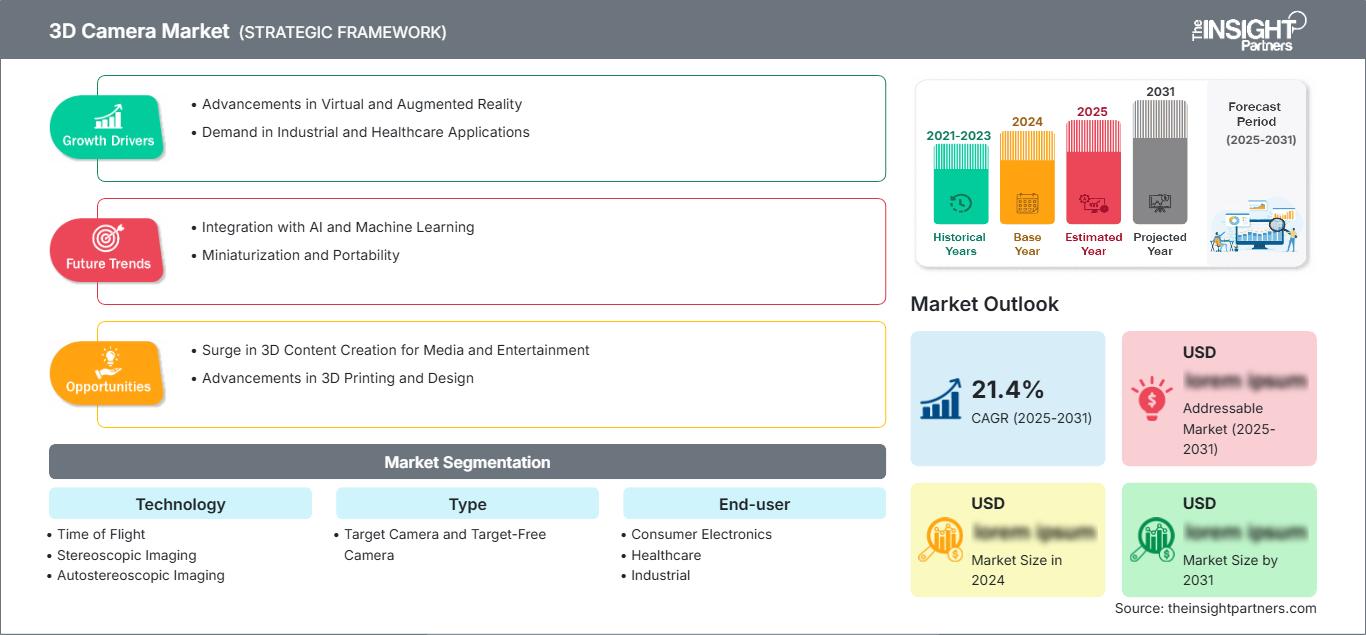
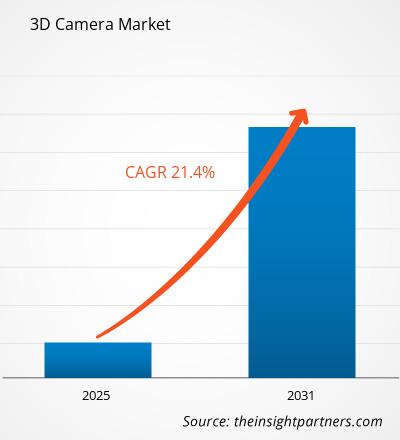
The 3D Camera Market was valued at US$ 5.6 Billion in 2025 and is projected to reach US$ 21.3 Billion by 2034; it is expected to register a CAGR of 16.00% from 2026 to 2034. The 3D Camera size reflects expanding demand for depth-enabled imaging across consumer electronics, healthcare, industrial automation, automotive safety, construction documentation, and media production applications.
North America is expected to record a CAGR of 14.8–15.4% during 2026–2034, supported by advanced electronics design, automation spending, defense imaging modernization, and clinical visualization upgrades. According to the 3D Camera Market report, regional demand is strengthened by AI-enabled inspection, robotics deployment, and automotive cabin-sensing programs, while established camera, sensor, and machine-vision suppliers help accelerate enterprise adoption of target and target-free systems.
3D Camera Market Assessment and Insights
- North America: The region accounts for an estimated 27–31% share of the market in 2025 and is projected to grow at a CAGR of 14.8–15.4% during 2026–2034. Strong demand for robotics, industrial automation, and advanced driver assistance systems (ADAS) supports regional market expansion.
- US: The US represents approximately 78–82% of the North American market in 2025 and is expected to register a CAGR of 15.0–15.6% during 2026–2034. Growth is driven by increasing adoption of robotics, autonomous technologies, and ADAS across industrial and automotive applications.
- Europe: Europe holds an estimated 21–25% share in 2025 and is anticipated to grow at a CAGR of 13.6–14.2% during 2026–2034. Germany, the UK, and France lead regional demand through industrial automation, metrology, and automotive depth-sensing applications.
- Asia Pacific: Asia Pacific captures approximately 38–42% of the global market in 2025 and is forecast to expand at a CAGR of 17.2–17.8% during 2026–2034. China, Japan, and South Korea drive growth through smartphone manufacturing, robotics, and factory vision technologies.
- Largest Segment: Consumer Electronics represents the largest market segment with strong growth at a CAGR of 15.4–16.0% during 2026–2034, supported by rising adoption in smartphones, augmented reality (AR) devices, biometric authentication, and computational photography.
- High Growth Segment: Automotive is the fastest-growing segment and is projected to register a CAGR of 18.4–19.0% during 2026–2034, driven by increasing deployment of ADAS, in-cabin monitoring systems, autonomous vehicle development, and advanced vehicle perception technologies.
- Key companies analyzed in detail: Canon Inc.; Eastman Kodak Company; SICK AG; FUJIFILM Holdings Corporation; GoPro, Inc.; LG Electronics Inc.; Nikon Corporation; Panasonic Holdings Corporation; Samsung Electronics Co., Ltd.; Sony Group Corporation; ifm electronic gmbh; IDS Imaging Development Systems GmbH; Zivid AS; LUCID Vision Labs, Inc.; Cognex Corporation; 1stVision, Inc.; Carl Zeiss GOM Metrology GmbH; DENSO WAVE INCORPORATED; Basler AG; Fluke Process Instruments GmbH.
Source: The Insight Partners' analysis based on proprietary research, government publications, company annual reports, investor presentations, industry databases, and expert interviews.
The 3D Camera Market has evolved from stereo imaging for specialist photography into a multi-technology sensing ecosystem built around time of flight, structured light, stereoscopic, and autostereoscopic platforms. Production has shifted toward compact modules, higher-resolution depth sensors, and embedded AI processors. Industrial buyers increasingly prioritize calibration stability, frame rate, environmental tolerance, and software compatibility, reflecting the move from image capture hardware toward integrated perception systems.
Future expansion will be shaped by Asia Pacific electronics manufacturing, North American automation investment, and European safety regulation for automotive and industrial systems. The International Federation of Robotics reported 542,000 industrial robot installations in 2024 and 4.664 million operational units, reinforcing machine-vision demand. Healthcare visualization, smart infrastructure, and defense imaging programs will widen the 3D Camera scope, while gains in 3D Camera market share are expected as depth sensing becomes embedded in decision-support workflows.
3D Camera Market Report Scope
| Report Attribute | Details |
|---|---|
| Market size in 2025 | US$ 5.6 Billion |
| Market Size by 2034 | US$ 21.3 Billion |
| Global CAGR (2026 - 2034) | 16.00% |
| Historical Data | 2021-2024 |
| Forecast period | 2026-2034 |
3D Camera Market Analysis
Demand is rising as depth perception becomes essential for automation, spatial computing, smart devices, and precision inspection. In the 3D Camera Market, buyers evaluate sensor accuracy, lighting robustness, latency, and integration cost rather than camera resolution alone. Value creation spans optics, CMOS sensors, emitters, processors, calibration software, and analytics platforms, making partnerships between component suppliers and application developers central to commercialization.
Supply dynamics remain influenced by semiconductor availability, image-sensor packaging, VCSEL sourcing, and machine-vision interface standards. Consumer electronics create high-volume demand, while industrial and healthcare applications require ruggedized designs and traceable performance. The 3D Camera market forecast indicates that suppliers offering complete hardware-software stacks can reduce deployment friction, particularly in robotics, automated inspection, surgical visualization, and vehicle sensing environments.
The market has players in the areas of imaging, industrial automation, metrology, and machine vision distribution. Consumer-based ecosystem players include Sony Group Corporation, Samsung Electronics Co., Ltd., Panasonic Holdings Corporation, and LG Electronics Inc. At the same time, SICK AG, Cognex Corporation, Basler AG, Zivid AS, and LUCID Vision Labs, Inc. are dedicated to industrial precision, software, and solutions for particular applications.
Capital investment trends are moving towards the development of artificial intelligence-assisted depth understanding, edge computing, multi-camera synchronization, and compact cameras for autonomous systems. In terms of the 3D Camera market share, there is an expectation of preference for companies offering optical design, sensors' reliability, and software. These include Canon Inc., Nikon Corporation, FUJIFILM Holdings Corporation, GoPro, Inc., and Eastman Kodak Company. Industrial positioning market shares will go to DENSO WAVE INCORPORATED and Carl Zeiss GOM Metrology GmbH.
● REPORT CUSTOMIZATION
Tailor This Report To Align With Your Specific Business Requirements
This report can be customized to align precisely with your business objectives, scope, and target markets. Customization options include tailored segmentation, geography, competitive analysis, and strategic insights to support informed decision-making.
Customize This Report →WHAT YOU CAN ADJUST
- ● Segmentations
- ● Geography
- ● Competitive Analysis
- ● Language Preferences
3D Camera Market: Strategic Insights
Regional Insights
North America 3D Camera Market
North America represented 27–31% of global revenue in 2025 and is projected to expand at a CAGR of 14.8–15.4% from 2026 to 2034. Demand is supported by high automation penetration, defense imaging upgrades, and enterprise adoption of AR-enabled training, digital twins, and robotic inspection. The region benefits from strong semiconductor design, cloud AI capability, and established machine-vision distributors, contributing to growth in the 3D Camera market size.
Automation in factories is still one of the structural factors since there is a need for accurate depth maps when using industrial robots for bin picking, metrology, collision detection, and quality control. The health care industry is also improving its visualization technology for minimally invasive surgeries and operations planning. There are some other structural factors driving the future market growth of 3D cameras.
U.S. 3D Camera Market
The U.S. accounted for 78–82% of North American demand in 2025 and is expected to grow at a CAGR of 15.0–15.6% through 2034. Adoption is concentrated in machine vision, autonomous systems, medical visualization, and content creation. Strong venture funding, defense procurement, and reshoring initiatives support demand for ruggedized cameras and high-performance depth modules, reflecting key 3D Camera market trends.
Sony Group Corporation, Cognex Corporation, LUCID Vision Labs, Inc., 1stVision, Inc., and Fluke Process Instruments GmbH maintain relevant commercial presence through sensors, inspection systems, distribution, and thermal-process applications. U.S. users increasingly deploy target-free cameras for mobile robots and target cameras for calibrated metrology, making application support and software interoperability critical purchasing factors.
Europe 3D Camera Market
Europe held 21–25% share in 2025 and is projected to grow at a CAGR of 13.6–14.2% in the 3D Camera market. Germany is ahead of others because of automotive engineering, robotics, and metrology requirements. Basler AG, Carl Zeiss GOM Metrology GmbH, SICK AG, and IDS Imaging Development Systems GmbH are the suppliers that add up to the regional ecosystem for calibrated inspection and factory automation.
The UK benefits from media production, aerospace engineering, defense electronics, and innovation in health care. The areas that generate high demand are those that require depth measurement for digital production, simulation, and inspection processes. Requirements for safety in the automotive industry and warehouse automation stimulate the use of time-of-flight and stereoscopic cameras, whereas the research institutes promote testing of autostereoscopic cameras.
France, Italy, and Spain help with the aerospace sector, industrial machinery, automotive parts, construction digitization, and medical devices. EU industrial policies and safety standards encourage investments in machine vision systems and driver monitoring. 3D Camera trends in Europe are geared towards calibrated solutions, supply chain traceability, and compliance-ready systems in demanding manufacturing environments.
APAC 3D Camera Market
Asia Pacific accounted for 38–42% share in 2025 and is expected to grow at a CAGR of 17.2–17.8% in the 3D Camera market, led by China—smartphone manufacturing, robotics, automotive electronics, and surveillance infrastructure, supporting large-volume deployment across the region.
Japan and South Korea remain important for image sensors, precision equipment, and consumer electronics, while India is scaling industrial automation and electronics assembly. Australia contributes through mining automation, healthcare imaging, and digital construction workflows.
Policy incentives for semiconductor localization, smart factories, and EV supply chains improve regional prospects. High robot density and electronics production make APAC the central growth arena for the 3D Camera Market.
Middle East & Africa 3D Camera Market
The Middle East & Africa is projected to expand at a CAGR of 12.2–12.8% through 2034 in the 3D Camera market, with Saudi Arabia leading regional adoption. Ruggedized 3D imaging is required for smart city projects, energy infrastructure inspection, and security upgrades.
The UAE focuses on sophisticated surveillance systems, media creation, logistics automation, and digital construction. South Africa creates demand through its mining industry, industrial inspection, healthcare upgrades, and transportation infrastructure inspection.
RoMEA deployment depends on specific projects, but there is potential within oil and gas maintenance, airport security, and large-scale infrastructure projects for both target-free and structured light solutions.
Segmentation Analysis
Technology
The technology segment is projected to grow at a CAGR of 15.8–16.4% during 2026–2034 in the 3D Camera market, driven by improving depth accuracy, lower sensor costs, and broader integration with AI vision software. Buyers select technologies based on range, lighting conditions, resolution, latency, and calibration requirements, making application fit more important than a single universal architecture.
- Time of Flight: High popularity in smartphones, robotics, and cabin monitoring systems owing to small size, on-the-spot range calculation, and application in gesture control, obstacle avoidance, and biometric 3D imaging.
- Stereoscopic Imaging: Recommended for industrial monitoring, navigation, and professional imaging owing to the passive nature of depth perception, high image resolution, and the ability to work outdoors without projecting light patterns.
- Autostereoscopic Imaging: Becoming more strategically important in media, medicine, and immersive displays as a way to achieve depth perception without wearing glasses, but subject to the availability of relevant content and display technology.
- Structured Light Imaging: Essential for metrology, face identification, dental imaging, and close-up inspection, as the projection of light patterns makes it possible to create a precise image of an object's surface.
Type
The type segment is expected to register a CAGR of 15.6–16.2% from 2026 to 2034 in the 3D Camera market as both calibrated and target-free solutions expand across inspection, mapping, navigation, and visualization tasks. Target cameras remain vital in controlled measurement environments, while target-free systems gain momentum in autonomous platforms and consumer interfaces that require flexible scene understanding.
- Target Camera: Used where reference markers, calibration targets, or known geometries improve repeatability, making the format strategically important in metrology, quality inspection, motion capture, and controlled industrial measurement.
- Target-Free Camera: Demand is rising in robotics, smartphones, vehicles, and construction documentation because the camera interprets natural scenes without markers, enabling flexible navigation, mapping, monitoring, and interaction.
End-user
The end-user segment is projected to grow at a CAGR of 16.3–16.9% during 2026–2034 as depth imaging moves from niche visualization into operational decision-making. Consumer electronics lead current revenue, while automotive and industrial applications provide higher technical differentiation. Healthcare, construction, aerospace, and media users increasingly value spatial accuracy, safer workflows, and richer digital content.
- Consumer Electronics: The highest revenue generator, driven by smartphones, tablets, AR glasses, biometrics, computational photography, and UIs that need small and power-efficient depth perception technology.
- Healthcare: Applications are growing in surgery visualization, rehabilitation analysis, dental imaging, wound diagnosis, and anatomical models, where accurate depth enhances planning and recording capabilities.
- Industrial: Manufacturing plants use 3D cameras for robot guidance, metrology, bin-picking, surface defect inspection, and warehouse management, so reliable operation and software integration are critical purchase considerations.
- Aerospace & Defense: Uses include surveillance, simulation, target recognition, maintenance inspection, autonomy, and mission training, where ruggedized systems and secure processing are key factors.
- Construction: 3D scanning is used for construction site monitoring, creation of digital twins, structural inspection, volume calculation, and safety monitoring, allowing contractors to minimize rework and documentation.
- Automotive: Expanding applications range from ADAS perception, driver monitoring, gesture recognition, in-car safety features, robotization in automotive manufacturing, and autonomous test driving in connected vehicles.
- Media & Entertainment: Creators use depth cameras to create volumetric content for virtual production, games, events, and media, tying adoption to the content pipeline and display ecosystem.
Opportunity Snapshot
| End-user | Revenue Contribution | Trend Tag | Adoption Stage |
| Consumer Electronics | High | Mobile Depth | Mature |
| Healthcare | Medium | Surgical Vision | Scaling |
| Industrial | High | Robot Vision | Scaling |
| Aerospace and Defense | Medium | Secure Imaging | Scaling |
| Construction | Medium | Site Mapping | Emerging |
| Automotive | High | Cabin Sensing | Scaling |
| Media & Entertainment | Medium | Volumetric Content | Emerging |
3D Camera Market Growth Drivers and Impact Analysis
Automation and Robotics Need Reliable Depth Perception
Automated systems form a key enabler since robots require precise spatial awareness for object recognition, collision prevention, and inspections without multiple manual adjustments. The figures from IFR indicating 542,000 industrial robot deployments by 2024 clearly illustrate the large installed base of automated solutions that increasingly rely on machine vision technology. On the production floor, 3D vision systems enhance bin picking, welding inspection, package inspection, and measurement of dimensions. Its effectiveness can be assessed by reduced scrap rates, quick changeovers, and traceability, especially in industries like electronics, automobiles, food processing, and logistics with labor shortages and stringent quality standards.
Consumer Devices Are Embedding Depth as a Standard Interface
Smartphones, tablets, smart home devices, and AR wearables are turning depth sensing into a mainstream interface rather than a premium feature. Time-of-flight and structured-light modules support facial authentication, portrait effects, gesture control, room mapping, and immersive shopping. This driver broadens the 3D Camera Market by creating high-volume manufacturing scale that lowers component costs for other sectors. As consumer platforms standardize software development kits and deep APIs, industrial and healthcare developers can adapt proven hardware architectures for specialized applications with shorter commercialization cycles.
Vehicle Safety and Autonomy Require Multimodal Sensing
Automotive requirements are increasing due to the incorporation of outside world perception, inside cabin perception, gestural control, and driver-state recognition. Depth sensors help in supplementing radar, lidar, ultrasonic, and 2D camera sensors in offering enhanced object recognition and occupant perception. Programs for assessing automotive safety in Europe and the global strategy of OEMs are leading to the adoption of advanced sensing capabilities at all levels of models. This has commercial implications since automotive programs need lengthy contract periods, rigorous qualification processes, and large unit volume requirements.
3D Camera Market Future Trends
Edge AI Will Shift Value from Capture to Interpretation
Future systems will increasingly process depth data at the edge, reducing latency and bandwidth while improving privacy for healthcare, retail, manufacturing, and vehicles. Instead of streaming raw point clouds, cameras will output object dimensions, occupancy maps, defect classifications, or gesture commands. This shift changes procurement priorities: buyers will compare algorithms, model update processes, cybersecurity, and integration tools alongside optics. Vendors that combine embedded processors, calibration software, and application-specific AI models will capture more value than hardware-only suppliers in the 3D Camera Market.
Volumetric Workflows Will Expand Beyond Entertainment
Volume capture is going to expand beyond the gaming and film industry into training, E-commerce, telepresence, education in health care, and industrial documentation. As the display, compression, and spatial computing technologies advance, companies are going to require cost-effective volume capture systems capable of producing reusable 3D models. The above tendencies explain the increase in popularity of multi-camera capture, targetless volume capture, and reconstruction software. The 3D Camera trends show an increasing interest in volume capture systems that are capable of digitizing physical space, goods, and movement.
3D Camera Market Opportunities
Industrial Vision Platforms for Small and Mid-Sized Manufacturers
Manufacturing businesses that are small to medium-sized have been underpenetrated due to the traditional 3D vision that needed specialized setup, programming, and calibration. These vendors can fill this void by offering packaged solutions consisting of cameras, lighting, software templates, and support for routine applications like palletizing, inspection, measuring volume, and robot guidance. Analytics subscription services and pre-trained models will reduce costs upfront and also generate regular income. Companies like 1stVision, Inc., Basler AG, IDS Imaging Development Systems GmbH, and LUCID Vision Labs, Inc. are highly capable of providing packages that are deployable.
Healthcare Visualization and Patient-Specific Digital Models
The field of healthcare presents one potential area where the use of 3D camera technology could be applied for purposes such as surgery planning, monitoring wounds, rehabilitation, dental scanning, prosthetics, and medical education. Clinics will be looking for solutions that enhance visualization without increasing workflow time, which means that smaller equipment and software for automatic measurements are highly valued. The key to success here would be focus on clinical validation and hygiene-friendly devices and systems, as well as integration with EHRs or imaging solutions.
Recent Developments
- February 2026: VA Imaging introduces a new structured light 3D camera, developed for industrial automation applications where measurement accuracy, depth stability, and repeatable 3D reconstruction are essential. The system is designed for short-range 3D vision tasks in production environments, where conventional 2D machine vision or consumer-grade depth sensors often struggle to deliver consistent results.
- January 2026: ASTERIA represents the latest generation of compact, space-qualified cameras developed by 3D PLUS, with the goal of achieving “10x” improvements across the most critical aspects of space hardware. To meet this objective, ASTERIA features an architecture that integrates a high-resolution image sensor with advanced electronics, providing strong imaging capabilities while optimizing SWaP-C (size, weight, power, and cost).
- March 2026: GoPro announced it will debut a new generation of cameras at the 2026 NAB Show, April 19—22, at Booth C5519, powered by the company’s exclusive, next‑generation GP3 processor. GoPro’s new GP3-powered cameras are more professionally focused than ever before, with more than double the pixel processing, larger sensors, expanded features, and market-leading low-light performance, resolution, and frame rates—all in compact, durable form factors that deliver industry-leading runtimes and thermal capability across a wide range of environmental conditions.
Frequently Asked Questions

- Comprehensive Market Sizing and Forecast Analysis
- Detailed Segmentation Analysis
- In-Depth Market Dynamics Assessment
- Regional and Country-Level Insights
- Competitive Landscape and Company Benchmarking
- Strategic Business Intelligence
Recent Reports
Testimonials

The Insight Partners provided valuable market intelligence that supported our global go-to-market strategy. Their team was professional, responsive, and attentive to our feedback, providing thoughtful analysis and helpful methodological clarifications throughout the project.
Junmo Kim Chief Financial Officer (CFO), Enertech Co., Ltd.
The Insight Partners' SCADA System Market report is comprehensive, with valuable insights on current trends and future forecasts. The team was highly professional, responsive, and supportive throughout. We are very satisfied and highly recommend their services.
RAN KEDEM Partner, Reali Technologies LTDs
I requested a report on a very specific software market and the team produced the report in a few days. The information was very relevant and well presented. I then requested some changes and additions to the report. The team was again very responsive and I got the final report in less than a week.
JEAN-HERVE JENN Chairman, Future Analytica
We worked with The Insight Partners for an important market study and forecast. They gave us clear insights into opportunities and risks, which helped shape our plans. Their research was easy to use and based on solid data. It helped us make smart, confident decisions. We highly recommend them.
PIYUSH NAGPAL Sr. Vice President, High Beam Global
The Insight Partners delivered insightful, well-structured market research with strong domain expertise. Their team was professional and responsive throughout. The user-friendly website made accessing industry reports seamless. We highly recommend them for reliable, high-quality research services
YUKIHIKO ADACHI CEO, Deep Blue, LLC.
This is the first time I have purchased a market report from The Insight Partners.While I was unsure at first, I visited their web site and felt more comfortable to take the risk and purchase a market report.I am completely satisfied with the quality of the report and customer service. I had several questions and comments with the initial report, but after a couple of dialogs over email with their analyst I believe I have a report that I can use as input to our strategic planning process.Thank you so much for taking the extra time and making this a positive experience.I will definitely recommend your service to others and you will be my first call when we need further market data.
JOHN SUZUKI President and Chief Executive Officer, Board Director, BK Technologies
I wish to appreciate your support and the professionalism you displayed in the course of attending to my request for information regarding to infectious disease IVD market in Nigeria. I appreciate your patience, your guidance, and the fact that you were willing to offer a discount, which eventually made it possible for us to close a deal. I look forward to engaging The Insight Partners in the future, all thanks to the impression you have created in me as a result of this first encounter.
DR CHIJIOKE ONYIA MANAGING DIRECTOR, PineCrest Healthcare Ltd.Reason to Buy
- Informed Decision-Making
- Understanding Market Dynamics
- Competitive Analysis
- Identifying Emerging Markets
- Customer Insights
- Market Forecasts
- Risk Mitigation
- Boosting Operational Efficiency
- Strategic Planning
- Investment Justification
- Tracking Industry Innovations
- Aligning with Regulatory Trends





 Get Free Sample for