
3D Parts Catalogs Software Market Demand, Share & Growth by 2034
Coverage: By Type (Cloud, On-Premise); End-Use (Automation/Robotics, Automotive, Chemical, Electrical, Oil and Energy, Retail, HVAC, Others), and Geography (North America, Europe, Asia Pacific, and South and Central America)
- Status : Data Released
- Report Code : TIPRE00016138
- Category : Technology, Media and Telecommunications
- No. of Pages : 150
- Available Report Formats :


- Last update date : August 05, 2026


2025 Market Size
US$ 728.37 Mn
Base year value
2034 Forecast
US$ 1,466.91 Mn
Projected by 2034
CAGR 2026-2034
8.09 %
Growth rate
Addressable Market
US$ 9,868.41 Mn
(2026-2034)
The 3D parts catalogs software market was valued at US$ 728.37 Million in 2025 and is projected to reach US$ 1,466.91 Million by 2034, registering a CAGR of 8.09% during 2026–2034. Growth is being driven by the increasing digitalization of engineering documentation, rising adoption of interactive spare-parts management systems, and expanding use of connected maintenance platforms across industrial sectors. Manufacturers are increasingly leveraging three-dimensional visualization capabilities to improve service efficiency, reduce component identification errors, and enhance lifecycle asset support.
Across North America, industrial enterprises are actively modernizing aftermarket support operations through integrated digital platforms. The 3D parts catalogs software market size across the region continues to benefit from investments in advanced manufacturing technologies, industrial automation systems, and cloud-based engineering ecosystems. Growing demand for digital service workflows, combined with strong software adoption across automotive and industrial machinery sectors, is expected to support regional expansion at an estimated CAGR of 7.5–8.5% through 2034.
3D Parts Catalogs Software Market Assessment and Insights
- North America: Share in 2025 estimated at 36–38%, supported by mature industrial software adoption, robust aftermarket ecosystems, and high digital engineering penetration. CAGR between 7.5–8.5% during 2026–2034.
- US: Represents 74–78% of North American demand in 2025, supported by extensive manufacturing software investments and advanced service digitization initiatives. CAGR between 7.8–8.8% during 2026–2034.
- Europe: Holds 28–30% share in 2025, led by Germany, the UK, and France. Strong engineering capabilities and industrial modernization programs support a CAGR of 7.2–8.2% during 2026–2034.
- Asia Pacific: Accounts for 24–26% share in 2025, driven by China, Japan, South Korea, and India. Expanding manufacturing activities support a CAGR of 9.0–10.0% during 2026–2034.
- Largest Segment: Cloud deployment captures 58–62% of the 3D parts catalogs software market share in 2025 due to scalability, rapid implementation, and integration flexibility. CAGR between 8.5–9.5% during 2026–2034.
- High Growth Segment: Automation/Robotics represents 18–22% market share in 2025 and is projected to expand at 9.5–10.5% CAGR during 2026–2034.
- Key companies analyzed in detail: Autodesk, Inc.; CADENAS GmbH; CDS Visual, Inc.; Cortona3D s.r.o.; Interactive SPares Pty Ltd; Lattice Technology, Inc.; PLM Group Sverige AB; TID Informatik GmbH; TraceParts S.A.S.; Siemens Digital Industries Software.
Source: The Insight Partners' analysis based on proprietary research, government publications, company annual reports, investor presentations, industry databases, and expert interviews.
Industrial software environments have undergone a substantial transformation as manufacturers increasingly move beyond conventional electronic documentation. Three-dimensional visualization tools are becoming essential components of digital service ecosystems, enabling enterprises to improve equipment maintenance, technical training, and spare-parts identification. The growing integration of catalog platforms with CAD, PLM, ERP, and customer support systems has strengthened their role within broader digital engineering strategies. Improvements in visualization technologies, cloud deployment models, and data synchronization capabilities continue to support wider adoption across industrial sectors with complex product structures.
3D parts catalogs software market demand is expected to increase across emerging manufacturing economies where industrial digitization remains a strategic priority. Government programs supporting smart manufacturing, automation, and industrial modernization are encouraging investments in advanced engineering software environments. Organizations are increasingly prioritizing cloud-native architectures, integrated lifecycle management systems, and AI-supported search functionality. These technological and operational developments are expected to expand adoption opportunities across automotive, automation, energy, and advanced manufacturing industries.
3D Parts Catalogs Software Market Report Scope
| Report Attribute | Details |
|---|---|
| Market size in 2025 | US$ 728.37 Million |
| Market Size by 2034 | US$ 1,466.91 Million |
| Global CAGR (2026 - 2034) | 8.09% |
| Historical Data | 2021-2024 |
| Forecast period | 2026-2034 |
3D Parts Catalogs Software Market Analysis
The 3D parts catalogs software market growth outlook is being shaped by increasing demand for efficient maintenance and service operations across industrial facilities. As manufacturing systems become more sophisticated, organizations require interactive visualization tools capable of simplifying component identification and spare-parts selection. Traditional static documentation often limits service efficiency, whereas three-dimensional solutions enable technicians to quickly locate, identify, and order replacement components. The resulting improvements in equipment uptime, inventory management, and maintenance accuracy continue to strengthen adoption across automotive, robotics, and industrial machinery applications.
Growing emphasis on lifecycle asset management has also increased the importance of integrated engineering data ecosystems. Modern catalog platforms increasingly connect product information from design, manufacturing, maintenance, and support functions. This integration improves operational consistency while reducing documentation duplication. Vendors continue to enhance interoperability with CAD platforms, product lifecycle management systems, enterprise resource planning software, and field service management applications, creating stronger value propositions for industrial enterprises.
The 3D parts catalogs software market analysis indicates a moderately consolidated competitive environment where innovation, integration capabilities, and visualization performance serve as key differentiators. Autodesk, Inc., Siemens Digital Industries Software, CADENAS GmbH, and TraceParts S.A.S. maintain strong competitive positions through extensive engineering-content ecosystems and established industrial customer bases. Specialized providers including Cortona3D s.r.o., CDS Visual, Inc., and Interactive SPares Pty Ltd focus on industry-specific functionality and advanced digital documentation capabilities.
Investment trends increasingly emphasize artificial intelligence, predictive search tools, and cloud-native infrastructure. Market participants are strengthening strategic partnerships to improve connectivity across engineering, maintenance, and procurement workflows. Lattice Technology, Inc., TID Informatik GmbH, and PLM Group Sverige AB continue expanding service capabilities through integration-focused solutions. As enterprises seek unified digital engineering environments, vendors are prioritizing product enhancements that improve data accessibility, workflow automation, and lifecycle visibility across globally distributed operations.
● REPORT CUSTOMIZATION
Tailor This Report To Align With Your Specific Business Requirements
This report can be customized to align precisely with your business objectives, scope, and target markets. Customization options include tailored segmentation, geography, competitive analysis, and strategic insights to support informed decision-making.
Customize This Report →WHAT YOU CAN ADJUST
- ● Segmentations
- ● Geography
- ● Competitive Analysis
- ● Language Preferences
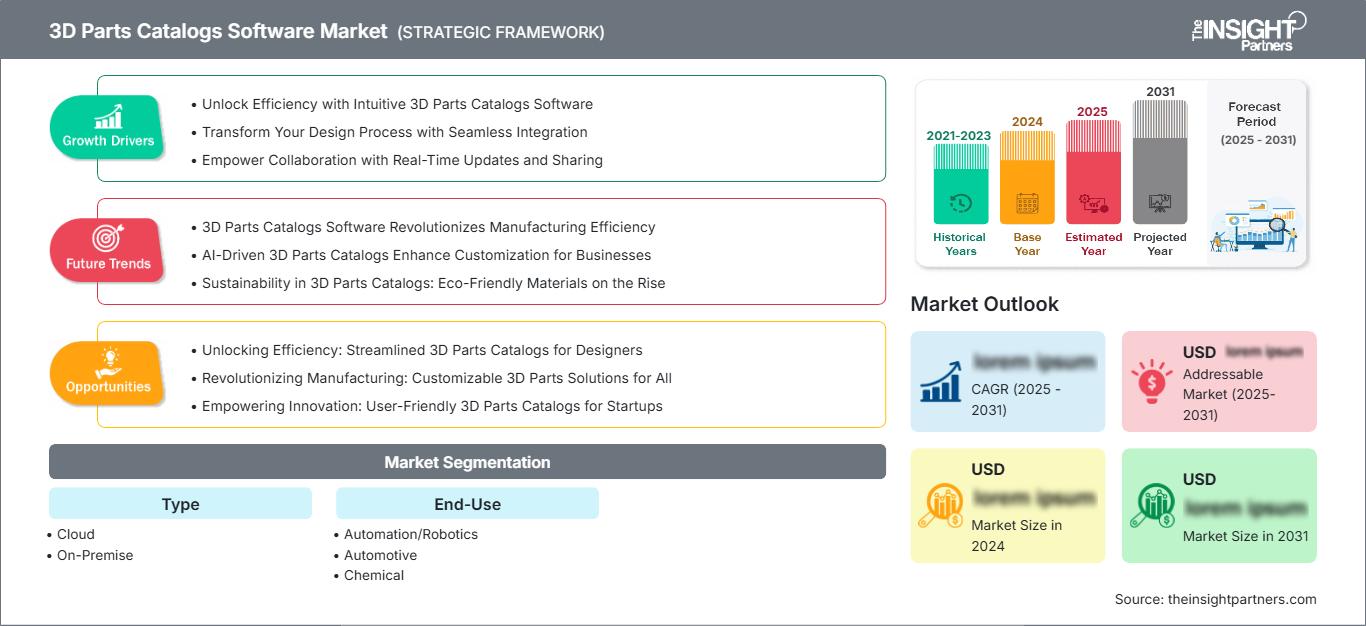
3D Parts Catalogs Software Market: Strategic Insights
Regional Insights
North America 3D parts catalogs software market
North America accounted for approximately 36–38% of global revenue in 2025, maintaining its position as the leading regional market. Extensive adoption of industrial software, advanced maintenance platforms, and digital engineering tools has created a favorable environment for market expansion. Manufacturers increasingly utilize interactive parts catalogs to support asset-intensive operations, improve technical documentation quality, and optimize spare-parts management processes. The region benefits from a mature technology infrastructure and a strong concentration of software developers serving industrial customers.
Demand is projected to advance at a 7.5–8.5% CAGR during 2026–2034. Growth is supported by increasing investment in automation technologies, smart manufacturing programs, and lifecycle asset management initiatives. Industries including automotive, industrial machinery, aerospace, and energy continue to adopt integrated visualization tools to enhance operational efficiency. Furthermore, cloud deployment models and continued digital transformation strategies are expected to strengthen long-term market performance throughout the region.
U.S. 3D parts catalogs software Market
The United States represents 74–78% of North American demand in 2025, reflecting its substantial manufacturing base and advanced enterprise software landscape. Industrial organizations increasingly rely on digital engineering solutions to improve maintenance accuracy, streamline procurement activities, and reduce equipment downtime. Strong investment in Industry 4.0 technologies further supports adoption across production-intensive sectors.
The market is anticipated to register a 7.8–8.8% CAGR through 2034, supported by rising deployment of connected service platforms and integrated product lifecycle management solutions. Presence of major software providers, continued industrial automation investments, and growing emphasis on digital maintenance ecosystems reinforce market expansion. Organizations across manufacturing, transportation, and energy sectors increasingly prioritize visual documentation tools to improve workforce productivity and operational resilience.
Europe 3D parts catalogs software Market
Europe held an estimated 28–30% share in 2025 and remains a significant market supported by advanced manufacturing capabilities and strong engineering traditions. Germany continues to lead regional adoption due to its concentration of automotive manufacturers, industrial machinery producers, and industrial automation companies that increasingly rely on integrated digital documentation environments. The region is projected to expand at a 7.2–8.2% CAGR during 2026–2034, supported by modernization initiatives and broader implementation of industrial digital transformation strategies.
The United Kingdom demonstrates healthy demand driven by aerospace, defense, industrial equipment, and engineering service sectors seeking improved lifecycle asset management. Germany maintains the largest national contribution because of its extensive installed manufacturing base and high level of engineering software adoption. France, Italy, and Spain are steadily increasing implementation of interactive catalog solutions as organizations modernize maintenance operations, improve service responsiveness, and strengthen technical documentation workflows. Demand across these countries is further encouraged by investments in factory automation, digitized service operations, and expanding aftermarket support requirements.
APAC 3D parts catalogs software Market
Asia Pacific region holds around 24-26% of the total demand in 2025 and is the fastest-growing geographic opportunity. China is a leading adopter due to its massive manufacturing capabilities and the adoption of industrial digitization technologies. Japan and South Korea continue to invest in advanced engineering solutions, and India is emerging as an important growth market due to expanding manufacturing capabilities and industrialization efforts.
The region is expected to grow at a CAGR of 9.0-10.0% between 2026 and 2034. Government efforts in automation, smart factories, and advanced manufacturing have made the environment conducive to software deployment. Increasing export-oriented manufacturing activity and efficiency in maintenance process management continue to fuel market growth.
Middle East & Africa 3D parts catalogs software Market
The Middle East and Africa market is gaining momentum as industrial diversification programs and infrastructure investments accelerate across several economies. Saudi Arabia and the United Arab Emirates account for a considerable share of regional demand owing to ongoing development of manufacturing, logistics, and energy infrastructure. South Africa continues to represent an important market for mining and industrial applications.
Growth is anticipated at a 7.8–8.8% CAGR through 2034. Expanding investment in energy projects, industrial facilities, and automation technologies is encouraging adoption of digital maintenance and equipment documentation solutions. Organizations across the region increasingly recognize the operational advantages of interactive parts identification and lifecycle information platforms.
Segmentation Analysis
Type
The type section remains crucial in software adoption methods, as companies assess deployment modes based on their business needs and other considerations. The scope of the 3D parts catalog software market has been expanding as businesses look for tools that help them integrate engineering information with maintenance, procurement, and services. The growth rate of the 3D parts catalog software market is projected to be 8.1–9.1% CAGR between 2026 and 2034, supported by accelerating digital transformation initiatives and expanded cloud adoption across industrial sectors.
- Cloud: The leading deployment model, benefiting from faster implementation, centralized updates, global accessibility, and seamless integration with enterprise systems. Cloud platforms are increasingly preferred by organizations managing distributed operations and complex product documentation requirements.
- On-Premise: Continues to maintain relevance among enterprises requiring direct control over infrastructure, highly customized workflows, and stricter data governance. Adoption remains notable in regulated environments and organizations with established legacy systems.
End-Use
The end-use segment is expected to grow at a CAGR of 8.3%-9.3% between 2026 and 2034, driven by increasing demand for digital maintenance assistance, product visualization, and lifecycle information management. Increasing equipment complexity in industrial settings broadens the scope for using interactive catalog technologies capable of improving operational performance and maintenance precision.
- Automation/Robotics: Adoption is driven by increasing use of highly engineered robotic systems that require detailed visualization, component tracking, and efficient replacement-part identification to minimize operational disruptions.
- Automotive: Remains one of the most significant user categories because manufacturers, dealer networks, and service providers require accurate parts identification and streamlined aftermarket support capabilities.
- Chemical: Companies leverage interactive catalogs to improve maintenance planning, strengthen operational continuity, and support documentation requirements across process-intensive production facilities.
- Electrical: Demand is supported by the complexity of component-rich systems that benefit from improved visualization, technical reference capabilities, and enhanced maintenance efficiency.
- Oil and Energy: Asset-intensive operations require accurate lifecycle information and efficient spare-parts management, making digital catalog solutions increasingly valuable for maintenance optimization.
- Retail: Organizations adopt digital catalog capabilities to improve online product presentation, customer engagement, and product configuration experiences across digital commerce channels.
- HVAC: Equipment manufacturers and service organizations use interactive solutions to accelerate repair workflows, improve technician effectiveness, and simplify component identification within extensive product portfolios.
Opportunity Snapshot
| End-Use | Revenue Contribution | Trend Tag | Adoption Stage |
| Automation/Robotics | High | Smart Cells | Scaling |
| Automotive | High | Aftermarket DX | Mature |
| Chemical | Medium | Asset Integrity | Scaling |
| Electrical | Medium | Component Sync | Scaling |
| Oil and Energy | High | Remote Service | Scaling |
| Retail | Low | Visual Commerce | Emerging |
| HVAC | Medium | Service Accuracy | Mature |
3D Parts Catalogs Software Market Growth Drivers and Impact Analysis
Industrial Digitalization of Maintenance Ecosystems
Manufacturers worldwide are accelerating the transition toward digital maintenance environments that connect engineering, service, and operational functions through unified software ecosystems. Interactive parts catalog solutions help technicians identify components more accurately, reduce delays associated with manual documentation, and improve maintenance productivity. As manufacturing becomes more asset-intensive, organizations require software solutions that provide instant access to technical documentation and component visuals. This leads to greater efficiencies, which help minimize downtime and maximize asset utilization. Additionally, as the number of connected factories and digital service operations increases, there is a growing need for advanced catalog technologies across many industries, including manufacturing, automotive, energy, and industrial machinery.
Growing Complexity of Industrial Equipment and Assemblies
The sophistication of industrial products continues to rise as manufacturers implement automated systems, high-technology electronics, smart control systems, and complex subsystems within their products. This complexity poses difficulties for maintenance staff trying to locate and replace malfunctioning parts. A three-dimensional catalog environment makes it easier for service staff to navigate complex assemblies to find the right parts. Companies will gain by minimizing misidentification of parts, procurement errors, and maintenance disruptions. With rising complexities in robots, transport vehicles, automation machinery, and energy structures, it is anticipated that companies will spend more on visualization documentation solutions.
Expansion of Integrated Engineering Software Ecosystems
The growing adoption of connected engineering ecosystems fosters a positive environment for market growth. Companies require interoperable software solutions across CAD, PLM, ERP, service management, and technical documentation. Three-dimensional catalog software can significantly help in linking these information flows and facilitate the reusability of engineering information. Improved system integration decreases administrative overheads and increases alignment between design specifications and service documentation. As companies continue to focus on digital thread and lifecycle information management projects, there will be an increasing need for software that can provide synchronized engineering content.
3D Parts Catalogs Software Market Future Trends
AI-Enabled Spare Parts Discovery and Contextual Search
Artificial intelligence is expected to become a defining capability in future catalog platforms. Among the most influential 3D parts catalogs software market trends, AI-supported search technologies are anticipated to aid in finding replacements through natural language searches, image searches, predictive techniques, and context-based maintenance advice. These capabilities will greatly facilitate the time-consuming process of parts identification and make it more efficient within a complex product architecture. The next generation of software solutions will also employ machine learning to analyze service history, inventory, and equipment setup, offering suggestions on which parts are needed and what maintenance is necessary. As industrial companies become increasingly digitized, intelligent search will be integrated into the platform itself and no longer be merely its distinctive feature.
Integration of Digital Twins with Service Documentation Platforms
The integration of the digital twin is anticipated to influence the development of engineering information and maintenance systems over the forecast period. Future catalogs will integrate with asset data across operations, simulations, and condition monitoring systems. Through such integrations, maintenance staff will be able to view asset status, parts catalogs, and relevant documentation. The combination of the digital twin with an interactive catalog is likely to enhance the effectiveness of troubleshooting and maintenance planning. Businesses adopting the concept of the connected factory tend to adopt solutions that integrate design information and operational data.
3D Parts Catalogs Software Market Opportunities
Expansion Across Emerging Industrial Manufacturing Hubs
Industrial development across Asia, the Middle East, and selected Latin American manufacturing regions presents a significant growth opportunity for software providers. Many organizations within these regions are building modern production environments that increasingly rely on digital-first maintenance and engineering processes. According to long-term 3D parts catalogs software market Forecasts, investment activity is expected to remain concentrated around smart manufacturing infrastructure, industrial automation initiatives, and digital engineering modernization programs. Service providers that offer cloud deployment options, multilingual abilities, and localized implementations stand to gain from meeting the needs of growing industrial companies. This possibility is enhanced by government policies that encourage industrial growth as well as the increasing need for effective spare parts management systems. Companies that form regional and sectoral alliances might enjoy consistent customer acquisition and software revenue.
Development of Industry-Specific Lifecycle Management Solutions
Another major opportunity concerns the development of specialized platforms for industries with highly complex maintenance processes and large asset inventories. Sectors such as automotive, industrial machinery, robotics, energy, and process manufacturing are increasingly reliant on customized software to facilitate specific business processes. The vendors' competitive advantage may consist of sophisticated visualization features, special content structures, documentation options tailored to specific regulations, and interoperability with operations systems. Such specialization will not only help to retain clients but will also enhance usage rates for these platforms. With the increased importance of efficient maintenance and lifecycle data management, there will be a growing demand for industry-specific software products. Companies with the required combination of skills are expected to improve their competitive position over the forecast period.
Frequently Asked Questions

- Comprehensive Market Sizing and Forecast Analysis
- Detailed Segmentation Analysis
- In-Depth Market Dynamics Assessment
- Regional and Country-Level Insights
- Competitive Landscape and Company Benchmarking
- Strategic Business Intelligence
Recent Reports
Testimonials

The Insight Partners' SCADA System Market report is comprehensive, with valuable insights on current trends and future forecasts. The team was highly professional, responsive, and supportive throughout. We are very satisfied and highly recommend their services.
RAN KEDEM Partner, Reali Technologies LTDs
I requested a report on a very specific software market and the team produced the report in a few days. The information was very relevant and well presented. I then requested some changes and additions to the report. The team was again very responsive and I got the final report in less than a week.
JEAN-HERVE JENN Chairman, Future Analytica
We worked with The Insight Partners for an important market study and forecast. They gave us clear insights into opportunities and risks, which helped shape our plans. Their research was easy to use and based on solid data. It helped us make smart, confident decisions. We highly recommend them.
PIYUSH NAGPAL Sr. Vice President, High Beam Global
The Insight Partners delivered insightful, well-structured market research with strong domain expertise. Their team was professional and responsive throughout. The user-friendly website made accessing industry reports seamless. We highly recommend them for reliable, high-quality research services
YUKIHIKO ADACHI CEO, Deep Blue, LLC.
This is the first time I have purchased a market report from The Insight Partners.While I was unsure at first, I visited their web site and felt more comfortable to take the risk and purchase a market report.I am completely satisfied with the quality of the report and customer service. I had several questions and comments with the initial report, but after a couple of dialogs over email with their analyst I believe I have a report that I can use as input to our strategic planning process.Thank you so much for taking the extra time and making this a positive experience.I will definitely recommend your service to others and you will be my first call when we need further market data.
JOHN SUZUKI President and Chief Executive Officer, Board Director, BK Technologies
I wish to appreciate your support and the professionalism you displayed in the course of attending to my request for information regarding to infectious disease IVD market in Nigeria. I appreciate your patience, your guidance, and the fact that you were willing to offer a discount, which eventually made it possible for us to close a deal. I look forward to engaging The Insight Partners in the future, all thanks to the impression you have created in me as a result of this first encounter.
DR CHIJIOKE ONYIA MANAGING DIRECTOR, PineCrest Healthcare Ltd.Reason to Buy
- Informed Decision-Making
- Understanding Market Dynamics
- Competitive Analysis
- Identifying Emerging Markets
- Customer Insights
- Market Forecasts
- Risk Mitigation
- Boosting Operational Efficiency
- Strategic Planning
- Investment Justification
- Tracking Industry Innovations
- Aligning with Regulatory Trends





 Get Free Sample for