
3D Rendering Market Size, Trends & Growth by 2034
Coverage: by Component (Solution, Services); Organization Size (SMEs, Large Enterprises); Application (Architectural and Product Visualization, High-End Video Games, Marketing and Advertisement, Training Simulation); End-user (Architecture Building and Construction, Media and Entertainment, Design and Engineering, Healthcare and Life Sciences, Academia, Others) , and Geography (North America, Europe, Asia Pacific, and South and Central America)
- Status : Data Released
- Report Code : TIPRE00010787
- Category : Technology, Media and Telecommunications
- No. of Pages : 150
- Available Report Formats :


- Last update date : August 05, 2026


2025 Market Size
US$ 7.04 Bn
Base year value
2034 Forecast
US$ 33.42 Bn
Projected by 2034
CAGR 2026-2034
18.89 %
Growth rate
Addressable Market
US$ 165.97 Bn
(2026-2034)
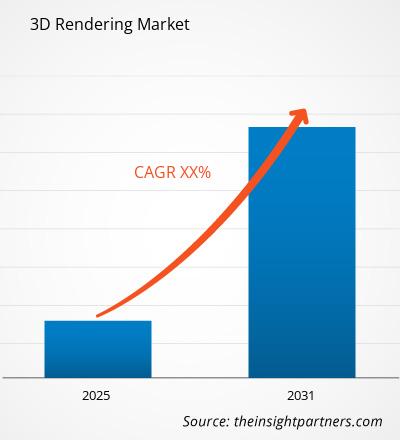
The global 3D Rendering market was valued at US$ 7.04 billion in 2025 and is expected to reach US$ 33.42 billion by 2034; it is estimated to record a CAGR of 18.89% during 2026-2034.
3D Rendering Market Assessment and Insights
- North America: Accounted for 34–38% share in 2025, supported by strong adoption across media, construction, engineering, and healthcare sectors. The region is projected to expand at a CAGR of 19–22% during 2026–2034.
- US: Represented approximately 72–76% of North American demand in 2025, supported by a concentration of major software providers and digital content creators. The market is forecast to grow at a CAGR of 20–23% during 2026–2034.
- Europe: Held 25–29% share in 2025, led by Germany, the United Kingdom, and France. Demand is supported by digital manufacturing and BIM adoption, with a projected CAGR of 18–21% during 2026–2034.
- Asia Pacific: Captured 28–32% share in 2025 and remains the fastest-developing regional market. China, Japan, India, and South Korea lead adoption, supporting a CAGR of 24–27% during 2026–2034.
- Largest Segment: Solution accounted for approximately 62–66% market share in 2025 due to extensive deployment of rendering software platforms and visualization environments. The segment is estimated to grow at a CAGR of 20–23% during 2026–2034.
- High Growth Segment: Training Simulation represented 12–16% market share in 2025 and is expected to record a CAGR of 25–28% during 2026–2034, driven by virtual learning and immersive workforce training demand.
- Key companies analyzed in detail: Adobe Inc., Autodesk, Inc., Chaos Software Ltd., Corel Corporation, Luxion, Inc., NewTek Inc., Next Limit Technologies, NVIDIA Corporation, SAP SE, Siemens AG.
Source: The Insight Partners' analysis based on proprietary research, government publications, company annual reports, investor presentations, industry databases, and expert interviews.
The 3D rendering market has evolved from traditional offline rendering processes toward highly integrated, cloud-accessible, and AI-enhanced workflows capable of delivering photorealistic outputs with significantly lower processing times. Improvements in ray tracing technologies, graphics processing units, and real-time visualization engines have expanded rendering capabilities beyond creative industries into manufacturing, construction, healthcare, education, and industrial simulation. As organizations increasingly prioritize digital transformation, rendering capabilities are becoming embedded within broader design and operational workflows.
Future development will be influenced by rising investments in digital twins, immersive collaboration environments, industrial metaverse initiatives, and cloud-native visualization platforms. Emerging economies are accelerating deployment through smart city programs, digital infrastructure initiatives, and manufacturing modernization efforts. Regulatory support for digital construction practices and increasing organizational focus on operational efficiency are expected to reinforce long-term demand for advanced visualization technologies across multiple industry verticals.
3D Rendering Market Report Scope
| Report Attribute | Details |
|---|---|
| Market size in 2025 | US$ 7.04 Billion |
| Market Size by 2034 | US$ 33.42 Billion |
| Global CAGR (2026 - 2034) | 18.89% |
| Historical Data | 2021-2024 |
| Forecast period | 2026-2034 |
3D Rendering Market Analysis
The 3D rendering market growth outlook remains highly favorable as organizations increasingly depend on advanced visualization to improve communication, design validation, and stakeholder engagement. Architectural firms employ rendering technologies to present realistic project concepts before construction begins, while manufacturers use visualization tools to accelerate product development cycles. Growth is also supported by rising demand for immersive experiences in advertising, entertainment, healthcare, and training environments. The increasing affordability of cloud rendering services is enabling smaller organizations to access capabilities that were previously available primarily to large enterprises.
Across the value chain, software developers, graphics hardware manufacturers, cloud service providers, and system integrators play complementary roles in delivering rendering solutions. Growing interoperability between rendering platforms, CAD applications, BIM environments, and simulation systems is strengthening ecosystem value. Cloud-based delivery models further reduce infrastructure requirements and improve scalability, allowing organizations to handle increasingly complex visualization projects while maintaining operational flexibility.
The 3D rendering market analysis shows a competitive environment characterized by continuous innovation, strategic alliances, and platform expansion initiatives. Industry participants are increasingly focused on improving rendering performance, enhancing workflow integration, and incorporating AI-driven automation. Vendors are allocating greater resources toward real-time rendering technologies, cloud-native deployment frameworks, and collaborative design ecosystems. These developments are improving customer retention while creating opportunities for expansion into adjacent applications such as simulation, digital twins, and immersive training.
Established participants including Adobe Inc., Autodesk, Inc., NVIDIA Corporation, Siemens AG, and SAP SE continue strengthening product portfolios through integration strategies and technology investments. Meanwhile, specialized providers such as Chaos Software Ltd., Luxion, Inc., and Next Limit Technologies concentrate on performance optimization and visualization quality. Market competition increasingly centers on rendering speed, scalability, interoperability, and user productivity enhancements. Strategic investments into AI-assisted content generation and automated scene optimization are likely to influence competitive positioning throughout the forecast period.
● REPORT CUSTOMIZATION
Tailor This Report To Align With Your Specific Business Requirements
This report can be customized to align precisely with your business objectives, scope, and target markets. Customization options include tailored segmentation, geography, competitive analysis, and strategic insights to support informed decision-making.
Customize This Report →WHAT YOU CAN ADJUST
- ● Segmentations
- ● Geography
- ● Competitive Analysis
- ● Language Preferences
3D Rendering Market: Strategic Insights
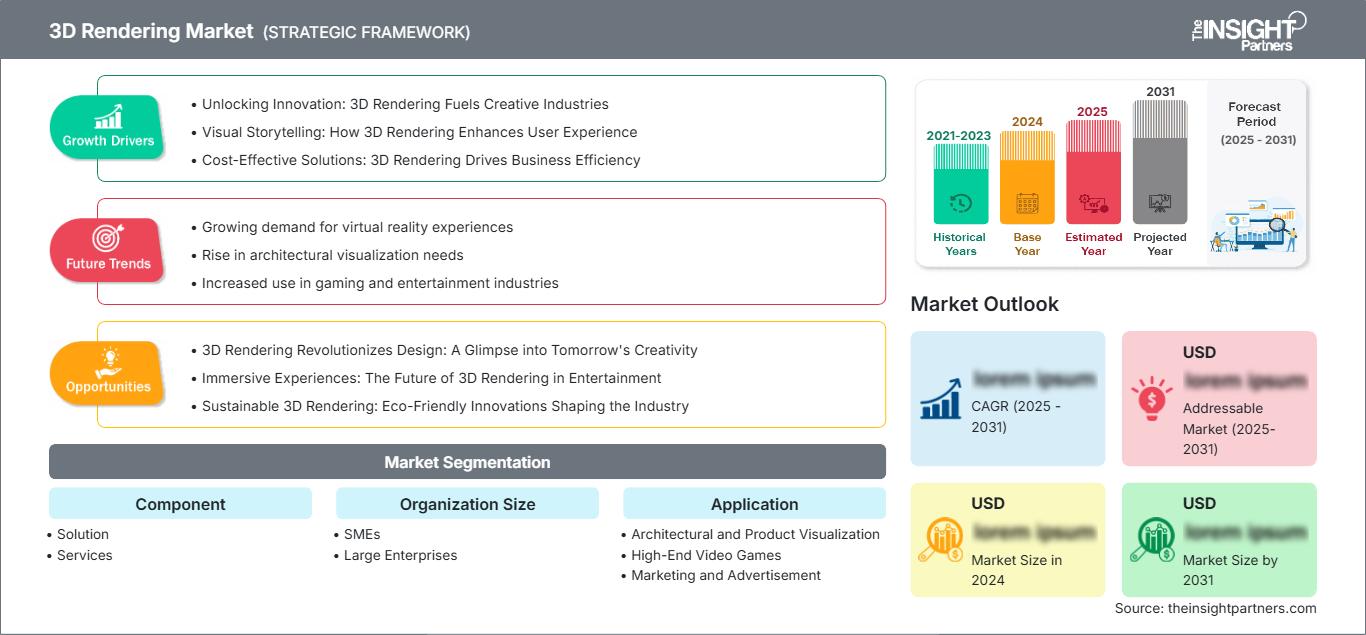
Regional Insights
North America 3D rendering market
North America accounted for approximately 34–38% of the global 3D rendering market share in 2025, making it the largest regional market. Strong software spending, mature cloud infrastructure, and widespread deployment of visualization technologies support regional leadership. The construction, entertainment, healthcare, engineering, and manufacturing industries continue investing in advanced rendering workflows to improve project outcomes and accelerate product development. Demand is further supported by increasing use of digital twins, virtual collaboration environments, and simulation-driven decision-making processes. Market expansion is projected to continue at a CAGR of 19–22% during 2026–2034.
The region's competitive advantage stems from strong innovation ecosystems and concentration of leading software vendors. Investments in real-time rendering, AI-enhanced visualization, and cloud-native production environments continue creating opportunities across commercial and industrial applications. Growing requirements for immersive customer experiences, infrastructure modernization programs, and digital engineering initiatives are expected to sustain demand. Organizations increasingly view rendering technologies as strategic tools capable of improving operational efficiency, communication, and decision quality across complex workflows.
U.S. 3D rendering market
The United States represented approximately 72–76% of North American revenue in 2025, reflecting its strong technology ecosystem and broad software adoption. Enterprises across architecture, engineering, media production, automotive design, aerospace, healthcare, and manufacturing continue investing in rendering solutions to improve visualization accuracy and accelerate innovation. Demand for virtual content creation, simulation-based training, and immersive digital experiences remains particularly strong. The market is anticipated to expand at a CAGR of 20–23% during 2026–2034.
Presence of technology leaders, advanced cloud infrastructure, and substantial research and development spending strengthens national competitiveness. Companies increasingly integrate rendering capabilities into digital twin initiatives and collaborative design workflows. High-end gaming studios, visual effects producers, and enterprise engineering organizations remain important demand contributors. Growing adoption of AI-assisted rendering techniques and automation tools is supporting productivity gains while increasing accessibility across a broader range of professional users and industry applications.
Europe 3D rendering market
The Europe market accounted for 25-29% of the worldwide revenue in 2025 and is anticipated to grow at a CAGR of 18-21% during 2026-2034. This region has strong manufacturing capabilities, excellent engineering expertise, and growing use of digital construction techniques. The dominant country in the European market is Germany due to its industrial technological capabilities and adoption of engineering visualization platforms.
The UK continues to draw considerable attention in the fields of architectural design, visual effects, advertising, and digital media design. Germany is a leader in industrial rendering, product development visualization, and the application of digital twins across various industries. Slow but steady growth is observed in France, Italy, and Spain due to infrastructure modernization and the introduction of new technologies in construction and engineering. Increased emphasis on sustainability and virtual prototyping will facilitate growth in this region.
APAC 3D rendering market
Asia Pacific has accounted for 28-32% of worldwide revenue in 2025 and is the most rapidly developing region in the major market, growing at a CAGR of 24-27% from 2026 to 2034. The high growth in the economy, industrialization, and digital content production continues driving the market.
China is leading the regional market due to its large gaming, manufacturing, and digital media sectors. Japan, South Korea, India, and Australia are increasing their investments in visualization technologies in healthcare, construction, engineering, and education sectors.
Middle East & Africa 3D rendering market
The Middle East & Africa 3D rendering market is forecast to expand at a CAGR of 17–20% during 2026–2034. Growth is supported by increasing use of rendering platforms in urban development, infrastructure planning, engineering visualization, and architectural presentation workflows.
The UAE and Saudi Arabia have continued to be the top adopters owing to extensive construction and smart-city ventures and investments in tourism infrastructure. South Africa and other neighboring regions are slowly deploying the technology in engineering, healthcare education, and industrial design.
Segmentation Analysis
Component
This component segment is expected to grow with a CAGR of 20–23% from 2026 to 2034. The trend towards integrated rendering systems that incorporate software capabilities, workflow automation, cloud connectivity, and technical support services remains strong. The need for scalable rendering environments that facilitate collaboration during design, visualization, and simulation is growing among organizations. Continuous development in rendering engines, as well as AI-driven production processes, has facilitated this adoption trend across various use cases.
- Solution: The dominant sub-segment, supported by extensive deployment of rendering software, visualization platforms, digital content creation tools, and real-time rendering engines across architecture, engineering, healthcare, and entertainment industries.
- Services: Demand is driven by implementation support, platform customization, training, consulting, migration assistance, and maintenance services that help organizations maximize the effectiveness of rendering environments and workflows.
Organization Size
The organization size segments are expected to grow at a CAGR of 21-24% from 2026 to 2034. The increased availability of cloud-based rendering facilities and subscription pricing models has helped organizations of various budgets penetrate the market. Businesses emphasize visualization tools to communicate and make decisions effectively.
- SMEs: Adoption is increasing as cloud rendering platforms reduce infrastructure costs while enabling access to professional-grade visualization capabilities for design, marketing, engineering, and content production activities.
- Large Enterprises: Significant investments in digital twins, collaborative design platforms, product development workflows, and enterprise visualization systems continue to support strong utilization among large organizations.
Application
The application segment is expected to advance at a CAGR of 22–25% during 2026–2034. Rendering technologies continue expanding beyond traditional visualization use cases into simulation, training, immersive communication, and industrial operations. Continuous innovation in real-time graphics and photorealistic rendering is broadening the range of commercial applications.
- Architectural and Product Visualization: Maintains a strong market position due to widespread use in project approvals, stakeholder engagement, design validation, and product presentation activities across multiple industries.
- High-End Video Games: Advanced rendering capabilities remain essential for realistic environments, visual effects, character development, and immersive gameplay experiences that enhance user engagement.
- Marketing and Advertisement: Organizations increasingly use photorealistic visual content to improve campaign effectiveness, communicate product value, and create differentiated customer experiences across digital channels.
- Training Simulation: Emerging as the fastest-developing application area due to rising use of virtual environments for workforce development, safety training, operational readiness, and technical education programs.
End-user
The End User category is projected to grow at a CAGR of 21-24% during 2026-2034. Increased adoption in technical, education, artistic, and industrial settings ensures continuous expansion of the addressable market. Businesses are increasingly inclined to integrate rendering into their core functions to enhance productivity, communication, and innovation.
- Architecture, Building and Construction: Rendering technologies support building visualization, BIM integration, project communication, client engagement, and design optimization throughout planning and execution phases.
- Media and Entertainment: Strong adoption across animation, broadcasting, film production, visual effects, streaming content, and digital media development continues supporting market demand.
- Design and Engineering: Utilized extensively for concept development, virtual prototyping, simulation support, design validation, and product engineering applications across manufacturing sectors.
- Healthcare and Life Sciences: Demand is increasing for medical visualization, surgical planning, educational simulation, anatomy modeling, and research communication activities requiring detailed three-dimensional imaging.
- Academia: Educational institutions and research organizations increasingly deploy rendering technologies to enhance learning experiences, support simulation-based instruction, and improve visualization of complex concepts.
Opportunity Snapshot
| End-User | Revenue Contribution | Trend Tag | Adoption Stage |
| Architecture Building and Construction | High | Digital Twin | Mature |
| Media and Entertainment | High | Real-Time VFX | Mature |
| Design and Engineering | High | Virtual Prototype | Scaling |
| Healthcare and Life Sciences | Medium | Medical Imaging | Scaling |
| Academia | Low | Spatial Learning | Emerging |
3D Rendering Market Growth Drivers and Impact Analysis
Acceleration of Digital Construction and Building Information Modeling Adoption
The construction sector is increasingly relying on digital workflows to improve planning accuracy, stakeholder communication, and the efficiency of project execution. The contemporary world of BIM systems requires advanced visualization tools that help architects, engineers, contractors, and even investors evaluate the design even before construction starts. Rendering tools may be used to detect potential design problems, improve presentation quality, and secure approvals. With the growing focus on infrastructure modernization and digitalization of project management by both the government and the private sector, the need for sophisticated visualization solutions continues to grow. The interaction among BIM tools, digital twins, and rendering engines is creating additional value by enhancing collaboration among project teams.
Rising Deployment of Digital Twins in Industrial Operations
The adoption of digital twins is accelerating in manufacturing, energy, transportation, logistics, and infrastructure. Highly realistic visualization tools are needed by organizations to create and observe virtual representations of their physical assets and the environments in which they operate. Modern rendering tools help achieve better insights into asset performance, associated risks, maintenance needs, and opportunities for process optimization. With more companies adopting Industry 4.0 strategies, rendering tools are being used as part of comprehensive digital transformation initiatives. Enhanced graphics processing power and scalability through cloud services are making it easier to visualize industrial environments.
Expansion of Immersive Simulation and Workforce Training Programs
Companies are looking for ways to achieve cost-effectiveness and scalability in training, readiness, and risk management. Rendering technology helps create lifelike simulation environments that reflect real-life conditions without causing any business interruption. Industries such as health care, aviation, manufacturing, education, emergency services, and defense are increasingly relying on immersive training solutions to enhance learning effectiveness and efficiency. The use of high-quality rendering enhances realism and enables users to gain practical experience in a simulated environment. The increase in adoption of VR/MR solutions also drives demand for rendering solutions, as visuals significantly impact user engagement and the overall effectiveness of the experience. Training simulation applications will continue to drive market growth in the coming years.
3D Rendering Market Future Trends
AI-Native Rendering Platforms Transforming Content Production
AI is anticipated to be an essential component of future rendering ecosystems. Beyond simple visualization software, rendering ecosystems are evolving into smart ecosystems that can automate processes related to materials selection, scene optimization, lighting changes, asset creation, and rendering. Shifts in the 3D rendering market trends are likely to help shorten production cycles and enhance output quality across sectors such as architecture, engineering, media, healthcare, and manufacturing. AI-based rendering may help lower barriers to entry for users without specialized skills, making production easier via natural language interfaces and workflow automation. As organizations will need to improve productivity and shorten project cycles, software vendors will increase their investments in generative design, automatic scene generation, and predictive rendering.
Convergence of Visualization, Simulation, and Collaborative Digital Twins
The future development of the market will be driven by the closer integration of rendering systems with simulations and digital twin technology. Companies need more integrated environments that provide a constant exchange of information among design, operations, and maintenance. Rendering systems evolve from simple visualization tools into the elements of digital transformation projects. Cloud computing, real-time collaboration, immersive interfaces, and simulation technologies will converge in an operational environment. This process will result in greater demand for scalable renderers capable of handling large volumes of data and producing realistic images in real time. Those organizations that successfully combine visualization with engineering and analytical tools will gain a competitive edge as more enterprise digitalization projects emerge worldwide.
3D Rendering Market Opportunities
Industrial Metaverse Deployments Creating New Revenue Streams
Industrial organizations are rapidly exploring immersive digital environments to improve planning, monitoring, collaboration, and operational efficiency. The 3D rendering market Forecasts indicate that rendering vendors may benefit substantially from increased investment in industrial metaverse initiatives across manufacturing, energy, logistics, transportation, and infrastructure sectors. These initiatives require precise visualization, simulation tools, digital twins, and collaboration interfaces that can handle complex operational scenarios. Going forward, demand will extend well beyond visualization to include operational intelligence and asset management software solutions. Tech companies that can provide cloud-based rendering solutions that integrate easily into the industrial software ecosystem have huge revenue potential for many years to come. Collaboration with manufacturing software and digital twin vendors can add to the competitive edge.
Cloud-First Platforms Expanding Access Among Small and Mid-Sized Businesses
There is an important opportunity in providing high-end visualization solutions via cloud-based deployment options. Traditionally, rendering processes required substantial investments in hardware and infrastructure, making it difficult for small companies to deploy such solutions. With cloud rendering technologies, businesses can easily leverage high-end visualization solutions as needed, saving on costs and effort. It is becoming increasingly important for small- and medium-sized enterprises to use professional visualization tools for marketing, design communications, product design, engineering, validation, and customer engagement. Companies that offer subscription-based solutions, easy integration and deployment, workflow interoperability, and productivity improvement due to AI could increase their customer reach by a great deal. Further advances in cloud infrastructure and remote collaboration technologies are likely to drive demand for scalable rendering solutions during the forecast period.
Frequently Asked Questions

- Comprehensive Market Sizing and Forecast Analysis
- Detailed Segmentation Analysis
- In-Depth Market Dynamics Assessment
- Regional and Country-Level Insights
- Competitive Landscape and Company Benchmarking
- Strategic Business Intelligence
Recent Reports
Testimonials

The Insight Partners' SCADA System Market report is comprehensive, with valuable insights on current trends and future forecasts. The team was highly professional, responsive, and supportive throughout. We are very satisfied and highly recommend their services.
RAN KEDEM Partner, Reali Technologies LTDs
I requested a report on a very specific software market and the team produced the report in a few days. The information was very relevant and well presented. I then requested some changes and additions to the report. The team was again very responsive and I got the final report in less than a week.
JEAN-HERVE JENN Chairman, Future Analytica
We worked with The Insight Partners for an important market study and forecast. They gave us clear insights into opportunities and risks, which helped shape our plans. Their research was easy to use and based on solid data. It helped us make smart, confident decisions. We highly recommend them.
PIYUSH NAGPAL Sr. Vice President, High Beam Global
The Insight Partners delivered insightful, well-structured market research with strong domain expertise. Their team was professional and responsive throughout. The user-friendly website made accessing industry reports seamless. We highly recommend them for reliable, high-quality research services
YUKIHIKO ADACHI CEO, Deep Blue, LLC.
This is the first time I have purchased a market report from The Insight Partners.While I was unsure at first, I visited their web site and felt more comfortable to take the risk and purchase a market report.I am completely satisfied with the quality of the report and customer service. I had several questions and comments with the initial report, but after a couple of dialogs over email with their analyst I believe I have a report that I can use as input to our strategic planning process.Thank you so much for taking the extra time and making this a positive experience.I will definitely recommend your service to others and you will be my first call when we need further market data.
JOHN SUZUKI President and Chief Executive Officer, Board Director, BK Technologies
I wish to appreciate your support and the professionalism you displayed in the course of attending to my request for information regarding to infectious disease IVD market in Nigeria. I appreciate your patience, your guidance, and the fact that you were willing to offer a discount, which eventually made it possible for us to close a deal. I look forward to engaging The Insight Partners in the future, all thanks to the impression you have created in me as a result of this first encounter.
DR CHIJIOKE ONYIA MANAGING DIRECTOR, PineCrest Healthcare Ltd.Reason to Buy
- Informed Decision-Making
- Understanding Market Dynamics
- Competitive Analysis
- Identifying Emerging Markets
- Customer Insights
- Market Forecasts
- Risk Mitigation
- Boosting Operational Efficiency
- Strategic Planning
- Investment Justification
- Tracking Industry Innovations
- Aligning with Regulatory Trends





 Get Free Sample for