
3D Scanner Market Trends, Demand & Growth by 2034
Coverage: By Product Type (3D Laser Scanners and Structured Light Scanners); Range (Short Range, Medium Range, and Long Range); Technology (Laser Triangulation, Pattern Fringe Triangulation, Laser Pulse Based, and Laser Phase-Shift Based), Scanner Type (Tripod Mounted, Fixed, Portable, Desktop), End-User Industry (Automotive, Aerospace and Defense, Healthcare, Architecture and Construction, Energy and Power, and Others)
- Status : Data Released
- Report Code : TIPTE100000301
- Category : Electronics and Semiconductor
- No. of Pages : 150
- Available Report Formats :


- Last update date : July 14, 2026


2025 Market Size
US$ 4.95 Bn
Base year value
2034 Forecast
US$ 11.21 Bn
Projected by 2034
CAGR 2026-2034
9.51 %
Growth rate
Addressable Market
US$ 72.11 Bn
(2026-2034)
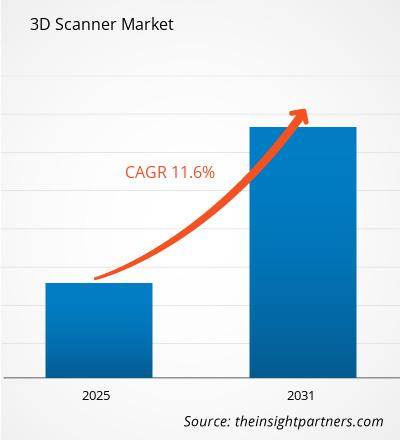
The 3D Scanner Market is projected to expand from US$ 4.95 Billion in 2025 to US$ 11.21 Billion by 2034, reflecting a CAGR of 9.51% during 2026–2034. Growth is driven by increasing deployment of high-precision digital measurement technologies across manufacturing, healthcare imaging, and infrastructure modeling. Rising integration of scanning systems in automated production environments and reverse engineering workflows continues to strengthen demand across both developed and emerging economies, particularly in industrialized production ecosystems.
North America is expected to maintain strong momentum in the 3D Scanner Market, with an estimated CAGR of 9.2–9.8% during 2026–2034. Expansion is supported by advanced aerospace manufacturing, automotive R&D investments, and increasing adoption of digital twin technologies. Additionally, strong enterprise digitization initiatives and widespread use of metrology solutions in quality control systems are reinforcing regional demand.
3D Scanner Market Assessment and Insights
- North America: North America holds a 2025 market share of 34–38%, expanding at a CAGR of 9.2–9.8% during 2026–2034. Growth is driven by industrial automation, aerospace engineering precision needs, and adoption of advanced metrology solutions across manufacturing clusters.
- US: The U.S. accounts for 82–86% of North America’s 3D Scanner Market share in 2025, growing at a CAGR of 9.3–9.9%. Strong demand from defense manufacturing, automotive prototyping, and digital engineering ecosystems supports sustained expansion.
- Europe: Europe holds a 25–29% share in 2025, growing at a CAGR of 8.8–9.3%. Germany, France, the UK, Italy, and Spain lead adoption due to strong automotive engineering, industrial design innovation, and increasing aerospace component manufacturing.
- Asia Pacific: Asia Pacific accounts for a 28–32% 3D Scanner market size in 2025, expanding at a CAGR of 10.2–10.8%. China, Japan, South Korea, India, and Australia drive demand through industrial automation, electronics manufacturing, and infrastructure modernization.
- Largest Segment – Hardware: Hardware dominates with a 62–66% share in 2025, growing at a CAGR of 9.2–9.6%, supported by high demand for portable, high-accuracy scanning devices across industrial applications.
- High Growth Segment – Structured Light Scanner: Structured light scanners hold a 20–24% share in 2025, growing at a CAGR of 10.5–11.5%, driven by precision imaging needs in healthcare, design, and reverse engineering applications.
- Key companies analyzed in detail: 3D Digital Corporation, 3D Systems Corporation, Autodesk, Inc., Creaform, Inc., FARO Technologies, Inc., GOM GmbH, Hexagon AB, Nikon Metrology NV, Trimble Navigation Ltd., Topcon Corporation.
Source: The Insight Partners' analysis based on proprietary research, government publications, company annual reports, investor presentations, industry databases, and expert interviews.
The 3D Scanner Market has evolved from basic manual digitization tools into highly automated, AI-integrated metrology systems capable of real-time spatial data capture. Early adoption was concentrated in industrial inspection, but advancements in structured light, laser triangulation, and optical scanning have expanded use cases across healthcare imaging and construction modeling. Integration with CAD/CAM ecosystems and cloud-based simulation platforms has further accelerated deployment. The transition toward portable and handheld scanners has improved accessibility, enabling field-based applications in automotive prototyping and infrastructure mapping environments.
Future market growth is expected to be influenced by the adoption of digital twins, the implementation of Industry 4.0, and investments in smart manufacturing ecosystems. The emerging markets in Asia Pacific and Latin America will support the demand through their digitization infrastructure projects. Quality assurance regulations in the aerospace and healthcare sectors will further drive adoption. Moreover, the adoption of artificial intelligence-based scanning analytics and cloud-based collaboration systems will revolutionize operations across engineering and design processes.
3D Scanner Market Report Scope
| Report Attribute | Details |
|---|---|
| Market size in 2025 | US$ 4.95 Billion |
| Market Size by 2034 | US$ 11.21 Billion |
| Global CAGR (2026 - 2034) | 9.51% |
| Historical Data | 2021-2024 |
| Forecast period | 2026-2034 |
3D Scanner Market Analysis
The 3D Scanner Market report is witnessing strong demand driven by precision manufacturing, automation in industrial inspection, and increasing reliance on digital modeling technologies. Expansion of smart factories and robotics-integrated production lines has significantly increased the need for accurate spatial measurement tools. The ecosystem includes hardware manufacturers, software developers, and service providers integrating scanning outputs into CAD and simulation environments.
Supply-side dynamics are influenced by technological advancements in laser and optical scanning systems, improving accuracy and reducing processing time. Rising miniaturization of sensors and integration with AI-driven analytics platforms further enhances usability. Growing demand from healthcare imaging and construction modeling is expanding application depth, strengthening the overall market scope across industries.
The competitive intensity remains high due to a focus on innovation and ecosystem integration. Autodesk, Inc. invests in software improvements, and Hexagon AB and FARO Technologies, Inc. concentrate on industrial metrology solutions. Creaform, Inc. and 3D Systems Corporation specialize in portable scanning systems, while Nikon Metrology NV and GOM GmbH develop optical high-precision technologies. The investment trends continue to be characterized by partnerships, mergers, and acquisitions.
Innovations in artificial intelligence, scanning analytics, and cloud-based platform development are becoming the main areas of investment. Trimble Navigation Ltd. and Topcon Corporation enter the construction digitization market, while startups enter with innovative light-scanning equipment for mobile applications. The competitive positions shift in response to developments in the hardware and software ecosystems.
● REPORT CUSTOMIZATION
Tailor This Report To Align With Your Specific Business Requirements
This report can be customized to align precisely with your business objectives, scope, and target markets. Customization options include tailored segmentation, geography, competitive analysis, and strategic insights to support informed decision-making.
Customize This Report →WHAT YOU CAN ADJUST
- ● Segmentations
- ● Geography
- ● Competitive Analysis
- ● Language Preferences
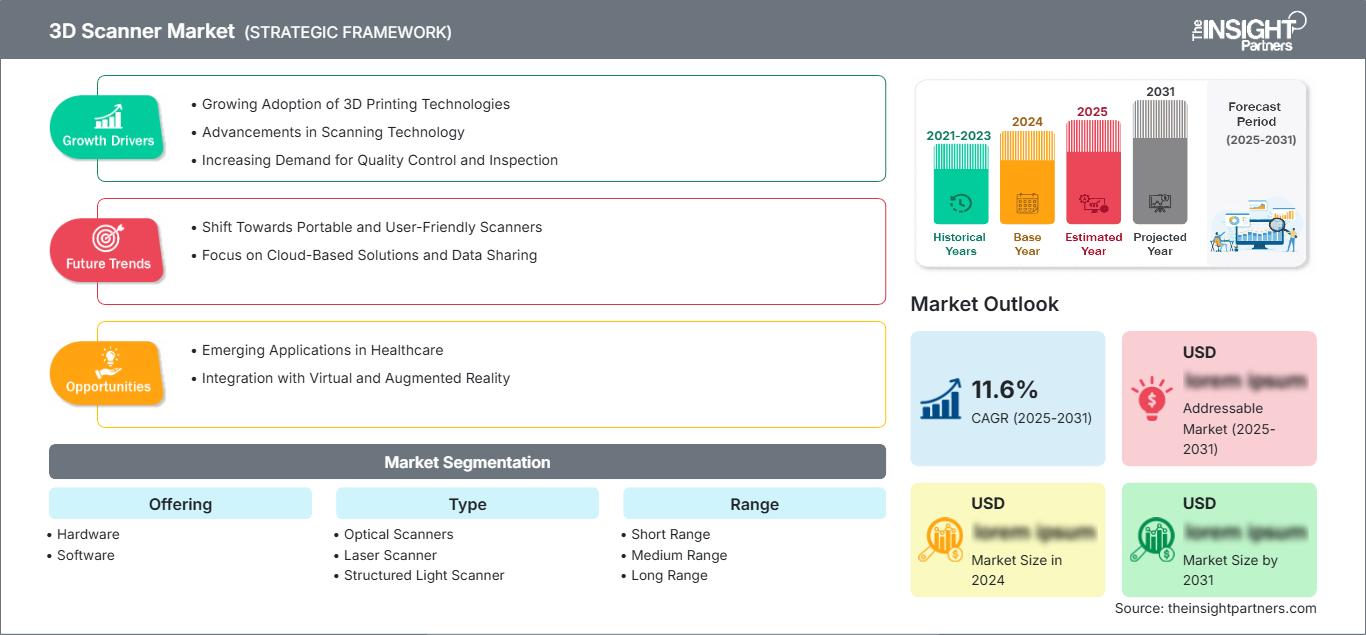
3D Scanner Market: Strategic Insights
Regional Insights
North America 3D Scanner Market
North America dominates the global 3D Scanner Market with a share of 34–38% in 2025, supported by strong industrial automation and advanced manufacturing ecosystems. The region benefits from high adoption of aerospace and automotive engineering technologies, particularly in the U.S. and Canada. Demand is further reinforced by increasing integration of digital twin frameworks in industrial operations and construction modeling.
The region is expected to experience a CAGR of 9.2% to 9.8% between 2026 and 2034, owing to increasing investment in precision engineering and smart factory development. The presence of major firms, including FARO Technologies, Inc., and 3D Systems Corporation, increases innovation in the industry. The increasing applications of metrology systems in defense manufacturing and healthcare imaging sectors ensure continued market growth.
U.S. 3D Scanner Market
The U.S. accounts for 82–86% of North America’s market in 2025, making it the largest country-level contributor. The growth is mainly fueled by innovations in aerospace engineering, automotive prototyping, and AI-powered manufacturing systems.
The growth rate of the U.S. market in 2026–2034 is expected to be at a 9.3%- 9.9% CAGR. The participation of companies such as Autodesk, Inc., and Hexagon AB makes an important contribution to innovation in digital design and metrology. The growing demand for accurate scanning in the defense industry and healthcare remains a trend.
Europe 3D Scanner Market
Europe is expected to hold 25-29% by 2025, owing to its excellent automotive engineering and industrial design industries. Europe is set to witness growth of 8.8-9.3%, with Germany, France, the United Kingdom, Italy, and Spain leading. Germany continues to hold a dominant position owing to its manufacturing capabilities and automotive innovation centers.
Technology has found wide use in the UK for modeling in construction and heritage, while Germany uses it widely for automotive prototyping and industrial metrology. France and Italy are concentrating their efforts on the aerospace industry and luxury manufacturing. The Spanish are using the technology to develop their infrastructure and smart cities initiatives, collectively strengthening regional demand.
APAC 3D Scanner Market
Asia Pacific region commands 28%-32% of the market in 2025, with a CAGR of 10.2%-10.8%, making it the fastest-growing region. China is the leader owing to its large-scale manufacturing, followed by Japan and South Korea, which have well-developed electronics and robotics industries.
The use of the technology is growing in the fields of infrastructure development and mining in both India and Australia. Many government policies on industrial automation and digital transformation are aiding the implementation of these technologies. The manufacturing sector and export production models are further reinforcing regional dominance.
Middle East & Africa 3D Scanner Market
MEA accounts for a 5–7% share in 2025, growing at a CAGR of 8.5–9.0%. Saudi Arabia and the UAE lead due to smart city development and infrastructure modernization programs. South Africa shows gradual adoption in mining and industrial inspection.
The rest of MEA is experiencing steady growth supported by construction and energy sector digitization. Rising investments in oil and gas infrastructure modeling and urban development projects are driving long-term adoption. Saudi Arabia remains the leading country in the region due to large-scale Vision-driven transformation projects.
Segmentation Analysis
Offering
The Offering segment is a foundational pillar of the market, driven by demand for integrated scanning ecosystems combining physical devices and analytics platforms. Hardware dominates due to widespread use in industrial inspection and reverse engineering, while software is rapidly gaining traction through cloud-based processing and simulation tools. Increasing convergence of scanning devices with AI-driven analytics is enhancing operational efficiency across manufacturing and healthcare applications.
- Hardware: Dominates industrial applications with strong adoption in precision engineering, metrology, and automotive prototyping environments requiring high-accuracy spatial data capture.
- Software: Expanding rapidly due to demand for cloud-based processing, CAD integration, and AI-enabled visualization tools improving workflow efficiency and collaboration.
Type
Type-based segmentation reflects technological diversity within scanning systems, where optical scanners lead due to cost-effectiveness and versatility. Laser scanners are widely used in industrial environments requiring high precision and long-range measurement. Structured light scanners are gaining traction in healthcare and design applications due to superior surface detail capture and accuracy improvements.
- Optical Scanners: Widely used across industrial and commercial applications due to affordability and adaptability across multiple scanning environments.
- Laser Scanners: Preferred in high-precision industrial applications requiring long-range measurement and high structural accuracy.
- Structured Light Scanners: Increasingly adopted in healthcare, design, and reverse engineering due to high-resolution surface mapping capabilities.
Range
Range-based segmentation plays a critical role in determining application suitability across industries. Short-range scanners dominate due to their precision in controlled environments, while medium-range systems serve versatile industrial applications. Long-range scanners are gaining momentum in construction and infrastructure mapping due to expanding geospatial modeling requirements.
- Short Range: Common in laboratory, healthcare, and product design applications requiring extremely high precision at close distances.
- Medium Range: Balanced use across industrial inspection and manufacturing environments requiring moderate distance scanning flexibility.
- Long Range: Used in construction and infrastructure modeling where large-scale spatial data capture is essential.
End User
End-user segmentation highlights industrial dominance supported by strong manufacturing adoption. Automotive and aerospace sectors remain key contributors due to precision engineering requirements. Healthcare is emerging as a high-growth vertical driven by imaging innovations, while architecture and construction continue expanding through BIM integration and digital twin adoption.
- Industrial: Largest contributor driven by automation, quality control, and reverse engineering applications across manufacturing ecosystems.
- Aerospace & Defense: High adoption due to stringent precision requirements in component manufacturing and structural inspection.
- Automotive: Strong usage in prototyping, design validation, and production optimization processes.
- Architecture & Construction: Increasing adoption through BIM integration and infrastructure digitization.
- Healthcare: Expanding rapidly in medical imaging, prosthetics design, and surgical planning applications.
- Others: Includes education, research, and specialized engineering applications.
Opportunity Snapshot
| Segment Name | Revenue Contribution | Trend Tag | Adoption Stage |
| Industrial | High | Smart Factory | Mature |
| Aerospace & Defense | Medium | Precision Engineering | Scaling |
| Automotive | Medium | Digital Prototyping | Mature |
| Architecture & Construction | Medium | BIM Integration | Scaling |
| Healthcare | High | Medical Imaging | Emerging |
| Others | Low | R&D Expansion | Emerging |
3D Scanner Market Growth Drivers and Impact Analysis
Rising Demand for Precision Manufacturing Automation
The increasing use of automation across industries is a major driver of growth in the 3D Scanner Market. Industries such as automotive, aerospace, and heavy machinery need accurate inspection systems to reduce defects. The use of 3D scanners helps with quality control and reduces dependence on manual measuring systems. Use with robotics and artificial intelligence-based inspection machines also increases the efficiency of production lines. With the transition to intelligent factories, there will be an increasing demand for sophisticated scanning systems across North America, Europe, and Asia Pacific.
Expansion of Digital Twin and Simulation Ecosystems
The growing use of digital twin technology across industries is driving greater uptake of 3D scanner technology. The technologies require accurate spatial information to develop real-time replicas of physical objects. Various industries, such as construction, energy, and transportation, are increasingly adopting scanning technologies to improve predictive maintenance and design optimization. Integration with CAD and simulations improves visibility and reduces costs throughout the lifecycle. 3D Scanner market trends have been observed, especially in developing economies that are building smart cities and industrializing.
Healthcare Imaging and Biomedical Engineering Growth
The use of 3D scanning technology in healthcare applications is a significant growth trend, owing to its increasing use in prosthetic and orthodontic design and surgical planning. The use of high-resolution imaging helps achieve personalized medicine solutions while also improving the diagnostic process. Structured light and optical scanners are being adopted in hospitals and institutes for non-invasive imaging. Growing investment in biomedical engineering and medical devices is driving the adoption of 3D scanning technology. Regulatory focus on precision diagnostics and patient-specific solutions is further strengthening demand, making healthcare one of the fastest-expanding application segments globally.
3D Scanner Market Future Trends
AI-Integrated Real-Time Scanning Systems
With the inclusion of artificial intelligence in 3D scanning systems, data collection and processing methods are changing. Scanners equipped with AI can correct distortions, increase resolution, and create optimized 3D models on the fly. This reduces post-processing time and improves workflow efficiency across industries. Nowadays, companies are implementing machine learning technologies in their scanners to analyze defects automatically and predict outcomes. It will reshape the quality control process in the automotive and aerospace industries, where precision and speed are critical.
Miniaturization and Portability of Scanning Devices
One of the emerging trends is the move towards small, portable, and handheld 3D scanning devices. With this move, applications in construction, archeology, and infrastructure inspection will become possible. The use of lightweight scanning machines with wireless and cloud capabilities has made it easier to extend usability beyond the industry's walls. In addition, with the growing need for mobility, improvements in battery performance and sensor size have become a necessity. As fieldwork goes digital, portable scanning technology is likely to be a game-changer in emerging markets.
3D Scanner Market Opportunities
Expansion in Emerging Infrastructure Markets
Rapid urbanization and infrastructure development in emerging economies present significant opportunities for the 3D Scanner Market. Countries across Asia Pacific, Latin America, and the Middle East are investing heavily in smart cities, transportation networks, and industrial zones. 3D scanning technologies are increasingly being used in construction planning, structural monitoring, and geospatial mapping. This creates strong demand for cost-effective, scalable scanning solutions. Companies that offer portable, high-accuracy devices integrated with cloud platforms are well-positioned to capture growth in this rapidly expanding 3D Scanner market forecast.
Integration with Industrial IoT and Cloud Ecosystems
The emergence of 3D scanning technology, alongside the Industrial Internet of Things and cloud computing, opens new possibilities for real-time data analysis and remote collaboration. Networked scanning devices facilitate the smooth exchange of data among engineering teams, thereby enhancing design precision and efficiency. In addition, cloud technologies facilitate the centralized storage and processing of massive spatial datasets. This combination is especially useful in complex global manufacturing facilities where coordination among dispersed teams is required.
Recent Developments
- May 2026: FARO CREAFORM announced that its HandySCAN 3D EVO Series handheld 3D scanner won a Red Dot Award for Product Design, reinforcing the importance of ergonomic, shop-floor-ready metrology tools with real-time visualization and improved operator efficiency.
- October 2025: Hexagon’s Manufacturing Intelligence division introduced ATLASCAN Pro, a lightweight handheld 3D laser scanner designed to make professional-grade scanning accessible to entry-level users, with wireless operation, scan-to-CAD workflow support, and inspection capabilities.
- July 2025: AMETEK completed its acquisition of FARO Technologies, bringing FARO together with Creaform and Virtek under AMETEK’s Ultra Precision Technologies Division to strengthen portable and automated 3D metrology, laser projection, and digital reality solutions.
Frequently Asked Questions

- Comprehensive Market Sizing and Forecast Analysis
- Detailed Segmentation Analysis
- In-Depth Market Dynamics Assessment
- Regional and Country-Level Insights
- Competitive Landscape and Company Benchmarking
- Strategic Business Intelligence
Recent Reports
Testimonials

The Insight Partners' SCADA System Market report is comprehensive, with valuable insights on current trends and future forecasts. The team was highly professional, responsive, and supportive throughout. We are very satisfied and highly recommend their services.
RAN KEDEM Partner, Reali Technologies LTDs
I requested a report on a very specific software market and the team produced the report in a few days. The information was very relevant and well presented. I then requested some changes and additions to the report. The team was again very responsive and I got the final report in less than a week.
JEAN-HERVE JENN Chairman, Future Analytica
We worked with The Insight Partners for an important market study and forecast. They gave us clear insights into opportunities and risks, which helped shape our plans. Their research was easy to use and based on solid data. It helped us make smart, confident decisions. We highly recommend them.
PIYUSH NAGPAL Sr. Vice President, High Beam Global
The Insight Partners delivered insightful, well-structured market research with strong domain expertise. Their team was professional and responsive throughout. The user-friendly website made accessing industry reports seamless. We highly recommend them for reliable, high-quality research services
YUKIHIKO ADACHI CEO, Deep Blue, LLC.
This is the first time I have purchased a market report from The Insight Partners.While I was unsure at first, I visited their web site and felt more comfortable to take the risk and purchase a market report.I am completely satisfied with the quality of the report and customer service. I had several questions and comments with the initial report, but after a couple of dialogs over email with their analyst I believe I have a report that I can use as input to our strategic planning process.Thank you so much for taking the extra time and making this a positive experience.I will definitely recommend your service to others and you will be my first call when we need further market data.
JOHN SUZUKI President and Chief Executive Officer, Board Director, BK Technologies
I wish to appreciate your support and the professionalism you displayed in the course of attending to my request for information regarding to infectious disease IVD market in Nigeria. I appreciate your patience, your guidance, and the fact that you were willing to offer a discount, which eventually made it possible for us to close a deal. I look forward to engaging The Insight Partners in the future, all thanks to the impression you have created in me as a result of this first encounter.
DR CHIJIOKE ONYIA MANAGING DIRECTOR, PineCrest Healthcare Ltd.Reason to Buy
- Informed Decision-Making
- Understanding Market Dynamics
- Competitive Analysis
- Identifying Emerging Markets
- Customer Insights
- Market Forecasts
- Risk Mitigation
- Boosting Operational Efficiency
- Strategic Planning
- Investment Justification
- Tracking Industry Innovations
- Aligning with Regulatory Trends





 Get Free Sample for