
Atelo-Gelatin Market Demand, Trends & Forecast by 2034
Coverage: By Type (Bovine Gelatin, Porcine Gelatin, Other); Application (Cosmetics, Pharmaceutical, Medical Devices, Food and Supplements, Other), and Geography (North America, Europe, Asia Pacific, and South and Central America)
- Status : Data Released
- Report Code : TIPRE00021880
- Category : Life Sciences
- No. of Pages : 150
- Available Report Formats :


- Last update date : September 07, 2026


2025 Market Size
US$ 3.63 Bn
Base year value
2034 Forecast
US$ 4.95 Bn
Projected by 2034
CAGR 2026-2034
3.51 %
Growth rate
Addressable Market
US$ 38.97 Bn
(2026-2034)
The Atelo-Gelatin market was valued at US$ 3.63 billion in 2025 and is expected to reach US$ 4.95 billion by 2034; it is estimated to record a CAGR of 3.51% during 2026-2034.
Atelo-Gelatin Market Assessment and Insights
- North America: North America is expected to account for 35–40% share in 2025 and expand at a CAGR of 3.7–4.2% between 2026–2034, supported by advanced biomedical manufacturing and established cosmetic ingredient demand.
- US: The US is projected to represent 76–80% of North American revenue in 2025 and grow at a CAGR of 3.8–4.3% during 2026–2034, supported by medical devices and regenerative applications.
- Europe: Europe is expected to hold a 28–31% share in 2025 and grow at a CAGR of 3.4–3.9% through 2034, led by Germany, France, the UK, Italy, and Spain, with strong regulatory oversight.
- Asia Pacific: Asia Pacific is estimated at a 22–26% share in 2025 and is projected to grow at a CAGR of 4.3–4.8%, led by China, Japan, South Korea, and India through manufacturing expansion.
- Largest Segment: Bovine Gelatin is estimated to hold a 55–60% market share in 2025, with a CAGR of 3.6–4.1% between 2026–2034, supported by established supply chains.
- High Growth Segment: Medical Devices is estimated to represent a 22–26% share in 2025 and grow at a CAGR of 4.4–4.9%, reflecting regenerative and wound-management applications.
- Key companies analyzed in detail: KOKEN CO., LTD.; dsm-firmenich AG; Integra LifeSciences Holdings Corporation; Collagen Matrix, Inc.; EnColl Corporation; Stryker Corporation; Collagen Solutions Plc; Innocoll Holdings Limited; SYMATESE; Shuangmei.
Source: The Insight Partners' analysis based on proprietary research, government publications, company annual reports, investor presentations, industry databases, and expert interviews.
The atelo-gelatin market development is now taking steps forward from traditional collagen manufacturing into specialized biomaterials and products of specific purity and customized physical characteristics. KOKEN offers atelocollagen for research, collagen for medical purposes and raw materials for cosmetics, whereas dsm-firmenich manufactures medical-grade bovine collagen in various forms such as powders, slurries, films, pads, and custom scaffolds. This illustrates how more precise manufacturing is becoming a factor in defining applicability in tissue repair, coating, scaffolds, and formulation development.
Opportunities are projected to increase in regenerative medicine, advanced wound care, aesthetics procedures, and research uses in Asia Pacific as well as emerging healthcare markets. Regulations related to animal-derived collagen and gelatin used in medical devices support this trend. The regulations specifically address collagen and gelatine used in medical devices, thus favoring manufacturers that have proper controls of the raw materials and their processing.
Atelo-Gelatin Market Report Scope
| Report Attribute | Details |
|---|---|
| Market size in 2025 | US$ 3.63 Billion |
| Market Size by 2034 | US$ 4.95 Billion |
| Global CAGR (2026 - 2034) | 3.51% |
| Historical Data | 2021-2024 |
| Forecast period | 2026-2034 |
Atelo-Gelatin Market Analysis
Demand trends are being influenced by the growing application of collagen-based biomaterials, where biocompatibility, tissue interaction, and degradation characteristics are key product properties. Atelo-gelatin market expansion can therefore be seen as being driven by applications in medical device production, cosmetics formulation, drug delivery systems, and functional foods.
Supply conditions are increasingly favoring suppliers that have the capability of ensuring consistency and traceability of molecular structure between batches. Processes for medical applications are much more tightly controlled compared to traditional food grade gelatins. Customers in the cosmetic and dietary supplements sectors have been increasingly looking at source consistency and formula efficacy as an added criterion. DSM-Firmenich, for instance, has been able to manufacture medical-grade collagen under cGMP guidelines and also offer FDA Master Files as a regulatory service.
The competitive environment consists of specialized collagen producers along with diversified healthcare companies. KOKEN has a wide range of products within the category of atelocollagens applicable for research, medical and cosmetic purposes. Meanwhile, Integra LifeSciences, Collagen Matrix, EnColl, Stryker, and Collagen Solutions have involvement in medical biomaterials and devices applications. Consequently, the analysis of the atelo-gelatin market report should focus on application-driven differentiation rather than simple commodity volumes, taking into account purity, regulation compliance, formulation experience and device integration as the competitive factors.
Investments are focused on scalable biomaterial processing, tissue engineering innovations and customized products. SYMATESE combines collagen processing and device manufacturing and states capabilities in terms of processing of raw materials up to manufacture of final products, while KOKEN continues researching atelocollagen, cell cultures and nucleic acid delivery. This approach allows suppliers to create additional value downstream integrating material science and application development.
● REPORT CUSTOMIZATION
Tailor This Report To Align With Your Specific Business Requirements
This report can be customized to align precisely with your business objectives, scope, and target markets. Customization options include tailored segmentation, geography, competitive analysis, and strategic insights to support informed decision-making.
Customize This Report →WHAT YOU CAN ADJUST
- ● Segmentations
- ● Geography
- ● Competitive Analysis
- ● Language Preferences
Atelo-Gelatin Market: Strategic Insights
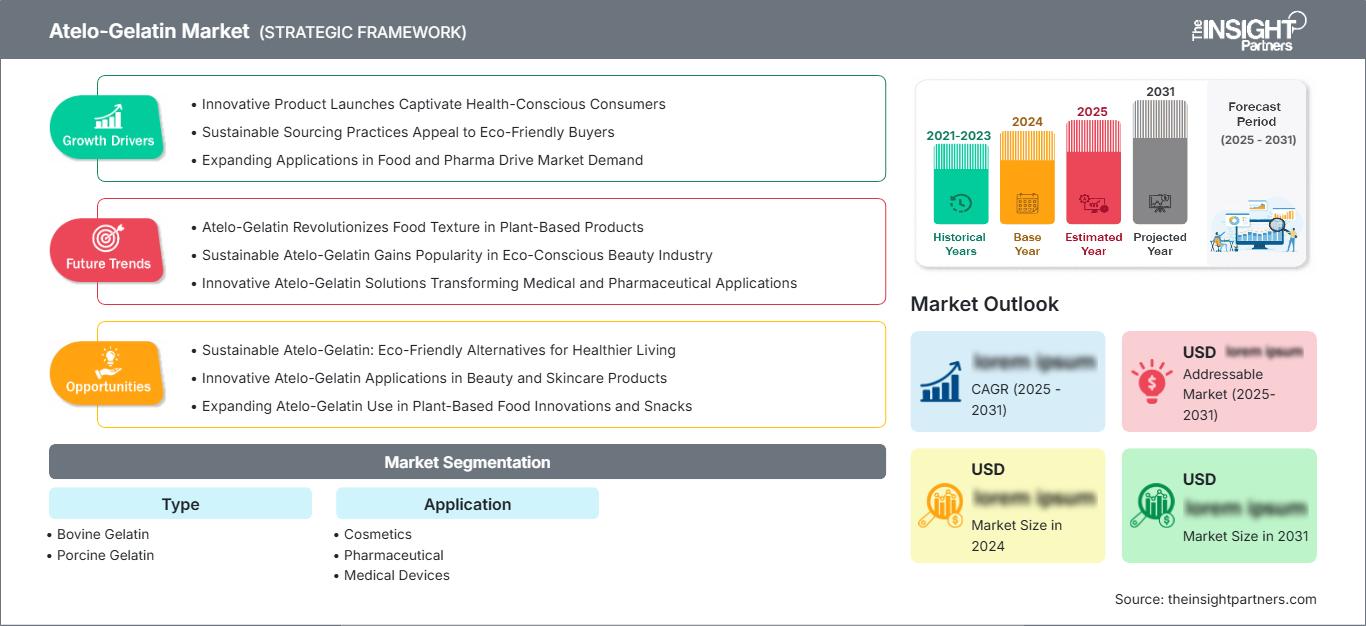
Regional Insights
North America atelo-gelatin market
North America is expected to maintain the largest regional position, with a 35–40% share in 2025 and a CAGR of 3.7–4.2% through 2034. The region benefits from mature medical device manufacturing, established pharmaceutical development, advanced cosmetic formulation, and strong research infrastructure. The US accounts for most regional demand because of its extensive healthcare expenditure, biotechnology ecosystem, and concentration of biomaterial developers.
Canada has involvement in biomedicine research, manufacturing specialization and application of ingredients in cosmetics whereas Mexico is providing a manufacturing facility which is increasing in size and linked with the healthcare supply chains of North America. Purchasing trends within the region are moving towards those buyers who can satisfy the requirements of documentations, traceability, sterility and consistency. Medical applications with its high value and formulation provide relatively stable demand along with research applications which give more chances for customizing collagen matrixes and atelocollagen.
U.S. atelo-gelatin Market
The US represents an estimated 76–80% of North American revenue in 2025 and is expected to grow at a CAGR of 3.8–4.3%. Demand is supported by medical devices, regenerative medicine research, wound management, pharmaceutical development, and premium cosmetic formulations. Leading healthcare companies and specialist biomaterial suppliers provide a broad commercialization ecosystem.
There is a clear trend towards material purity and application specificity as opposed to generic collagen input material used in the applications under consideration. Stryker has significant research and development capacities, whereas Integra LifeSciences and Collagen Matrix engage in medical applications with intensive use of biomaterials. Another source of strength in the market is active academia and biotech engagement in the sphere of tissue engineering and cell culture.
Europe atelo-gelatin Market
The continent accounts for 28-31% of the atelo-gelatin market share of worldwide revenues in 2025 and registers CAGR of 3.4-3.9%, with Germany being one of the dominant markets. Europe comprises manufacturing of medical devices, pharmaceutical formulation, cosmetics, and experience in collagen processing. The strengths of Germany and France include industrial and research infrastructure, whereas the strengths of the UK, Italy, and Spain involve specialized healthcare and cosmetic applications.
Strengths of Germany include advanced manufacturing and high demand for regulated biomaterials, whereas strengths of France include ecosystem related to collagen and tissue regeneration, including such companies as SYMATESE. Strengths of the UK include research in pharmaceutical and biotechnology industries, whereas strengths of Italy and Spain include significant demand for cosmetic, medical devices, and food formulation. The demand for animal derived products used in medical devices in Europe highlights issues of sourcing, processing, safety, and traceability.
APAC atelo-gelatin Market
APAC is estimated to represent 22–26% of global revenue in 2025 and is expected to expand at a CAGR of 4.3–4.8%, making it the fastest-growing major region. China, Japan, South Korea, India, and Australia form the principal demand centers, supported by healthcare investment and manufacturing capacity.
For China, it would be beneficial to increase production in biomedical sciences, while Japan has expertise in collagen because of KOKEN. For South Korea, the contributions would be in aesthetic medicine and biomaterials. India is building its capacity in the manufacture of devices and medicines, while Australia offers an advanced but small market. It will be important for policy to support healthcare infrastructure, local manufacturing, research in regenerative medicine, and advanced medical technologies.
Middle East & Africa atelo-gelatin Market
Middle East and Africa is expected to expand at a CAGR of 4.1–4.6%, supported by healthcare infrastructure investment and increasing demand for advanced medical and cosmetic products. Saudi Arabia and the UAE represent the principal Gulf markets, while South Africa provides the strongest regional healthcare manufacturing and distribution base.
The agenda for the change of healthcare in Saudi Arabia encourages specialized medicine practices, while in the UAE, there is demand for top-quality biomaterials arising out of the private healthcare industry and aesthetic medicine. South Africa offers access to a relatively advanced medical environment, whereas the rest of the region depends on imports. Other factors that are critical to the market development include supply chain management, registration, refrigeration, and technical support.
Segmentation Analysis
Type
The Type segment in the atelo-gelatin market is expected to grow at a CAGR of 3.7–4.1% between 2026–2034. Source selection remains closely linked to application requirements, regulatory considerations, availability, processing economics, and customer preferences. Bovine and porcine materials occupy different commercial niches, with manufacturers increasingly emphasizing traceability and consistent biochemical characteristics.
- Bovine Gelatin: Bovine-derived material maintains a strong position because of broad industrial availability and established processing infrastructure. It is important across medical biomaterials, cosmetics, pharmaceutical formulations, and selected food applications.
- Porcine Gelatin: Porcine-derived material remains commercially important where formulation performance, established processing routes, and source availability align with customer requirements. Its strategic role varies by geography, application, and sourcing policy.
Application
The Application segment in the atelo-gelatin market is projected to grow at a CAGR of 3.8–4.3% from 2026–2034. Demand is diversified across consumer and healthcare markets, but medical and pharmaceutical applications generally require greater purity, documentation, and functional consistency. This creates opportunities for suppliers that can transition from bulk material supply toward application-specific formulations.
- Cosmetics: Cosmetic applications benefit from collagen-associated positioning in skin-care formulations, topical products, and professional aesthetic products. Demand favors consistent texture, formulation compatibility, and documented sourcing.
- Pharmaceutical: Pharmaceutical applications require controlled quality and reproducibility, particularly when materials are incorporated into delivery systems or specialized formulations. Regulatory documentation and manufacturing controls are central purchasing criteria.
- Medical Devices: Medical device applications emphasize biocompatibility, controlled degradation, sterilization compatibility, and mechanical performance. The segment supports higher-value opportunities in wound management, tissue regeneration, scaffolds, and implant-related technologies.
- Food and Supplements: Food and supplement applications are influenced by consumer interest in protein-derived ingredients and functional nutrition. Source transparency, formulation stability, regulatory compliance, and sensory characteristics shape supplier selection.
Opportunity Snapshot
| Application | Revenue Contribution | Trend Tag | Adoption Stage |
| Cosmetics | High | Skin Repair | Mature |
| Pharmaceutical | Medium | Drug Delivery | Scaling |
| Medical Devices | High | Tissue Repair | Scaling |
| Food and Supplements | High | Functional Nutrition | Mature |
Atelo-Gelatin Market Growth Drivers and Impact Analysis
Expansion of regenerative and biomaterial-based medical applications
Regenerative medicine is creating demand for biomaterials capable of supporting cellular attachment, tissue remodeling, controlled delivery, and wound repair. Collagen-derived materials can be processed into scaffolds, membranes, sponges, coatings, and other structures that address different clinical requirements. dsm-firmenich reports collagen use across vascular, dental, orthopedic, and wound-management applications, demonstrating the breadth of established medical use. The commercial impact is significant because medical applications generally require greater purification, documentation, and manufacturing controls than conventional gelatin uses. As developers move toward combination products and more application-specific constructs, suppliers with validated processes and regulatory expertise can secure longer development cycles and stronger customer relationships.
Rising demand for multifunctional cosmetic and aesthetic biomaterials
Cosmetic and aesthetic markets are broadening the role of collagen-derived materials from conventional formulation ingredients toward specialized products supporting skin appearance, tissue interaction, and professional procedures. This trend increases the value of materials with predictable rheology, purity, and compatibility with other formulation components. SYMATESE illustrates the convergence of collagen, hyaluronic acid, and delivery-system expertise across regenerative and aesthetic applications. The commercial impact extends beyond raw-material volume because formulation developers can differentiate products through material characteristics, processing methods, and application-specific claims. Suppliers able to provide customized grades, technical support, and consistent documentation are positioned to participate earlier in product development and potentially capture higher-value recurring demand from cosmetic and aesthetic manufacturers.
Stronger traceability and regulatory requirements for animal-derived materials
Regulatory scrutiny of animal-derived materials is increasing the operational importance of sourcing controls, manufacturing validation, and traceability. European rules governing collagen and gelatine used in medical devices establish requirements related to animal tissues and processing, illustrating how regulatory compliance can influence supplier selection. These requirements increase the cost and complexity of qualification but simultaneously create barriers to entry for less sophisticated suppliers. Companies with documented sourcing systems, validated purification, quality management, and regulatory support can differentiate themselves from lower-cost producers. The impact is particularly relevant for medical device and pharmaceutical customers, where qualification cycles are lengthy and material changes may trigger additional validation. This encourages longer-term supplier relationships and supports premium positioning for compliant, consistent biomaterials.
Atelo-Gelatin Market Future Trends
Transition toward customized and application-specific collagen platforms
Future development is likely to shift from standardized collagen inputs toward customized biomaterial platforms engineered around specific clinical, pharmaceutical, cosmetic, or research requirements. Manufacturers will increasingly adjust concentration, molecular characteristics, physical form, cross-linking behavior, porosity, and degradation profiles to meet defined performance targets. This transition can increase the strategic value of technical services because customers may require formulation support, prototyping, analytical characterization, and regulatory documentation alongside the material itself. KOKEN's portfolio already illustrates this direction through multiple atelocollagen formats for research and scaffold applications. Over time, similar customization should support broader use in cell culture, tissue engineering, drug delivery, and advanced wound-care products, creating a market structure where technical differentiation becomes more important than simple production scale.
Integration of biomaterials with advanced regenerative technologies
The next phase of atelo-gelatin market trends is expected to involve greater integration of collagen-derived materials with cell therapies, nucleic-acid delivery, three-dimensional culture, tissue engineering, and precision regenerative technologies. Atelocollagen is particularly relevant because removal of telopeptide regions reduces immunogenicity while retaining collagen characteristics, supporting specialized biomedical experimentation and product development. KOKEN describes research involving atelocollagen-based nucleic-acid delivery and pluripotent stem-cell applications. These technologies could expand addressable demand beyond conventional formulations into high-value research and therapeutic development. Commercial success will depend on demonstrating reproducible biological performance, scalable manufacturing, and appropriate regulatory pathways. Partnerships between material specialists, biotechnology companies, academic institutions, and medical-device developers are therefore likely to become increasingly important.
Atelo-Gelatin Market Opportunities
Develop premium medical-grade material platforms for device manufacturers
Suppliers can capture additional value by developing medical-grade material platforms designed specifically for device manufacturers rather than selling undifferentiated collagen inputs. Opportunities include standardized powders, membranes, sponges, coatings, scaffolds, and customized matrices supported by analytical characterization and regulatory documentation. dsm-firmenich's medical-grade collagen business demonstrates the commercial model of combining biomaterial production with technical services, regulatory support, and customized manufacturing. Smaller specialists can pursue similar positioning through contract development, private-label production, or co-development agreements with medical-device companies. The strongest opportunities are likely to emerge where material qualification creates high switching costs and where customers require consistent supply over multiple product generations. This strategy can also improve margins by shifting competition from raw-material pricing toward performance and technical service.
Expand Asian manufacturing and application-development partnerships
Asia Pacific offers the atelo-gelatin market forecast opportunity to combine expanding healthcare manufacturing with established regional expertise in collagen and aesthetic applications. Partnerships with Japanese, South Korean, Chinese, and Indian manufacturers can provide access to local formulation knowledge, regulatory capabilities, and downstream customers. KOKEN's Japanese base and extensive atelocollagen development experience illustrate the depth of regional technical expertise, while growing biomedical manufacturing in India and China can support commercialization. Suppliers should prioritize partnerships that combine raw-material processing with application development rather than relying solely on distribution. Localized technical centers, joint development programs, and regulatory support can shorten customer qualification cycles. Such models may also improve supply resilience by reducing dependence on a limited number of geographically concentrated production sites.
Recent Developments
- April 2026: KOKEN CO., LTD. continued expanding its atelocollagen research ecosystem, including educational and technical content around epidermal models and cell-based applications. Its portfolio covers AteloCell research materials, atelocollagen scaffolds, membranes, sponges, and related technologies, reinforcing its positioning across research and translational applications.
- February 2026: dsm-firmenich reported continued transformation of its Biomedical business, including strengthened global expansion, natural-material initiatives, and investment in manufacturing capacity. Its biomedical portfolio includes medical-grade collagen for vascular, dental, orthopedic, and wound-management applications, supported by regulatory and manufacturing capabilities.
- May 2025: SYMATESE announced an international expansion program targeting broader global commercialization and strategic partnerships. The company highlighted its collagen and tissue-regeneration expertise, with expansion supported by partnerships and a broader international operating footprint across Europe, Latin America, China, and other markets.
Frequently Asked Questions

- Comprehensive Market Sizing and Forecast Analysis
- Detailed Segmentation Analysis
- In-Depth Market Dynamics Assessment
- Regional and Country-Level Insights
- Competitive Landscape and Company Benchmarking
- Strategic Business Intelligence
Recent Reports
Testimonials

The Insight Partners provided valuable market intelligence that supported our global go-to-market strategy. Their team was professional, responsive, and attentive to our feedback, providing thoughtful analysis and helpful methodological clarifications throughout the project.
Junmo Kim Chief Financial Officer (CFO), Enertech Co., Ltd.
The Insight Partners' SCADA System Market report is comprehensive, with valuable insights on current trends and future forecasts. The team was highly professional, responsive, and supportive throughout. We are very satisfied and highly recommend their services.
RAN KEDEM Partner, Reali Technologies LTDs
I requested a report on a very specific software market and the team produced the report in a few days. The information was very relevant and well presented. I then requested some changes and additions to the report. The team was again very responsive and I got the final report in less than a week.
JEAN-HERVE JENN Chairman, Future Analytica
We worked with The Insight Partners for an important market study and forecast. They gave us clear insights into opportunities and risks, which helped shape our plans. Their research was easy to use and based on solid data. It helped us make smart, confident decisions. We highly recommend them.
PIYUSH NAGPAL Sr. Vice President, High Beam Global
The Insight Partners delivered insightful, well-structured market research with strong domain expertise. Their team was professional and responsive throughout. The user-friendly website made accessing industry reports seamless. We highly recommend them for reliable, high-quality research services
YUKIHIKO ADACHI CEO, Deep Blue, LLC.
This is the first time I have purchased a market report from The Insight Partners.While I was unsure at first, I visited their web site and felt more comfortable to take the risk and purchase a market report.I am completely satisfied with the quality of the report and customer service. I had several questions and comments with the initial report, but after a couple of dialogs over email with their analyst I believe I have a report that I can use as input to our strategic planning process.Thank you so much for taking the extra time and making this a positive experience.I will definitely recommend your service to others and you will be my first call when we need further market data.
JOHN SUZUKI President and Chief Executive Officer, Board Director, BK Technologies
I wish to appreciate your support and the professionalism you displayed in the course of attending to my request for information regarding to infectious disease IVD market in Nigeria. I appreciate your patience, your guidance, and the fact that you were willing to offer a discount, which eventually made it possible for us to close a deal. I look forward to engaging The Insight Partners in the future, all thanks to the impression you have created in me as a result of this first encounter.
DR CHIJIOKE ONYIA MANAGING DIRECTOR, PineCrest Healthcare Ltd.Reason to Buy
- Informed Decision-Making
- Understanding Market Dynamics
- Competitive Analysis
- Identifying Emerging Markets
- Customer Insights
- Market Forecasts
- Risk Mitigation
- Boosting Operational Efficiency
- Strategic Planning
- Investment Justification
- Tracking Industry Innovations
- Aligning with Regulatory Trends





 Get Free Sample for