
Augmented Analytics Market Size, Growth & Trends by 2034
Coverage: By Component (Software and Service); Business Function (Sales & Marketing, Finance, IT, Operations, and Others); Deployment Type (On-Premise, Cloud); and Industry Vertical (BFSI, Retail and Consumer Goods, Manufacturing, Healthcare and Medical Sciences, Energy & Utilities, Transportation & Logistics, IT & Telecom, Media & Entertainment, and Others); , and Geography (North America, Europe, Asia Pacific, and South and Central America)
- Status : Data Released
- Report Code : TIPRE00003218
- Category : Technology, Media and Telecommunications
- No. of Pages : 150
- Available Report Formats :


- Last update date : September 08, 2026


2025 Market Size
US$ 13.44 Bn
Base year value
2034 Forecast
US$ 70.87 Bn
Projected by 2034
CAGR 2026-2034
20.29 %
Growth rate
Addressable Market
US$ 340.48 Bn
(2026-2034)
The augmented analytics market was valued at US$ 13.44 Billion in 2025 and is projected to reach US$ 70.87 Billion by 2034, growing at a CAGR of 20.29% during 2026–2034. Demand is accelerating as enterprises use artificial intelligence, machine learning, natural language processing, and automated insight generation to reduce manual analysis and improve decision quality across business functions.
North America remains the primary adoption hub, supported by advanced cloud infrastructure, mature business intelligence spending, and strong enterprise use of AI-enabled analytics platforms. The augmented analytics market size is expanding as organizations shift from dashboard-led reporting toward conversational analytics, automated data preparation, anomaly detection, predictive modeling, and governed self-service insight delivery.
Augmented Analytics Market Assessment and Insights
- North America: North America held 41–43% share in 2025 and is expected to grow at a CAGR of 18–21% during 2026–2034, supported by AI analytics adoption across BFSI, retail, healthcare, and technology enterprises.
- US: The US represented 79–82% of North American revenue in 2025 and is projected to grow at 18–20% CAGR, driven by hyperscale cloud ecosystems and enterprise modernization.
- Europe: Europe accounted for 25–28% share in 2025 and is expected to grow at 17–20% CAGR, with the UK, Germany, France, Italy, and Spain leading adoption.
- Asia Pacific: Asia Pacific held 22–25% share in 2025 and is expected to grow at 23–26% CAGR, supported by digital transformation in China, Japan, India, South Korea, and Australia.
- Largest Segment: Software led with 66–70% share in 2025 and is expected to grow at 19–22% CAGR because AI-enabled analytics platforms remain the core enterprise procurement category.
- High Growth Segment: Cloud deployment held 57–61% share in 2025 and is projected to grow at 22–25% CAGR as enterprises prioritize scalable, subscription-led analytics delivery.
- Key companies analyzed in detail: International Business Machines Corporation, Microsoft Corporation, Oracle Corporation, QlikTech International AB, SAP SE, SAS Institute Inc., Sisense Ltd., Tableau Software, LLC, ThoughtSpot, Inc., and Cloud Software Group, Inc.
Source: The Insight Partners' analysis based on proprietary research, government publications, company annual reports, investor presentations, industry databases, and expert interviews.
Adoption has moved from descriptive business intelligence toward automated discovery and decision-support systems. The augmented analytics market growth is shaped by enterprise data complexity, shortages of specialized analysts, and the need to enable business users to generate reliable insights without advanced coding. Analytics processes have seen the incorporation of AI copilots, semantic layers, automated stories, and model governance.
Future demand will be determined by cloud modernization, responsible AI governance, and investments made by regions in the operations of enterprises driven by data. Up-and-coming economies will be quick to embrace cloud-native solutions because they are able to circumvent legacy reporting systems. Regulatory industries will lean toward platforms offering explainability, access control, lineage, and insight generation.
Augmented Analytics Market Report Scope
| Report Attribute | Details |
|---|---|
| Market size in 2025 | US$ 13.44 Billion |
| Market Size by 2034 | US$ 70.87 Billion |
| Global CAGR (2026 - 2034) | 20.29% |
| Historical Data | 2021-2024 |
| Forecast period | 2026-2034 |
Augmented Analytics Market Analysis
The augmented analytics market analysis indicates that demand is strongest where organizations manage high-volume, multi-source data but lack enough analytics specialists. Automatic preparation, recognition of patterns, and natural-language querying remove friction between business groups and data groups. BFSI, retail, manufacturing, healthcare, and IT companies leverage such technologies to transform operational data into insights related to risk, customers, logistics, and finance.
The supply chain dynamics are being improved due to the integration of analytics packages with the data warehouse, lakehouse, customer platform, and productivity software. Providers are competing on credibility, ease-of-use, workflow integration, and quality of artificial intelligence instead of visualization alone. The ecosystem is evolving to include not only cloud vendors but also BI companies, database vendors, consulting partners, and industry application providers.
Positioning is influenced by platform width and intelligence. The following are companies that are improving the enterprise analytics ecosystem: Microsoft Corporation, International Business Machines Corporation, Oracle Corporation, SAP SE, Tableau Software, LLC, and QlikTech International AB. Companies focused on search-driven analytics, sophisticated modeling, and scalable deployment include ThoughtSpot, Inc., Sisense Ltd., SAS Institute Inc., and Cloud Software Group, Inc.
There is increasing investment in the following: generative AI-based interfaces, semantically governed models, reusable metrics layer, and automated decision intelligence. Increasingly, buyers are assessing the platforms in terms of the following: explainability, security, integration, and user adoption, which will favor vendors capable of offering enterprise controls together with easy-to-use self-service.
● REPORT CUSTOMIZATION
Tailor This Report To Align With Your Specific Business Requirements
This report can be customized to align precisely with your business objectives, scope, and target markets. Customization options include tailored segmentation, geography, competitive analysis, and strategic insights to support informed decision-making.
Customize This Report →WHAT YOU CAN ADJUST
- ● Segmentations
- ● Geography
- ● Competitive Analysis
- ● Language Preferences
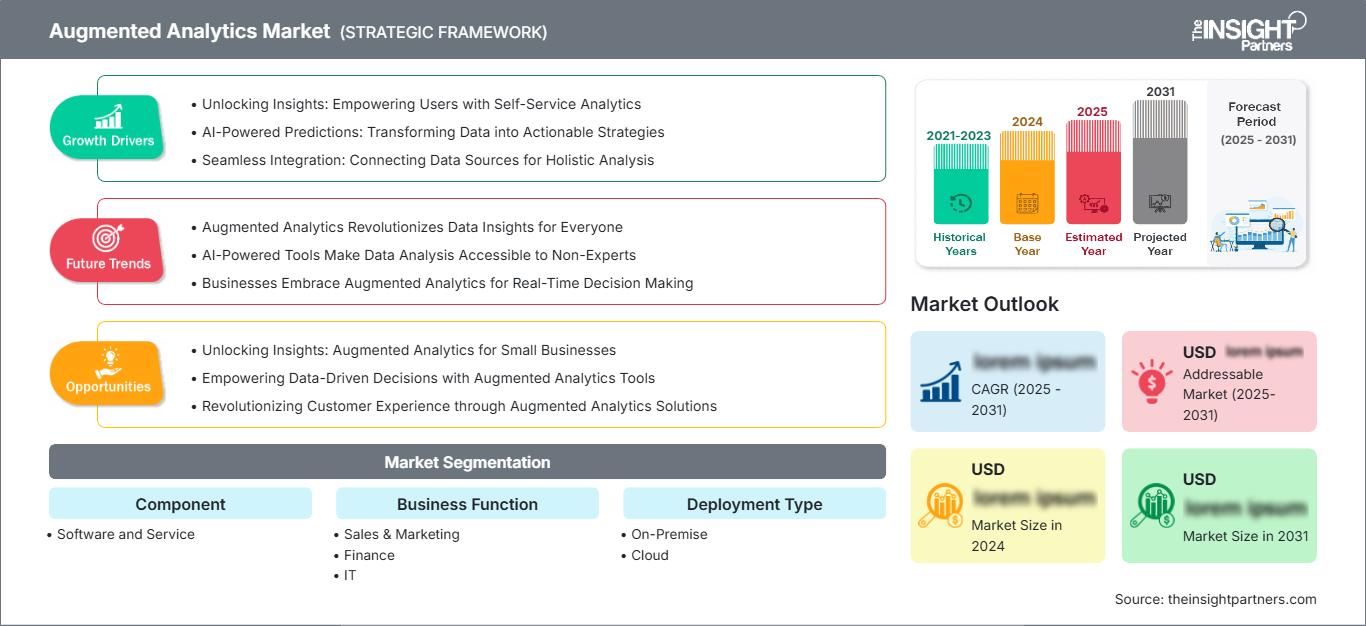
Augmented Analytics Market: Strategic Insights
Regional Insights
North America Augmented Analytics Market
North America generated 41–43% share in 2025 and is forecast to expand at 18–21% CAGR. The region benefits from high analytics maturity, large enterprise cloud budgets, and strong use of AI-supported planning across banking, retail, technology, healthcare, and media organizations. The augmented analytics market share remains highest in this region because buyers already operate mature data warehouses, BI teams, and governance frameworks.
American and Canadian companies are also bringing analytics into their business processes via productivity suites and customer platforms. The need is greatest among those looking for conversational search, anomaly detection, and predictive insights. Cloud-based platforms that are integrated with identity management and compliance tools are becoming more popular among procurement organizations.
U.S. Augmented Analytics Market
The US accounted for 79–82% of North American revenue in 2025 and is expected to grow at 18–20% CAGR. Large companies have started integrating AI-powered analytics capabilities into financial planning, marketing optimization, fraud detection, supply chain management, and IT infrastructure operations, thus creating a constant need for licenses and services.
The company’s presence is key in the market, and the leading enterprises in the segment include Microsoft Corporation, International Business Machines Corporation, Oracle Corporation, Tableau Software, LLC, ThoughtSpot, Inc., SAS Institute Inc., and Sisense Ltd. Consumers now look for analytics solutions offering both natural language capabilities and metric governance.
Europe Augmented Analytics Market
Europe held 25–28% share of the Augmented Analytics Market in 2025 and is projected to grow at 17–20% CAGR. Financial services, retail analytics, and public digital applications are the key areas for regional leadership in the UK. Predictive analytics is widely adopted in manufacturing, automotive, logistics, and industrial processes, where it enhances process efficiency and planning rigor in Germany.
Telecommunications, healthcare, energy, and consumer industries have increasing adoption of analytics in France, Italy, and Spain. Buyers from Europe care about privacy, data sovereignty, and AI governance, which are significant criteria for purchasing decisions. Growth will stay consistent in Europe due to cloud migration and regulations in the analytics industry.
APAC Augmented Analytics Market
APAC accounted for 22–25% share of the Augmented Analytics Market in 2025 and is forecast to grow at 23–26% CAGR, making it the fastest-expanding region. China and Japan lead on enterprise digitization, South Korea advances analytics in electronics and telecom, while India expands adoption through IT services, BFSI, and fast-growing digital businesses.
Australia supports demand through cloud-first enterprise modernization and analytics use in banking, healthcare, mining, and public services. Regional growth reflects expanding data volumes, rising automation needs, and increased spending on AI-ready platforms that help businesses scale insight generation without large specialist teams.
Middle East & Africa Augmented Analytics Market
The Middle East & Africa Augmented Analytics Market is expected to grow at 16–19% CAGR during 2026–2034. Adoption in Saudi Arabia and the UAE is leading thanks to intelligent government initiatives, banking, telecommunications, and energy analytics. South Africa is the most advanced enterprise analytics center on the African continent.
MEA’s other countries are still cautious yet demonstrate growing potential in cloud analytics, infrastructure planning, and customer insights. The sectors of energy, utilities, transportation, and government modernization generate demand for automation of dashboards, predictive modeling, and decision support tools.
Segmentation Analysis
Component
Component is expected to grow at 19–22% CAGR during 2026–2034. The market scope, as outlined in the augmented analytics market report, covers software and services, with software generating the largest revenue and services supporting integration, customization, training, governance, and adoption across complex enterprise environments.
- Software: Software dominates because enterprises need AI-enabled platforms for data preparation, automated insight generation, natural language querying, visualization, forecasting, anomaly detection, and governed analytics delivery.
- Service: Services remain critical for implementation, data model design, workflow integration, user enablement, governance setup, and continuous optimization across departments and industry-specific analytics use cases.
Business Function
Business Function is expected to grow at 20–23% CAGR as organizations deploy analytics closer to decision-makers. Sales, finance, IT, and operations teams use automated insights to reduce reporting delays, detect risks, and identify opportunities faster.
- Sales & Marketing: Sales and marketing teams use augmented analytics for customer segmentation, campaign performance, churn prediction, pricing signals, and next-best-action insights across digital and offline channels.
- Finance: Finance teams apply automated analytics to budgeting, forecasting, variance analysis, compliance monitoring, fraud detection, and working-capital visibility across business units and geographies.
- IT: IT teams use analytics automation to monitor infrastructure, identify anomalies, improve service performance, manage security signals, and optimize cloud usage across enterprise environments.
- Operations: Operations teams rely on augmented analytics for supply chain visibility, process performance, capacity planning, quality monitoring, logistics optimization, and predictive maintenance insights.
Deployment Type
Deployment Type is expected to grow at 20–24% CAGR. Cloud adoption is accelerating because enterprises need flexible compute, faster model updates, collaborative workspaces, and easier integration with modern data platforms, while on-premise deployment remains relevant in regulated settings.
- On-Premise: On-premise deployment appeals to organizations with strict data residency, latency, customization, or legacy integration requirements, especially in banking, government, defense, and regulated industrial environments.
- Cloud: Cloud deployment leads growth because it enables scalable analytics, faster innovation cycles, subscription pricing, remote collaboration, AI integration, and centralized governance across distributed business teams.
Industry Vertical
Industry Vertical is projected to grow at 19–23% CAGR. Adoption is broadening across data-intensive sectors that require faster decisions, stronger forecasting, and democratized analytics access for business users beyond centralized data teams.
- BFSI: BFSI remains a leading vertical through fraud analytics, customer intelligence, risk modeling, regulatory reporting, credit monitoring, and personalized financial product recommendations.
- Retail and Consumer Goods: Retailers use augmented analytics for demand forecasting, merchandising, pricing, promotion planning, inventory optimization, customer segmentation, and omnichannel performance measurement.
- Manufacturing: Manufacturers deploy analytics automation for production quality, predictive maintenance, supply chain visibility, plant performance, procurement planning, and energy efficiency monitoring.
- Healthcare and Medical Sciences: Healthcare users apply automated analytics to patient flow, operations, resource planning, clinical performance, population health insights, and pharmaceutical research support.
- Energy & Utilities: Energy and utility companies use analytics for grid performance, asset reliability, demand forecasting, outage prediction, ESG monitoring, and infrastructure investment planning.
- Transportation & Logistics: Transportation and logistics providers use augmented analytics for route planning, fleet utilization, shipment visibility, cost control, warehouse performance, and demand-supply balancing.
- IT & Telecom: IT and telecom companies apply analytics automation to network optimization, customer churn reduction, service assurance, capacity planning, and operational incident management.
- Media & Entertainment: Media firms use automated insights for audience analytics, content performance, advertising yield, subscription retention, personalization, and cross-platform engagement measurement.
Opportunity Snapshot
| Industry Vertical | Revenue Contribution | Trend Tag | Adoption Stage |
| BFSI | High | Risk Intelligence | Mature |
| Retail and Consumer Goods | High | Demand Signals | Scaling |
| Manufacturing | Medium | Plant Visibility | Scaling |
| Healthcare and Medical Sciences | Medium | Care Insights | Scaling |
| Energy & Utilities | Medium | Grid Analytics | Scaling |
| Transportation & Logistics | Medium | Route Intelligence | Emerging |
| IT & Telecom | High | Network Insight | Mature |
| Media & Entertainment | Low | Audience Signals | Emerging |
Augmented Analytics Market Growth Drivers and Impact Analysis
Rising Enterprise Demand for Self-Service Decision Intelligence
Companies are increasingly facing the need for a reduction in the interval between the creation of information and making business decisions based on that information. The traditional approach to reporting relies extensively on analysts, static dashboards, and manual information preprocessing, which delays decision-making processes during volatile market conditions. The augmentation of analytics involves automation of discovery, explanation, and predictive signals, whereby managers can make queries through natural language and get guided answers.
Growth of Cloud Data Platforms and AI-Ready Infrastructure
Cloud migration has helped companies make their enterprise data more available, scalable, and ready for analysis through AI. The current lakehouse, warehouse, and integration solutions enable the platforms to handle big volumes of data and update models quickly compared to the old report generation tools. As companies consolidate their fragmented data infrastructures, there will be a need for analytics solutions that can help in automating data preparation, anomaly detection, and providing accurate insights.
Need for Explainable and Governed AI in Business Analytics
Organizations seek speedier AI-based insights, but they also require assurance regarding data lineage, assumptions, access rights, and outputs of AI models. Augmented analytics solutions that offer explainable insights, role-based governance capabilities, and workflow tracking are gaining popularity in the highly regulated sectors. With governance, there is a lower likelihood of conflicting metrics and unsubstantiated decision-making. As AI increasingly integrates into the planning and operation processes, organizations will find automated transparency vendors more trustworthy.
Augmented Analytics Market Future Trends
Generative AI Interfaces for Conversational Analytics
Augmented analytics market trends are moving toward conversational interfaces that let business users question data, request visualizations, and receive narrative explanations through natural language. With the emergence of generative AI, analytics will be more interactive, but companies need semantic governance to ensure consistency in responses. Platforms that link together large language models and credible data models and metrics definitions and control permissions will define the next era of analytics adoption.
Decision Automation Linked to Enterprise Workflows
The future platforms will gradually shift from offering insights to taking action. Platforms of the future will not only offer insights about anomalies and predictions but will go further in offering guidance on the next actions. The process will include generating workflow notifications and linking analytics to planning, support, finance, and supply chain management systems. This means that the future will see an increased strategic value of augmented analytics.
Augmented Analytics Market Opportunities
Industry-Specific Analytics Packages
Vendors can unlock stronger growth by offering prebuilt analytics packages tailored to regulated and data-intensive sectors. BFSI needs risk, fraud, compliance, and customer profitability models. Retailers need demand, inventory, and promotion intelligence. Manufacturers require asset, quality, and supply chain insights. The augmented analytics market Forecasts suggest that packaged solutions can shorten implementation timelines, reduce customization costs, and improve adoption among business users who prefer industry language over generic analytics terminology.
Managed Services for AI Governance and Adoption
Service organizations may choose to offer help to businesses that lack capabilities in terms of AI governance, data modeling, and change management. Managed services may be used to set up metrics, create semantic layers, educate users, monitor model performance, and ensure compliance on a departmental level. Such an approach proves to be quite beneficial for mid-size companies that implement cloud analytics for the first time.
Frequently Asked Questions

- Comprehensive Market Sizing and Forecast Analysis
- Detailed Segmentation Analysis
- In-Depth Market Dynamics Assessment
- Regional and Country-Level Insights
- Competitive Landscape and Company Benchmarking
- Strategic Business Intelligence
Recent Reports
Testimonials

The Insight Partners provided valuable market intelligence that supported our global go-to-market strategy. Their team was professional, responsive, and attentive to our feedback, providing thoughtful analysis and helpful methodological clarifications throughout the project.
Junmo Kim Chief Financial Officer (CFO), Enertech Co., Ltd.
The Insight Partners' SCADA System Market report is comprehensive, with valuable insights on current trends and future forecasts. The team was highly professional, responsive, and supportive throughout. We are very satisfied and highly recommend their services.
RAN KEDEM Partner, Reali Technologies LTDs
I requested a report on a very specific software market and the team produced the report in a few days. The information was very relevant and well presented. I then requested some changes and additions to the report. The team was again very responsive and I got the final report in less than a week.
JEAN-HERVE JENN Chairman, Future Analytica
We worked with The Insight Partners for an important market study and forecast. They gave us clear insights into opportunities and risks, which helped shape our plans. Their research was easy to use and based on solid data. It helped us make smart, confident decisions. We highly recommend them.
PIYUSH NAGPAL Sr. Vice President, High Beam Global
The Insight Partners delivered insightful, well-structured market research with strong domain expertise. Their team was professional and responsive throughout. The user-friendly website made accessing industry reports seamless. We highly recommend them for reliable, high-quality research services
YUKIHIKO ADACHI CEO, Deep Blue, LLC.
This is the first time I have purchased a market report from The Insight Partners.While I was unsure at first, I visited their web site and felt more comfortable to take the risk and purchase a market report.I am completely satisfied with the quality of the report and customer service. I had several questions and comments with the initial report, but after a couple of dialogs over email with their analyst I believe I have a report that I can use as input to our strategic planning process.Thank you so much for taking the extra time and making this a positive experience.I will definitely recommend your service to others and you will be my first call when we need further market data.
JOHN SUZUKI President and Chief Executive Officer, Board Director, BK Technologies
I wish to appreciate your support and the professionalism you displayed in the course of attending to my request for information regarding to infectious disease IVD market in Nigeria. I appreciate your patience, your guidance, and the fact that you were willing to offer a discount, which eventually made it possible for us to close a deal. I look forward to engaging The Insight Partners in the future, all thanks to the impression you have created in me as a result of this first encounter.
DR CHIJIOKE ONYIA MANAGING DIRECTOR, PineCrest Healthcare Ltd.Reason to Buy
- Informed Decision-Making
- Understanding Market Dynamics
- Competitive Analysis
- Identifying Emerging Markets
- Customer Insights
- Market Forecasts
- Risk Mitigation
- Boosting Operational Efficiency
- Strategic Planning
- Investment Justification
- Tracking Industry Innovations
- Aligning with Regulatory Trends





 Get Free Sample for