
Panic Exit Devices Market Size, Growth & Demand by 2034
Coverage: By Material (Steel, Aluminum, Others); Product (Vertical Rod, Mortise, Rim Type, Others); Type (Push Type, Touch Type); Application (Residential, Commercial, Industrial), and Geography (North America, Europe, Asia Pacific, and South and Central America)
- Status : Data Released
- Report Code : TIPRE00017204
- Category : Manufacturing and Construction
- No. of Pages : 150
- Available Report Formats :


- Last update date : August 05, 2026


2025 Market Size
US$ 1.26 Bn
Base year value
2034 Forecast
US$ 2.55 Bn
Projected by 2034
CAGR 2026-2034
8.15 %
Growth rate
Addressable Market
US$ 17.12 Bn
(2026-2034)
The Panic Exit Devices Market is projected to be US$ 1.26 Billion in 2025 and will further expand to US$ 2.55 Billion in 2034, growing at a CAGR of 8.15% during 2026-2034. Market drivers include emergency exit requirements in compliance with regulations in commercial, residential, and industrial buildings, and need for certified push, touch, rim, mortise, and vertical rod devices, which have now become key elements in life-safety planning.
In North America, need for replacements and strict enforcement of egress code provisions have ensured that the Panic Exit Devices Market size will grow at a CAGR of 7.6% to 8.4% over 2034. Retrofits are prevalent in schools, healthcare facilities, offices, and places of high occupancy. Requirements of listed devices are driven by the provisions of IBC & NFPA 101 for assembly, educational, and high hazard occupancies.
Panic Exit Devices Market Assessment and Insights
- North America accounted for 32–35% share in 2025 and is expected to grow at a CAGR of 7.6–8.4% during 2026–2034, led by retrofit demand and enforcement of exit hardware rules.
- US represented 78–82% of North America in 2025 and is expected to grow at a CAGR of 7.5–8.3% during 2026–2034, supported by institutional upgrades.
- Europe held 25–28% share in 2025 and is expected to grow at a CAGR of 7.0–7.8% during 2026–2034, with Germany, the UK, France, Italy, and Spain leading certification-led adoption.
- Asia Pacific captured 22–25% share in 2025 and is expected to grow at a CAGR of 8.8–9.6% during 2026–2034, driven by China, India, Japan, South Korea, and Australia.
- Largest Segment Commercial applications held 54–58% market share in 2025 and are expected to grow at a CAGR of 8.0–8.8% during 2026–2034.
- High Growth Segment Touch type devices held 30–34% market share in 2025 and are expected to grow at a CAGR of 9.0–9.8% during 2026–2034.
- Key companies analyzed in detail: Allegion plc, ASSA ABLOY AB, C.R. Laurence Co., Inc., dormakaba Holding AG, GEZE GmbH, Giesse S.p.A., Godrej & Boyce Manufacturing Company Limited, Hager Companies, ISEO Serrature S.p.A., DORMA-Glas GmbH, and Lawrence Hardware Inc.
Source: The Insight Partners' analysis based on proprietary research, government publications, company annual reports, investor presentations, industry databases, and expert interviews.
Hardware development trends are heading from simple latch-release hardware toward certification, robustness, and architectural integration hardware designed for high traffic loads. Steel continues to play a role in areas where abuse resistance and fire-rated assemblies are required, whereas aluminum is becoming important in glazing applications and lighter commercial doors. Moreover, manufacturers continue to develop touch bars, hidden fasteners, and modular trims in order to reduce installation times and better integrate access control, alarms, and door automation.
The growth potential in the upcoming years will be driven by emerging construction corridors in Asia Pacific and the Middle East. In addition, public infrastructure, transit stations, educational campuses, and healthcare construction offer repeated opportunities for specification. The most favorable regulatory tailwinds are present where fire inspections, insurance reviews, and occupancy permits increasingly require compliance documentation, turning Panic Exit Devices Market into both replacement and new construction business.
Panic Exit Devices Market Report Scope
| Report Attribute | Details |
|---|---|
| Market size in 2025 | US$ 1.26 Billion |
| Market Size by 2034 | US$ 2.55 Billion |
| Global CAGR (2026 - 2034) | 8.15% |
| Historical Data | 2021-2024 |
| Forecast period | 2026-2034 |
Panic Exit Devices Market Analysis
Panic Exit Devices Market Share is driven by the mandatory requirements for egress in buildings with high occupancy, especially assembly buildings, educational institutions, healthcare, hospitality, and industrial premises. The presence of codes referring to IBC, NFPA 101, EN 1125, and UL-listed hardware will establish base demand, as the exit doors have to unlock fast in case of emergencies. Retrofit investments are increasing, due to replacement of old bars, rods, and trims during fire safety checks and tenant improvements.
The supply chain consists of metal suppliers, casting and extrusion providers, latch system suppliers, finishers, testing labs, distributors, door makers, and installers. Metal costs, fire rating, and finish are influencing lead time, as suppliers with certified families of products for both steel and aluminum doors are in advantage.
The Panic Exit Devices Market Report reveals competition to be highly concentrated between access hardware firms that have wide range of certified products. Allegion plc and ASSA ABLOY AB compete via international brands, distribution capabilities, and electronic access, while dormakaba Holding AG and GEZE GmbH focus on architectural openings and building movement systems. C.R. Laurence Co., Inc. and Giesse S.p.A. cover needs related to glass and fenestrations.
Capital investments go into product portfolio growth, acquisition deals, compliance testing, and connected hardware. Godrej & Boyce Manufacturing Company Limited and Hager Companies cater to regional and North American specification routes, while ISEO Serrature S.p.A., DORMA-Glas GmbH, and Lawrence Hardware Inc. improve specialization capabilities. Strategic positioning increasingly relies on certified interoperability with doors, frames, access readers, alarms, and maintenance solutions.
● REPORT CUSTOMIZATION
Tailor This Report To Align With Your Specific Business Requirements
This report can be customized to align precisely with your business objectives, scope, and target markets. Customization options include tailored segmentation, geography, competitive analysis, and strategic insights to support informed decision-making.
Customize This Report →WHAT YOU CAN ADJUST
- ● Segmentations
- ● Geography
- ● Competitive Analysis
- ● Language Preferences
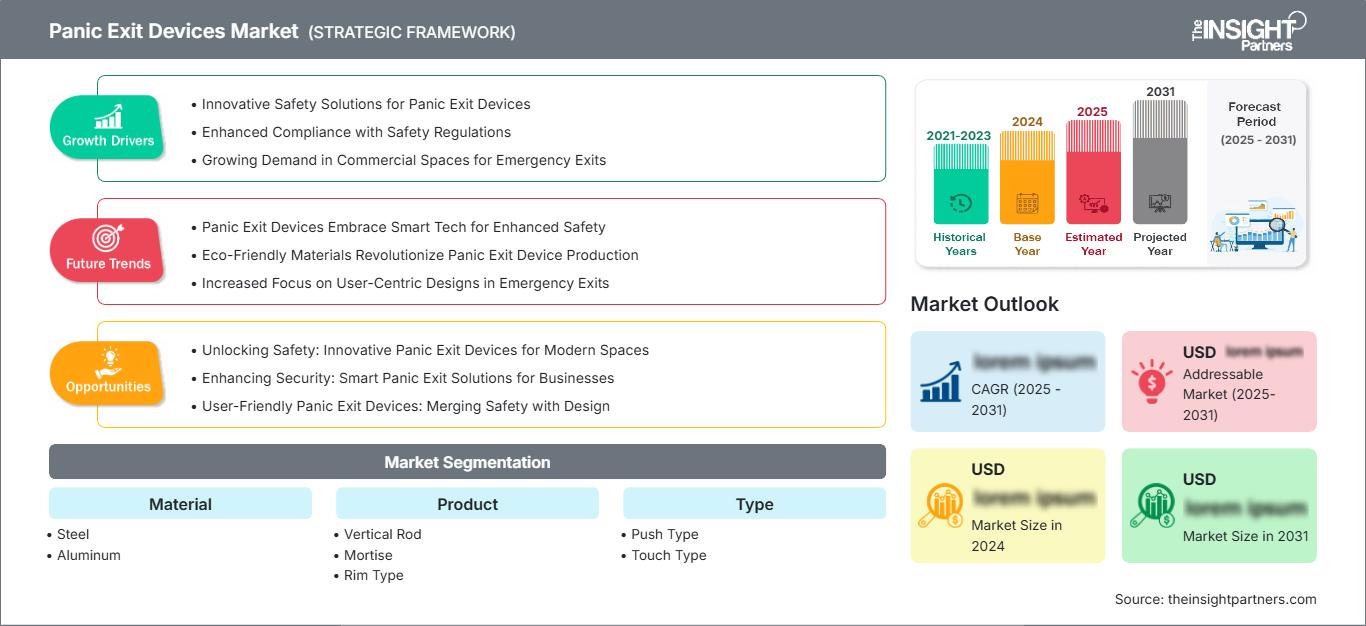
Panic Exit Devices Market: Strategic Insights
Regional Insights
North America Panic Exit Devices Market
North America held 32–35% share in 2025 and is projected to expand at a CAGR of 7.6–8.4% during 2026–2034. The Panic Exit Devices Market share is supported by mature enforcement of IBC, NFPA 101, and fire marshal inspection practices. Demand is strongest in schools, hospitals, offices, hotels, warehouses, and assembly venues where panic hardware is mandated by occupancy load and risk category.
Replacement demand is structurally important because many installed devices are upgraded during door replacements, tenant improvements, and security modernization programs. Facility owners increasingly specify listed hardware compatible with electrified trim, delayed egress controls, and access management. Distribution through locksmiths, commercial door dealers, and specification consultants gives established suppliers a durable route to market.
U.S. Panic Exit Devices Market
The U.S. accounted for 78–82% of North America in 2025 and is expected to grow at a CAGR of 7.5–8.3% during 2026–2034. Adoption is tied to large stocks of educational, healthcare, retail, government, and industrial buildings. Panic hardware is required in many doors serving assembly and educational occupancies with high occupant loads, which keeps compliance spending recurring.
Allegion plc, ASSA ABLOY AB, dormakaba Holding AG, C.R. Laurence Co., Inc., Hager Companies, and Lawrence Hardware Inc. maintain visible U.S. distribution and specification channels. Application trends favor rim type devices for single doors, vertical rods for pairs without mullions, and touch type devices where accessibility, aesthetics, and quick actuation are prioritized.
Europe Panic Exit Devices Market
Europe accounted for 25–28% of the market share in 2025 and is expected to register a CAGR of 7.0–7.8% from 2026 to 2034. Germany leads the market due to high commercial building construction norms, industrial safety awareness, and demand for EN-approved devices. The UK gains from the renovation of school buildings, office buildings, hospitals, and public buildings, where fire doors are scrutinized.
France, Italy, and Spain contribute via hospitality, retail, transport, and mixed-use property renovations. GEZE GmbH, dormakaba Holding AG, ASSA ABLOY AB, ISEO Serrature S.p.A., Giesse S.p.A., and DORMA-Glas GmbH are important players in the region. The growing influence on demand includes compatibility of door hardware systems, decorative hardware products, and documentation for compliance with inspection and insurance requirements.
APAC Panic Exit Devices Market
APAC held 22–25% share in 2025 and is projected to grow at a CAGR of 8.8–9.6% during 2026–2034, the fastest regional pace. China is the leading country, followed by Japan, South Korea, India, and Australia. Industrial parks, metros, airports, data centers, hospitals, and education campuses are expanding the addressable base for certified hardware.
Policy emphasis on safer public buildings and higher-quality construction is strengthening specification standards. India and Southeast Asian economies are moving from basic door fittings toward listed egress hardware in premium commercial and institutional projects. Japan, South Korea, and Australia add replacement demand through strict building maintenance and accessibility expectations.
Middle East & Africa Panic Exit Devices Market
The Middle East & Africa region is expected to grow at a CAGR of 7.4–8.2% during 2026–2034. Saudi Arabia is the leading country, followed by the UAE and South Africa, with Rest of MEA demand tied to hospitals, hotels, malls, schools, and logistics facilities. Large energy, tourism, and transport projects require robust evacuation planning.
Specification is concentrated in high-value developments where international consultants apply global fire and life-safety norms. Harsh operating environments increase demand for corrosion-resistant finishes and durable mechanical assemblies. Local distributors play a critical role because installation quality and inspection documentation determine whether panic hardware performs as intended.
Segmentation Analysis
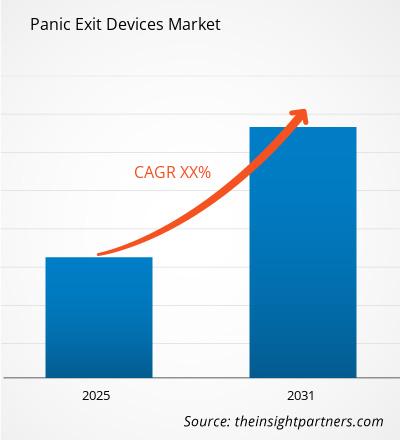
Material
Material is expected to grow at a CAGR of 7.8–8.6% during 2026–2034 as door construction, fire rating, corrosion resistance, and aesthetic requirements influence specification. The Panic Exit Devices Market scope covers steel and aluminum designs used across hollow metal, glazed, and architectural openings. Material choice affects durability, finish life, maintenance cost, and compatibility with certified door assemblies.
- Steel remains preferred for high-abuse doors in schools, factories, warehouses, and fire-rated corridors because it offers strength, dependable latch engagement, and long service life under heavy traffic.
- Aluminum is widely used in storefronts, glazed entrances, offices, and hospitality properties where lower weight, corrosion resistance, and visual compatibility with architectural framing are important.
Product
Product is projected to grow at a CAGR of 8.0–8.8% during 2026–2034, reflecting the need for device types matched to door configuration. Rim type devices dominate single-door openings, vertical rod systems address paired doors, and mortise solutions support projects requiring concealed latching, stronger aesthetics, or specific fire-door configurations.
- Vertical Rod devices are important for double doors without fixed mullions, supporting wide clear openings in schools, retail entrances, hospitals, and assembly spaces requiring rapid evacuation.
- Mortise devices suit premium commercial and institutional doors where concealed locking, improved appearance, and controlled latch performance are valued by architects and facility owners.
- Rim Type devices remain the most common choice for single doors because installation is straightforward, maintenance is familiar, and stocked parts are widely available through distribution channels.
Type
Type is expected to expand at a CAGR of 8.3–9.1% during 2026–2034 as ergonomics, accessibility, and actuation reliability become stronger purchasing criteria. Push type devices provide durable baseline performance, while touch type devices gain traction in high-traffic buildings where lower operating force, faster release, and improved user familiarity are important.
- Push Type devices serve cost-sensitive and rugged applications where simple mechanics, proven performance, and easier inspection make them suitable for industrial and institutional doors.
- Touch Type devices are increasingly specified in airports, hospitals, offices, and schools because broad actuation surfaces support accessibility, panic response, and smoother movement during evacuation.
Application
Application is forecast to grow at a CAGR of 8.0–8.8% during 2026–2034, led by commercial buildings that combine high occupancy, inspection frequency, and diversified door types. Residential demand is selective, mainly in multifamily and senior living projects, while industrial sites require robust devices for warehouses, plants, and hazardous areas.
- Residential demand is concentrated in multifamily towers, student housing, senior living, and mixed-use buildings where shared exits, stairwells, and amenity spaces must meet safety requirements.
- Commercial applications lead installations across offices, retail, healthcare, education, hotels, and entertainment venues because occupant density and inspection obligations make compliant egress hardware essential.
- Industrial applications prioritize rugged devices for factories, logistics centers, laboratories, and utility rooms where emergency release, fire separation, and worker safety are central operating requirements.
Opportunity Snapshot
| Application | Revenue Contribution | Trend Tag | Adoption Stage |
| Residential | Medium | Multifamily Safety | Scaling |
| Commercial | High | Code Retrofit | Mature |
| Industrial | Medium | Hazard Egress | Scaling |
Panic Exit Devices Market Growth Drivers and Impact Analysis
Mandatory Egress Compliance in High-Occupancy Buildings
The building code is the most powerful demand anchor as panic hardware is non-discretionary in many occupancy classes. IBC standards are usually applicable to assemblies and educational occupancies where occupant load is 50 and above, whereas NFPA 101 still influences all life safety decision making in both new and existing buildings. Thus, there will be an enforced cycle of product replacement in schools, theatres, hospitals, malls, and factories. There will be market consequences in terms of the purchasing process since customers prefer to buy products that are listed, tested, properly installed, and have documentation ready for inspection rather than low initial cost solutions.
Retrofit Spending Across Aging Building Stock
There is a constant demand for the doors as there are large numbers of already installed old doors. These units are usually used for many years but at times need replacement due to re-rating of the door assembly, tenant changes, upgrades in access control, or any damage to latches and touch bars due to inspections. Retrofit is very important in North America and Europe due to the combination of old buildings and audit. Property managers use code-compliant exits to minimize their operational risks and insurance issues as well as prevent delays in occupancy permits.
Integration With Access Control and Smart Buildings
The use of exit devices in addition to electronic trim packages, alarm systems, contacts for monitoring, and access control systems is becoming more common. It is not a move away from the mechanical requirements but an increase in the importance of products that integrate safety with ease of entry and exit. Door-status monitoring, unapproved exit alerts, and maintenance diagnostics will be useful for applications such as airports, hospitals, office spaces, campuses, and logistics centers. The key driver will have an impact on the economics of the market since the electronic and connected products have greater content value compared to the basic mechanical bars.
Panic Exit Devices Market Future Trends
Connected Exit Hardware for Predictive Maintenance
Panic Exit Devices Market trends will increasingly center on connected exit hardware that reports status, usage cycles, latch faults, and unauthorized openings. Facility teams are moving from reactive repairs to preventive maintenance because a failed exit device can close a building area or trigger compliance findings. Over time, data from high-traffic doors will help owners schedule service before actuation force, alignment, or latch engagement deteriorates. This trend is most relevant in hospitals, airports, campuses, and logistics facilities where doors are mission-critical assets. Suppliers that combine certified mechanical reliability with secure digital monitoring will capture premium retrofit and new-build specifications.
Low-Force and Inclusive Egress Design
Future product development will place greater emphasis on low-force actuation, clearer visual cues, and easier use by occupants with varied mobility. Accessibility expectations are converging with emergency planning, particularly in healthcare, education, transit, and public administration buildings. Touch type devices, longer actuating surfaces, smoother latch release, and better finish contrast can reduce hesitation during evacuation. The commercial benefit is twofold: owners improve user safety while reducing the risk of non-compliance findings during audits. Manufacturers that validate ease of operation without sacrificing durability, fire rating, or security will be better positioned in specification-led projects.
Panic Exit Devices Market Opportunities
Specification-Led Growth in Emerging Infrastructure
Transport, healthcare, education, tourism, and data center investments in Asia Pacific and the Middle East create attractive opportunities for suppliers that engage early with architects, consultants, and code reviewers. Panic Exit Devices Market Forecasts point to stronger adoption where international developers apply global safety standards across airports, metros, hospitals, and mixed-use districts. Companies can improve win rates by offering tested door-and-hardware combinations, local installer training, and documentation aligned with authority approvals. The investment case is strongest for modular product platforms that serve multiple door types, finishes, and certification pathways while keeping inventory manageable for regional distributors.
Aftermarket Programs for Compliance and Lifecycle Service
Aftermarket services offer a defensible opportunity because compliance does not end at installation. Facility owners need inspection, adjustment, parts replacement, and documentation over the full door lifecycle. Suppliers and distributors can build recurring revenue through service kits, certified technician networks, digital records, and planned replacement programs for high-use doors. This approach is especially valuable in schools, hospitals, hotels, factories, and public buildings where failed exits carry safety and operational consequences. Companies that link hardware sales with maintenance support can reduce commoditization, improve customer retention, and capture replacement demand before competitors enter during emergency repairs.
Recent Developments
- June 2026: ASSA ABLOY present APOGEO, the new range of ASSA ABLOY panic exit devices designed to meet a wide variety of application requirements by combining certified safety, long-term reliability and modern design. The devices are certified to EN 1125 and suited fro fire-rated and smoke resistant doors.
- January 2026: WENZHOU DOORCARE HARDWARE CO.,LTD introduced Panic Exit Device and Door Closer catalogue featuring certified hardware solutions for emergency exits, commercial doors, and safety applications.
- May 2025: Hampton Products International Corp’s brand Brinks Commercial security solutions launched high-performance M91P Rim Panic Exit Device, designed for high-traffic commercial spaces like hospitals, schools, stadiums, and convention centers. M91P Rim Panic Exit Device, engineered for heavy-duty performance, delivers a reliable door exit device at nearly half the cost of comparable industry-leading solutions.
Frequently Asked Questions

- Comprehensive Market Sizing and Forecast Analysis
- Detailed Segmentation Analysis
- In-Depth Market Dynamics Assessment
- Regional and Country-Level Insights
- Competitive Landscape and Company Benchmarking
- Strategic Business Intelligence
Recent Reports
Testimonials

The Insight Partners' SCADA System Market report is comprehensive, with valuable insights on current trends and future forecasts. The team was highly professional, responsive, and supportive throughout. We are very satisfied and highly recommend their services.
RAN KEDEM Partner, Reali Technologies LTDs
I requested a report on a very specific software market and the team produced the report in a few days. The information was very relevant and well presented. I then requested some changes and additions to the report. The team was again very responsive and I got the final report in less than a week.
JEAN-HERVE JENN Chairman, Future Analytica
We worked with The Insight Partners for an important market study and forecast. They gave us clear insights into opportunities and risks, which helped shape our plans. Their research was easy to use and based on solid data. It helped us make smart, confident decisions. We highly recommend them.
PIYUSH NAGPAL Sr. Vice President, High Beam Global
The Insight Partners delivered insightful, well-structured market research with strong domain expertise. Their team was professional and responsive throughout. The user-friendly website made accessing industry reports seamless. We highly recommend them for reliable, high-quality research services
YUKIHIKO ADACHI CEO, Deep Blue, LLC.
This is the first time I have purchased a market report from The Insight Partners.While I was unsure at first, I visited their web site and felt more comfortable to take the risk and purchase a market report.I am completely satisfied with the quality of the report and customer service. I had several questions and comments with the initial report, but after a couple of dialogs over email with their analyst I believe I have a report that I can use as input to our strategic planning process.Thank you so much for taking the extra time and making this a positive experience.I will definitely recommend your service to others and you will be my first call when we need further market data.
JOHN SUZUKI President and Chief Executive Officer, Board Director, BK Technologies
I wish to appreciate your support and the professionalism you displayed in the course of attending to my request for information regarding to infectious disease IVD market in Nigeria. I appreciate your patience, your guidance, and the fact that you were willing to offer a discount, which eventually made it possible for us to close a deal. I look forward to engaging The Insight Partners in the future, all thanks to the impression you have created in me as a result of this first encounter.
DR CHIJIOKE ONYIA MANAGING DIRECTOR, PineCrest Healthcare Ltd.Reason to Buy
- Informed Decision-Making
- Understanding Market Dynamics
- Competitive Analysis
- Identifying Emerging Markets
- Customer Insights
- Market Forecasts
- Risk Mitigation
- Boosting Operational Efficiency
- Strategic Planning
- Investment Justification
- Tracking Industry Innovations
- Aligning with Regulatory Trends





 Get Free Sample for