
Absence Management Software Market Demand, Trends & Forecast by 2034
Coverage: By Deployment Type (Cloud, On-Premise); Organization Size (SMEs, Large Enterprises) , and Geography (North America, Europe, Asia Pacific, and South and Central America)
- Status : Data Released
- Report Code : TIPRE00007477
- Category : Technology, Media and Telecommunications
- No. of Pages : 150
- Available Report Formats :


- Last update date : August 07, 2026


2025 Market Size
US$ 1.30 Bn
Base year value
2034 Forecast
US$ 2.83 Bn
Projected by 2034
CAGR 2026-2034
8.98 %
Growth rate
Addressable Market
US$ 18.43 Bn
(2026-2034)
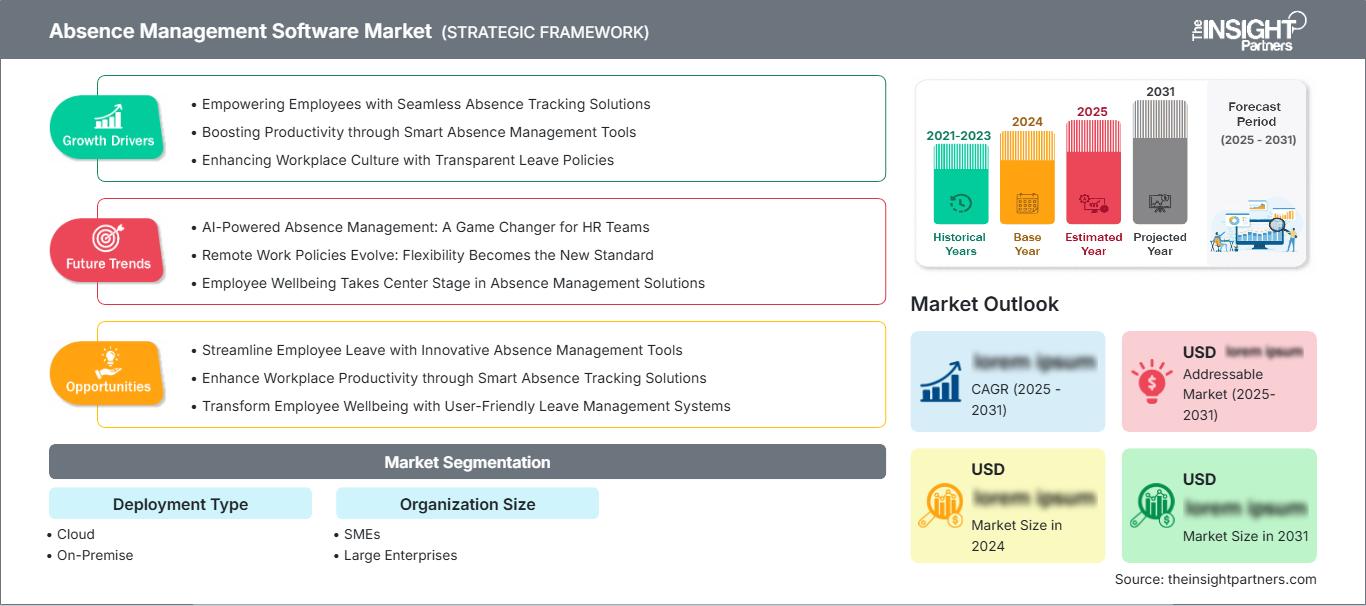
The absence management software market was valued at US$ 1.30 Billion in 2025 and is projected to reach US$ 2.83 Billion by 2034, expanding at a CAGR of 8.98% during 2026–2034. Growing workforce digitization strategies, greater emphasis on employee experience management, and increasing adoption of integrated human capital management platforms are supporting market expansion. Organizations across healthcare, manufacturing, retail, education, and government sectors continue investing in automated absence administration systems to improve compliance, efficiency, and workforce planning capabilities.
Amid increasing workforce mobility and hybrid work adoption, North America continues to represent a strategically important market for workforce administration technologies. The absence management software market size in the region is supported by widespread cloud HR deployment, stringent labor compliance requirements, and strong enterprise software investment patterns. Regional demand is expected to advance at a CAGR range of 8.0–9.0% through 2034, driven by analytics-enabled workforce optimization and growing integration between payroll, scheduling, and leave management platforms.
Absence Management Software Market Assessment and Insights
- North America: Accounted for an estimated 38–42% share in 2025, benefiting from advanced HR technology penetration, complex workforce compliance frameworks, and significant enterprise software spending. The market is projected to grow at a CAGR of 8.0–9.0% during 2026–2034.
- US: Represented approximately 78–82% of North American absence management software market revenue in 2025, supported by widespread deployment among healthcare, retail, manufacturing, and public-sector employers. Expected to expand at a CAGR of 8.1–9.1% during 2026–2034.
- Europe: Held approximately 27–31% share in 2025, led by Germany, the United Kingdom, and France. Continued labor regulation complexity and workforce modernization initiatives support a projected CAGR of 7.8–8.8% during 2026–2034.
- Asia Pacific: Accounted for 22–26% share in 2025, with strong demand emerging from China, India, Japan, South Korea, and Australia. Regional growth is forecast at a CAGR of 10.0–11.0% during 2026–2034.
- Largest Segment: Cloud deployment remained dominant with a 62–66% market share in 2025, supported by scalability, lower implementation costs, and easier integration. Expected CAGR is 9.5–10.5% during 2026–2034.
- High Growth Segment: SMEs accounted for an estimated 34–38% of the absence management software market share in 2025 and are forecast to record a CAGR of 10.2–11.2% during 2026–2034 due to expanding SaaS adoption.
- Key companies analyzed in detail: ADP, Inc.; UKG Inc.; Oracle Corporation; Payworks Inc.; Presagia Inc.; Replicon Inc.; UKG Inc. (Ultimate Software platform); Visma Group; WorkForce Software, an ADP Company; Zoho Corporation.
Source: The Insight Partners' analysis based on proprietary research, government publications, company annual reports, investor presentations, industry databases, and expert interviews.
Absence management software market report shifts in workforce administration practices have significantly influenced software adoption over the past decade. Organizations have increasingly transitioned from spreadsheet-based absence tracking and fragmented HR processes toward integrated, cloud-enabled workforce management environments. The growing utilization of analytics, mobile accessibility, self-service employee tools, and automated workflows has improved operational visibility while reducing administrative burdens. Simultaneously, enterprises are demanding stronger interoperability between payroll, scheduling, attendance, and leave management functions, encouraging vendors to expand platform capabilities and strengthen ecosystem integration.
Over the forecast period, market development is expected to be supported by investment in digital workplace infrastructure, broader adoption among small and medium-sized enterprises, and stronger regulatory oversight of employee leave administration. Emerging economies in Asia Pacific and the Middle East are anticipated to provide significant growth opportunities as organizations modernize HR operations. Increased integration of artificial intelligence, predictive workforce planning, and advanced reporting capabilities is also expected to influence future deployment decisions across industries.
Absence Management Software Market Report Scope
| Report Attribute | Details |
|---|---|
| Market size in 2025 | US$ 1.30 Billion |
| Market Size by 2034 | US$ 2.83 Billion |
| Global CAGR (2026 - 2034) | 8.98% |
| Historical Data | 2021-2024 |
| Forecast period | 2026-2034 |
Absence Management Software Market Analysis
The absence management software market growth trajectory remains closely associated with increasing workforce complexity and the need for centralized employee leave administration. Organizations face growing challenges in managing vacation leave, family leave, medical absences, disability programs, and regional compliance obligations across geographically dispersed teams. Manual administration often contributes to operational inefficiencies, inconsistent policy application, and regulatory risks. Consequently, employers are increasingly adopting software platforms that automate entitlement calculations, workflow approvals, employee notifications, and reporting functions.
Another important demand driver stems from changing workforce structures. Hybrid work arrangements, flexible scheduling practices, and distributed labor models have increased the need for accurate workforce visibility. Employers now require real-time information regarding employee availability, staffing levels, and leave patterns to maintain operational continuity. Digital absence management solutions provide centralized access to such information while improving transparency for both managers and employees. Integration with workforce management, payroll, and scheduling platforms further enhances administrative efficiency and resource allocation capabilities.
The broader workforce technology ecosystem continues to strengthen demand conditions throughout the value chain. Human capital management providers, payroll vendors, cloud infrastructure companies, implementation consultants, and workforce analytics specialists collectively contribute to solution adoption. Organizations increasingly prefer integrated systems capable of consolidating multiple workforce functions into unified digital platforms. This absence management software market trend has encouraged software developers to introduce configurable workflows, analytics dashboards, compliance monitoring tools, and mobile-enabled self-service functionality.
Supply-side dynamics also favor continued innovation. Cloud-native software architectures allow vendors to deliver updates more efficiently while scaling services across global customer bases. Improved cybersecurity frameworks, lower deployment costs, subscription-based pricing models, and software interoperability standards continue increasing accessibility among diverse customer groups. As enterprises pursue workforce optimization initiatives and employee experience improvements, software providers are positioned to benefit from sustained demand across multiple industries.
● REPORT CUSTOMIZATION
Tailor This Report To Align With Your Specific Business Requirements
This report can be customized to align precisely with your business objectives, scope, and target markets. Customization options include tailored segmentation, geography, competitive analysis, and strategic insights to support informed decision-making.
Customize This Report →WHAT YOU CAN ADJUST
- ● Segmentations
- ● Geography
- ● Competitive Analysis
- ● Language Preferences
Absence Management Software Market: Strategic Insights
Regional Insights
North America Absence Management Software Market
North America represented approximately 38–42% of the global absence management software market share in 2025 and maintained the leading regional position within the market. High adoption of cloud-based human capital management technologies, widespread workforce digitization programs, and strong enterprise software expenditure collectively support regional demand. The market is projected to advance at a CAGR of 8.0–9.0% through 2034, benefiting from continued modernization of workforce administration processes. Industries including healthcare, retail, manufacturing, education, logistics, and government remain among the most active adopters, reflecting growing emphasis on productivity optimization and compliance management.
Labor regulation complexity across federal, state, and provincial jurisdictions continues influencing purchasing decisions. Employers increasingly rely on automated platforms to administer paid leave, medical leave, family leave, disability programs, and attendance policies. Advanced analytics functionality also supports workforce planning by providing insights into absenteeism patterns and staffing requirements. Continued investment in artificial intelligence, cloud infrastructure, and integrated workforce management ecosystems is expected to reinforce regional growth throughout the forecast period.
U.S. Absence Management Software Market
The United States accounted for approximately 78–82% of North American revenue in 2025 and remains the region's most influential absence management software market. Growth is expected at a CAGR of 8.1–9.1% during 2026–2034, supported by high digital maturity across enterprise HR environments. Large employers continue prioritizing software investments that improve workforce visibility, automate compliance processes, and strengthen employee experience outcomes. Healthcare organizations, retailers, manufacturers, and public agencies remain key users of sophisticated leave administration platforms.
The country also benefits from the presence of major workforce technology providers, software developers, and implementation specialists. Integrated workforce ecosystems have become increasingly important as organizations seek seamless connectivity across payroll, scheduling, attendance tracking, and leave administration. Demand for predictive workforce analytics and data-driven workforce planning tools continues expanding. Ongoing labor market shifts and the adoption of hybrid work further encourage organizations to deploy centralized absence management systems that support evolving workforce needs.
Europe Absence Management Software Market
Europe held an estimated 27–31% share of global revenue in 2025 and is forecast to grow at a CAGR of 7.8–8.8% through 2034. Germany serves as the region's leading market due to strong enterprise technology investment, advanced industrial sectors, and extensive labor compliance requirements. The country continues adopting integrated workforce management solutions to improve reporting accuracy, administrative efficiency, and employee scheduling effectiveness.
The UK is yet another important market, supported by further adoption of cloud software and workforce modernization. British companies are gradually adopting systems that enable integrated HR services to facilitate leave management and workforce analysis. France, Italy, and Spain are an important source of demand for the digital transformation of organizations, their well-being, and the automation of workforce administration processes. Across Europe, changes in labor legislation, workforce mobility patterns, and hybrid work structures continue encouraging investment in advanced absence management technologies.
APAC Absence Management Software Market
The Asia-Pacific region held around 22-26% market share in the absence management software industry in 2025 and is expected to grow at a CAGR of 10.0-11.0% until 2034, making it the fastest-growing regional market. China, Japan, India, South Korea, and Australia continue to be significant drivers of demand owing to growing adoption of enterprise software solutions and digital workplace initiatives.
Government digitalization efforts, growing cloud infrastructure, and the increasing formalization of the workforce help drive market growth. India and Southeast Asian countries are emerging as promising new markets as enterprises increasingly adopt technological tools to manage their workforce administration capabilities and scalable HR software platforms.
Middle East & Africa Absence Management Software Market
The Middle East and Africa absence management software market is expected to expand at a CAGR of 8.5–9.5% during 2026–2034. Saudi Arabia and the United Arab Emirates remain leading adopters owing to digital transformation programs, large-scale infrastructure investments, and growing enterprise technology expenditure.
South Africa also contributes meaningful demand, particularly among larger enterprises seeking workforce administration modernization. Across the region, cloud adoption, workforce formalization efforts, and economic diversification programs are creating favorable conditions for broader software deployment and workforce management innovation.
Segmentation Analysis
Deployment Type
The deployment type segment of the absence management software market is projected to grow at a CAGR of 8.8%-9.8% from 2026 to 2034. As companies look for scalable and secure platforms, their deployment preferences keep changing. It will continue to be an integral part of the buying process because companies are looking for products that fit into their workforce sizes and geographies. Cloud architecture will continue to influence the strategy for implementing solutions, but on-premises deployments will remain relevant owing to strict data governance requirements.
- Cloud: The dominant deployment model due to flexible implementation, subscription-based pricing, lower infrastructure requirements, simplified upgrades, and seamless integration with payroll, workforce management, scheduling, and HR platforms. Organizations increasingly prefer cloud solutions for faster deployment cycles and stronger support for hybrid work environments.
- On-Premise: Maintains a stable position among organizations requiring direct control over workforce data, customized configurations, internal hosting environments, and strict compliance oversight. Adoption remains particularly relevant within regulated sectors where data sovereignty and system customization carry strategic importance.
Organization Size
The organization size segment of the absence management software market is projected to register a CAGR of 9.0–10.0% during 2026–2034. Adoption patterns vary according to workforce complexity, administrative resources, compliance obligations, and technology investment priorities. While large enterprises continue generating the majority of market revenue, expanding cloud accessibility and declining implementation complexity are increasing adoption among smaller organizations. Software vendors are also introducing simplified deployment models specifically tailored to the operational requirements of organizations with limited human resource infrastructure.
- SMEs: This segment is gaining momentum as affordable software-as-a-service solutions enable smaller businesses to automate leave administration, reduce manual workloads, improve employee experience, and strengthen compliance management. Demand is supported by increasing digitalization initiatives, workforce expansion, and a growing need for operational visibility.
- Large Enterprises: Large organizations remain major adopters due to extensive workforce management requirements, multiple business locations, complex leave policies, and significant regulatory obligations. These enterprises continue investing in advanced analytics, automation capabilities, and integrated workforce ecosystems to improve workforce planning and administrative efficiency.
Opportunity Snapshot
| Organization Size | Revenue Contribution | Trend Tag | Adoption Stage |
| SMEs | Medium | Cloud HR | Scaling |
| Large Enterprises | High | Workforce AI | Mature |
Absence Management Software Market Growth Drivers and Impact Analysis
Growing emphasis on workforce productivity optimization
The growing importance of absence management as a driver of workforce productivity and efficiency has become evident for organizations nowadays. Given the continuous increase in workers' salaries in the developed and developing worlds, the need for better insight into workforce availability, absences, and scheduling is essential. Software solutions can now automate leave approvals, thereby reducing processing time and optimizing workforce allocation. Also, having information on the number of people available for work will enable better preparation to sustain business operations and to measure the effectiveness of service delivery. Industries such as the health care, manufacturing, retail, and logistics industries have been known to use these solutions. With continued interest from executives in productivity initiatives, investments in automating absence management solutions are forecast to remain robust.
Increasing regulatory complexity across labor markets
New regulations governing the workforce are continually changing worldwide, creating administrative challenges for organizations managing numerous employees across multiple regions. Regulations such as those about leave of absence, sick leave, disability accommodation, and paid time-off programs require proper documentation and reporting. Manual administration is prone to increasing the risk of noncompliance and reducing efficiency. Leave management software addresses these challenges by providing features such as policy enforcement, documentation, calculation of employee entitlements, and audit preparation. In addition, organizations will get uniformity in their leave management administration processes. As government regulations change, organizations will have a greater need to use digital technology to ensure compliance.
Expansion of integrated human capital management ecosystems
Human capital management systems are increasingly adopting integrated technology that brings together payroll, scheduling, time management, employee engagement, and workforce analytics into a single ecosystem. In this system, the absence management solution is vital because it provides real-time information on workforce availability and helps plan resources accordingly. It reduces duplication of effort in data entry and improves reporting and the employee self-service experience. Additionally, companies are now using connected systems to improve their workforce planning by consolidating all analytics in one place and automating the process flow. Those vendors who enable seamless integration are getting ahead in the competition. As enterprises pursue digital workplace transformation initiatives and seek greater return on technology investments, demand for integrated solutions is expected to accelerate, creating favorable growth conditions for absence management software providers.
Absence Management Software Market Future Trends
Predictive workforce intelligence adoption
The ability of organizations to leverage advanced analytics is believed to transform absence management solutions into workforce planning tools. Predictive algorithms will analyze attendance data, seasonal workforce needs, shift-coverage trends, and operational performance metrics to predict absence risks. The companies will benefit from using these predictions to make better staffing decisions, overcome labor shortages, and manage productivity. AI will also provide additional capabilities for automatic recommendations and anomaly detection. While organizations will rely more on data to make workforce decisions, predictive intelligence features are likely to become an important competitive advantage for software solutions.
Expansion of employee-centric workforce experiences
Future product development will focus on engagement, transparency, and accessibility. As organizations now consider employee technology an important strategic asset for increasing employee satisfaction in the workplace, this will lead to better absence management systems with improved user interfaces, mobile-first design, personalization options, and stronger integrations with a broader employee experience ecosystem. This way, employees will have better access to information about their leave balance, leave approval status, leave policy, and the impact of leave on their schedule, all within a cohesive digital environment. This will reduce administrative hassles while increasing workforce engagement and trust in the process. Consumer experience at the workplace will affect priorities for software development in the absence management software market forecast period.
Absence Management Software Market Opportunities
Expansion into underserved mid-market organizations
The mid-market is a lucrative target audience for solution providers, with most such companies continuing to rely on fragmented approaches, leaving management isolated, with isolated payroll systems, and manual approval processes. In an increasingly complex regulatory environment and with growing workforce flexibility, such companies are facing increasing demands for automation of their business processes. The nature of contemporary cloud computing systems, characterized by subscription-based fees, rapid deployment, and scalability, suits the requirements of this sector well. Companies that offer vertical templates, an easy deployment process, and compliance features stand a good chance of accelerating adoption. The growing acceptance of software-as-a-service solutions and the recognition of the benefits of increased workforce productivity help create an enabling environment for sustainable revenue growth.
Localized workforce solutions for emerging economies
The Asian Pacific region, the Middle East, and selected African nations present highly favorable growth prospects due to the continued advancement of workforce management practices. The increasing level of formal employment, growing investment in enterprise software, and governments' digital transformation efforts are prompting businesses to look at cloud solutions for managing their workforces. The success of operations in the above-mentioned areas will depend on the ability to adapt to local employment policies, linguistic issues, and personnel management, and on offering competitive prices. Those organizations that make regional connections, develop local solutions, and modify products to comply with regulations will gain an advantage. Besides, the need for such solutions will be positively influenced by companies' implementation of the Internet and cloud technologies.
Frequently Asked Questions

- Comprehensive Market Sizing and Forecast Analysis
- Detailed Segmentation Analysis
- In-Depth Market Dynamics Assessment
- Regional and Country-Level Insights
- Competitive Landscape and Company Benchmarking
- Strategic Business Intelligence
Recent Reports
Testimonials

The Insight Partners' SCADA System Market report is comprehensive, with valuable insights on current trends and future forecasts. The team was highly professional, responsive, and supportive throughout. We are very satisfied and highly recommend their services.
RAN KEDEM Partner, Reali Technologies LTDs
I requested a report on a very specific software market and the team produced the report in a few days. The information was very relevant and well presented. I then requested some changes and additions to the report. The team was again very responsive and I got the final report in less than a week.
JEAN-HERVE JENN Chairman, Future Analytica
We worked with The Insight Partners for an important market study and forecast. They gave us clear insights into opportunities and risks, which helped shape our plans. Their research was easy to use and based on solid data. It helped us make smart, confident decisions. We highly recommend them.
PIYUSH NAGPAL Sr. Vice President, High Beam Global
The Insight Partners delivered insightful, well-structured market research with strong domain expertise. Their team was professional and responsive throughout. The user-friendly website made accessing industry reports seamless. We highly recommend them for reliable, high-quality research services
YUKIHIKO ADACHI CEO, Deep Blue, LLC.
This is the first time I have purchased a market report from The Insight Partners.While I was unsure at first, I visited their web site and felt more comfortable to take the risk and purchase a market report.I am completely satisfied with the quality of the report and customer service. I had several questions and comments with the initial report, but after a couple of dialogs over email with their analyst I believe I have a report that I can use as input to our strategic planning process.Thank you so much for taking the extra time and making this a positive experience.I will definitely recommend your service to others and you will be my first call when we need further market data.
JOHN SUZUKI President and Chief Executive Officer, Board Director, BK Technologies
I wish to appreciate your support and the professionalism you displayed in the course of attending to my request for information regarding to infectious disease IVD market in Nigeria. I appreciate your patience, your guidance, and the fact that you were willing to offer a discount, which eventually made it possible for us to close a deal. I look forward to engaging The Insight Partners in the future, all thanks to the impression you have created in me as a result of this first encounter.
DR CHIJIOKE ONYIA MANAGING DIRECTOR, PineCrest Healthcare Ltd.Reason to Buy
- Informed Decision-Making
- Understanding Market Dynamics
- Competitive Analysis
- Identifying Emerging Markets
- Customer Insights
- Market Forecasts
- Risk Mitigation
- Boosting Operational Efficiency
- Strategic Planning
- Investment Justification
- Tracking Industry Innovations
- Aligning with Regulatory Trends





 Get Free Sample for