
Accounts Receivable Automation Market Size, Growth & Demand by 2034
Coverage: By Component (Software, Service); Deployment Type (On-Premises, Cloud); Enterprise Size (Large Enterprises, Small and Medium-Size Enterprises); Industry Vertical (Energy and Utilities, BFSI, Consumer Goods and Retail, Healthcare, IT and Telecom, Others) , and Geography (North America, Europe, Asia Pacific, and South and Central America)
- Status : Data Released
- Report Code : TIPRE00007581
- Category : Technology, Media and Telecommunications
- No. of Pages : 150
- Available Report Formats :


- Last update date : August 07, 2026


2025 Market Size
US$ 5,089.62 Mn
Base year value
2034 Forecast
US$ 14,513.47 Mn
Projected by 2034
CAGR 2026-2034
12.35 %
Growth rate
Addressable Market
US$ 85,752.15 Mn
(2026-2034)
The accounts receivable automation market was valued at US$ 5,089.62 Million in 2025 and is projected to reach US$ 14,513.47 Million by 2034, expanding at a CAGR of 12.35% during 2026–2034. The market is being shaped by the increasing digitalization of finance functions, demand for accelerated cash conversion cycles, and wider adoption of intelligent automation tools that streamline invoice processing, collections management, dispute resolution, and customer payment workflows across industries.
Across North America, organizations are accelerating investments in finance transformation programs to improve working capital management and reduce manual receivables administration. The accounts receivable automation market size in the region continues to benefit from cloud-first enterprise strategies, increasing use of artificial intelligence in finance operations, and regulatory emphasis on financial transparency. North America is expected to register a CAGR in the range of 11.5–12.5% through the forecast period, supported by rapid adoption among large enterprises and mid-sized businesses.
Accounts Receivable Automation Market Assessment and Insights
- North America: Strong adoption of cloud-based financial platforms, mature enterprise software ecosystems, and automation-led cash management practices support leadership. Share in 2025: 36–40% and CAGR between 2026–2034: 11.5–12.5%.
- US: Large installed base of enterprise finance applications and widespread digital transformation initiatives drive demand. Share of North America in 2025: 76–80% and CAGR between 2026–2034: 11.8–12.8%.
- Europe: Regulatory compliance requirements and finance modernization programs support adoption across Germany, the UK, France, Italy, and Spain. Accounts receivable automation market share in 2025: 27–31% and CAGR between 2026–2034: 10.8–11.8%.
- Asia Pacific: Expanding digital economies and growing enterprise software spending across China, Japan, India, South Korea, and Australia accelerate deployment. Share in 2025: 22–26% and CAGR between 2026–2034: 13.8–14.8%.
- Largest Segment: Software remains the dominant component category due to rising demand for integrated receivables management platforms. Accounts receivable automation market share in 2025: 68–72% and CAGR between 2026–2034: 12.0–13.0%.
- High Growth Segment: Cloud deployment exhibits the strongest expansion as enterprises prioritize scalability and lower implementation complexity. Market share in 2025: 58–62% and CAGR between 2026–2034: 14.0–15.0%.
- Key companies analyzed in detail: Bottomline Technologies, Comarch SA, Esker SA, HighRadius Corporation, Tungsten Automation Corporation (Kofax), Oracle Corporation, Sage Group plc, SAP SE, Workday, Inc., Zoho Corporation Pvt. Ltd.
Source: The Insight Partners' analysis based on proprietary research, government publications, company annual reports, investor presentations, industry databases, and expert interviews.
Finance departments have shifted from isolated invoicing tools toward integrated order-to-cash platforms that combine analytics, workflow orchestration, collections automation, and AI-driven decision support. As organizations prioritize liquidity and operational resilience, solution providers are embedding machine learning capabilities into receivables operations. The market has also benefited from cloud-native architectures, expanded API connectivity, and growing interoperability with ERP ecosystems, allowing businesses to improve collection efficiency and reduce days sales outstanding across increasingly complex customer networks.
Looking ahead, accounts receivable automation market adoption is expected to broaden beyond traditional enterprise users into digitally transforming mid-market organizations. Investment activity is likely to focus on AI-enabled cash forecasting, predictive collections, and intelligent dispute management capabilities. Expanding digital payment ecosystems, evolving e-invoicing requirements, and ongoing modernization of finance functions across emerging economies are expected to create sustained demand for advanced receivables automation solutions throughout the forecast period.
Accounts Receivable Automation Market Report Scope
| Report Attribute | Details |
|---|---|
| Market size in 2025 | US$ 5,089.62 Million |
| Market Size by 2034 | US$ 14,513.47 Million |
| Global CAGR (2026 - 2034) | 12.35% |
| Historical Data | 2021-2024 |
| Forecast period | 2026-2034 |
Accounts Receivable Automation Market Analysis
The accounts receivable automation market growth is closely linked to the increasing strategic importance of working capital optimization across industries. Organizations face mounting pressure to improve cash flow visibility, reduce collection cycles, and limit manual intervention in receivables management. Automated solutions enable finance teams to digitize invoice generation, automate payment reminders, prioritize customer accounts through risk analytics, and streamline dispute resolution processes. These capabilities have become increasingly valuable as enterprises manage larger transaction volumes and more complex customer ecosystems.
Beyond operational efficiency, the market benefits from a broad technology ecosystem that includes ERP vendors, cloud infrastructure providers, payment platforms, analytics specialists, and workflow automation developers. Integration between receivables automation solutions and enterprise finance platforms allows businesses to improve forecasting accuracy, strengthen compliance controls, and gain real-time visibility into outstanding payments. Growing acceptance of software-as-a-service deployment models further supports adoption by reducing implementation costs and accelerating deployment timelines.
The accounts receivable automation market analysis indicates a competitive environment characterized by platform innovation, AI integration, and ecosystem expansion. Major vendors continue to strengthen their positions through enhanced analytics capabilities, automation engines, and embedded intelligence. Oracle Corporation, SAP SE, and Workday, Inc. leverage extensive ERP footprints to integrate receivables automation within broader finance transformation initiatives, while specialized providers such as HighRadius Corporation and Esker SA focus on advanced order-to-cash optimization and collections intelligence.
Competitive differentiation increasingly depends on predictive analytics, cloud scalability, customer experience enhancement, and integration flexibility. Bottomline Technologies, Sage Group plc, Comarch SA, Tungsten Automation Corporation (Kofax), and Zoho Corporation Pvt. Ltd. continue expanding solution portfolios to address evolving enterprise requirements. Strategic investments in artificial intelligence, low-code workflow capabilities, digital payments integration, and automated dispute management are expected to influence vendor positioning and accelerate innovation across the market over the coming years.
● REPORT CUSTOMIZATION
Tailor This Report To Align With Your Specific Business Requirements
This report can be customized to align precisely with your business objectives, scope, and target markets. Customization options include tailored segmentation, geography, competitive analysis, and strategic insights to support informed decision-making.
Customize This Report →WHAT YOU CAN ADJUST
- ● Segmentations
- ● Geography
- ● Competitive Analysis
- ● Language Preferences
Accounts Receivable Automation Market: Strategic Insights
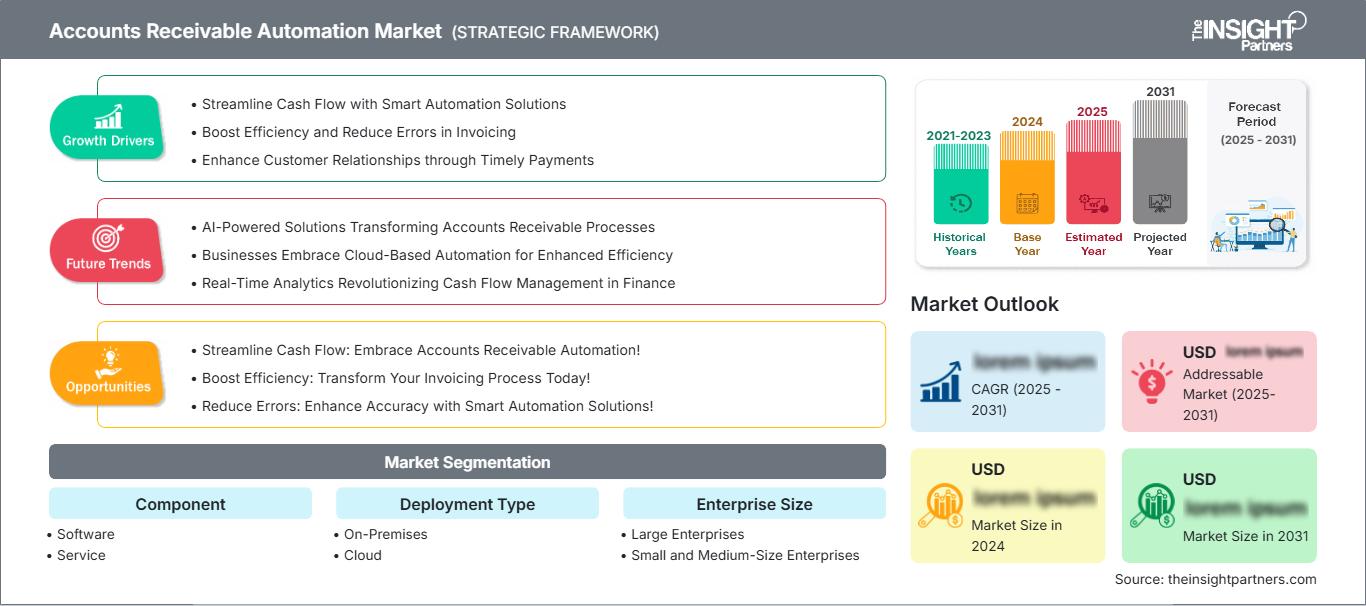
Regional Insights
North America accounts receivable automation market
North America represented 36–40% of the accounts receivable automation market share in 2025 and remains the largest regional market. Strong penetration of ERP platforms, widespread cloud adoption, and continuous investment in finance digitalization programs support sustained deployment. Large enterprises are increasingly adopting automated collections, electronic invoicing, and AI-assisted payment forecasting to improve cash-flow management while reducing manual workloads across finance departments.
The region is projected to expand at a CAGR of 11.5–12.5% during 2026–2034. Growth is supported by increasing demand for integrated order-to-cash solutions and the modernization of corporate finance functions. Financial institutions, healthcare providers, retailers, and telecom operators are accelerating automation initiatives to improve customer payment experiences, enhance compliance, and strengthen operational efficiency. Continued innovation from enterprise software vendors and automation specialists further supports long-term market expansion throughout North America.
U.S. accounts receivable automation market
The U.S. accounted for approximately 76–80% of the North American market in 2025, making it the dominant national contributor. High enterprise software spending, significant cloud infrastructure investments, and extensive deployment of digital finance solutions continue to support adoption. Organizations increasingly seek automated receivables solutions to reduce days sales outstanding, improve cash forecasting accuracy, and enhance customer relationship management across diverse business sectors.
The U.S. accounts receivable automation market is forecast to grow at a CAGR of 11.8–12.8% through 2034. The strong presence of major vendors including Oracle Corporation, Workday, Inc., HighRadius Corporation, and Bottomline Technologies contributes to market development. Demand is particularly notable among BFSI, healthcare, retail, and technology companies seeking integrated receivables management capabilities. Artificial intelligence-enabled collections prioritization and predictive payment behavior analytics are expected to remain important differentiators supporting future adoption.
Europe accounts receivable automation market
Europe captured 27–31% of the global market in 2025 and is projected to register a CAGR of 10.8–11.8% during 2026–2034. Germany leads regional adoption due to its strong industrial base and high enterprise software utilization. The United Kingdom follows closely, driven by financial services modernization and extensive cloud deployment. Regulatory compliance initiatives and digital invoicing requirements continue shaping implementation strategies across European organizations.
The UK market benefits from broad digital transformation programs across financial services, retail, and professional services sectors. Germany remains the leading national market owing to advanced manufacturing ecosystems, enterprise resource planning adoption, and growing interest in automated working-capital optimization. France, Italy, and Spain are witnessing expanding demand as organizations strengthen digital finance capabilities, automate collections processes, and improve receivables visibility. Regional enterprises increasingly prioritize automation investments that support compliance, efficiency gains, and improved customer payment management.
APAC accounts receivable automation market
Asia Pacific accounted for 22–26% of global accounts receivable automation market revenue in 2025 and represents the fastest-expanding major regional market. China leads regional demand, supported by enterprise digitalization and growing adoption of cloud business applications. Japan, South Korea, India, and Australia are also advancing investments in finance automation and integrated receivables management platforms.
The region is expected to grow at a CAGR of 13.8–14.8% through 2034. Government-supported digital transformation initiatives, expanding software spending, and increasing adoption among small and medium-sized enterprises contribute to growth. Organizations continue investing in automation technologies to improve operational visibility, enhance cash management, and support scalable financial operations.
Middle East & Africa accounts receivable automation market
The Middle East & Africa market remains smaller than North America, Europe, and APAC but demonstrates growing potential. Saudi Arabia and the UAE are benefiting from extensive digital transformation efforts, and South Africa boasts an established enterprise software market. Energy companies, utilities, banks, and telecommunications providers are some of the main adopters of automation solutions.
The regional market is forecasted to grow at a CAGR of 10.5–11.5% from 2026 to 2034. The reasons for that include continuous diversification efforts, infrastructure development, and adoption of cloud services. Enterprises in this market are looking for ways to improve receivables visibility and cash flow management through financial automation.
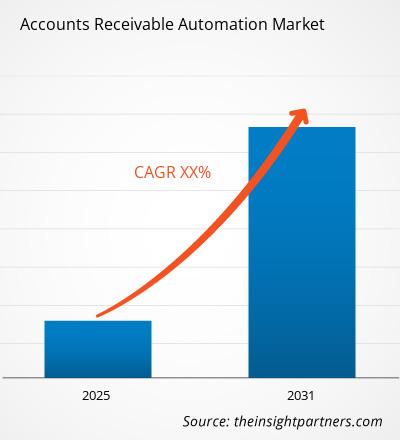
Segmentation Analysis
Component
The Component segment is expected to grow at a CAGR of 11.8–12.8% during 2026–2034. The accounts receivable automation market has been growing as companies continue to invest in software and additional services to enhance payment efficiency and improve financial visibility. Demand is supported by digital transformation initiatives, ERP integration requirements, and increasing emphasis on working-capital optimization.
- Software: Represents the largest portion of spending as organizations implement platforms for invoice management, collections automation, analytics, dispute resolution, and customer payment tracking. Integration with ERP and finance systems remains strategically important.
- Service: Includes consulting, deployment, training, integration, and support activities. Demand is increasing as organizations require specialized expertise to optimize workflows, accelerate implementation timelines, and maximize technology utilization.
Deployment Type
The Deployment Type segment is expected to see growth at a CAGR of 12.5-13.5% from 2026 to 2034. Factors driving deployment choices in the receivable automation market include scalability, data governance requirements, rapid implementation, and flexibility. There has been a growing trend toward cloud-based deployments, but some companies still choose on-premises solutions.
- On-Premises: Preferred by organizations with strict data control requirements, complex legacy infrastructures, or highly customized workflows. Adoption remains relevant in regulated industries that prioritize direct management of financial systems.
- Cloud: Experiences strong demand due to lower upfront costs, rapid deployment, automatic updates, and easier integration with modern enterprise applications. Cloud architectures also support distributed workforces and scalability objectives.
Enterprise Size
The Enterprise Size segment is expected to grow at a CAGR of 12.2–13.2% during 2026–2034. Both large organizations and smaller enterprises increasingly recognize the operational benefits associated with receivables digitization. Adoption levels vary according to budget availability, transaction complexity, and digital maturity across different business environments.
- Large Enterprises: Continue leading adoption due to extensive transaction volumes, multinational operations, and the need for sophisticated collections management capabilities that improve visibility and control.
- Small and Medium-Size Enterprises: Show rising interest in cloud-based solutions that provide affordable automation, improve cash-flow management, and reduce dependence on manual financial processes.
Industry Vertical
The Industry Verticals segment is estimated to experience growth at a CAGR of 12.8% to 13.8% between 2026 and 2034. The need to meet the demands of a particular industry increasingly shapes purchase decisions, as companies seek systems that address the complexities of payments, compliance, and customer interactions. Vendors are responding through sector-focused functionalities and integration capabilities.
- Energy and Utilities: Utilities and energy providers utilize automation tools to manage large customer bases, recurring billing environments, collections workflows, and dispute resolution activities more efficiently.
- BFSI: Financial institutions deploy advanced receivables technologies to improve payment tracking, strengthen customer engagement, and support operational efficiency initiatives aligned with digital transformation objectives.
- Consumer Goods and Retail: Retailers and consumer goods companies prioritize faster collections, improved invoice visibility, and stronger customer payment experiences across complex distribution networks.
- Healthcare: Healthcare organizations increasingly automate receivables operations to manage billing complexity, improve reimbursement visibility, and streamline payment collection workflows.
- IT and Telecom: Telecom operators and technology firms leverage automation to handle recurring invoices, customer account management, and large transaction volumes while maintaining operational scalability.
Opportunity Snapshot
| Industry Vertical | Revenue Contribution | Trend Tag | Adoption Stage |
| Energy and Utilities | Medium | Smart Billing | Scaling |
| BFSI | High | Risk Analytics | Mature |
| Consumer Goods and Retail | High | Omnichannel Pay | Scaling |
| Healthcare | Medium | Claims Sync | Scaling |
| IT and Telecom | High | Subscription AR | Mature |
Accounts Receivable Automation Market Growth Drivers and Impact Analysis
Rising Demand for Working Capital Optimization
Organizations across industries are placing greater emphasis on improving liquidity, reducing days sales outstanding, and strengthening cash-flow predictability. The accounts receivable automation software enables finance departments to speed up invoice processing, prioritize collections, and gain better insight into the status of balances. Such functionality becomes increasingly critical as companies face sophisticated payment processes for their clients and rising operating expenses. The automated management of receivables is also beneficial for data analysis and decision-making based on prediction and behavioral analysis. With the growing need for companies to free up working capital amid rising financing costs, the demand for smart receivables solutions is steadily rising.
Expansion of Cloud-Based Finance Transformation Programs
Finance executives are now opting for cloud-based systems because they offer scalability, rapid deployment, and easy integration with enterprise systems. Cloud deployment allows companies to update their receivables process without making significant changes to their infrastructure, while enabling remote and dispersed finance teams to work from anywhere. Enhanced cloud environments will also enable real-time collaboration, automated workflow management, and software updates. Providers are continuously developing cloud capabilities by adding advanced features such as embedded analytics, artificial intelligence, and integration tools that enable data integration across all business functions. Digital transformation efforts have increased worldwide, and cloud deployment has played a key role in this process.
Growing Integration of Artificial Intelligence in Finance Operations
AI is driving the application of receivables automation from mere transaction processing to financial forecasting. Receivables management systems using artificial intelligence can determine which collection tasks to perform, forecast payment trends, identify risks, and recommend optimal strategies. The benefits here include increased efficiency along with proactive handling of payments and customer complaints. AI technologies such as machine learning, natural language processing, and intelligent workflows have become increasingly common among vendors developing receivables software products to deliver tangible business results. With the growing acceptance of enterprise AI, finance teams are adopting intelligent automation solutions to improve operational performance and decision-making.
Accounts Receivable Automation Market Future Trends
Autonomous Receivables Operations Driven by AI
The accounts receivable automation market trends increasingly point toward autonomous finance operations supported by predictive and generative AI technologies. The platforms of the future are expected to automate customer communications, payment predictions, collection priorities, and dispute resolution with little or no manual involvement. The vendors are now developing intelligent systems that can analyze transactions and make appropriate recommendations without human intervention. As companies seek greater efficiency and scalability, self-service receivables will become standard tools in financial ecosystems. It will enable organizations to better manage their collections, shorten the cash cycle, and deploy finance resources on more productive tasks.
Growing Convergence of Digital Payments and Receivables Platforms
Receivables automation platforms will become increasingly connected to digital payment infrastructure to form an invoice-to-cash ecosystem. Future systems will be designed to integrate invoicing, payment, reconciliation, reporting, and customer engagement processes. With the development of electronic payment infrastructure across different business environments, there will be a need for systems that help handle payment processes in real time. The integration of finance platforms with payment infrastructure will bring greater transparency to processes and make reconciliation much easier. This trend will result in a better customer experience and faster payment cycles.
Accounts Receivable Automation Market Opportunities
Expansion Among Small and Medium-Size Enterprises
Small and medium-sized enterprises remain largely underpenetrated compared with large enterprises, despite growing recognition of the advantages of automation. Subscription services provided by cloud platforms have lowered entry barriers for many organizations, thereby contributing to higher adoption rates. Solution providers may capitalize on this by providing flexible deployment options, easy-to-use platforms, and industry-specific applications. With more SMEs adopting digitization projects, there will be a greater need for cost-effective receivables automation solutions. Accounts receivable automation market Forecasts indicate that vendors capable of balancing functionality, scalability, and cost efficiency will be particularly well positioned to expand customer bases and strengthen recurring revenue streams over the coming years.
Industry-Specific Automation Solutions
Opportunities abound for vendors offering platforms specifically designed to meet the needs of individual industries. Each industry has its own unique billing and payment cycles, regulatory concerns, and issues surrounding customer interactions. It is therefore possible to offer receivables solutions that better cater to these needs rather than using generic solutions. There would be greater benefits, including faster implementation and increased customer satisfaction, from platforms specifically designed to meet the needs of individual industries. Vendors specializing in verticals, building ecosystems, and flexible automation frameworks will get to distinguish themselves in an increasingly competitive environment.
Frequently Asked Questions

- Comprehensive Market Sizing and Forecast Analysis
- Detailed Segmentation Analysis
- In-Depth Market Dynamics Assessment
- Regional and Country-Level Insights
- Competitive Landscape and Company Benchmarking
- Strategic Business Intelligence
Recent Reports
Testimonials

The Insight Partners provided valuable market intelligence that supported our global go-to-market strategy. Their team was professional, responsive, and attentive to our feedback, providing thoughtful analysis and helpful methodological clarifications throughout the project.
Junmo Kim Chief Financial Officer (CFO), Enertech Co., Ltd.
The Insight Partners' SCADA System Market report is comprehensive, with valuable insights on current trends and future forecasts. The team was highly professional, responsive, and supportive throughout. We are very satisfied and highly recommend their services.
RAN KEDEM Partner, Reali Technologies LTDs
I requested a report on a very specific software market and the team produced the report in a few days. The information was very relevant and well presented. I then requested some changes and additions to the report. The team was again very responsive and I got the final report in less than a week.
JEAN-HERVE JENN Chairman, Future Analytica
We worked with The Insight Partners for an important market study and forecast. They gave us clear insights into opportunities and risks, which helped shape our plans. Their research was easy to use and based on solid data. It helped us make smart, confident decisions. We highly recommend them.
PIYUSH NAGPAL Sr. Vice President, High Beam Global
The Insight Partners delivered insightful, well-structured market research with strong domain expertise. Their team was professional and responsive throughout. The user-friendly website made accessing industry reports seamless. We highly recommend them for reliable, high-quality research services
YUKIHIKO ADACHI CEO, Deep Blue, LLC.
This is the first time I have purchased a market report from The Insight Partners.While I was unsure at first, I visited their web site and felt more comfortable to take the risk and purchase a market report.I am completely satisfied with the quality of the report and customer service. I had several questions and comments with the initial report, but after a couple of dialogs over email with their analyst I believe I have a report that I can use as input to our strategic planning process.Thank you so much for taking the extra time and making this a positive experience.I will definitely recommend your service to others and you will be my first call when we need further market data.
JOHN SUZUKI President and Chief Executive Officer, Board Director, BK Technologies
I wish to appreciate your support and the professionalism you displayed in the course of attending to my request for information regarding to infectious disease IVD market in Nigeria. I appreciate your patience, your guidance, and the fact that you were willing to offer a discount, which eventually made it possible for us to close a deal. I look forward to engaging The Insight Partners in the future, all thanks to the impression you have created in me as a result of this first encounter.
DR CHIJIOKE ONYIA MANAGING DIRECTOR, PineCrest Healthcare Ltd.Reason to Buy
- Informed Decision-Making
- Understanding Market Dynamics
- Competitive Analysis
- Identifying Emerging Markets
- Customer Insights
- Market Forecasts
- Risk Mitigation
- Boosting Operational Efficiency
- Strategic Planning
- Investment Justification
- Tracking Industry Innovations
- Aligning with Regulatory Trends





 Get Free Sample for