
Acoustic Vehicle Alerting System (AVAS) Market Developments, Analysis, and Forecast by 2031
Coverage: By Propulsion (Battery Electric Vehicle (BEV), Plug-In Hybrid Electric Vehicle (PHEV), Fuel Cell Electric Vehicle (FCEV), Hybrid Electric Vehicle (HEV)); Vehicle Type (Passenger Vehicle, Commercial Vehicle); Mounting Position (Separated, Integrated) , and Geography (North America, Europe, Asia Pacific, and South and Central America)
- Status : Data Released
- Report Code : TIPRE00007133
- Category : Automotive and Transportation
- No. of Pages : 150
- Available Report Formats :


- Last update date : August 07, 2026


2024 Market Size
US$ 1.69 Bn
Base year value
2031 Forecast
US$ 3.76 Bn
Projected by 2031
CAGR 2025-2031
11.6 %
Growth rate
Addressable Market
US$ 18.80 Bn
(2025-2031)
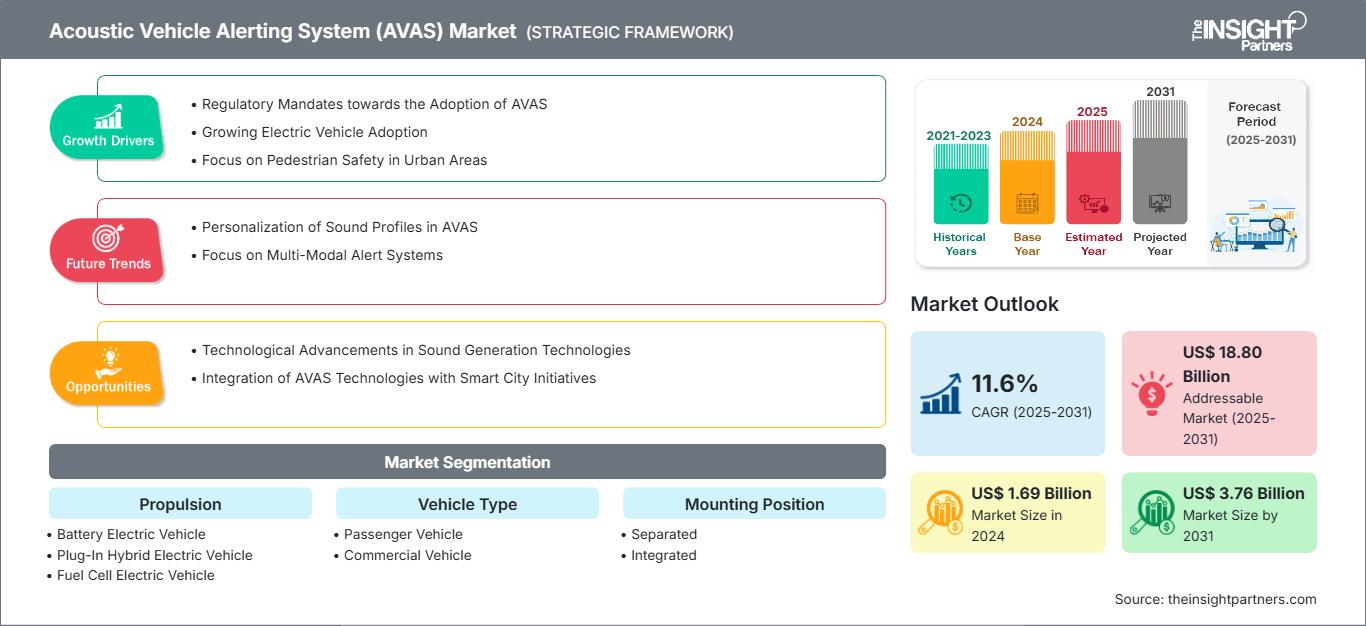
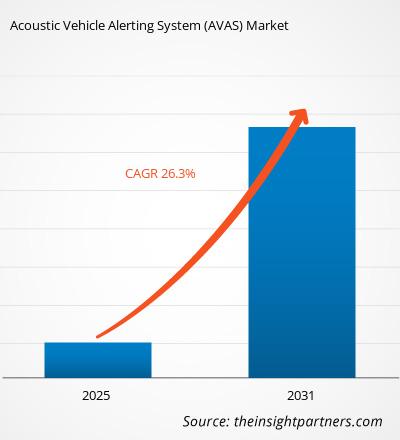
The acoustic vehicle alerting system market was valued at US$ 1.69 Billion in 2025 and is projected to reach US$ 3.76 Billion by 2034, expanding at a CAGR of 11.6% during 2026–2034. Market expansion is being driven by the growing penetration of electric and hybrid vehicles, increasing pedestrian safety regulations, and wider integration of external sound generation technologies across passenger and commercial mobility platforms. Regulatory requirements covering silent vehicle operation continue to support deployment across major automotive manufacturing regions.
Across North America, regulatory implementation, rising battery electric vehicle adoption, and increasing investments in advanced automotive electronics are supporting sustained demand. The acoustic vehicle alerting system market size in the region is expected to expand at a CAGR ranging between 10.5% and 12.0% through 2034. Vehicle safety mandates, strong original equipment manufacturer presence, and continued electrification strategies across the U.S. and Canada remain the primary structural factors shaping regional demand.
Acoustic Vehicle Alerting System (AVAS) Market Assessment and Insights
- North America: Accounted for an estimated 31–35% share in 2025 and is projected to grow at a CAGR of 10.8–11.8% during 2026–2034. Demand remains supported by mature EV deployment, safety regulations, and strong integration of vehicle electronics across premium and commercial fleets.
- US: Represented approximately 72–76% of North America in 2025 and is anticipated to record a CAGR of 10.9–11.9% during 2026–2034, driven by increasing electric vehicle production and compliance with pedestrian safety standards.
- Europe: Held an estimated 27–31% share in 2025 and is forecast to expand at a CAGR of 10.5–11.5% during 2026–2034. Germany, the United Kingdom, and France remain leading markets due to electrification initiatives and established automotive manufacturing ecosystems.
- Asia Pacific: Accounted for approximately 30–34% share in 2025 and is expected to grow at a CAGR of 12.5–13.5% during 2026–2034. China, Japan, South Korea, and India continue to drive demand through EV production capacity expansion and supportive government policies.
- Largest Segment: Passenger Vehicle maintained a market share of 68–72% in 2025 and is anticipated to register a CAGR of 11.0–12.0% during 2026–2034, supported by large-scale integration of alerting technologies in electric passenger mobility platforms.
- High Growth Segment: Battery Electric Vehicle captured 44–48% market share in 2025 and is projected to expand at a CAGR of 13.5–14.5% during 2026–2034, reflecting accelerating global EV adoption and tightening safety regulations.
- Key companies analyzed in detail: Brigade Electronics Group Plc, Mercedes-Benz Group AG, HARMAN International Industries, Incorporated, HELLA GmbH & Co. KGaA, Jaguar Land Rover Limited, Kendrion N.V., Siemens Digital Industries Software, Novosim Ltd., SoundRacer AB, Texas Instruments Incorporated.
Source: The Insight Partners' analysis based on proprietary research, government publications, company annual reports, investor presentations, industry databases, and expert interviews.
Vehicle electrification continues to reshape automotive safety architecture, encouraging manufacturers to incorporate advanced external sound generation systems into next-generation mobility platforms. Regulatory frameworks introduced across major automotive markets have accelerated deployment, while component innovation has improved sound customization, energy efficiency, and integration capabilities. Growing production of battery electric and hybrid vehicles has created a broader addressable market for suppliers specializing in acoustic control modules, speakers, software algorithms, and vehicle communication systems.
Over the coming decade, investment activity is expected to expand beyond mature automotive regions toward rapidly growing Asian manufacturing hubs and selected Middle Eastern markets. Increasing urbanization, smart-city transportation programs, and evolving road-safety standards are supporting broader adoption scenarios. Automotive manufacturers are also exploring differentiated sound signatures that strengthen brand identity while meeting compliance requirements, creating additional opportunities for software developers and acoustic technology providers within the acoustic vehicle alerting system market.
Acoustic Vehicle Alerting System (AVAS) Market Report Scope
| Report Attribute | Details |
|---|---|
| Market size in 2024 | US$ 1.69 Billion |
| Market Size by 2031 | US$ 3.76 Billion |
| Global CAGR (2025 - 2031) | 11.6% |
| Historical Data | 2021-2023 |
| Forecast period | 2025-2031 |
Acoustic Vehicle Alerting System (AVAS) Market Analysis
Rising electric vehicle sales remain a central growth catalyst for the industry. Because electric propulsion systems generate substantially lower operating noise at low speeds than conventional internal combustion engines, regulatory agencies increasingly require artificial sound generation solutions to enhance pedestrian awareness. Consequently, manufacturers are integrating dedicated warning systems into vehicle design cycles rather than treating them as optional safety features. The resulting expansion of supplier ecosystems is strengthening long-term demand across component manufacturing, software development, system integration, and aftermarket service channels. The acoustic vehicle alerting system market growth outlook remains closely tied to continued electrification across passenger and commercial transportation sectors.
Supply-chain developments are also influencing adoption patterns. Semiconductor suppliers, speaker manufacturers, acoustic software developers, and automotive OEMs are increasingly collaborating to optimize system integration and reduce deployment costs. Enhanced production scale has improved component availability, while advances in electronic control units support more sophisticated sound generation capabilities. Regulatory convergence among major automotive markets is further helping manufacturers standardize product platforms, reducing engineering complexity and supporting broader commercial deployment.
The competitive environment is characterized by a combination of established automotive technology providers and specialty acoustic solution developers. Companies including HARMAN International Industries, Incorporated, HELLA GmbH & Co. KGaA, Kendrion N.V., and Texas Instruments Incorporated continue investing in vehicle electronics and audio technologies that support differentiated warning systems. Meanwhile, Brigade Electronics Group Plc and SoundRacer AB focus on specialized safety and sound-generation applications, contributing to product diversification across vehicle categories. This evolving landscape strengthens the overall acoustic vehicle alerting system market analysis by expanding the range of available solutions.
Strategic investment increasingly targets software-defined vehicle architectures capable of supporting customizable sound profiles, regulatory updates, and enhanced user experiences. Mercedes-Benz Group AG and Jaguar Land Rover Limited are integrating advanced acoustic capabilities into premium electrified vehicles, while Siemens Digital Industries Software and Novosim Ltd. contribute simulation and validation technologies that improve development efficiency. As automakers seek greater differentiation and compliance flexibility, partnerships between electronics suppliers, software firms, and vehicle manufacturers are expected to become more prominent, reinforcing long-term market competitiveness.
● REPORT CUSTOMIZATION
Tailor This Report To Align With Your Specific Business Requirements
This report can be customized to align precisely with your business objectives, scope, and target markets. Customization options include tailored segmentation, geography, competitive analysis, and strategic insights to support informed decision-making.
Customize This Report →WHAT YOU CAN ADJUST
- ● Segmentations
- ● Geography
- ● Competitive Analysis
- ● Language Preferences
Acoustic Vehicle Alerting System (AVAS) Market: Strategic Insights
Regional Insights
North America Acoustic Vehicle Alerting System Market
North America accounted for approximately 31–35% of the acoustic vehicle alerting system market share in 2025 and is projected to expand at a CAGR of 10.8–11.8% through 2034. Regulatory requirements covering pedestrian safety remain among the most important growth drivers. Vehicle manufacturers operating in the United States and Canada continue increasing electric vehicle production, creating sustained demand for integrated sound-generation solutions. Strong consumer awareness regarding vehicle safety technologies further supports adoption across passenger and commercial vehicle categories.
The region also benefits from a mature automotive electronics ecosystem and extensive research activity related to advanced mobility. Technology providers continue introducing improved acoustic software, speaker architectures, and digital control systems designed to meet evolving compliance requirements. Investments in EV manufacturing facilities, battery supply chains, and connected vehicle platforms are expected to strengthen long-term deployment opportunities. Original equipment manufacturers increasingly view acoustic warning technology as a standard safety feature rather than a regulatory obligation alone, supporting steady market expansion throughout the forecast period.
U.S. Acoustic Vehicle Alerting System Market
The United States represented approximately 72–76% of the North American market in 2025 and is expected to register a CAGR of 10.9–11.9% during 2026–2034. High EV adoption rates, continued investments in vehicle electrification, and extensive automotive innovation activity contribute to sustained demand. Federal safety requirements regarding low-speed vehicle audibility continue encouraging broad deployment across multiple vehicle categories, including passenger cars, delivery vans, and urban mobility fleets.
Acoustic vehicle alerting system market participants benefit from strong domestic technology capabilities and collaborations between automakers, semiconductor suppliers, and electronics specialists. HARMAN International Industries, Incorporated, Texas Instruments Incorporated, and several global automotive technology companies maintain significant operational presence within the country. Growing use of software-driven vehicle architectures is allowing manufacturers to deploy customizable sound profiles while maintaining regulatory compliance. As EV ownership expands and commercial fleet electrification accelerates, demand for integrated acoustic warning systems is expected to remain robust throughout the forecast period.
Europe Acoustic Vehicle Alerting System Market
Europe captured market share of 27–31% in 2025 and is projected to grow at 10.5-11.5% during 2026 to 2034. Germany has been identified as the dominant market in the region owing to the presence of the automotive manufacturing industry and the integration of electrified mobility technology. The country boasts strong research capabilities, an advanced supplier network, and large-scale adoption of premium electric vehicles, which are complex in terms of warning system integration.
The UK acoustic vehicle alerting system market is being supported by vehicle safety regulations and EV registration, driving the deployment of this system. France, Italy, and Spain collectively drive demand in the region, with increasing production and the development of sustainable infrastructure in these countries. Suppliers such as HELLA GmbH & Co. KGaA, Mercedes-Benz Group AG, Jaguar Land Rover Limited, and other automotive technology companies play an integral role in the region's value chain.
APAC Acoustic Vehicle Alerting System Market
Asia Pacific accounted for approximately 30–34% of the acoustic vehicle alerting system market in 2025 and is projected to achieve a CAGR of 12.5–13.5% during 2026–2034, making it the fastest-growing major region. China remains the dominant contributor owing to large-scale electric vehicle manufacturing capacity and supportive industrial policies.
Japan, South Korea, India, and Australia will bolster their transportation infrastructure through vehicle manufacturing and other consumer incentives. Robust regional value chains, rising needs for urban mobility, and increasing use of advanced automotive electronics will be driving demand for acoustic vehicle alerting systems during the forecast period.
Middle East & Africa Acoustic Vehicle Alerting System Market
The Middle East & Africa market is anticipated to expand at a CAGR of 9.5–10.5% between 2026 and 2034. Saudi Arabia and the United Arab Emirates are driving regional demand through investments in smart mobility initiatives, electric transportation projects, and advanced urban infrastructure development.
The South African region is gradually increasing its uptake due to vehicle electrification and evolving safety regulations. Even though the market size is small compared to North America, Europe, and Asia Pacific, modernized infrastructure and sustainable initiatives are anticipated to present new opportunities for system providers in the coming years.
Segmentation Analysis
Propulsion
The propulsion segment is expected to remain the primary driver of acoustic warning systems, as the regulatory framework primarily focuses on electrified vehicles operating at lower speeds. The propulsion segment is expected to grow at a CAGR of 12.0-13.0% between 2026 and 2034. Rising adoption of electric mobility solutions, enhanced safety regulations, and increasing sound differentiation through vehicle sound branding will drive the adoption of acoustic warning technology in automotive production. The acoustic vehicle alerting system market scope continues to widen as automakers diversify propulsion technologies and incorporate advanced warning systems at the design stage.
- Battery Electric Vehicle (BEV) – Represents the most significant deployment category due to complete dependence on artificial sound generation at low speeds. Regulatory compliance requirements and rising production volumes position this sub-segment as a strategic demand driver for suppliers.
- Plug-In Hybrid Electric Vehicle (PHEV) – Combines electric and conventional propulsion modes, creating strong demand for intelligent sound management systems capable of supporting seamless transitions between operating conditions while maintaining pedestrian safety compliance.
- Fuel Cell Electric Vehicle (FCEV) – Though comparatively smaller in volume, this category requires similar low-speed acoustic notification systems. Expansion of hydrogen mobility initiatives in selected markets is supporting long-term deployment opportunities.
- Hybrid Electric Vehicle (HEV) – Continued global adoption of hybrid platforms sustains demand for acoustic alert solutions, particularly in urban driving environments where electric-only operation necessitates enhanced pedestrian awareness capabilities.
Vehicle Type
The vehicle type category is anticipated to exhibit a CAGR of 11.2–12.2% for the acoustic vehicle alerting system market from 2026 to 2034. There are regulatory compliance requirements applicable not only to passenger cars but also to commercial and personal mobility, promoting the use of acoustic alerts beyond passenger cars. Acoustic alerts are now becoming part of the vehicle safety architecture for various reasons, including improved compliance and future electrification plans.
- Passenger Vehicle – Accounted for an estimated 68–72% share in 2025, supported by growing electric vehicle ownership, stringent safety regulations, and the increasing integration of advanced electronic safety features across mass-market and premium models.
- Commercial Vehicle – Fleet electrification initiatives, urban logistics expansion, and regulatory compliance requirements are driving adoption. Operators increasingly prioritize technologies that improve safety performance in densely populated environments and delivery corridors.
Mounting Position
The mounting position category is estimated to register a CAGR of 10.8%-11.8% from 2026 to 2034 in the global acoustic vehicle alerting system market. As companies strive for better acoustic results, simpler installation, and effective space utilization, there is an ongoing trend toward developing mounting positions using new system integration techniques.
- Separated – Utilizes distinct hardware configurations that provide flexibility in sound projection and design customization. This approach remains relevant for specialized vehicle applications requiring tailored acoustic performance characteristics.
- Integrated – Increasingly preferred by manufacturers due to simplified assembly processes, lower component complexity, and compatibility with modern vehicle platforms emphasizing efficiency, packaging optimization, and scalable production approaches.
Opportunity Snapshot
| Vehicle Type | Revenue Contribution | Trend Tag | Adoption Stage |
| Passenger Vehicle | High | EV Safety | Mature |
| Commercial Vehicle | Medium | Fleet Silence | Scaling |
Acoustic Vehicle Alerting System (AVAS) Market Growth Drivers and Impact Analysis
Global Electric Vehicle Production Expansion
The rapidly growing production of electric vehicles globally is one of the biggest factors influencing demand in the industry. Since battery-electric, plug-in hybrid, and fuel cell vehicles produce much less noise than conventional vehicles, regulations to strengthen pedestrian safety are becoming ever stronger. Consequently, car manufacturers incorporate acoustic alerting systems that comply with new regulations as an integral part of a vehicle rather than as an add-on option. Increased manufacturing capacities of electric cars in China, the United States, Germany, South Korea, and other production centers will create a larger base of vehicles that will need such acoustic systems. It creates demand for speakers, electronic control units, software for generating sound, and validation systems. The demand volumes are expected to grow throughout the forecast period.
Strengthening Pedestrian Safety Regulations Worldwide
Government agencies are making ongoing efforts to introduce regulations to help minimize the dangers posed by quiet automobiles in urban areas. These regulatory measures are pushing for the widespread deployment of acoustic alert technologies in key automobile markets. These compliance requirements have made acoustic alert systems an integral part of cars. There are growing investments by automakers in technologies that meet regional specifications without compromising their unique characteristics or the consumer experience. There are further benefits of regulatory standardization across regions, which make it easier for suppliers to scale and for automakers to develop cars. In light of ongoing initiatives to promote sustainable transportation in cities, it is anticipated that safety regulations will contribute to demand for advanced alert systems.
Advancement of Software-Defined Vehicle Architectures
The move towards software-defined cars is opening up possibilities for smart acoustic warnings. Modern vehicle platforms are adopting computing platforms that support over-the-air upgrades, custom sound profiles, and adaptable systems. There is an advantage to acoustic technologies in this regard because car manufacturers can change the warning features without much change to hardware designs. Software also enables compliance adaptability as the laws keep changing across regions. Automotive companies are using sound customization to enhance brand awareness while maintaining high performance standards. Enhanced processing capabilities enable natural warning sounds that improve pedestrian recognition. As vehicle software ecosystems become more sophisticated, demand for programmable and upgradeable alerting systems is expected to expand alongside broader digital mobility transformation initiatives.
Acoustic Vehicle Alerting System (AVAS) Market Future Trends
Brand-Specific Acoustic Identity Development
Automotive manufacturers are increasingly viewing vehicle sound generation as both a safety requirement and a branding opportunity. The acoustic vehicle alerting system market trends indicate growing investment in proprietary sound signatures to enhance vehicle recognition while meeting regulatory requirements. Future systems will integrate artificial intelligence, digital sound libraries, and computer-controlled interfaces to deliver adaptable acoustic environments. Sound characteristics can vary with vehicle speed, driving mode, environment, and even regional compliance requirements. Premium car manufacturers pay particular attention to creating unique audio brand identities for their electric vehicle ranges. With growing awareness of electrified transport, customized audio branding will become a significant part of product marketing.
Integration with Connected and Autonomous Mobility Platforms
The future vehicle architecture is expected to feature acoustic warning capabilities integrated with innovations in connected mobility and autonomous vehicles. Sensor technology, vehicle-to-everything communication technology, and intelligent control platforms are anticipated to enhance the process of producing and managing external sound alerts. The systems will be able to operate in response to varying numbers of pedestrians, traffic conditions, climate, and the status of the vehicles’ operation. It is expected that this process will lead to improved safety and efficiency, and reduced noise pollution in cities. Increased use of self-driving delivery vehicles, robotaxis, and smart transport networks is expected to drive the demand for intelligent sound generation systems.
Acoustic Vehicle Alerting System (AVAS) Market Opportunities
Expansion into Emerging Electric Commercial Fleets
Rapid electrification of logistics systems, transport infrastructure, and last-mile delivery is a major growth opportunity. Transport operators are increasingly using electric vehicles to reduce their carbon footprint, meet their sustainability goals, and comply with urban regulations. Electric vehicles need appropriate alerting systems to improve pedestrian awareness in densely populated areas. The growing demand is not limited to passenger cars; it also creates opportunities for scalable, fleet-focused acoustic solutions. Companies that develop affordable solutions designed specifically for vans, buses, and urban delivery trucks could win contracts with fleet operators. Acoustic vehicle alerting system market forecasts suggest that commercial mobility applications will become an increasingly important revenue contributor throughout the forecast period.
Software-Based Upgrade and Customization Services
Increasing acceptance of software-defined vehicles is driving new revenue streams beyond hardware. In increasing numbers, car makers require an adaptable acoustic platform that can accommodate changing regulations, over-the-air updates, and sound profiles. Providers have an opportunity to earn from software licenses, testing, acoustic libraries, and compliance management. With the help of such a model, automotive manufacturers will be able to adjust their warning systems to comply with ever-changing regulations without making too many hardware changes. Moreover, it is possible to create personalized premium sounds for users. Organizations that integrate hardware capabilities with software lifecycle management services will have an advantage in the market in the coming decade.
Frequently Asked Questions

- Comprehensive Market Sizing and Forecast Analysis
- Detailed Segmentation Analysis
- In-Depth Market Dynamics Assessment
- Regional and Country-Level Insights
- Competitive Landscape and Company Benchmarking
- Strategic Business Intelligence
Recent Reports
Testimonials

The Insight Partners' SCADA System Market report is comprehensive, with valuable insights on current trends and future forecasts. The team was highly professional, responsive, and supportive throughout. We are very satisfied and highly recommend their services.
RAN KEDEM Partner, Reali Technologies LTDs
I requested a report on a very specific software market and the team produced the report in a few days. The information was very relevant and well presented. I then requested some changes and additions to the report. The team was again very responsive and I got the final report in less than a week.
JEAN-HERVE JENN Chairman, Future Analytica
We worked with The Insight Partners for an important market study and forecast. They gave us clear insights into opportunities and risks, which helped shape our plans. Their research was easy to use and based on solid data. It helped us make smart, confident decisions. We highly recommend them.
PIYUSH NAGPAL Sr. Vice President, High Beam Global
The Insight Partners delivered insightful, well-structured market research with strong domain expertise. Their team was professional and responsive throughout. The user-friendly website made accessing industry reports seamless. We highly recommend them for reliable, high-quality research services
YUKIHIKO ADACHI CEO, Deep Blue, LLC.
This is the first time I have purchased a market report from The Insight Partners.While I was unsure at first, I visited their web site and felt more comfortable to take the risk and purchase a market report.I am completely satisfied with the quality of the report and customer service. I had several questions and comments with the initial report, but after a couple of dialogs over email with their analyst I believe I have a report that I can use as input to our strategic planning process.Thank you so much for taking the extra time and making this a positive experience.I will definitely recommend your service to others and you will be my first call when we need further market data.
JOHN SUZUKI President and Chief Executive Officer, Board Director, BK Technologies
I wish to appreciate your support and the professionalism you displayed in the course of attending to my request for information regarding to infectious disease IVD market in Nigeria. I appreciate your patience, your guidance, and the fact that you were willing to offer a discount, which eventually made it possible for us to close a deal. I look forward to engaging The Insight Partners in the future, all thanks to the impression you have created in me as a result of this first encounter.
DR CHIJIOKE ONYIA MANAGING DIRECTOR, PineCrest Healthcare Ltd.Reason to Buy
- Informed Decision-Making
- Understanding Market Dynamics
- Competitive Analysis
- Identifying Emerging Markets
- Customer Insights
- Market Forecasts
- Risk Mitigation
- Boosting Operational Efficiency
- Strategic Planning
- Investment Justification
- Tracking Industry Innovations
- Aligning with Regulatory Trends





 Get Free Sample for