
Adaptive learning Software Market Size, Share & Forecast by 2034
Coverage: by Component (Software, Services); End User (K-12, Higher Education, Corporate, Others); Deployment Mode (Deployment, On-Premises, Hybrid ) , and Geography (North America, Europe, Asia Pacific, and South and Central America)
- Status : Data Released
- Report Code : TIPRE00010644
- Category : Technology, Media and Telecommunications
- No. of Pages : 150
- Available Report Formats :


- Last update date : August 10, 2026


2025 Market Size
US$ 5.39 Bn
Base year value
2034 Forecast
US$ 26.30 Bn
Projected by 2034
CAGR 2026-2034
19.27 %
Growth rate
Addressable Market
US$ 129.58 Bn
(2026-2034)
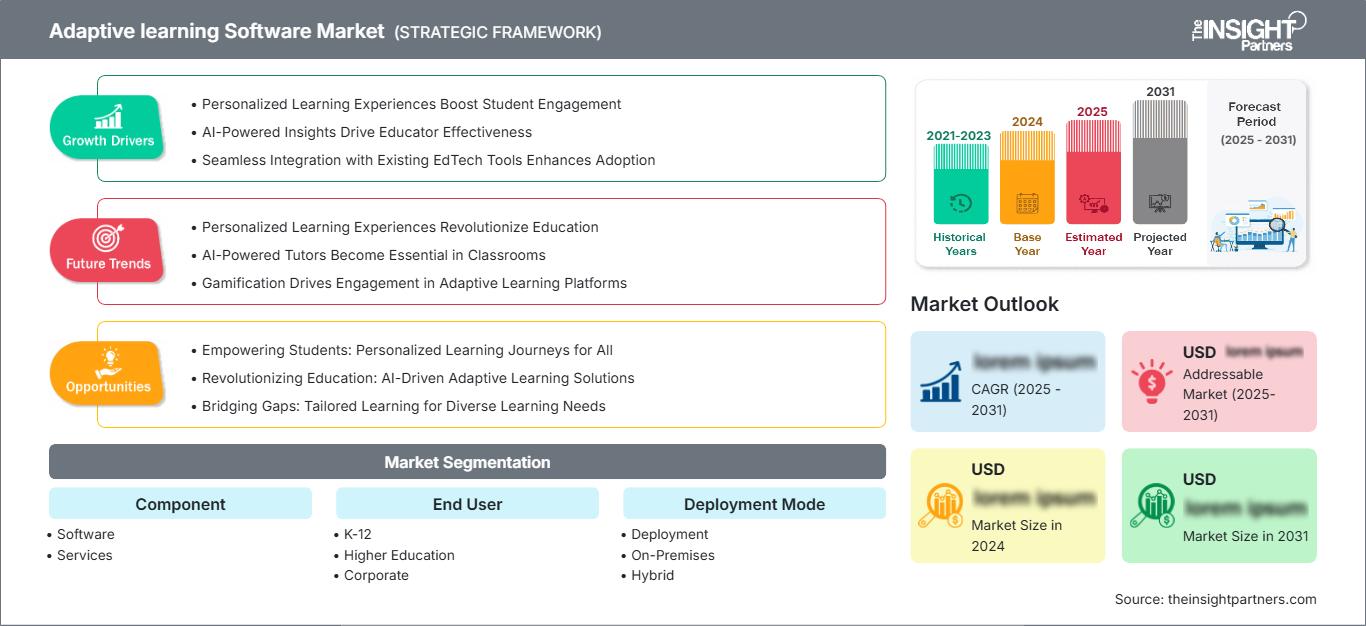
The adaptive learning software market was valued at US$ 5.39 Billion in 2025 and is projected to reach US$ 26.30 Billion by 2034, expanding at a CAGR of 19.27% during 2026–2034. Growing adoption of personalized digital education, artificial intelligence-enabled instruction, and data-driven learning assessment frameworks is transforming educational delivery across academic institutions and enterprises. Expanding digital learning ecosystems and increasing emphasis on learner engagement continue to support long-term expansion of adaptive technologies globally.
Across North America, institutional investments in personalized learning platforms, cloud-based educational infrastructure, and workforce reskilling initiatives continue to strengthen market expansion. The adaptive learning software market size in the region benefits from strong edtech funding activity, widespread digital device penetration, and favorable technology adoption across schools, universities, and corporate training environments. Regional growth is expected to progress at a CAGR range of 17.5–19.5% during the forecast period.
Adaptive learning Software Market Assessment and Insights
- North America: Accounted for a share range of 37–41% in 2025. Strong adoption of AI-driven education tools, mature digital infrastructure, and institutional technology spending support growth at a CAGR of 17.5–19.5% during 2026–2034.
- US: Represented 72–76% of North American revenue in 2025. Advanced deployment of personalized learning platforms and strong enterprise training demand support a CAGR of 18.0–20.0% during 2026–2034.
- Europe: Held approximately 24–28% share in 2025. Germany, the UK, and France remain major contributors, while digital education initiatives support a CAGR of 18.0–20.0% during 2026–2034.
- Asia Pacific: Captured 26–30% of the adaptive learning software market share in 2025. China, India, Japan, South Korea, and Australia drive adoption through expanding digital education ecosystems, supporting a CAGR of 21.0–23.0% during 2026–2034.
- Largest Segment: Software accounted for approximately 70–74% market share in 2025, supported by platform licensing and analytics capabilities. The segment is projected to grow at a CAGR of 18.5–20.5% during 2026–2034.
- High Growth Segment: Corporate represented approximately 24–28% share in 2025. Rising workforce reskilling and enterprise learning personalization support growth at a CAGR of 21.5–23.5% during 2026–2034.
- Key companies analyzed in detail: Cerego, Inc., CogBooks Ltd., DreamBox Learning, Inc., Fishtree Inc., Kidaptive, Inc., Knewton, Inc., New Leaf Technologies, Pearson plc, Realizeit, Smart Sparrow Pty Ltd.
Source: The Insight Partners' analysis based on proprietary research, government publications, company annual reports, investor presentations, industry databases, and expert interviews.
Digital learning environments have evolved from standardized content delivery toward highly personalized educational experiences. Artificial intelligence, machine learning algorithms, predictive analytics, and learning behavior monitoring increasingly help institutions identify individual strengths and knowledge gaps. The adaptive learning software market has benefited from improvements in cloud computing infrastructure, broader internet access, and demand for measurable learning outcomes. Educational institutions and enterprises are integrating adaptive systems into broader digital transformation strategies to improve engagement and performance metrics while optimizing training effectiveness.
Future development is expected to be supported by increasing investments across emerging economies, stronger government focus on digital education accessibility, and enhanced interoperability between learning platforms. Workforce development requirements, lifelong learning initiatives, and competency-based education models are anticipated to encourage adoption. Greater integration of generative AI, content automation tools, and advanced learner analytics will further enhance personalization capabilities while improving scalability across educational and corporate learning ecosystems.
Adaptive learning Software Market Report Scope
| Report Attribute | Details |
|---|---|
| Market size in 2025 | US$ 5.39 Billion |
| Market Size by 2034 | US$ 26.30 Billion |
| Global CAGR (2026 - 2034) | 19.27% |
| Historical Data | 2021-2024 |
| Forecast period | 2026-2034 |
Adaptive learning Software Market Analysis
The adaptive learning software market growth trajectory is supported by increasing demand for individualized instruction that aligns educational content with learner performance. Educational institutions continue to prioritize student retention, assessment accuracy, and academic achievement, creating favorable conditions for adaptive platforms. Simultaneously, corporations increasingly deploy personalized training solutions to address rapidly evolving workforce skill requirements. The value chain includes content developers, software providers, cloud infrastructure vendors, educational institutions, enterprises, and learning analytics specialists.
Supply-side development is characterized by continuous innovation in AI-powered recommendation engines, real-time assessment technologies, and data integration capabilities. Vendors are focusing on platform scalability, interoperability, and mobile accessibility to widen adoption. Subscription-based business models and cloud deployment capabilities have reduced implementation barriers, allowing a broader range of educational institutions and organizations to deploy adaptive learning environments effectively.
The competitive environment remains moderately fragmented, with established education technology providers competing alongside specialized adaptive learning innovators. The adaptive learning software market analysis reveals that technology differentiation increasingly depends on predictive analytics performance, content customization capabilities, and learner engagement effectiveness. Pearson plc continues expanding digital learning ecosystems, while DreamBox Learning, Inc. strengthens K-12 personalization solutions. Realizeit and CogBooks Ltd. emphasize adaptive learning pathways that support institutional learning outcomes.
Investment activity increasingly targets AI-enabled learning platforms, immersive educational technologies, and workforce upskilling solutions. Companies including Cerego, Inc., Knewton, Inc., Kidaptive, Inc., Fishtree Inc., New Leaf Technologies, and Smart Sparrow Pty Ltd. focus on advanced analytics and adaptive content delivery capabilities to improve competitive positioning. Strategic partnerships between educational institutions, enterprises, and software vendors are expected to support innovation and market expansion throughout the forecast period.
● REPORT CUSTOMIZATION
Tailor This Report To Align With Your Specific Business Requirements
This report can be customized to align precisely with your business objectives, scope, and target markets. Customization options include tailored segmentation, geography, competitive analysis, and strategic insights to support informed decision-making.
Customize This Report →WHAT YOU CAN ADJUST
- ● Segmentations
- ● Geography
- ● Competitive Analysis
- ● Language Preferences
Adaptive learning Software Market: Strategic Insights
Regional Insights
North America Adaptive Learning Software Market
North America represented approximately 37–41% of global revenue in 2025, maintaining leadership through advanced educational technology ecosystems and substantial investment in digital learning infrastructure. Educational institutions continue adopting personalized learning frameworks to improve academic outcomes and student engagement. Corporate organizations also increasingly deploy adaptive training platforms to support workforce development and reskilling initiatives. Regional demand is strengthened by cloud adoption, digital device penetration, and widespread acceptance of data-driven educational models.
The adaptive learning software market is projected to expand at a CAGR of 17.5–19.5% during 2026–2034. Technological innovation, strong venture investment activity, and integration of artificial intelligence into educational applications remain important structural drivers. Regulatory support for digital education accessibility and increasing emphasis on measurable learning outcomes further contribute to regional adoption across both academic and enterprise environments.
U.S. Adaptive Learning Software Market
The United States accounted for around 72–76% of North American revenue in 2025, driven by the widespread use of educational technologies in K-12 education, higher education, and corporate learning programs. The presence of major software providers and the existing digital education ecosystem will continue to create a positive market environment. Learning analytics, automated testing, and artificial intelligence-based personalization will be major drivers for adoption.
The U.S. adaptive learning software market is estimated to witness a CAGR of 18.0–20.0% during 2026–2034. Enterprises' personalized workforce development needs will align with the adoption of the solution in the educational field. Companies utilize adaptive learning platforms to increase the productivity of employees, compliance training success rates, and skill acquisition efficiency.
Europe Adaptive Learning Software Market
Europe accounted for about 24–28% of worldwide revenues in 2025 and is estimated to increase at a CAGR of 18.0–20.0% until 2034. The UK will be an important region due to the usage of e-learning platforms, digital education systems, and universities that have adopted personalized learning platforms. Institutional attention to student retention and learning effectiveness will drive demand.
Germany will lead adoption across the continent by investing in workforce training and modernizing digital education systems. Countries such as France, Italy, and Spain continue to deploy digital learning ecosystems as part of public education transformation initiatives. Competency-based learning and lifelong education programs will continue to drive the adoption of adaptive platforms.
APAC Adaptive Learning Software Market
The Asia-Pacific region was estimated to account for 26–30% of the industry's global revenue in 2025. Factors such as a large student population, growth in digital infrastructure, and increasing government support for technology-driven learning drive demand in the region. China is the dominant country market in the region, whereas India offers a lot of room for expansion owing to increased uptake of digital learning.
The regional market for adaptive learning software is projected to record a CAGR of 21.0–23.0% between 2026 and 2034. Japan, South Korea, and Australia are implementing innovative technologies in institutional learning systems. Increasing internet connectivity and mobile learning trends also contribute to market growth.
Middle East & Africa Adaptive Learning Software Market
The Middle East and Africa market remains at an earlier stage of development but demonstrates increasing adoption potential. Saudi Arabia and the United Arab Emirates continue investing in digital education modernization programs, while South Africa represents an emerging growth center supported by expanding online learning participation.
The market is projected to expand at a CAGR of 19.0–21.0% during 2026–2034. Investments in digital infrastructure, educational technology deployment, and workforce development initiatives support future demand. Governments and educational institutions increasingly prioritize technology-enabled learning accessibility throughout the region.
Segmentation Analysis
Component
The component segment represents the overall scope of the adaptive learning software market, including platform technologies and related capabilities. The demand for this segment is increasing owing to the growing need for analytics-driven learning solutions, implementation skills, and platform optimization. The component segment is estimated to grow at a CAGR of 18.5-20.5% between 2026- 2034 as institutions seek scalable personalized learning solutions.
- Software – Represents the dominant revenue contributor through adaptive algorithms, personalized content delivery, learner analytics, and assessment tools. Institutions prioritize software investments to improve learning outcomes and strengthen engagement efficiency across educational environments.
- Services – Includes implementation, training, consulting, integration, and maintenance support. Organizations increasingly rely on specialized services to maximize platform utilization, facilitate deployment, and ensure successful adaptive learning adoption strategies.
End User
End-user demand is driven by uptake from educational institutions and corporate training facilities. The growing emphasis on measuring learning performance, competency building, and skill improvement favors the use of platforms, driving a 20.0–22.0% CAGR for the period 2026–2034 due to increasing global engagement in digital learning.
- K-12 – Schools increasingly utilize personalized instruction models that adapt content according to student performance, enabling educators to improve engagement, assessment accuracy, and learning progression management.
- Higher Education – Universities leverage adaptive technologies to improve retention rates, academic achievement, and individualized learning experiences while supporting flexible learning pathways for students.
- Corporate – Enterprise users deploy adaptive platforms to personalize training programs, accelerate skill acquisition, and improve workforce readiness across rapidly changing business environments.
Deployment Mode
Deployment preferences keep changing as companies weigh scalability, security, and infrastructure needs. Cloud-based deployments have begun to play a major role in decision-making, offering flexibility. It is estimated that the deployment mode segment will grow with a CAGR of 19.0–21.0% during 2026-2034.
- Deployment – Widely adopted by organizations seeking simplified implementation processes, rapid scalability, and reduced administrative complexity within digital learning ecosystems.
- On-Premises – Preferred by institutions requiring stronger control over sensitive educational and learner data, particularly where regulatory compliance remains a primary consideration.
- Hybrid – Combines operational flexibility with enhanced data management capabilities, supporting organizations pursuing balanced digital transformation and infrastructure optimization strategies.
Opportunity Snapshot
| End User | Revenue Contribution | Trend Tag | Adoption Stage |
| K-12 | High | AI Tutoring | Mature |
| Higher Education | Medium | Learning Analytics | Scaling |
| Corporate | High | Workforce Reskilling | Scaling |
Adaptive learning Software Market Growth Drivers and Impact Analysis
Expansion of Personalized Learning Frameworks Across Institutions
Educational facilities are now shifting from delivering a standardized curriculum to personalized learning systems that cater to learners' individual progress. These adaptive systems aid in assessing and personalizing educational content, making it easier for teachers to identify students' knowledge gaps. The increasing pressure to meet educational outcome targets has driven schools and universities to embrace technologies that improve retention, advancement, and performance. Adaptive systems also help address inefficiencies in teaching by making recommendations and automatically assessing performance. With the increasing reliance on learning technology in educational approaches, adoption rates continue to grow in both private and public institutions. This has led to higher levels of platform usage and subscription income, among other outcomes.
Increasing Enterprise Demand for Workforce Reskilling Solutions
With rapid changes in various technologies, companies must continually ensure they train their employees accordingly. Traditional training methods offer very little personalization and yield inconsistent learning outcomes, making adaptive technology platforms increasingly popular for delivering tailored training content. Adaptive technology platforms make training more efficient by focusing on areas where employees lack competency. Companies that want to improve efficiency and compliance performance and ensure preparedness increasingly rely on adaptive technologies in their talent development programs. As remote work becomes increasingly common and hybrid workplaces emerge, the need for adaptive technology is rising. Considering the growing importance of continuous learning, the use of adaptive systems is an essential means of successful professional development programs.
Advancements in Artificial Intelligence and Learning Analytics
Adaptive learning capabilities have been continuously enhanced by artificial intelligence through predictive assessments, recommendations for learning materials, and analyses of the learners' behaviors. Contemporary systems use machine learning to analyze behavior, personalize learning paths, and enhance learning outcomes. Increased efficiency in cloud computing technology, data processing capacity, and standardization has improved the scalability and accessibility of these systems. The use of advanced dashboards and analytics systems allows for more insightful learning about progress. AI-driven automation reduces administrative activities while increasing content relevance. All of these developments help increase the value propositions offered by these systems and their adoption.
Adaptive learning Software Market Future Trends
Growing Integration of Generative AI in Learning Content Creation
The adaptive learning software market trends increasingly indicate stronger incorporation of generative artificial intelligence into learning content development and personalization processes. Future platforms are predicted to produce dynamic learning content with automated difficulty adjustment, delivery methods, and assessment methods based on the learner’s performance. Organizations will definitely reap the benefits of increased content production speed and reduced instructional design costs. The functions of generative AI could be further leveraged for multilingual education, customized tutoring, and enhanced feedback systems. As the models improve in accuracy and transparency, more people will use the technology in academic and enterprise learning environments.
Expansion of Skills-Based and Competency-Oriented Learning Models
Learning organizations and institutions of higher education are moving away from conventional learning and focusing on competencies rather than qualifications. It is anticipated that adaptive software will be instrumental in monitoring learners’ development in line with specific skills and career goals. Future implementations will probably focus on micro-certifications, digital certifications, and measurable pathways for competency growth. Connecting the systems to workforce planning and talent management platforms can add strategic value for employers. With rapid changes in labor markets, there will be more need for technologies that facilitate targeted learning and growth.
Adaptive learning Software Market Opportunities
Expansion into Emerging Education Digitization Programs
The nations that have recently emerged continue to invest in digital classrooms, internet connectivity, and technology-based learning solutions that offer numerous opportunities for adaptive learning providers. Governments pay more attention to educational accessibility and improvements in the quality of the learning process amid an increasing number of students. Providers can benefit by implementing scalable platforms tailored to different infrastructure conditions and multilingual content needs. Collaboration with public organizations, telecommunications companies, and education bodies may help to reach the market faster. The opportunity to implement the solution in the cloud will facilitate deployment and reduce implementation costs. According to modeled adaptive learning software market Forecasts, emerging economies are expected to represent some of the most attractive long-term investment destinations for providers seeking sustainable revenue expansion and user growth across the coming decade.
Vertical-Specific Corporate Training Solutions
Significant opportunities exist for designing adaptive learning platforms tailored to the requirements of specific industries, including healthcare, financial services, manufacturing, technology, and professional services. Solutions tailored to the industry are more likely to provide role-specific learning, compliance education, and competency development paths compared with generalized learning solutions. Companies are increasingly focused on proving the return on their investment in training, thus increasing the need for advanced analytics and assessment tools. Suppliers that combine adaptive technologies with enterprise human capital management systems are likely to achieve better client retention and recurring revenue. In light of rapid changes in the labor market, vertical-oriented solutions have become a lucrative business model.
Frequently Asked Questions

- Comprehensive Market Sizing and Forecast Analysis
- Detailed Segmentation Analysis
- In-Depth Market Dynamics Assessment
- Regional and Country-Level Insights
- Competitive Landscape and Company Benchmarking
- Strategic Business Intelligence
Recent Reports
Testimonials

The Insight Partners' SCADA System Market report is comprehensive, with valuable insights on current trends and future forecasts. The team was highly professional, responsive, and supportive throughout. We are very satisfied and highly recommend their services.
RAN KEDEM Partner, Reali Technologies LTDs
I requested a report on a very specific software market and the team produced the report in a few days. The information was very relevant and well presented. I then requested some changes and additions to the report. The team was again very responsive and I got the final report in less than a week.
JEAN-HERVE JENN Chairman, Future Analytica
We worked with The Insight Partners for an important market study and forecast. They gave us clear insights into opportunities and risks, which helped shape our plans. Their research was easy to use and based on solid data. It helped us make smart, confident decisions. We highly recommend them.
PIYUSH NAGPAL Sr. Vice President, High Beam Global
The Insight Partners delivered insightful, well-structured market research with strong domain expertise. Their team was professional and responsive throughout. The user-friendly website made accessing industry reports seamless. We highly recommend them for reliable, high-quality research services
YUKIHIKO ADACHI CEO, Deep Blue, LLC.
This is the first time I have purchased a market report from The Insight Partners.While I was unsure at first, I visited their web site and felt more comfortable to take the risk and purchase a market report.I am completely satisfied with the quality of the report and customer service. I had several questions and comments with the initial report, but after a couple of dialogs over email with their analyst I believe I have a report that I can use as input to our strategic planning process.Thank you so much for taking the extra time and making this a positive experience.I will definitely recommend your service to others and you will be my first call when we need further market data.
JOHN SUZUKI President and Chief Executive Officer, Board Director, BK Technologies
I wish to appreciate your support and the professionalism you displayed in the course of attending to my request for information regarding to infectious disease IVD market in Nigeria. I appreciate your patience, your guidance, and the fact that you were willing to offer a discount, which eventually made it possible for us to close a deal. I look forward to engaging The Insight Partners in the future, all thanks to the impression you have created in me as a result of this first encounter.
DR CHIJIOKE ONYIA MANAGING DIRECTOR, PineCrest Healthcare Ltd.Reason to Buy
- Informed Decision-Making
- Understanding Market Dynamics
- Competitive Analysis
- Identifying Emerging Markets
- Customer Insights
- Market Forecasts
- Risk Mitigation
- Boosting Operational Efficiency
- Strategic Planning
- Investment Justification
- Tracking Industry Innovations
- Aligning with Regulatory Trends





 Get Free Sample for