
Admission Management Software Market Trends, Share & Demand by 2034
Coverage: By Deployment (On-Premise, Cloud); End-user (Primary and Secondary Schools, Collages/Universities, Research Institute, Others) , and Geography (North America, Europe, Asia Pacific, and South and Central America)
- Status : Data Released
- Report Code : TIPRE00007234
- Category : Technology, Media and Telecommunications
- No. of Pages : 150
- Available Report Formats :


- Last update date : August 10, 2026


2025 Market Size
US$ 1.83 Bn
Base year value
2034 Forecast
US$ 4.12 Bn
Projected by 2034
CAGR 2026-2034
9.43 %
Growth rate
Addressable Market
US$ 26.55 Bn
(2026-2034)
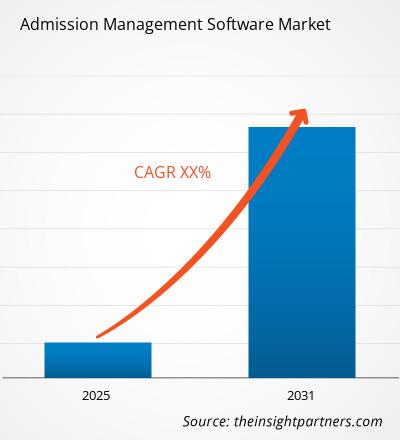
The Admission management software market was valued at US$ 1.83 Billion in 2025 and is projected to reach US$ 4.12 Billion by 2034, registering a CAGR of 9.43% during 2026–2034. The market is benefiting from increasing digitization of educational administration, rising demand for student enrollment automation, and expanding adoption of integrated academic management platforms. Institutions are increasingly deploying admission technologies to improve application processing efficiency, applicant engagement, and enrollment planning capabilities.
Across North America, educational institutions continue accelerating investments in cloud-based student information systems and digital admissions platforms. The admission management software market size in the region is supported by strong technology spending, competitive student recruitment strategies, and growing demand for seamless applicant experiences. Ongoing modernization initiatives among universities and private schools are expected to support a regional CAGR of 8.8–9.8% through the forecast period.
Admission Management Software Market Assessment and Insights
- North America: Accounted for approximately 36–40% share in 2025, supported by widespread digital transformation across educational institutions. The region is projected to expand at a CAGR of 8.8–9.8% during 2026–2034, driven by established technology infrastructure and high SaaS adoption.
- US: Represented approximately 74–78% of the North American admission management software market revenue in 2025. Continued investments in enrollment management technologies and student experience platforms are expected to support a CAGR of 8.9–9.9% during 2026–2034.
- Europe: Held approximately 26–30% share in 2025, led by the UK, Germany, and France. Growing digital education initiatives and increasing international student mobility are expected to support a CAGR of 8.4–9.4% during 2026–2034.
- Asia Pacific: Accounted for approximately 24–28% share in 2025, with China, India, Japan, South Korea, and Australia serving as major contributors. The region is anticipated to record a CAGR of 10.5–11.5% during 2026–2034.
- Largest Segment: Cloud deployment generated an estimated 62–66% of the admission management software market share in 2025 and is projected to expand at a CAGR of 10.2–11.2% during 2026–2034, supported by scalability and deployment flexibility.
- High Growth Segment: Colleges/Universities accounted for approximately 46–50% market share in 2025 and are forecast to grow at a CAGR of 10.4–11.4% during 2026–2034 owing to increasing enrollment complexity and recruitment competition.
- Key companies analyzed in detail: Advanta Innovations, Aries Estrrado Technologies Pvt. Ltd., Blackbaud, Inc., Campus Café Software, Creatrix Campus, Edunext Technologies Pvt. Ltd., Ellucian Company L.P., Embark Corporation, Hyland Software, Inc., and MasterSoft.
Source: The Insight Partners' analysis based on proprietary research, government publications, company annual reports, investor presentations, industry databases, and expert interviews.
Educational institutions across the world are increasingly replacing manual and fragmented enrollment processes with cloud-enabled admissions platforms that consolidate applicant tracking, communications, document management, and analytics into unified systems. The shift toward digital-first recruitment strategies, growing student expectations for responsive online experiences, and rising application volumes have accelerated technology adoption. Vendors have responded by integrating automation, artificial intelligence, and workflow orchestration capabilities that improve administrative efficiency while supporting more accurate enrollment forecasting and decision-making processes across educational organizations globally.
Over the coming decade, the admission management software market expansion is expected to be influenced by growing investments in education technology modernization, increasing international student recruitment efforts, and broader adoption of data-driven admissions strategies. Emerging economies are strengthening educational infrastructure and digital service delivery, creating favorable conditions for platform implementation. Regulatory focus on data transparency, institutional accountability, and digital accessibility is also expected to encourage greater use of advanced admissions software solutions, particularly in higher education environments that process large applicant populations annually.
Admission Management Software Market Report Scope
| Report Attribute | Details |
|---|---|
| Market size in 2025 | US$ 1.83 Billion |
| Market Size by 2034 | US$ 4.12 Billion |
| Global CAGR (2026 - 2034) | 9.43% |
| Historical Data | 2021-2024 |
| Forecast period | 2026-2034 |
Admission Management Software Market Analysis
The admission management software market growth trajectory is supported by increasing demand for digital enrollment experiences and improved operational efficiency within educational institutions. Schools, universities, and research-oriented organizations are handling larger application volumes while facing pressure to accelerate admission decisions and improve applicant engagement. Admission software enables institutions to automate repetitive tasks, centralize applicant information, and strengthen communication throughout the enrollment journey. Growing awareness of data-driven recruitment strategies has further elevated demand for platforms capable of delivering real-time visibility into applicant pipelines and conversion metrics.
The broader ecosystem includes software developers, cloud service providers, implementation partners, educational consultants, and institutional technology teams. Integration capabilities remain a central purchasing criterion because institutions increasingly seek interoperability between admission systems, customer relationship management platforms, student information systems, and financial aid solutions. As educational organizations prioritize operational continuity and remote accessibility, cloud-based deployment models continue gaining momentum across both developed and developing markets.
Competitive intensity within the sector is increasing as vendors expand product functionality and pursue differentiated positioning strategies. The admission management software market analysis highlights growing emphasis on artificial intelligence, predictive enrollment modeling, workflow automation, and applicant engagement technologies. Established providers such as Ellucian Company L.P., Blackbaud, Inc., and Hyland Software, Inc. continue enhancing platform ecosystems to deliver broader student lifecycle management capabilities while supporting institutional digital transformation priorities.
At the same time, specialized providers including MasterSoft, Creatrix Campus, Campus Café Software, Embark Corporation, Advanta Innovations, Aries Estrrado Technologies Pvt. Ltd., and Edunext Technologies Pvt. Ltd. are focusing on customization, regional deployment expertise, and institution-specific workflow optimization. Strategic investments increasingly target cloud-native architecture, analytics capabilities, and integration frameworks that allow educational organizations to streamline technology environments while improving recruitment outcomes and administrative performance.
● REPORT CUSTOMIZATION
Tailor This Report To Align With Your Specific Business Requirements
This report can be customized to align precisely with your business objectives, scope, and target markets. Customization options include tailored segmentation, geography, competitive analysis, and strategic insights to support informed decision-making.
Customize This Report →WHAT YOU CAN ADJUST
- ● Segmentations
- ● Geography
- ● Competitive Analysis
- ● Language Preferences
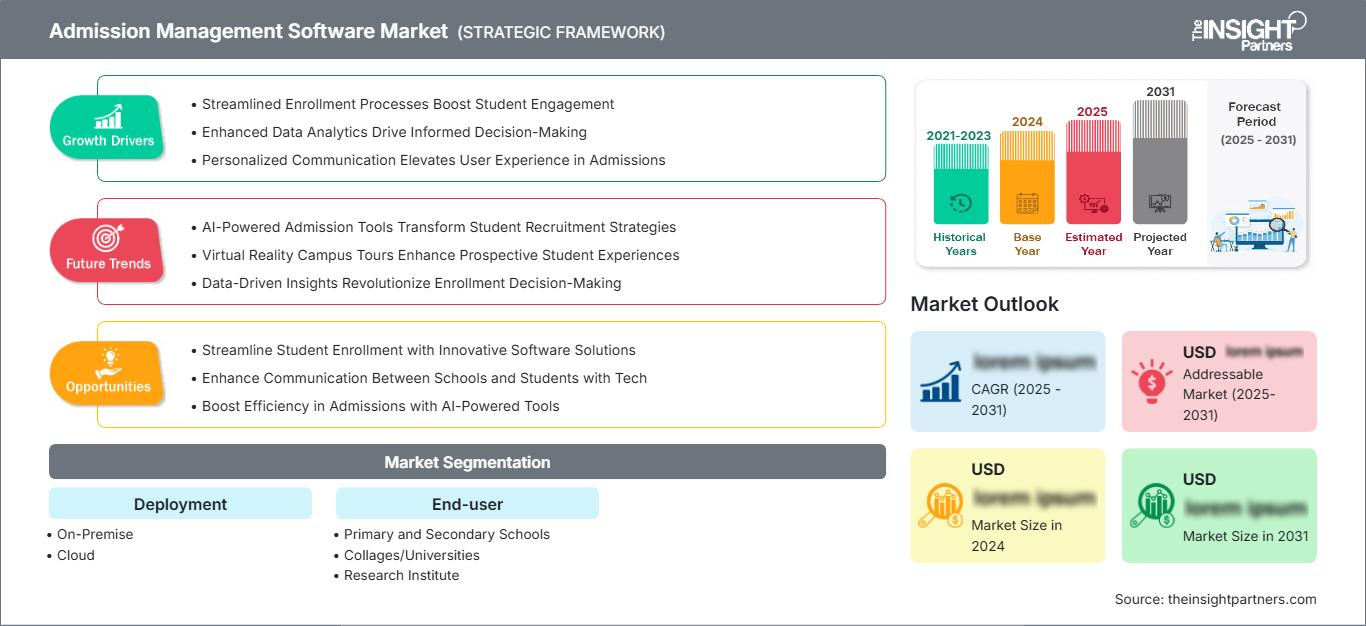
Admission Management Software Market: Strategic Insights
Regional Insights
North America Admission Management Software Market
North America accounted for an estimated 36–40% share of the global market in 2025 and is projected to register a CAGR of 8.8–9.8% during 2026–2034. Strong adoption of educational technology solutions, advanced digital infrastructure, and significant institutional spending have positioned the region as a leading market for admissions software. The admission management software market share remains particularly strong among universities and private educational institutions seeking integrated enrollment management platforms capable of supporting applicant engagement, document processing, and enrollment forecasting.
Technology modernization initiatives continue driving demand across the United States and Canada. Educational institutions increasingly integrate admission platforms with customer relationship management systems, analytics tools, and student information solutions to create seamless applicant experiences. Demand is also being supported by data-driven recruitment strategies, regulatory reporting requirements, and growing emphasis on application transparency. As institutions pursue operational efficiency and improved enrollment outcomes, software investments are expected to remain a priority throughout the forecast period.
U.S. Admission Management Software Market
The United States accounted for approximately 74–78% of market revenue in North America in 2025, and is projected to grow at a CAGR of 8.9–9.9% during 2026–2034. The US has an advantage due to the high density of higher education institutions, adoption of technologies, and highly competitive student recruiting markets. Admissions technologies have become increasingly used by universities to manage rising application volumes and improve their response and conversion rates.
Vendor participation is exceptionally prominent nationwide, which helps foster innovation and support the implementation of their products. There is increased use of technologies such as AI-enabled communication features, application analysis, automated document verification, and predictive enrollment. Even private schools, public universities, and community colleges are focusing on providing mobile-friendly solutions and streamlined administrative processes. These will help consolidate the United States' market status as the leading revenue-generating region.
Europe Admission Management Software Market
The European admissions management software market accounted for around 26% to 30% of global revenue in 2025 and is expected to grow at a CAGR of 8.4% to 9.4% from 2026 to 2034. This growth is driven by rising trends in digitalizing the education system, regulatory reform, and international student mobility. Among individual nations, the United Kingdom holds the leading position due to its higher education enrollment rates and international student population, and ongoing investments in student recruitment technologies.
Germany will see sustained demand driven by modernization efforts and the increased adoption of integrated campus management systems. Institutions are increasingly implementing solutions to improve efficiency and communication among applicants. The adoption of the solution in Germany is enabled by the country's embrace of digital government.
France, Italy, and Spain are also driving regional growth through digital admission processes and improved student service delivery at universities. Increasing demand for multilingual application management, international recruitment, and centralized admissions management continues to drive adoption efforts in the region. Regional growth is anticipated to persist, with institutions seeking adaptable solutions to meet future regulatory requirements and changing student demographics.
APAC Admission Management Software Market
The Asia Pacific region had around 24% to 28% of global revenues in 2025, with the highest regional growth, at a CAGR of 10.5% to 11.5% from 2026 to 2034. Increasing student numbers, the quickening pace of digital transformation projects, and increased spending on educational infrastructure development make an ideal environment for software adoption. China remains the leader here, benefiting from its digital campus program and ongoing updates to its academic administration system.
India, Japan, South Korea, and Australia are experiencing increased use of admissions software owing to growing enrollments, online application management, and improved student interaction. Some of the reasons for the increasing usage include government-backed digital education policies, growth in the private education industry, and efforts to recruit more students. Educational institutions are increasingly turning to cloud platforms to manage their admissions process.
Middle East & Africa Admission Management Software Market
The Middle East and Africa admission management software market is projected to expand at a CAGR of 9.5–10.5% during 2026–2034. Educational modernization initiatives, technology investments, and broader digital transformation strategies are encouraging adoption across both public and private institutions. Saudi Arabia continues leading regional demand owing to substantial investment in education technology and smart campus development programs.
The United Arab Emirates will remain a key market due to its international education system and students' reliance on digital services. Cloud-based admissions systems are being adopted in countries such as South Africa to improve process efficiency. Investments in education infrastructure and technological administration will fuel future growth in the region through the forecast period.
Segmentation Analysis
Deployment
The deployment segment is forecast to grow at a CAGR of 9.6%–10.6% between 2026 and 2034. Organizations have started evaluating their software based on factors such as deployment flexibility, scalability, security, and maintenance. Preference for centralized management, remote access, and the integration of data environments continues to influence deployment strategies in educational institutions.
- On-Premise: On-premise solutions remain relevant among institutions requiring direct control over infrastructure, security environments, and data storage policies. Adoption is strongest among organizations with established internal technology resources and specialized compliance requirements.
- Cloud: Cloud deployment represents the dominant market category due to lower infrastructure costs, simplified implementation, automatic software updates, and strong support for multi-campus operations. The segment accounted for 62–66% market share in 2025.
End-user
End users are anticipated to witness growth at a CAGR of 9.8%-10.8% between 2026 and 2034. Growth in the competition for enrollment, a higher volume of applications, and an increased need for data-driven recruitment techniques have made institutions more inclined to invest in admissions solutions.
- Primary and Secondary Schools: Schools increasingly utilize admissions platforms to simplify enrollment workflows, improve parent communications, manage applicant records, and support digital-first registration processes. Adoption is particularly strong among private educational institutions seeking operational efficiency improvements.
- Colleges/Universities: This segment accounted for approximately 46–50% market share in 2025 and remains the largest institutional user category. Universities require sophisticated solutions capable of supporting large applicant pools, international recruitment activities, and complex evaluation workflows.
- Research Institute: Research-oriented institutions deploy admissions technologies to manage specialized applicant assessments, academic eligibility reviews, and program-specific enrollment activities. Demand is growing as institutes pursue digital administration and improved applicant tracking capabilities.
Opportunity Snapshot
| End-User | Revenue Contribution | Trend Tag | Adoption Stage |
| Primary and Secondary Schools | Medium | Parent Portal | Scaling |
| Colleges/Universities | High | AI Enrollment | Mature |
| Research Institute | Low | Research Intake | Emerging |
Admission Management Software Market Growth Drivers and Impact Analysis
Digital transformation across educational administration systems
The trend towards digital transformation in educational institutions worldwide continues at an accelerated pace. Paper-based admissions procedures can lead to delays, increased workload for administrative staff, and limited insight into applicant flows. All these issues are solved with advanced admissions management software systems. The growing competition in student recruitment is prompting more and more schools and universities to recognize the need to use innovative technology. Digital applications, automated document verification, online communication means, and self-service portals become essential components of such technologies. With the continuous modernization of academic administration and student services, the demand for advanced admissions management software is likely to grow steadily.
Growth in higher education enrollment and recruitment competition
The increasing competition among educational institutions to attract students is prompting them to adopt modern technologies in their recruitment and admissions processes. Today, universities compete not only for the most talented students but also for foreign students and for highly qualified candidates. To attract such candidates, universities need to adopt more complex approaches to working with them throughout the enrollment process. Admissions management software helps institutions build relationships with prospective students, track conversion rates, and communicate with them in a personalized way. The growing complexity of the enrollment process, driven by the development of online courses and international educational mobility, contributes to increased demand for this kind of software platform.
Expansion of cloud-based software deployment models
The increasing adoption of cloud computing has been continuously changing the face of the education technology sector. The advantages of using cloud-based admission tools include scalability, reduced infrastructure requirements, remote access, and simplified installation procedures compared with traditional deployment environments. Educational institutions can enjoy benefits such as stable subscription fees, easier software management, and faster feature updates. Multi-campus educational institutions can also leverage centralized data storage and standardized administrative processes offered by cloud computing solutions. Vendors are also working to improve the security, compliance, and integration of cloud-based platforms. With an increased focus on flexibility and agility in organizational operations, cloud deployment will be one of the most important drivers of software adoption.
Admission Management Software Market Future Trends
AI-driven predictive enrollment ecosystems
The admission management software market trends are increasingly shaped by predictive technologies that transform enrollment planning from reactive administration to proactive decision-making. During the forecast period, institutions are expected to implement sophisticated artificial intelligence solutions to analyze applicants' behavior, engagement levels, demographics, and past enrollment outcomes. In this way, admissions departments will be able to enhance forecasting precision, identify applicants with high conversion potential, and streamline their recruitment budgets. Additionally, predictive enrollment ecosystems will enable flexible communication techniques to personalize communication with applicants throughout the entire process. Given that educational organizations face tough competition in acquiring students, vendors implementing machine learning, predictive analytics, and intelligent automation in admissions will become more popular.
Expansion of unified student lifecycle platforms
Future software developments are expected to extend beyond admissions to encompass holistic platforms for managing the entire student lifecycle. More and more colleges require integration of systems for recruiting, admissions, enrollment, student success management, financial management, alumni management, and institutional analytics. Such systems help reduce data silos, provide more precise reports, and increase efficiency across all administrative departments. Software providers invest heavily in developing interoperability solutions, APIs, and data architectures to meet these requirements. In time, institutions are likely to focus on technology ecosystems, which will provide continuous visibility from inquiry through alumni relations. This will foster the development of software consolidation strategies and increase demand for scalable systems.
Admission Management Software Market Opportunities
Expansion opportunities within emerging higher education hubs
The rapid development of educational infrastructure in the Asia-Pacific, the Middle East, and selected African countries presents a good opportunity for growth for software suppliers. Governments and private capital continue to invest in universities, research centers, and special education centers to ensure economic and workforce development goals. These markets feature educational establishments that adopt new digital technologies, with minimal barriers posed by legacy systems. Admission management software market Forecasts predict the growing demand for admission management systems among organizations that need scalable solutions capable of handling larger numbers of students and foreign recruitment campaigns. Software vendors that establish regional partnerships, localized interfaces, multilingual communication tools, and compliance capabilities will be able to capitalize on increased purchasing interest.
Development of specialized solutions for niche institutional requirements
A growing number of educational organizations require admissions functionality tailored to highly specific operational workflows. However, research institutes, professional education institutions, vocational training centers, executive education centers, and multidisciplinary university networks may operate their own distinctive applicant assessment processes that differ from the usual university admissions process. This enables vendors to offer configurable software solutions without compromising their deployability or support. Specialized workflow engines, sophisticated assessment management systems, competency-based admission systems, and integrated credential verification systems have become more important in recent times. Vendors that focus on providing modular platform solutions can meet the diverse requirements of different institutions while enabling scalability. As the mode of educational delivery continues to change, there will be opportunities in industry-specific admissions technologies.
Frequently Asked Questions

- Comprehensive Market Sizing and Forecast Analysis
- Detailed Segmentation Analysis
- In-Depth Market Dynamics Assessment
- Regional and Country-Level Insights
- Competitive Landscape and Company Benchmarking
- Strategic Business Intelligence
Recent Reports
Testimonials

The Insight Partners' SCADA System Market report is comprehensive, with valuable insights on current trends and future forecasts. The team was highly professional, responsive, and supportive throughout. We are very satisfied and highly recommend their services.
RAN KEDEM Partner, Reali Technologies LTDs
I requested a report on a very specific software market and the team produced the report in a few days. The information was very relevant and well presented. I then requested some changes and additions to the report. The team was again very responsive and I got the final report in less than a week.
JEAN-HERVE JENN Chairman, Future Analytica
We worked with The Insight Partners for an important market study and forecast. They gave us clear insights into opportunities and risks, which helped shape our plans. Their research was easy to use and based on solid data. It helped us make smart, confident decisions. We highly recommend them.
PIYUSH NAGPAL Sr. Vice President, High Beam Global
The Insight Partners delivered insightful, well-structured market research with strong domain expertise. Their team was professional and responsive throughout. The user-friendly website made accessing industry reports seamless. We highly recommend them for reliable, high-quality research services
YUKIHIKO ADACHI CEO, Deep Blue, LLC.
This is the first time I have purchased a market report from The Insight Partners.While I was unsure at first, I visited their web site and felt more comfortable to take the risk and purchase a market report.I am completely satisfied with the quality of the report and customer service. I had several questions and comments with the initial report, but after a couple of dialogs over email with their analyst I believe I have a report that I can use as input to our strategic planning process.Thank you so much for taking the extra time and making this a positive experience.I will definitely recommend your service to others and you will be my first call when we need further market data.
JOHN SUZUKI President and Chief Executive Officer, Board Director, BK Technologies
I wish to appreciate your support and the professionalism you displayed in the course of attending to my request for information regarding to infectious disease IVD market in Nigeria. I appreciate your patience, your guidance, and the fact that you were willing to offer a discount, which eventually made it possible for us to close a deal. I look forward to engaging The Insight Partners in the future, all thanks to the impression you have created in me as a result of this first encounter.
DR CHIJIOKE ONYIA MANAGING DIRECTOR, PineCrest Healthcare Ltd.Reason to Buy
- Informed Decision-Making
- Understanding Market Dynamics
- Competitive Analysis
- Identifying Emerging Markets
- Customer Insights
- Market Forecasts
- Risk Mitigation
- Boosting Operational Efficiency
- Strategic Planning
- Investment Justification
- Tracking Industry Innovations
- Aligning with Regulatory Trends





 Get Free Sample for