
Advance Analytics Market Size, Share & Demand by 2034
Coverage: By Offering (Software, Service), by Deployment Mode (On-premise, Cloud), by Type (Predictive Analytics, Prescriptive Analytics, Data Visualization, Data Mining, Others), by Application (Supply Chain, Sales and Marketing, Finance, Human resources (HR), Others), by Enterprise Size (Large Enterprises, SMEs), by Industry Vertical (BFSI, Manufacturing, Healthcare, Government and Defense, Energy and Utilities, Transportation and Logistics, Retail and E-commerce, IT and Telecom, Media and Entertainment, Others), and Geography (North America, Europe, Asia Pacific, and South and Central America)
- Status : Data Released
- Report Code : TIPTE100000354
- Category : Technology, Media and Telecommunications
- No. of Pages : 150
- Available Report Formats :


- Last update date : August 05, 2026


2025 Market Size
US$ 100.55 Bn
Base year value
2034 Forecast
US$ 786.04 Bn
Projected by 2034
CAGR 2026-2034
25.67 %
Growth rate
Addressable Market
US$ 3,356.08 Bn
(2026-2034)
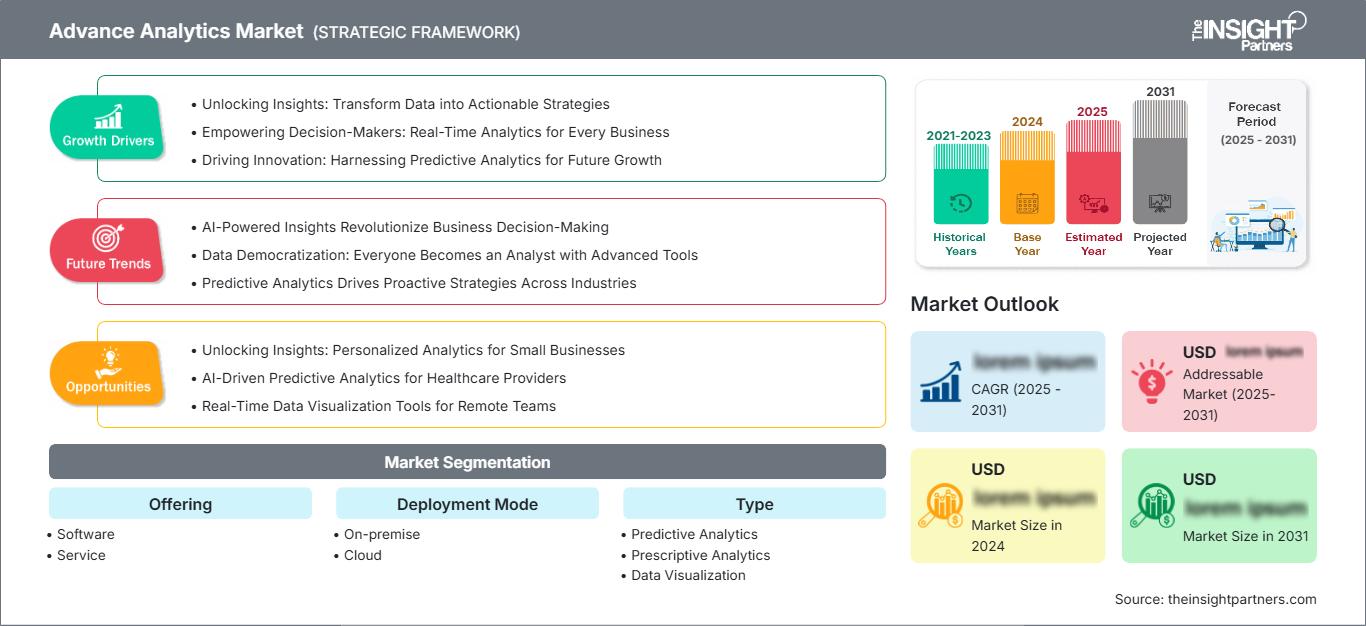
The advance analytics market was valued at US$100.55 billion in 2025 and is projected to reach US$786.04 billion by 2034, expanding at a CAGR of 25.67% during 2026–2034. Rising volumes of enterprise data, the growing popularity of artificial intelligence technologies, and increasing reliance on prediction-based decision-making are boosting demand for modern analytics tools. Companies keep investing in integrated solutions that help turn structured and unstructured data into business intelligence for further growth in developed and developing countries.
In North America, ongoing digital transformation endeavors are also continuing to provide a favorable business ecosystem for enterprise adoption. The advance analytics market size in North America can gain advantages from mature cloud infrastructure, heavy technology spending, and growing utilization of AI-powered operational intelligence solutions. Financial services firms, healthcare organizations, manufacturing businesses, and retail establishments are enhancing their investments in analytics software for enhanced forecasting, resource optimization, and automation of processes. It is estimated that the regional market growth will remain at a 22–26% CAGR until 2034.
Advance Analytics Market Assessment and Insights
- North America: Strong enterprise analytics adoption, mature cloud ecosystems, and large AI investments support regional leadership. Share in 2025 is estimated at 36–40%, while CAGR between 2026–2034 is projected at 22–26%.
- US: Extensive deployment across BFSI, healthcare, and retail sectors sustains market leadership. Share in 2025 accounts for 76–80% of North America, with CAGR between 2026–2034 estimated at 22–26%.
- Europe: Digitalization initiatives and increasing analytics adoption across Germany, the UK, and France support expansion. Share in 2025 is expected at 24–28%, growing at a CAGR of 21–25% during 2026–2034.
- Asia Pacific: Rising enterprise digitization and investments in AI infrastructure across China, India, Japan, and South Korea accelerate growth. Share in 2025 is projected at 22–26%, with CAGR of 29–33% during 2026–2034.
- Largest Segment: Software remains dominant due to enterprise preference for scalable analytics platforms. Market share in 2025 is estimated at 68–72%, while CAGR during 2026–2034 is expected at 24–28%.
- High Growth Segment: Cloud Deployment demonstrates the fastest expansion as organizations prioritize flexibility and operational efficiency. Market share in 2025 is estimated at 54–58%, while CAGR during 2026–2034 is anticipated at 28–32%.
- Key companies analyzed in detail: MicroStrategy Incorporated, Fair Isaac Corporation (FICO), Microsoft Corporation, Angoss Software Corporation, StatSoft Inc., KNIME AG, Oracle Corporation, International Business Machines Corporation, SAP SE, SAS Institute Inc.
Source: The Insight Partners' analysis based on proprietary research, government publications, company annual reports, investor presentations, industry databases, and expert interviews.
Enterprise analytics capabilities have come a long way since descriptive reporting and now include systems for autonomous, predictive decision-making. With the advancements in machine learning technologies, cloud-native architectures, and real-time processing technologies, the scope of opportunities for extracting business value from large volumes of data has increased greatly. Today, industries make use of analytics in operations in order to be able to make decisions proactively and optimize resources.
Looking ahead, investment is anticipated to become more active in Asia-Pacific, Latin America, as well as in some Middle Eastern countries. Various government programs to develop digital economy, increasing importance of data transparency regulations, and development of cloud computing are contributing to that. Intelligent automation and predictive planning features are among top priorities for businesses, while technological vendors keep extending the platforms' functionality by introducing generative AI.
Advance Analytics Market Report Scope
| Report Attribute | Details |
|---|---|
| Market size in 2025 | US$ 100.55 Billion |
| Market Size by 2034 | US$ 786.04 Billion |
| Global CAGR (2026 - 2034) | 25.67% |
| Historical Data | 2021-2024 |
| Forecast period | 2026-2034 |
Advance Analytics Market Analysis
The primary driver of advance analytics market growth is the increasing need for business intelligence derived from rapidly expanding enterprise datasets. Organizations create information through cloud applications, connected devices, transactional systems, and online customer engagements. The use of analytics technology allows businesses to transform these information resources into tangible business and financial results. There is a particular high demand for such technology in the health care industry, finance sector, telecommunications industry, and manufacturing.
At the same time, the value chain is moving towards integration in the form of ecosystems, including software vendors, cloud platforms, consulting companies, data engineers, and AI experts. Data management infrastructure using the cloud enhances availability, but also reduces the deployment difficulty. The ability to process data in real time increases the adoption, as it provides instant insight into continuous business data streams.
Current advance analytics market analysis indicates that there is increased competition between tech companies trying to enhance their AI-powered capabilities, industry-specific solutions, and cloud-based products. Platform consolidation has been seen to be one of the emerging product strategies as more vendors incorporate data management, visualization, predictive analytics, and automation solutions into one platform.
Strategic positioning remains an area of influence with the help of strategic investment and ecosystem growth. Microsoft Corporation and Oracle Corporation improve their cloud-enabled analytics offerings; International Business Machines Corporation and SAS Institute Inc. emphasize intelligence using artificial intelligence. SAP SE enhances its analytics offering through embedded analytics in enterprise software environments, and KNIME AG remains focused on data science workflows. MicroStrategy Incorporated and Fair Isaac Corporation retain their competitive positioning through specific analytical solutions.
● REPORT CUSTOMIZATION
Tailor This Report To Align With Your Specific Business Requirements
This report can be customized to align precisely with your business objectives, scope, and target markets. Customization options include tailored segmentation, geography, competitive analysis, and strategic insights to support informed decision-making.
Customize This Report →WHAT YOU CAN ADJUST
- ● Segmentations
- ● Geography
- ● Competitive Analysis
- ● Language Preferences
Advance Analytics Market: Strategic Insights
Regional Insights
North America Advance Analytics Market
North America represents the largest regional market, accounting for approximately 36–40% advance analytics market share in 2025. The widespread use of enterprise software, high cloud infrastructure penetration, and substantial use of artificial intelligence technology will keep the leadership going for some time to come. Advanced analytics is being used by firms to enhance customer interactions, automate decision-making, and improve forecasting. Large adopters of these solutions include financial firms, healthcare organizations, retail companies, and manufacturing organizations.
The region is projected to grow at a CAGR of 22–26% through 2034. Large-scale digital transformation projects, the extensive use of hybrid cloud platforms, and the adoption of machine learning technologies in organizational systems help fuel robust market growth. Investments in data management systems and automation also help drive the need for powerful analytical solutions that can provide timely intelligence.
U.S. Advance Analytics Market
The United States accounts for approximately 76–80% of the North American market in 2025, with a significant presence of technology vendors, cloud computing providers, and enterprise software providers. The market is characterized by the good level of penetration in banking, healthcare, governmental organizations, manufacturing, and telecommunications industries. Advanced analytics is being used by companies for more accurate forecasting, improved customer experience, and automation of data-driven decision making processes.
The U.S. advance analytics market is expected to grow at a CAGR of 22–26% from 2026 to 2034. Generative AI adoption, rising investments in predictive intelligence in enterprises, and transition to the cloud will remain major driving forces. The participation of such large players as Microsoft Corporation, Oracle Corporation, International Business Machines Corporation, and SAS Institute Inc. is also expected to support innovations and the commercialization of the new generation of analytical tools.
Europe Advance Analytics Market
Europe is estimated to hold 24–28% of the global market in 2025 and is expected to grow at a CAGR of 21–25% during the forecast period. Germany remains the leading regional advance analytics market due to strong manufacturing digitization, industrial automation initiatives, and extensive adoption of data-driven operational management. Investments related to Industry 4.0 continue encouraging broader use of predictive and prescriptive analytics solutions throughout industrial sectors.
The United Kingdom is showing high levels of adoption in financial services, retail, and health care settings, backed by mature data ecosystems and high levels of cloud adoption. France, Italy, and Spain are continuing to grow their analytic adoption through enterprise modernization and digital transformation efforts. The need for governance and transparency in regulations also spurs the adoption of more sophisticated analytical solutions.
APAC Advance Analytics Market
Asia Pacific holds an estimated 22–26% share of the global advance analytics market in 2025 and represents the fastest-growing region. China leads regional adoption due to extensive AI investment, industrial digitalization, and large-scale enterprise data generation. Significant government support for technology modernization further strengthens long-term growth prospects.
The region is expected to grow at a rate of 29% to 33% CAGR up to 2034. There will be growing investments in cloud computing, automation, and enterprise intelligence solutions by India, Japan, South Korea, and Australia. Increasing digitalization in sectors such as banking, manufacturing, retail, and telecommunication will drive the demand for advance analytics.
Middle East & Africa Advance Analytics Market
The Middle East and Africa market remains comparatively smaller but demonstrates increasing adoption driven by economic diversification initiatives and infrastructure modernization programs. Saudi Arabia and the United Arab Emirates lead regional deployment through investments in smart cities, digital government projects, and AI-enabled business transformation initiatives.
The region is projected to grow at a CAGR of 23–27% during 2026–2034. South Africa continues to strengthen adoption across banking and telecommunications sectors, while investments in energy, logistics, and public-sector modernization support broader implementation of advanced analytics technologies across the rest of the region.
Segmentation Analysis
Offering
The Offering segment is projected to expand at a CAGR of 24–28% during 2026–2034. The segment remains central to enterprise analytics adoption as organizations increasingly seek integrated platforms capable of managing data preparation, predictive modeling, visualization, and automated insights. Growing demand for scalable analytical ecosystems and AI-enhanced decision intelligence continues to strengthen spending on both software and supporting services. The advance analytics market scope continues to broaden as enterprises pursue greater operational efficiency, forecasting accuracy, and business agility through data-centric strategies.
- Software: Represents the largest revenue-generating sub-segment owing to widespread deployment of cloud-native analytics platforms, predictive intelligence tools, dashboard solutions, and integrated AI capabilities supporting enterprise-wide decision-making.
- Service: Demand is supported by consulting, system integration, deployment, training, and managed analytics services. Organizations frequently require specialist expertise to maximize platform utilization and accelerate digital transformation initiatives.
Deployment Mode
The Deployment Mode segment is expected to grow at a CAGR of 26–30% during the forecast period. Deployment preferences increasingly reflect organizational priorities related to scalability, security, compliance, and operational flexibility. While large institutions continue maintaining critical workloads on dedicated infrastructure, cloud-based models are gaining substantial momentum due to lower upfront costs, easier implementation, and rapid access to advanced analytical capabilities.
- On-premise: Preferred by organizations operating in highly regulated environments where data sovereignty, internal governance requirements, and direct infrastructure control remain major strategic considerations.
- Cloud: Continues expanding rapidly due to flexible resource allocation, subscription pricing models, seamless software updates, and growing integration with artificial intelligence and machine learning environments.
Type
The Type segment is anticipated to register a CAGR of 25–29% between 2026 and 2034. Organizations increasingly adopt specialized analytics methodologies based on operational priorities and business objectives. The transition from descriptive reporting toward predictive and prescriptive intelligence is transforming enterprise decision-making processes. Continued developments in machine learning algorithms, automation frameworks, and real-time data processing are enhancing the effectiveness of advanced analytical solutions.
- Predictive Analytics: Widely adopted for forecasting customer behavior, operational performance, maintenance schedules, and financial outcomes. Demand remains strong across banking, healthcare, retail, and manufacturing environments.
- Prescriptive Analytics: Supports strategic decision optimization by recommending specific actions based on modeled scenarios, risk assessments, and anticipated business outcomes across complex operating conditions.
- Data Visualization: Enables rapid interpretation of large datasets through interactive dashboards and graphical reporting interfaces, helping stakeholders convert analytical findings into actionable business intelligence.
- Data Mining: Plays an important role in identifying hidden patterns, correlations, and relationships within structured and unstructured datasets, driving deeper understanding of customer and operational dynamics.
Application
The Application segment is expected to expand at a CAGR of 27–31% through 2034. Expanding enterprise data volumes and rising emphasis on measurable business outcomes continue to increase the value of analytics within operational functions. Organizations are deploying advanced analytical tools to improve forecasting, optimize resources, manage risks, and enhance workforce effectiveness. Application-specific implementations increasingly determine platform purchasing strategies and investment priorities.
- Supply Chain: Supports demand forecasting, logistics optimization, inventory planning, and procurement intelligence, enabling organizations to improve efficiency and resilience throughout increasingly complex supply networks.
- Sales and Marketing: Utilized for customer segmentation, campaign optimization, pricing analysis, and revenue forecasting. Enterprises increasingly depend on data-driven customer engagement strategies to improve profitability.
- Finance: Facilitates fraud detection, risk assessment, budgeting, scenario planning, and compliance monitoring, making analytics a strategic capability for financial decision-making processes.
- Human resources: Expanding adoption reflects growing use of workforce planning, employee retention analysis, talent acquisition optimization, and productivity measurement across modern enterprise environments.
Opportunity Snapshot
| Application | Revenue Contribution | Trend Tag | Adoption Stage |
|---|---|---|---|
| Supply Chain | High | Demand Sensing | Mature |
| Sales and Marketing | High | Customer AI | Scaling |
| Finance | High | Risk Modeling | Mature |
| Human resources | Medium | Talent Analytics | Scaling |
Advance Analytics Market Growth Drivers and Impact Analysis
Expansion of Enterprise AI and Machine Learning Deployments
As organizations increasingly integrate artificial intelligence across operational functions, demand for advanced analytics platforms continues to rise. Enterprises require analytical infrastructure capable of supporting data preparation, model development, performance monitoring, and automated decision support. Modern AI initiatives depend on high-quality analytical environments that can process large volumes of structured and unstructured information. Banking institutions utilize predictive models for fraud detection, manufacturers rely on predictive maintenance capabilities, and retailers deploy recommendation engines powered by analytical insights. This growing reliance on machine learning technologies directly strengthens investment in advanced analytics solutions. The increasing accessibility of cloud-based AI services further accelerates implementation among mid-sized enterprises, expanding the addressable advance analytics market and creating sustained demand throughout the forecast period.
Rapid Growth of Cloud-Based Data Ecosystems
The migration of enterprise workloads toward cloud infrastructure is fundamentally reshaping analytics adoption patterns. Organizations increasingly prefer scalable environments capable of integrating data from multiple business systems while maintaining flexibility and reducing operational complexity. Cloud deployment enables faster implementation, lower capital expenditure, and easier access to sophisticated analytical capabilities that previously required substantial internal resources. As digital transformation initiatives accelerate across industries, organizations seek centralized platforms capable of supporting real-time analytics, business intelligence, and predictive modeling. Cloud service providers continue enhancing integrated analytical offerings, enabling broader accessibility and supporting adoption among businesses of varying sizes. These developments significantly contribute to long-term market expansion and increased enterprise utilization.
Rising Strategic Importance of Data-Driven Decision Making
Competitive business environments increasingly require organizations to make faster and more informed decisions. Advanced analytics technologies provide actionable intelligence that supports pricing strategies, customer engagement, operational optimization, inventory planning, and risk management. Executive leaders are prioritizing investments capable of improving visibility into business performance and enabling proactive responses to changing market conditions. Growing availability of real-time data further increases the value of analytical capabilities, allowing organizations to react quickly to emerging opportunities and challenges. Across healthcare, financial services, manufacturing, telecommunications, and retail sectors, analytics-driven decision frameworks are becoming essential components of corporate strategy, reinforcing sustained demand for advanced analytical platforms and services.
Advance Analytics Market Future Trends
Generative AI Integration into Enterprise Analytics Platforms
The most significant among emerging advance analytics market trends is the integration of generative AI capabilities into enterprise analytics environments. During the forecast period, organizations are expected to transition from traditional dashboard-driven interaction toward conversational and context-aware analytics experiences. Natural language interfaces will allow business users to generate insights without extensive technical expertise, expanding adoption beyond specialist data teams. Vendors are increasingly embedding AI copilots, automated modeling tools, and intelligent recommendation engines into analytics platforms. These innovations will reduce analytical complexity while improving accessibility and productivity. As enterprises seek faster decision cycles and broader utilization of business intelligence, generative AI-enhanced analytics platforms are expected to become a fundamental component of digital transformation strategies across industries.
Expansion of Real-Time and Edge Analytics Capabilities
Real-time intelligence is expected to become a defining characteristic of next-generation analytics deployments. Growing adoption of connected devices, industrial sensors, and digital transaction systems is creating demand for analytical architectures capable of processing information instantly. Edge analytics will increasingly complement cloud-based processing by enabling decisions closer to data generation points. Manufacturing operations, transportation networks, financial institutions, and healthcare providers are expected to benefit substantially from low-latency analytical capabilities. Future investments will prioritize platforms capable of supporting continuous monitoring, predictive decision-making, and automated operational responses. As organizations seek greater agility and responsiveness, real-time analytics frameworks will evolve from competitive differentiators into essential business infrastructure components across major industries.
Advance Analytics Market Opportunities
Industry-Specific Analytics Solutions for Mid-Market Enterprises
A major growth opportunity exists in the development of specialized analytical solutions tailored to industry-specific requirements among mid-sized organizations. While large enterprises have historically led adoption, many mid-market businesses now possess sufficient data resources to justify significant investment in advanced intelligence capabilities. Vendors that provide preconfigured analytical models, industry-focused dashboards, and streamlined implementation frameworks can accelerate adoption and reduce deployment complexity. Sectors including manufacturing, retail, healthcare, education, and logistics present particularly attractive opportunities. Increasing cloud accessibility further lowers barriers to implementation, enabling vendors to reach underserved customer groups. According to evolving advance analytics market Forecasts, companies delivering scalable and cost-efficient solutions for mid-market organizations are positioned to capture considerable long-term revenue opportunities.
Expansion Across Emerging Digital Economies
Emerging economies present substantial investment opportunities as governments and enterprises accelerate digital transformation initiatives. Countries across Southeast Asia, the Middle East, Africa, and Latin America are expanding cloud infrastructure, digital service delivery, and data-driven governance frameworks. These developments create favorable conditions for broad analytics adoption across public and private sectors. Businesses operating in these markets increasingly require forecasting capabilities, customer intelligence tools, and operational optimization solutions to support growth and competitiveness. Technology providers that establish local partnerships, regional data capabilities, and industry-specific service models can strengthen market penetration. As digital maturity improves, demand for advanced analytics platforms is expected to expand significantly across these high-growth regions throughout the forecast period.
Frequently Asked Questions

- Comprehensive Market Sizing and Forecast Analysis
- Detailed Segmentation Analysis
- In-Depth Market Dynamics Assessment
- Regional and Country-Level Insights
- Competitive Landscape and Company Benchmarking
- Strategic Business Intelligence
Recent Reports
Testimonials

The Insight Partners' SCADA System Market report is comprehensive, with valuable insights on current trends and future forecasts. The team was highly professional, responsive, and supportive throughout. We are very satisfied and highly recommend their services.
RAN KEDEM Partner, Reali Technologies LTDs
I requested a report on a very specific software market and the team produced the report in a few days. The information was very relevant and well presented. I then requested some changes and additions to the report. The team was again very responsive and I got the final report in less than a week.
JEAN-HERVE JENN Chairman, Future Analytica
We worked with The Insight Partners for an important market study and forecast. They gave us clear insights into opportunities and risks, which helped shape our plans. Their research was easy to use and based on solid data. It helped us make smart, confident decisions. We highly recommend them.
PIYUSH NAGPAL Sr. Vice President, High Beam Global
The Insight Partners delivered insightful, well-structured market research with strong domain expertise. Their team was professional and responsive throughout. The user-friendly website made accessing industry reports seamless. We highly recommend them for reliable, high-quality research services
YUKIHIKO ADACHI CEO, Deep Blue, LLC.
This is the first time I have purchased a market report from The Insight Partners.While I was unsure at first, I visited their web site and felt more comfortable to take the risk and purchase a market report.I am completely satisfied with the quality of the report and customer service. I had several questions and comments with the initial report, but after a couple of dialogs over email with their analyst I believe I have a report that I can use as input to our strategic planning process.Thank you so much for taking the extra time and making this a positive experience.I will definitely recommend your service to others and you will be my first call when we need further market data.
JOHN SUZUKI President and Chief Executive Officer, Board Director, BK Technologies
I wish to appreciate your support and the professionalism you displayed in the course of attending to my request for information regarding to infectious disease IVD market in Nigeria. I appreciate your patience, your guidance, and the fact that you were willing to offer a discount, which eventually made it possible for us to close a deal. I look forward to engaging The Insight Partners in the future, all thanks to the impression you have created in me as a result of this first encounter.
DR CHIJIOKE ONYIA MANAGING DIRECTOR, PineCrest Healthcare Ltd.Reason to Buy
- Informed Decision-Making
- Understanding Market Dynamics
- Competitive Analysis
- Identifying Emerging Markets
- Customer Insights
- Market Forecasts
- Risk Mitigation
- Boosting Operational Efficiency
- Strategic Planning
- Investment Justification
- Tracking Industry Innovations
- Aligning with Regulatory Trends





 Get Free Sample for