
Advanced Disaster Management Simulator Market Growth, Size, Share, Trends, Key Players Analysis, and Forecast till 2034
Coverage: By Component (Software, Hardware, Services); Industry (Government and Defense, Industrial, Commercial Training, Others) , and Geography (North America, Europe, Asia Pacific, and South and Central America)
- Status : Data Released
- Report Code : TIPRE00028945
- Category : Technology, Media and Telecommunications
- No. of Pages : 150
- Available Report Formats :


- Last update date : August 04, 2026


2025 Market Size
US$ 923.45 Mn
Base year value
2034 Forecast
US$ 1919.33 Mn
Projected by 2034
CAGR 2026-2034
8.80 %
Growth rate
Addressable Market
US$ 12,973.24 Mn
(2026-2034)
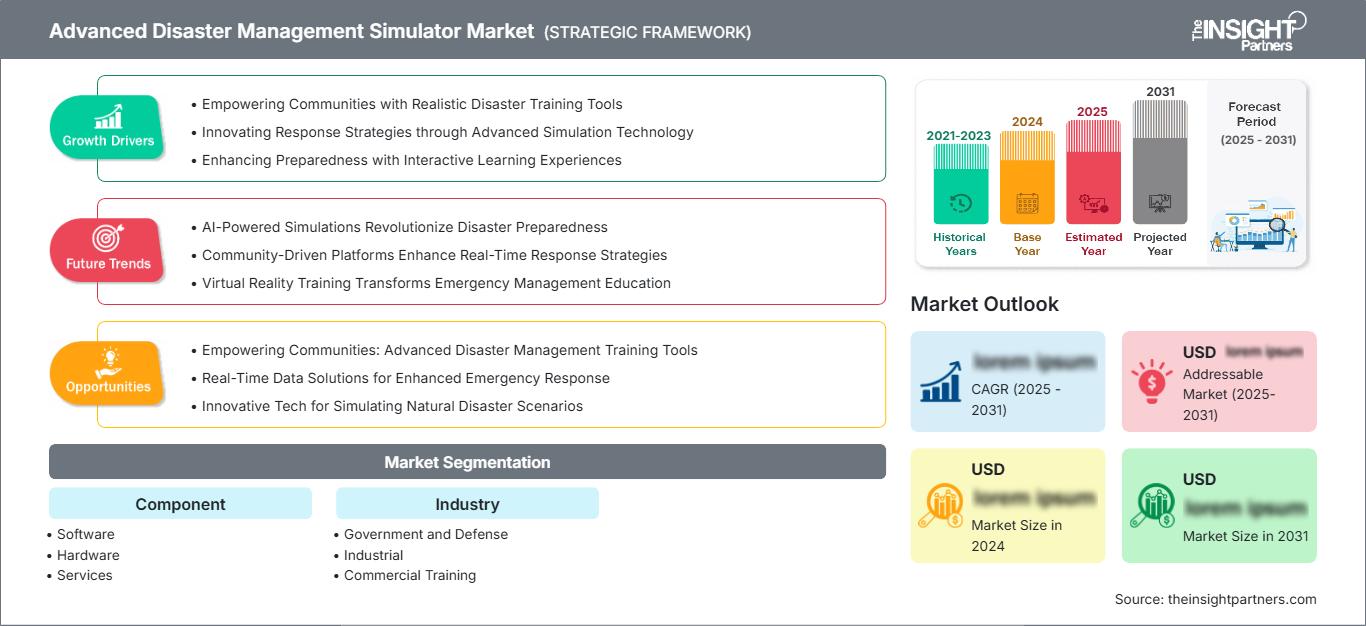
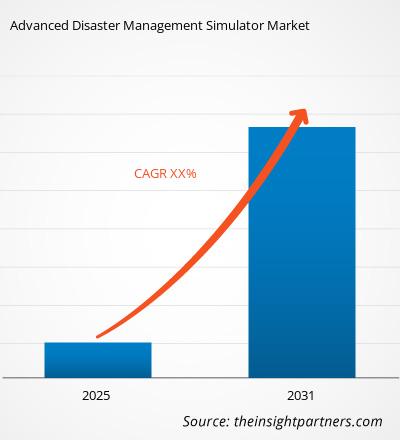
The Advanced disaster management simulator market was valued at US$ 923.45 Million in 2025 and is projected to reach US$ 1919.33 Million by 2034, registering a CAGR of 8.80% during 2026–2034. The development of the market is being aided by an increase in investments in disaster preparedness solutions, the increased adoption of simulation-based training solutions, and the increased need for crisis management planning solutions.
Across North America, increased emphasis on resilience planning and emergency response modernization continues to support adoption of simulation technologies. The advanced disaster management simulator market size is growing due to the use of government funding for readiness programs, infrastructure risk management, and increasing adoption of digital modeling tools. The regional market is expected to grow at the rate of high single digits through the forecast period.
Advanced Disaster Management Simulator Market Assessment and Insights
- North America: The region maintains market leadership due to established emergency preparedness frameworks, strong technology adoption, and advanced training infrastructure. Share in 2025: 38–42%. CAGR between 2026–2034: 8.2–9.0%.
- US: Sustained investments by homeland security agencies, defense organizations, and public safety departments support market expansion. Share in 2025: 72–76% of North America. CAGR between 2026–2034: 8.3–9.1%.
- Europe: Demand is driven by civil protection modernization and resilience-focused public policy, with Germany, the UK, and France leading adoption. Share in 2025: 26–30%. CAGR between 2026–2034: 8.0–8.8%.
- Asia Pacific: Rapid urbanization, disaster-risk reduction initiatives, and infrastructure development programs support expansion across China, Japan, India, South Korea, and Australia. Share in 2025: 22–26%. CAGR between 2026–2034: 9.6–10.4%.
- Largest Segment: Software remains the dominant segment due to increasing demand for scenario modeling, command-center analytics, and digital twin capabilities. Market share in 2025: 48–52%. CAGR 2026–2034: 8.7–9.5%.
- High Growth Segment: Services is expected to witness the strongest expansion as organizations seek customization, implementation assistance, and managed simulation programs. Market share in 2025: 20–24%. CAGR 2026–2034: 9.8–10.6%.
- Key companies analyzed in detail: ETC Simulation, ForgeFX Simulations, Oasys Limited, IBM Corporation, NEC Corporation, Schneider Electric SE, ABB Ltd., The AnyLogic Company, Laerdal Medical AS, Siemens AG.
Source: The Insight Partners' analysis based on proprietary research, government publications, company annual reports, investor presentations, industry databases, and expert interviews.
The increasing complexity of disasters has been spurring innovations and technological advancements in simulation platforms. In the current age, there is increased integration of technologies such as artificial intelligence, machine learning, digital twins, 3D visualization, and geospatial analysis to simulate a more realistic environment. There is also a shift from conventional tabletop drills to simulation ecosystems that can simulate scenarios involving natural hazards, infrastructure failures, public health hazards, and cyber-physical threats.
Future development is expected to be supported by increasing investments in public safety modernization, climate adaptation programs, and critical infrastructure resilience initiatives. Emerging markets are enhancing their disaster management practices by implementing digital and smart city initiatives. At the same time, there are stricter regulations regarding business continuity and emergency management, which have led to increased adoption of simulation technology. Both trends are likely to drive further growth in the market in the long run.
Advanced Disaster Management Simulator Market Report Scope
| Report Attribute | Details |
|---|---|
| Market size in 2025 | US$ 923.45 Million |
| Market Size by 2034 | US$ 1919.33 Million |
| Global CAGR (2026 - 2034) | 8.80% |
| Historical Data | 2021-2024 |
| Forecast period | 2026-2034 |
Advanced Disaster Management Simulator Market Analysis
The advanced disaster management simulator market growth is strongly influenced by the increasing financial and operational consequences of natural and man-made disasters. Investment by governments, infrastructure providers, health organizations, and industries in simulation environments for proactive readiness is increasing. Such systems provide the capacity for real-life simulations for the processes of evacuation, crisis communication, emergency resource management, and response mechanisms. There is increased awareness of resilience planning in the sectors in which disruption could lead to economic and societal costs.
Ecosystem within the industry includes software companies, simulation experts, system integrators, cloud service providers, emergency management agencies, training institutes, and consulting firms. The demand for the solutions offered in this industry is additionally boosted by technological improvements in real-time data integration and predictive analysis technologies. Companies are more and more often using simulation tools to identify risks, enhance efficiency of response and evaluate preparedness performance in various emergency situations.
The advanced disaster management simulator market analysis indicates a highly competitive market where innovation, interoperability, and simulation realism play a key role. Increasing differentiation between players is occurring by the use of artificial intelligence, immersive visualizations, and digital twin technology. The IBM Corporation utilizes its experience in analytics, and NEC Corporation specializes in disaster management preparation and advanced response tools.
Strategic investments are becoming more oriented to cloud-native systems, collaborative training tools, and predictive models. Schneider Electric SE and ABB Ltd. are enhancing their capabilities for resilient infrastructure and continuous operation, whereas Siemens AG and The AnyLogic Company offer simulation-based operations planning. Laerdal Medical AS participates in providing emergency response training tools. With increasing demand for scalable and measurable preparation solutions from customers, the competitive pressures will become higher in the segments of software, hardware, and services.
● REPORT CUSTOMIZATION
Tailor This Report To Align With Your Specific Business Requirements
This report can be customized to align precisely with your business objectives, scope, and target markets. Customization options include tailored segmentation, geography, competitive analysis, and strategic insights to support informed decision-making.
Customize This Report →WHAT YOU CAN ADJUST
- ● Segmentations
- ● Geography
- ● Competitive Analysis
- ● Language Preferences
Advanced Disaster Management Simulator Market: Strategic Insights
Regional Insights
North America Advanced Disaster Management Simulator Market
North America accounted for 38–42% advanced disaster management simulator market share in 2025, making it the largest regional market. Growth is supported by strong public-sector investment in emergency preparedness, disaster resilience, infrastructure protection, and defense modernization initiatives. The region is projected to expand at a CAGR of 8.2–9.0% through 2034. Growing adoption of simulation-based training solutions allows agencies and organizations to improve readiness levels while reducing the financial and logistical burden of large-scale physical exercises.
Technology ecosystems and command-and-control technologies are also key advantages for the market. Various government departments, utilities companies, transport providers, hospitals, and industries are still putting more investment into complex simulation technologies that aid in planning and coordinated response efforts. Digital twin technology, predictive analytics, and artificial intelligence have all become an important part of the market.
U.S. Advanced Disaster Management Simulator Market
The United States represented approximately 72–76% of North American revenue in 2025 and is forecast to register a CAGR of 8.3–9.1% during the forecast period. Advanced disaster management simulator market expansion is driven by homeland security priorities, climate-related risk exposure, defense training requirements, and public-sector modernization initiatives. Federal, state, and local agencies increasingly employ simulation technologies to strengthen preparedness strategies and improve operational coordination during emergencies.
The presence of a mature vendor community plays a key role in facilitating market growth. Organizations such as IBM Corporation, ForgeFX Simulations, Schneider Electric SE, and Siemens AG are currently engaged in driving innovation via sophisticated modeling solutions as well as preparedness platforms. There is a shift from applications in emergency response training to digital twin utilization and crisis management planning.
Europe Advanced Disaster Management Simulator Market
Europe captured 26–30% of global Advanced disaster management simulator market revenue in 2025 and is expected to expand at a CAGR of 8.0–8.8% through 2034. Growth is supported by increasing focus on climate resilience, public safety modernization, and critical infrastructure preparedness. Germany remains the leading national market owing to strong industrial safety standards, extensive investment in risk-management technologies, and advanced emergency planning capabilities.
The United Kingdom continues expanding deployment across emergency services, transportation networks, and municipal agencies seeking enhanced disaster preparedness. Germany maintains a leadership position in industrial resilience applications and simulation-driven risk assessment programs. France, Italy, and Spain are steadily strengthening civil protection capabilities through investments in digital emergency management systems and advanced preparedness initiatives. Collectively, these developments support a favorable outlook for simulation technology adoption across the broader European market.
APAC Advanced Disaster Management Simulator Market
Asia Pacific accounted for 22–26% of global revenue in 2025 and is anticipated to record the highest regional growth rate. Market expansion is forecast at a CAGR of 9.6–10.4%, supported by rapid urbanization, industrialization, and increasing disaster-risk reduction initiatives.
China leads regional demand due to large-scale infrastructure development and public safety investments. Japan, South Korea, India, and Australia are also enhancing preparedness capabilities through advanced simulation technologies. Government resilience programs, smart-city strategies, and industrial safety requirements continue to drive broader adoption across the region.
Middle East & Africa Advanced Disaster Management Simulator Market
The Middle East & Africa market is projected to expand at a CAGR of 8.4–9.2% through 2034. Demand is supported by infrastructure modernization initiatives, emergency preparedness programs, and increasing investment in resilience planning across critical sectors.
Saudi Arabia and the UAE are leading adopters owing to smart-city development projects and public-safety modernization efforts. South Africa remains an important market supported by industrial risk-management requirements. Growth opportunities continue emerging from energy, transportation, and infrastructure sectors seeking advanced simulation solutions for operational preparedness and continuity planning.
Segmentation Analysis
Component
The Component segment is projected to expand at a CAGR of 8.9–9.7% between 2026 and 2034. Market growth is supported by increasing demand for integrated simulation ecosystems capable of combining data visualization, predictive modeling, immersive training, and operational decision support. The advanced disaster management simulator market scope continues broadening as organizations seek comprehensive platforms that can improve preparedness, reduce response uncertainty, and strengthen multi-agency coordination during emergency situations.
- Software: The largest sub-segment, driven by growing deployment of cloud-based modeling platforms, digital twins, artificial intelligence tools, scenario-generation engines, and analytics capabilities that enable realistic disaster preparedness simulations across public and private sectors.
- Hardware: Includes simulation workstations, immersive visualization systems, command-center displays, communication devices, and virtual reality equipment. Hardware remains important for organizations requiring high-fidelity training environments and operational realism during preparedness exercises.
- Services: Encompasses implementation support, consulting, scenario customization, training, maintenance, and managed simulation programs. Demand continues to rise as organizations seek expert guidance for maximizing simulation effectiveness and long-term operational value.
Industry
The Industry segment is expected to register a CAGR of 8.6–9.4% during the forecast period. Adoption patterns vary according to preparedness requirements, regulatory expectations, and operational complexity. Increasing awareness of resilience planning and business continuity strategies is driving organizations to deploy advanced simulation systems capable of supporting risk assessment, training, and crisis-response planning across multiple operational environments.
- Government and Defense: The largest industry sub-segment, utilizing simulation technologies for homeland security training, emergency response exercises, disaster preparedness planning, military readiness programs, and multi-jurisdiction crisis management coordination activities.
- Industrial: Widely adopted across utilities, energy, transportation, manufacturing, mining, and critical infrastructure sectors to evaluate operational vulnerabilities, test emergency procedures, and strengthen business continuity strategies under complex disruption scenarios.
- Commercial Training: Includes educational institutions, emergency-management academies, professional training providers, and private organizations focused on workforce preparedness, crisis-management competency development, and emergency-response capability enhancement through simulation-based learning environments.
Opportunity Snapshot
| Industry | Revenue Contribution | Trend Tag | Adoption Stage |
|---|---|---|---|
| Government and Defense | High | Crisis Modeling | Mature |
| Industrial | Medium | Digital Twin | Scaling |
| Commercial Training | Low | Virtual Drills | Emerging |
Advanced Disaster Management Simulator Market Growth Drivers and Impact Analysis
Expansion of National Disaster Preparedness and Resilience Programs
Governments across developed and emerging economies are increasing spending on disaster risk reduction, resilience planning, and emergency preparedness initiatives. Rising climate-related incidents, urban population concentration, and infrastructure interdependence are creating greater demand for sophisticated training and simulation environments. Advanced disaster management simulators provide agencies with the ability to evaluate evacuation plans, communication protocols, command structures, and resource deployment strategies before real emergencies occur. The technology enables repeatable exercises at significantly lower cost than large-scale field operations while generating measurable performance outcomes. As resilience strategies become integrated into transportation, healthcare, energy, and public-safety planning, demand for highly realistic simulation platforms is expected to increase steadily. These investments are supporting widespread deployment across public-sector organizations, civil protection authorities, defense agencies, and critical infrastructure operators worldwide.
Rising Integration of Artificial Intelligence and Digital Twin Technologies
Artificial intelligence and digital twin capabilities are transforming simulation platforms into sophisticated decision-support environments. Advanced systems increasingly integrate real-time sensor information, infrastructure data, geospatial intelligence, predictive analytics, and machine-learning models to create dynamic representations of operational environments. Organizations can evaluate multiple disaster scenarios, forecast outcomes, identify vulnerabilities, and optimize response strategies before incidents occur. These capabilities enhance preparedness while improving operational efficiency and strategic planning effectiveness. Large infrastructure operators, industrial enterprises, and government agencies are adopting digital twin-enabled simulation tools to support long-term resilience objectives. As organizations pursue broader digital-transformation programs, AI-powered simulation environments are expected to become critical components of preparedness, operational continuity, and risk-management strategies across diverse industries and geographic markets.
Increasing Regulatory Focus on Infrastructure Continuity and Public Safety
Regulators, policymakers, and industry authorities are placing greater emphasis on operational resilience, critical infrastructure protection, and emergency preparedness standards. Organizations operating essential services face increasing pressure to demonstrate readiness against natural disasters, industrial accidents, cyber-physical disruptions, and public-health emergencies. Simulation technologies provide highly effective tools for validating emergency response plans, identifying process weaknesses, testing coordination mechanisms, and improving workforce preparedness. Utilities, transportation networks, healthcare systems, and industrial facilities increasingly utilize advanced simulators to strengthen compliance and mitigate operational risks. The ability to quantify preparedness performance and continuously improve procedures creates measurable value for both public and private organizations. Consequently, stronger regulatory expectations continue to act as a significant catalyst for long-term market expansion.
Advanced Disaster Management Simulator Market Future Trends
AI-Driven Adaptive Scenario Generation
The advanced disaster management simulator market trends increasingly reflect the emergence of artificial intelligence capable of generating adaptive and continuously evolving scenario environments. Future simulation platforms are expected to create disaster situations dynamically using real-time risk indicators, operational datasets, weather intelligence, and infrastructure conditions. Rather than relying on static training exercises, organizations will deploy systems capable of adjusting events according to participant decisions and external variables. This approach will improve realism, reduce scenario-development timelines, and enhance learning outcomes. Greater use of automated performance evaluation, predictive response modeling, and intelligent recommendations will further strengthen the value proposition of simulation-based preparedness programs across government, industrial, and public-safety applications.
Convergence of Immersive Technologies and Collaborative Crisis Training
Virtual reality, augmented reality, mixed reality, and cloud-based collaboration technologies are expected to significantly transform preparedness and emergency-response training. Organizations increasingly require simulation environments that can connect geographically distributed participants within a single operational scenario. Future platforms will support real-time interaction among emergency responders, government agencies, healthcare providers, infrastructure operators, and private-sector stakeholders. By creating highly immersive and collaborative experiences, advanced simulators will enable more effective testing of communication processes, coordination mechanisms, and decision-making capabilities. Continued advances in visualization technologies will improve training realism while supporting scalable deployment models suitable for organizations of varying sizes and operational requirements.
Advanced Disaster Management Simulator Market Opportunities
Expansion of Industrial Resilience and Continuity Platforms
Industrial operators are increasingly moving beyond conventional emergency-response planning toward integrated resilience management frameworks. Advanced simulation technologies are becoming important tools for evaluating operational continuity, infrastructure vulnerabilities, supply-chain disruptions, and workforce readiness. Energy providers, utilities, transportation companies, and manufacturing organizations are investing in simulation-driven planning solutions capable of quantifying risk exposure and validating improvement strategies. The advanced disaster management simulator market Forecasts indicate strong opportunity for vendors that can combine predictive analytics, digital twins, infrastructure modeling, and preparedness training within unified platforms. Providers offering subscription-based software ecosystems and industry-specific scenario libraries are particularly well positioned to capture long-term business. Increased regulatory scrutiny and growing concerns surrounding infrastructure resilience are expected to accelerate investment decisions, creating attractive opportunities across developed and emerging industrial markets throughout the forecast period.
Growth Potential Across Emerging Economies and Smart-City Initiatives
Emerging economies present substantial untapped opportunity as governments strengthen disaster-risk reduction capabilities and accelerate public-sector digital transformation programs. Rapid urbanization, expanding infrastructure networks, and increasing climate-related risks are encouraging investment in modern preparedness frameworks. Smart-city initiatives are creating favorable conditions for simulation technologies that can support evacuation planning, infrastructure resilience assessment, emergency-response coordination, and public-safety modernization. Technology providers capable of delivering scalable and cost-effective solutions suited to regional requirements may benefit significantly from this transition. Strategic partnerships involving governments, emergency management agencies, educational institutions, and infrastructure operators are likely to expand adoption rates. As investment in resilience and preparedness becomes a national priority for many countries, simulation vendors gain valuable opportunities to establish long-term market presence and recurring revenue streams.
Frequently Asked Questions

- Comprehensive Market Sizing and Forecast Analysis
- Detailed Segmentation Analysis
- In-Depth Market Dynamics Assessment
- Regional and Country-Level Insights
- Competitive Landscape and Company Benchmarking
- Strategic Business Intelligence
Recent Reports
Testimonials

The Insight Partners' SCADA System Market report is comprehensive, with valuable insights on current trends and future forecasts. The team was highly professional, responsive, and supportive throughout. We are very satisfied and highly recommend their services.
RAN KEDEM Partner, Reali Technologies LTDs
I requested a report on a very specific software market and the team produced the report in a few days. The information was very relevant and well presented. I then requested some changes and additions to the report. The team was again very responsive and I got the final report in less than a week.
JEAN-HERVE JENN Chairman, Future Analytica
We worked with The Insight Partners for an important market study and forecast. They gave us clear insights into opportunities and risks, which helped shape our plans. Their research was easy to use and based on solid data. It helped us make smart, confident decisions. We highly recommend them.
PIYUSH NAGPAL Sr. Vice President, High Beam Global
The Insight Partners delivered insightful, well-structured market research with strong domain expertise. Their team was professional and responsive throughout. The user-friendly website made accessing industry reports seamless. We highly recommend them for reliable, high-quality research services
YUKIHIKO ADACHI CEO, Deep Blue, LLC.
This is the first time I have purchased a market report from The Insight Partners.While I was unsure at first, I visited their web site and felt more comfortable to take the risk and purchase a market report.I am completely satisfied with the quality of the report and customer service. I had several questions and comments with the initial report, but after a couple of dialogs over email with their analyst I believe I have a report that I can use as input to our strategic planning process.Thank you so much for taking the extra time and making this a positive experience.I will definitely recommend your service to others and you will be my first call when we need further market data.
JOHN SUZUKI President and Chief Executive Officer, Board Director, BK Technologies
I wish to appreciate your support and the professionalism you displayed in the course of attending to my request for information regarding to infectious disease IVD market in Nigeria. I appreciate your patience, your guidance, and the fact that you were willing to offer a discount, which eventually made it possible for us to close a deal. I look forward to engaging The Insight Partners in the future, all thanks to the impression you have created in me as a result of this first encounter.
DR CHIJIOKE ONYIA MANAGING DIRECTOR, PineCrest Healthcare Ltd.Reason to Buy
- Informed Decision-Making
- Understanding Market Dynamics
- Competitive Analysis
- Identifying Emerging Markets
- Customer Insights
- Market Forecasts
- Risk Mitigation
- Boosting Operational Efficiency
- Strategic Planning
- Investment Justification
- Tracking Industry Innovations
- Aligning with Regulatory Trends





 Get Free Sample for