
Advanced Malware Detection (AMD) Market Size, Share & Demand by 2034
Coverage: By Component (Solution, Services); Enterprise Size (SMEs, Large Enterprises); Industry Vertical (BFSI, IT and Telecom, Manufacturing, Travel and Hospitality, Healthcare, Energy and Utilities, Others) , and Geography (North America, Europe, Asia Pacific, and South and Central America)
- Status : Data Released
- Report Code : TIPRE00027022
- Category : Technology, Media and Telecommunications
- No. of Pages : 150
- Available Report Formats :


- Last update date : August 05, 2026


2025 Market Size
US$ 9.96 Bn
Base year value
2034 Forecast
US$ 29.98 Bn
Projected by 2034
CAGR 2026-2034
14.77 %
Growth rate
Addressable Market
US$ 190.01 Bn
(2026-2034)
The advanced malware detection market was valued at US$ 9.96 Billion in 2025 and is projected to reach US$ 29.98 Billion by 2034, expanding at a CAGR of 14.77% during 2026–2034. The market is driven by the advancement in cyber attacks, the use of advanced artificial intelligence based threat detection systems, and the need for threat awareness in enterprises. Security vendors are constantly improving their offerings in terms of behavioral analytics, threat intelligence, and automated responses.
Across North America, enterprise cybersecurity spending remains supported by strict regulatory environments, increasing ransomware incidents, and broad cloud adoption. The advanced malware detection market size in the region will continue to see benefits from investment in zero-trust architecture and managed security services. This need will be highly observed by financial organizations, healthcare organizations, and government organizations that seek advanced protection against threats. Regional growth is expected to be within high double digits during the forecast period.
Advanced Malware Detection (AMD) Market Assessment and Insights
- North America: Maintains leadership through mature cybersecurity investments, strong security compliance standards, and extensive enterprise digitalization. Share in 2025: 36–40% and expected to grow at a CAGR of 13–15% during 2026–2034.
- US: Strong adoption across BFSI, healthcare, government, and technology sectors supports continued expansion. Share of North America in 2025: 74–78% and anticipated CAGR of 13–15% during 2026–2034.
- Europe: Growing cybersecurity mandates and heightened focus on critical infrastructure protection support market development. Germany, the UK, and France remain leading countries. Share in 2025: 24–28% with a CAGR of 13–14% during 2026–2034.
- Asia Pacific: Digital transformation initiatives, rising cybercrime activity, and expanding cloud adoption create strong demand. China, India, Japan, and South Korea represent key growth centers. Share in 2025: 22–26% with a CAGR of 16–18% during 2026–2034.
- Largest Segment: Solution segment dominates due to widespread deployment of endpoint, network, and cloud security platforms. Market share in 2025: 66–70% and estimated CAGR of 14–15% during 2026–2034.
- High Growth Segment: Services segment benefits from increasing demand for managed detection, incident response, and security consulting. Market share in 2025: 30–34% and expected CAGR of 16–18% during 2026–2034.
- Key companies analyzed in detail: Cisco Systems, Inc.; Palo Alto Networks, Inc.; NetScreen Technologies, Inc.; Sophos Ltd.; Huawei Technologies Co., Ltd.; Trend Micro Incorporated; Check Point Software Technologies Ltd.; SonicWall Inc.; WatchGuard Technologies, Inc.; Forcepoint LLC.
Source: The Insight Partners' analysis based on proprietary research, government publications, company annual reports, investor presentations, industry databases, and expert interviews.
The development of threat intelligence systems, machine learning, and cloud-native architecture has brought a revolutionary change in the capability of detecting malware. Nowadays, organizations need to be able to detect polymorphic, fileless malware and also zero-day attacks, which can bypass any traditional detection mechanisms based on signatures. Behavioral analysis, endpoint data, and automated mitigation measures have become an essential part of cybersecurity in organizations.
From a future perspective, there will be more investment in cybersecurity in new digital economies experiencing rapid growth in cloud adoption and infrastructure connectivity. Regulatory efforts aimed at cyber resilience, data protection, and critical infrastructure protection are providing a positive environment for the application of cybersecurity solutions. More investments in cybersecurity modernization, along with the growth of security operations centers and managed detection services, is expected to support sustained advanced malware detection market momentum throughout the forecast period.
Advanced Malware Detection (AMD) Market Report Scope
| Report Attribute | Details |
|---|---|
| Market size in 2025 | US$ 9.96 Billion |
| Market Size by 2034 | US$ 29.98 Billion |
| Global CAGR (2026 - 2034) | 14.77% |
| Historical Data | 2021-2024 |
| Forecast period | 2026-2034 |
Advanced Malware Detection (AMD) Market Analysis
The advanced malware detection market growth curve is driven by rising cyber attacks on cloud infrastructure, enterprise networks, and connected devices. Hackers now employ artificial intelligence and automation, and even evasive technologies that evade standard security measures. As a result, businesses are focusing on advanced malware detection solutions that will constantly monitor user activity, network traffic, and endpoint actions. The value chain comprises of threat intelligence firms, security software vendors, managed security service providers, and end users.
The supply side continues to evolve as suppliers incorporate machine learning, XDR, and security orchestration into their offerings. The demand will be especially high within regulated sectors where cyber threats may have financial, operational, and reputational repercussions. Adoption of cloud-native security architecture and hybrid workforce will increase the demand for malware detection solutions that are flexible across different infrastructures.
The advanced malware detection market analysis indicates that the level of competitiveness is still very high since the vendors are concentrating on the development of platform capabilities and enhancing the partnerships within the ecosystem. Among the companies that continue developing solutions in terms of artificial intelligence, threat intelligence enrichment, and security automation include Cisco Systems, Inc., Palo Alto Networks, Inc., Check Point Software Technologies Ltd., Trend Micro Incorporated, and Sophos Ltd. The product innovation is focused on the development of unified security platforms.
The investments made strategically in cybersecurity startups, security analytics, and managed detection services have brought change in the competitive environment. Organizations, including Forcepoint LLC, WatchGuard Technologies, Inc., SonicWall Inc., Huawei Technologies Co., Ltd., and NetScreen Technologies, Inc., are continuing to build their regional presence and portfolio to cope with enterprise needs. Partnerships with cloud service providers and technology integrators are also becoming important routes for expanding customer reach and accelerating deployment of advanced threat detection capabilities.
● REPORT CUSTOMIZATION
Tailor This Report To Align With Your Specific Business Requirements
This report can be customized to align precisely with your business objectives, scope, and target markets. Customization options include tailored segmentation, geography, competitive analysis, and strategic insights to support informed decision-making.
Customize This Report →WHAT YOU CAN ADJUST
- ● Segmentations
- ● Geography
- ● Competitive Analysis
- ● Language Preferences
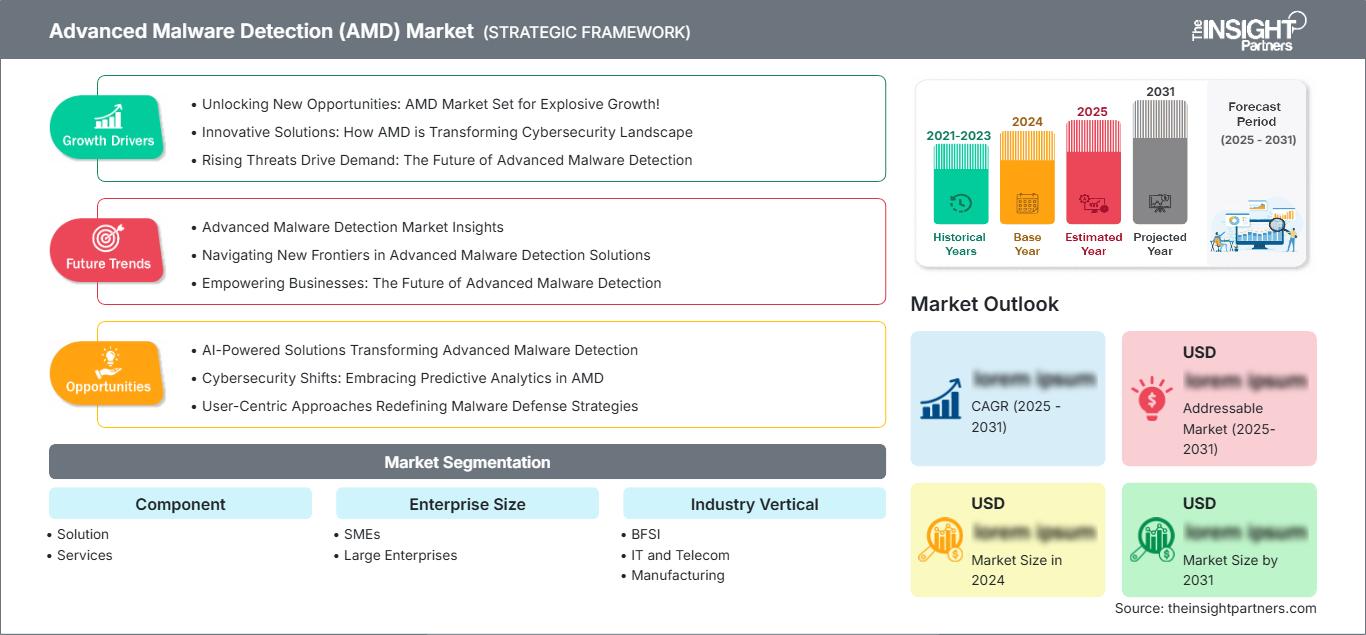
Advanced Malware Detection (AMD) Market: Strategic Insights
Regional Insights
North America Advanced Malware Detection Market
North America accounted for approximately 36–40% of the global advanced malware detection market in 2025 and continues to represent the largest regional contributor. Positive spending trends on cybersecurity, cloud adoption, and rising levels of threat sophistication constitute the major structural growth factors that will drive the market demand. Advanced malware defense solutions are being adopted by large corporations in the banking, healthcare, energy, and governmental industries. The region is expected to grow at a CAGR of 13-15% during 2026-2034.
Increased use of zero-trust architectures and security operations platforms is still enabling the use of technology across the region. The need to hunt for threats, as well as the need for managed detection and response services, and using artificial intelligence-driven analytics for identifying sophisticated threats before disruption is witnessed, continues to drive investments.
U.S. Advanced Malware Detection Market
The United States represents approximately 74–78% of the North American advanced malware detection market share in 2025. Strong adoption of digital technologies, extensive cloud workloads, and elevated ransomware activity sustain demand from enterprises and public-sector organizations. Security investments remain particularly robust within BFSI, healthcare, government, and telecommunications environments. The U.S. market is projected to grow at a CAGR of 13–15% through 2034.
Leading vendors in the cybersecurity space have a strong presence in the form of operations, R&D, and development efforts throughout the country, which offers businesses the capability of using advanced detection tools. The deployment of zero trust architecture, extended detection and response, and cloud security solutions remains an important reason behind the expansion of the market.
Europe Advanced Malware Detection Market
Europe represented approximately 24–28% of global revenue in 2025 and is anticipated to expand at a CAGR of 13–14% during 2026–2034. Regulatory frameworks emphasizing cybersecurity readiness, data privacy, and digital sovereignty continue to encourage investments across public and private organizations. Germany remains the leading country within the region due to its large industrial base and strong cybersecurity spending.
Demand from the UK is significant through financial services, governmental bodies, and technology firms looking to improve their threat visibility and attack prevention. The demand in Germany is high due to large-scale implementation in industries such as manufacturing, automobiles, and industrial automation, where cybersecurity is becoming an essential part of operations. Threat analytics and managed security services are becoming common in France, Italy, and Spain as well.
APAC Advanced Malware Detection Market
Asia Pacific accounted for approximately 22–26% of global revenue in 2025 and represents the fastest-expanding regional market. Strong digital transformation programs, rapid cloud migration, and rising cybercrime activity continue to support the advanced malware detection market expansion. The region is projected to grow at a CAGR of 16–18% during 2026–2034.
China remains the largest national market, while India exhibits particularly strong adoption momentum. Japan, South Korea, and Australia continue investing in advanced threat protection across critical infrastructure and enterprise networks. Government cybersecurity policies and expanding digital economies further strengthen long-term demand for advanced malware detection technologies.
Middle East & Africa Advanced Malware Detection Market
The Middle East and Africa market continues to gain importance as organizations accelerate digital modernization initiatives. Energy infrastructure operators, financial institutions, and government organizations increasingly deploy advanced security platforms to address growing cyber risks. Regional advanced malware detection market development is supported by expanding digital services and greater awareness of cyber resilience requirements.
Saudi Arabia and the United Arab Emirates remain leading markets due to substantial investments in smart infrastructure and digital transformation programs. South Africa also contributes significantly through enterprise cybersecurity spending. The region is expected to advance at a CAGR of 14–16% during 2026–2034, supported by increasing cybersecurity regulations and infrastructure modernization efforts.
Segmentation Analysis
Component
The Component segment remains the foundation of cybersecurity spending as organizations balance investments between technology platforms and operational expertise. Growing attack complexity, regulatory requirements, and cloud-centric infrastructure are encouraging enterprises to adopt integrated detection frameworks supported by specialist service providers. The advanced malware detection market scope continues to broaden as organizations prioritize continuous monitoring and rapid threat containment. The Component segment is projected to expand at a CAGR of 14–16% during 2026–2034.
- Solution: The leading sub-segment, supported by strong deployment of endpoint detection, behavioral analytics, network monitoring, threat intelligence integration, and AI-enabled security platforms designed to identify sophisticated malware attacks across hybrid environments.
- Services: Demand is rising due to increasing reliance on managed detection and response, incident remediation, cybersecurity consulting, and threat-hunting capabilities that help organizations address persistent skill shortages and operational complexity.
Enterprise Size
Enterprise size significantly influences cybersecurity procurement strategies, deployment models, and investment priorities. Larger organizations typically require highly scalable and integrated security ecosystems, while smaller businesses increasingly seek cloud-based and managed security solutions. Continued digital transformation and regulatory compliance requirements are expected to support broad advanced malware detection market adoption. The Enterprise Size segment is anticipated to grow at a CAGR of 14–15% during 2026–2034.
- SMEs: Small and medium-sized enterprises increasingly adopt subscription-based security solutions and outsourced security services to strengthen protection against ransomware, phishing campaigns, and advanced malware attacks without significant internal resource requirements.
- Large Enterprises: Large organizations maintain substantial cybersecurity budgets and deploy advanced detection technologies across complex global infrastructures, prioritizing visibility, automation, threat intelligence integration, and cyber resilience initiatives.
Industry Vertical
Industry-specific cybersecurity requirements substantially influence purchasing decisions and deployment priorities. Organizations operating critical services and data-intensive environments face elevated risks from advanced malware attacks, driving investment in specialized threat detection tools. Expanding digitization initiatives across sectors continue to strengthen demand for proactive cybersecurity capabilities. The Industry Vertical segment is forecast to register a CAGR of 15–17% during 2026–2034.
- BFSI: Financial institutions prioritize advanced malware detection to protect transactional systems, customer information, digital banking platforms, and regulatory compliance frameworks while minimizing operational disruption from targeted cyberattacks.
- IT and Telecom: Technology providers and telecommunications operators deploy advanced security platforms to safeguard digital infrastructure, cloud services, customer data, and interconnected communication networks against evolving threats.
- Manufacturing: Industrial organizations increasingly secure operational technology environments, connected machinery, and production systems as cyber threats targeting industrial control systems continue to increase globally.
- Travel and Hospitality: Digital booking platforms, loyalty programs, and customer databases require enhanced protection, encouraging investments in sophisticated monitoring and malware detection capabilities across hospitality ecosystems.
- Healthcare: Healthcare providers focus on protecting patient records, connected medical devices, and clinical systems while ensuring service continuity amid increasing ransomware activity and regulatory scrutiny.
- Energy and Utilities: Grid operators, utility companies, and energy infrastructure organizations deploy advanced threat detection to secure mission-critical assets, improve operational resilience, and support infrastructure modernization programs.
Opportunity Snapshot
| Industry Vertical | Revenue Contribution | Trend Tag | Adoption Stage |
|---|---|---|---|
| BFSI | High | Fraud Defense | Mature |
| IT and Telecom | High | Cloud Security | Mature |
| Manufacturing | Medium | OT Protection | Scaling |
| Travel and Hospitality | Low | Booking Security | Emerging |
| Healthcare | High | Clinical Security | Scaling |
| Energy and Utilities | Medium | Infrastructure Defense | Scaling |
Advanced Malware Detection (AMD) Market Growth Drivers and Impact Analysis
Escalating Sophistication of Cyber Threats
The growing complexity of malware attacks remains one of the strongest catalysts for market expansion. Attackers increasingly employ artificial intelligence, polymorphic malware, fileless attack methods, and advanced evasion techniques capable of bypassing traditional signature-based security controls. Organizations across industries face rising operational and financial risks as threat actors target cloud environments, critical infrastructure, and digital business platforms. This evolving threat landscape is accelerating the adoption of behavior-based detection systems and advanced analytics. Enterprises are investing in technologies that can identify anomalies in real time, improve visibility across distributed environments, and automate investigation workflows. As cybercriminal tactics continue to evolve, enterprises are expected to prioritize proactive and adaptive threat detection capabilities that reduce attack dwell time and improve incident response effectiveness.
Expansion of Cloud and Hybrid IT Environments
Rapid migration toward cloud computing and hybrid infrastructure models is creating substantial demand for advanced malware detection solutions. Many organizations now operate across public clouds, private clouds, remote workforce environments, and on-premises systems simultaneously. This diversity increases visibility challenges and introduces new attack surfaces that require continuous monitoring. Advanced malware detection platforms provide centralized threat visibility, behavioral analytics, and real-time security controls across complex environments. Businesses increasingly seek integrated platforms capable of securing endpoints, applications, cloud workloads, and network traffic through a unified architecture. As cloud adoption continues to expand across industries, organizations will remain focused on strengthening cybersecurity posture and reducing exposure to malware threats that can exploit interconnected and distributed infrastructures.
Growing Regulatory Focus on Cyber Resilience
Governments and regulatory bodies worldwide continue introducing stricter cybersecurity requirements as digital economies become increasingly dependent on secure infrastructure. Financial institutions, healthcare organizations, energy operators, and public-sector agencies are facing heightened expectations related to threat monitoring, incident response preparedness, and data protection. Advanced malware detection solutions assist organizations in meeting these regulatory obligations by improving threat visibility and accelerating detection processes. Greater enforcement activity and higher penalties associated with cyber incidents are encouraging executives to strengthen cybersecurity investments. Organizations also recognize that regulatory compliance supports broader operational resilience objectives. Consequently, advanced malware detection technologies are becoming strategic investments that help reduce business risk while supporting governance, compliance, and long-term cybersecurity maturity.
Advanced Malware Detection (AMD) Market Future Trends
AI-Driven Security Operations Platforms
The advanced malware detection market trends increasingly indicate movement toward AI-enabled security operations platforms capable of continuously analyzing user behavior, endpoint telemetry, network traffic, and threat intelligence data. Future deployments are expected to emphasize automated investigation, predictive threat detection, and contextual risk analysis rather than reactive monitoring approaches. Vendors are likely to expand generative AI capabilities that assist analysts with incident prioritization and remediation recommendations. As security teams continue to face staffing constraints, intelligent automation will become a critical differentiator. Organizations are expected to adopt integrated platforms that improve operational efficiency while maintaining detection accuracy across expanding hybrid digital ecosystems.
Convergence of Detection, Response, and Threat Intelligence
Future market development is expected to be shaped by increasing convergence between detection systems, incident response platforms, and threat intelligence services. Enterprises are seeking unified cybersecurity ecosystems that eliminate fragmented visibility across security infrastructure. Next-generation solutions will likely deliver enhanced correlation of security events from cloud environments, endpoints, applications, and network assets. Vendors are expected to expand ecosystem interoperability through open architectures and API-driven integration models. This convergence will help organizations accelerate investigation processes, simplify management complexity, and enhance resilience against increasingly sophisticated cyber threats. Demand for comprehensive threat management capabilities is therefore expected to strengthen throughout the forecast period.
Advanced Malware Detection (AMD) Market Opportunities
Expansion Across Critical Infrastructure Security Programs
Critical infrastructure modernization programs are creating substantial opportunities for cybersecurity vendors and investors. Governments and infrastructure operators are increasing spending on the protection of energy networks, transportation systems, healthcare facilities, water utilities, and telecommunications infrastructure. As operational technology environments become increasingly connected, organizations require advanced capabilities capable of detecting both traditional malware and sophisticated targeted attacks. The advanced malware detection market Forecasts indicate that infrastructure operators will prioritize integrated threat monitoring and response platforms capable of securing IT and OT environments simultaneously. Vendors that develop sector-specific detection capabilities, compliance-focused solutions, and managed security offerings are positioned to benefit from growing demand. Partnerships with public-sector agencies, utility operators, and infrastructure contractors are expected to create long-term deployment opportunities throughout the forecast period.
Growth Potential in Managed Detection and Response Services
The shortage of skilled cybersecurity professionals continues to challenge organizations worldwide, creating favorable conditions for managed security offerings. Many enterprises lack the internal expertise required to operate sophisticated threat detection platforms around the clock. As a result, demand for managed detection and response services is increasing across mid-sized and large organizations seeking cost-effective cybersecurity capabilities. Service providers have opportunities to expand recurring revenue streams by offering threat monitoring, incident investigation, threat hunting, and remediation support. Organizations increasingly prefer outcome-based security models that reduce operational complexity while maintaining strong protection standards. Vendors capable of integrating automation, analytics, and expert security services into a unified offering are expected to benefit significantly from evolving enterprise purchasing preferences.
Frequently Asked Questions

- Comprehensive Market Sizing and Forecast Analysis
- Detailed Segmentation Analysis
- In-Depth Market Dynamics Assessment
- Regional and Country-Level Insights
- Competitive Landscape and Company Benchmarking
- Strategic Business Intelligence
Recent Reports
Testimonials

The Insight Partners' SCADA System Market report is comprehensive, with valuable insights on current trends and future forecasts. The team was highly professional, responsive, and supportive throughout. We are very satisfied and highly recommend their services.
RAN KEDEM Partner, Reali Technologies LTDs
I requested a report on a very specific software market and the team produced the report in a few days. The information was very relevant and well presented. I then requested some changes and additions to the report. The team was again very responsive and I got the final report in less than a week.
JEAN-HERVE JENN Chairman, Future Analytica
We worked with The Insight Partners for an important market study and forecast. They gave us clear insights into opportunities and risks, which helped shape our plans. Their research was easy to use and based on solid data. It helped us make smart, confident decisions. We highly recommend them.
PIYUSH NAGPAL Sr. Vice President, High Beam Global
The Insight Partners delivered insightful, well-structured market research with strong domain expertise. Their team was professional and responsive throughout. The user-friendly website made accessing industry reports seamless. We highly recommend them for reliable, high-quality research services
YUKIHIKO ADACHI CEO, Deep Blue, LLC.
This is the first time I have purchased a market report from The Insight Partners.While I was unsure at first, I visited their web site and felt more comfortable to take the risk and purchase a market report.I am completely satisfied with the quality of the report and customer service. I had several questions and comments with the initial report, but after a couple of dialogs over email with their analyst I believe I have a report that I can use as input to our strategic planning process.Thank you so much for taking the extra time and making this a positive experience.I will definitely recommend your service to others and you will be my first call when we need further market data.
JOHN SUZUKI President and Chief Executive Officer, Board Director, BK Technologies
I wish to appreciate your support and the professionalism you displayed in the course of attending to my request for information regarding to infectious disease IVD market in Nigeria. I appreciate your patience, your guidance, and the fact that you were willing to offer a discount, which eventually made it possible for us to close a deal. I look forward to engaging The Insight Partners in the future, all thanks to the impression you have created in me as a result of this first encounter.
DR CHIJIOKE ONYIA MANAGING DIRECTOR, PineCrest Healthcare Ltd.Reason to Buy
- Informed Decision-Making
- Understanding Market Dynamics
- Competitive Analysis
- Identifying Emerging Markets
- Customer Insights
- Market Forecasts
- Risk Mitigation
- Boosting Operational Efficiency
- Strategic Planning
- Investment Justification
- Tracking Industry Innovations
- Aligning with Regulatory Trends





 Get Free Sample for