
Advanced Predictive Analytics Software Market Size, Share & Forecast by 2034
Coverage: By Type (Data Mining, Statistical, Testing Analytics, Others); Application (BFSI, Pharmaceuticals , Transportation and Logistics , Telecom and IT, Retail , Others) , and Geography (North America, Europe, Asia Pacific, and South and Central America)
- Status : Data Released
- Report Code : TIPRE00017036
- Category : Technology, Media and Telecommunications
- No. of Pages : 150
- Available Report Formats :


- Last update date : August 06, 2026


2025 Market Size
US$ 13.71 Bn
Base year value
2034 Forecast
US$ 86.22 Bn
Projected by 2034
CAGR 2026-2034
22.66 %
Growth rate
Addressable Market
US$ 392.24 Bn
(2026-2034)
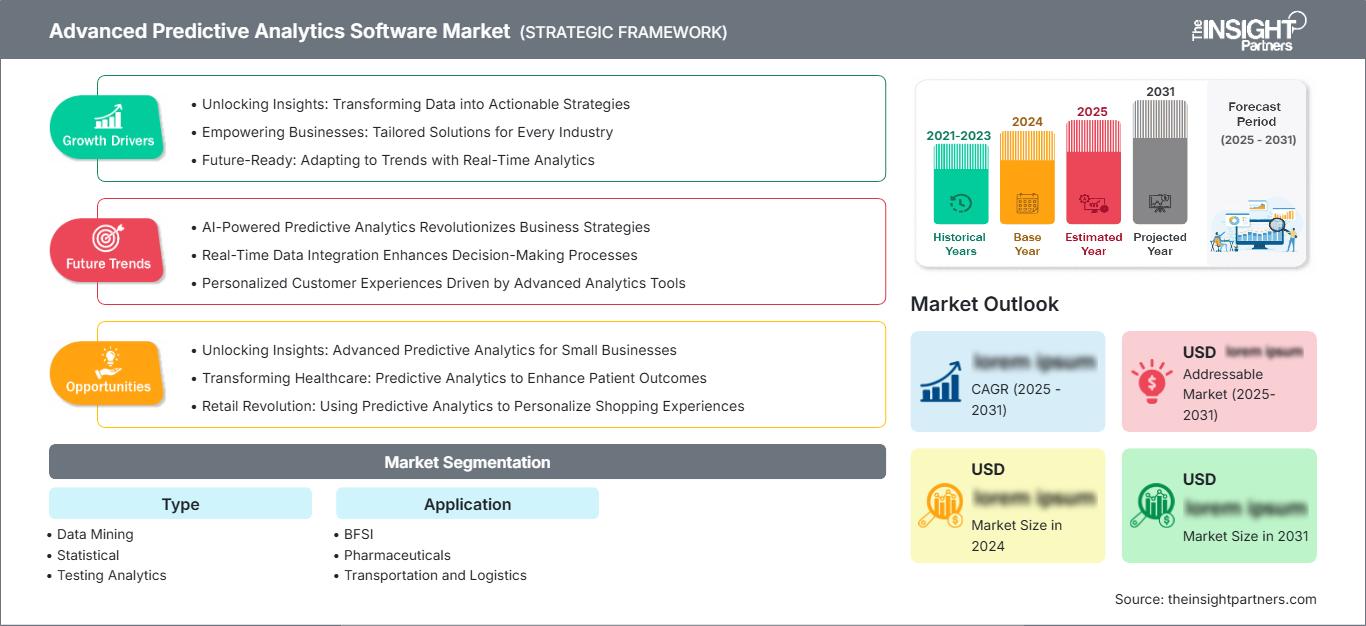
The Advanced predictive analytics software market was valued at US$ 13.71 Billion in 2025 and is projected to reach US$ 86.22 Billion by 2034, expanding at a CAGR of 22.66% during 2026–2034. Growth is driven by increasing enterprise adoption of artificial intelligence, machine learning-enabled forecasting tools, and demand for real-time decision intelligence across financial services, healthcare, telecommunications, retail, and logistics environments. Organizations are increasingly leveraging predictive models to improve resource allocation, revenue planning, customer retention, and operational resilience.
Across North America, enterprises continue to prioritize advanced analytics platforms capable of integrating structured and unstructured data for actionable forecasting. The advanced predictive analytics software market size expansion in the region is supported by strong cloud infrastructure, high digital maturity, and rising investments in enterprise AI. Market growth in North America is expected to remain within a CAGR range of 20–23% through 2034, supported by financial services modernization and increasing adoption of data-driven business models.
Advanced Predictive Analytics Software Market Assessment and Insights
• North America: Share in 2025 estimated at 38–42%, supported by mature analytics adoption, extensive cloud deployment, and substantial enterprise AI investment. CAGR between 2026–2034 is expected at 20–23% as organizations scale predictive decision systems.
• US: Accounts for 72–76% of North American revenue in 2025 with CAGR between 20–23% during 2026–2034, supported by strong demand from BFSI, healthcare, retail, and technology sectors.
• Europe: Share in 2025 estimated at 24–28%, led by Germany, the United Kingdom, and France. CAGR during 2026–2034 is expected at 21–24%, supported by data governance initiatives and enterprise digital transformation programs.
• Asia Pacific: Share in 2025 estimated at 27–31%, led by China, Japan, India, South Korea, and Australia. CAGR during 2026–2034 is projected at 25–28%, reflecting accelerated enterprise digitization and analytics adoption.
• Largest Segment: BFSI is expected to hold 26–30% market share in 2025 with CAGR of 22–25% during 2026–2034 due to fraud analytics, risk management, and customer intelligence requirements.
• High Growth Segment: Telecom and IT is projected to account for 18–22% market share in 2025 while advancing at a CAGR of 25–28% between 2026–2034 due to network optimization and customer behavior analytics.
• Key companies analyzed in detail: Acxiom LLC, Fair Isaac Corporation, IBM Corporation, Microsoft Corporation, Oracle Corporation, SAP SE, SAS Institute Inc., Tableau Software, LLC, Teradata Corporation, TIBCO Software Inc.
Source: The Insight Partners' analysis based on proprietary research, government publications, company annual reports, investor presentations, industry databases, and expert interviews.
The market has evolved from traditional statistical modeling platforms into comprehensive AI-driven decision intelligence ecosystems. Growing enterprise data volumes, increased cloud adoption, and advances in machine learning have transformed predictive analytics from a specialized business intelligence function into a strategic operational capability. Modern solutions combine forecasting, automated modeling, visualization, and data preparation, enabling broader adoption across industries seeking faster and more accurate business decisions.
Looking forward, opportunities are expected to emerge from developing digital economies, industry-specific analytics platforms, and expanding use of generative AI. Regulatory emphasis on transparency, responsible AI frameworks, and data governance is likely to encourage investments in explainable analytics systems. Increased spending on cloud-native architectures and automation will further strengthen enterprise adoption across both large organizations and mid-sized businesses.
Advanced Predictive Analytics Software Market Report Scope
| Report Attribute | Details |
|---|---|
| Market size in 2025 | US$ 13.71 Billion |
| Market Size by 2034 | US$ 86.22 Billion |
| Global CAGR (2026 - 2034) | 22.66% |
| Historical Data | 2021-2024 |
| Forecast period | 2026-2034 |
Advanced Predictive Analytics Software Market Analysis
The advanced predictive analytics software market growth trajectory is supported by organizations seeking predictive capabilities that extend beyond descriptive reporting. Businesses increasingly require solutions capable of forecasting customer behavior, equipment performance, financial risks, and supply chain disruptions before they occur. The value chain includes data providers, cloud infrastructure platforms, analytics software vendors, systems integrators, and consulting firms that collectively enable deployment and optimization of predictive analytics environments.
Demand is also rising due to growing availability of enterprise data generated from connected devices, digital channels, enterprise applications, and operational systems. Organizations are incorporating predictive intelligence into strategic planning processes to improve efficiency, reduce operational costs, and identify revenue opportunities. Cloud deployment continues to simplify implementation and support scalable analytics models across distributed operations.
The competitive environment within the advanced predictive analytics software market analysis reflects a blend of established enterprise software companies and specialized analytics providers. IBM Corporation, SAS Institute Inc., Oracle Corporation, SAP SE, and Microsoft Corporation continue strengthening their offerings through artificial intelligence integration and cloud-native functionality. Tableau Software, LLC, Teradata Corporation, and TIBCO Software Inc. focus on advanced visualization, data management, and analytical scalability to address enterprise requirements.
Investment activity remains concentrated around automation, AI-enabled analytics workflows, industry-specific predictive models, and self-service analytics capabilities. Acxiom LLC and Fair Isaac Corporation maintain strong positions in customer intelligence and risk analytics applications. Strategic differentiation increasingly depends on the ability to integrate predictive modeling with cloud ecosystems, governance frameworks, and real-time decision support capabilities, enabling organizations to accelerate digital transformation initiatives.
● REPORT CUSTOMIZATION
Tailor This Report To Align With Your Specific Business Requirements
This report can be customized to align precisely with your business objectives, scope, and target markets. Customization options include tailored segmentation, geography, competitive analysis, and strategic insights to support informed decision-making.
Customize This Report →WHAT YOU CAN ADJUST
- ● Segmentations
- ● Geography
- ● Competitive Analysis
- ● Language Preferences
Advanced Predictive Analytics Software Market: Strategic Insights
Regional Insights
North America Advanced Predictive Analytics Software Market
North America represents the largest regional contributor to market revenue, accounting for 38–42% share in 2025. The advanced predictive analytics software market share leadership is supported by mature enterprise technology ecosystems, strong cloud adoption rates, and continuous investments in artificial intelligence. Organizations across financial services, healthcare, retail, and manufacturing increasingly deploy predictive systems to improve operational efficiency, customer engagement, and risk management outcomes.
Strong availability of analytics talent, advanced data infrastructure, and substantial technology spending continue to support regional growth. Enterprises are increasingly shifting from retrospective reporting to forward-looking decision intelligence models. The regional market is projected to advance at a 20–23% CAGR during 2026–2034, driven by cloud-native analytics adoption, expanding data volumes, and greater use of machine learning in business planning processes.
U.S. Advanced Predictive Analytics Software Market
The United States accounts for approximately 72–76% of North American revenue in 2025, positioning it as the most influential national market globally. Adoption remains particularly strong among banking institutions, insurance providers, telecommunications operators, technology companies, and retail enterprises. The country benefits from a highly developed software industry, widespread cloud infrastructure, and significant investment in artificial intelligence innovation.
Leading vendors including Microsoft Corporation, IBM Corporation, Oracle Corporation, Fair Isaac Corporation, and Tableau Software, LLC maintain extensive operations in the country. Advanced applications such as customer churn prediction, fraud detection, predictive maintenance, and demand forecasting continue driving implementation. Supported by continuing enterprise modernization initiatives and AI investments, the U.S. market is expected to expand at a 20–23% CAGR through 2034.
Europe Advanced Predictive Analytics Software Market
Europe accounted for an estimated 24–28% share in 2025, supported by enterprise digital transformation programs, rising regulatory focus on data governance, and increasing adoption of artificial intelligence across financial services and manufacturing sectors. Germany remains the leading regional market, while the United Kingdom and France contribute significantly through investments in analytics-driven business models and cloud modernization initiatives.
The United Kingdom benefits from strong BFSI adoption, advanced fintech ecosystems, and growing deployment of predictive customer analytics solutions. German enterprises continue adopting industrial analytics and predictive maintenance technologies across manufacturing environments. France, Italy, and Spain are witnessing growing implementation across retail, healthcare, and logistics applications. Supported by expanding enterprise AI spending and cloud migration projects, the region is expected to record a 21–24% CAGR during 2026–2034, with Germany maintaining its position as the largest national contributor.
APAC Advanced Predictive Analytics Software Market
Asia Pacific represents the fastest expanding regional market, accounting for an estimated 27–31% share in 2025. China leads regional adoption, while Japan, India, South Korea, and Australia continue increasing investments in enterprise analytics platforms, cloud infrastructure, and artificial intelligence applications.
Development of smart manufacturing, digital banking, telecommunications modernization, and government-led digital transformation programs support adoption across the region. Growing enterprise data generation and increasing demand for real-time forecasting capabilities are expected to drive a 25–28% CAGR during 2026–2034, making APAC the fastest-growing geography within the global market.
Middle East & Africa Advanced Predictive Analytics Software Market
The Middle East & Africa market remains comparatively smaller but demonstrates increasing adoption across energy, government, financial services, and telecommunications sectors. Saudi Arabia and the UAE lead regional deployment due to ambitious digital economy initiatives and growing investment in artificial intelligence infrastructure.
South Africa continues strengthening analytics adoption across banking and retail segments, while other regional economies increasingly explore data-driven decision-making capabilities. Expansion of smart city projects, infrastructure modernization, and enterprise cloud investments is expected to support a 22–25% CAGR during 2026–2034, with Saudi Arabia emerging as the leading national Advanced predictive analytics software market.
Segmentation Analysis
Type
The Type segment remains central to market development as enterprises increasingly deploy specialized predictive methodologies to extract value from expanding data assets. The segment is projected to grow at a 22–25% CAGR during 2026–2034. The advanced predictive analytics software market scope continues expanding as organizations move from descriptive reporting toward proactive forecasting, risk assessment, and automated decision intelligence. Adoption is influenced by industry-specific requirements, data maturity levels, and the complexity of analytical workloads.
- Data Mining: Widely adopted for identifying hidden patterns, customer behavior insights, and operational trends. Organizations use these capabilities to improve segmentation, retention strategies, fraud detection, and revenue optimization programs.
- Statistical: Continues serving as a foundation for predictive modeling across regulated industries requiring transparent and explainable analytical processes. Demand remains strong among healthcare, BFSI, and public-sector organizations.
- Testing Analytics: Increasingly utilized to validate predictive assumptions, optimize business strategies, and improve analytical reliability. Adoption is rising among enterprises seeking continuous model improvement and performance assessment.
Application
The Application segment reflects broad deployment across multiple industries seeking enhanced operational efficiency and competitive differentiation. This segment is anticipated to advance at a 23–26% CAGR during 2026–2034. Growing demand for predictive insights, automation, and real-time decision support continues accelerating implementation across customer-centric and operationally intensive sectors.
- BFSI: The largest application area, driven by fraud detection, credit risk assessment, customer lifetime value prediction, and regulatory compliance analytics. Financial institutions prioritize predictive intelligence to improve profitability and risk control.
- Pharmaceuticals: Increasingly uses predictive analytics for clinical trial optimization, patient outcome modeling, demand planning, and drug development efficiency. Advanced modeling helps reduce costs and improve operational visibility.
- Transportation and Logistics: Supports route optimization, fleet utilization, supply-chain forecasting, and predictive maintenance initiatives. Organizations leverage analytics to improve efficiency and operational resilience.
- Telecom and IT: Fast-growing adoption supported by network performance optimization, customer churn prediction, service quality improvement, and resource allocation strategies. AI integration is accelerating deployment.
- Retail: Demand is driven by personalized marketing, inventory forecasting, customer segmentation, and pricing optimization. Retail organizations increasingly use predictive analytics to enhance consumer engagement and profitability.
Opportunity Snapshot
| Application | Revenue Contribution | Trend Tag | Adoption Stage |
|---|---|---|---|
| BFSI | High | Fraud Modeling | Mature |
| Pharmaceuticals | Medium | Trial Prediction | Scaling |
| Transportation and Logistics | Medium | Route Intelligence | Scaling |
| Telecom and IT | High | Churn Prediction | Scaling |
| Retail | Medium | Personalization AI | Mature |
Advanced Predictive Analytics Software Market Growth Drivers and Impact Analysis
Expansion of Enterprise Artificial Intelligence Initiatives
The use of artificial intelligence has become one of the key catalysts for predictive analytics implementations in various companies. There is an ever-growing need for organizations to have forecasting tools that can help them plan strategically, optimize their processes, and engage with their customers. Modern predictive platforms enable enterprises to process large data volumes generated from business applications, digital channels, and connected devices. The financial sector uses predictive intelligence to mitigate fraud risk, and retailers use it for better demand forecasting and personalization in marketing. Predictive analysis is used by producers for maintenance planning and asset management. As the AI budget of companies around the world grows, investment in predictive analysis tools will also grow proportionally. Automation of the whole process, along with the quality of decision-making, is one of the important reasons behind the usage of predictive analysis.
Growing Demand for Real-Time Business Decision Intelligence
Organizations increasingly operate in environments characterized by rapid Advanced predictive analytics software market changes, evolving customer behavior, and complex supply chains. Traditional reporting systems often provide historical insights, whereas predictive analytics delivers forward-looking guidance. Businesses seek solutions capable of identifying risks and opportunities before they significantly affect performance. In the transport sector, the application of predictive models is aimed at increasing the efficiency of the transportation routes. Telecommunication providers, on the other hand, use analytics to retain customers and improve the quality of their services. Predictive methods are also used in the healthcare and pharmaceutical sectors for better planning and utilization of resources. Demand for real-time visibility and proactive management will continue to push the adoption of predictive analytics platforms.
Acceleration of Cloud-Based Analytics Adoption
Cloud computing has transformed the deployment and accessibility of predictive analytics technologies. Enterprises increasingly prefer cloud-based environments because they provide scalability, flexibility, and reduced implementation complexity compared with traditional on-premise systems. With cloud computing, businesses will be able to use sophisticated predictive models without making significant investments in infrastructure. Software firms are working on integrating machine learning, automation, and data governance capabilities into cloud-based systems to improve their functionalities and cut down their time to implementation. Even small and medium-sized businesses are able to benefit from more advanced predictive technologies that were only available to bigger organizations. With growing cloud deployments across the globe and industries, the demand for advanced predictive analytics software solutions will rise dramatically.
Advanced Predictive Analytics Software Market Future Trends
Convergence of Generative AI and Predictive Analytics
One of the most significant advanced predictive analytics software market trends is the integration of generative artificial intelligence with predictive modeling platforms. Future solutions will enable scenario creation, natural language analysis, and decision support capabilities. Organizations will combine forecasting tools with conversation tools to make sure that business experts are able to make sense of complicated data without knowing anything about technology. Explainability is going to become a very important feature of AI solutions offered by vendors. The more frequently it is used, the quicker organizations get their hands on predictive data.
Industry-Specific Analytics Platforms Gain Momentum
The Advanced predictive analytics software market is poised to see an increasing number of predictive analytics solutions that are designed according to the needs of a particular industry. Financial services, healthcare, retail, logistics, and telecommunications are among the industries where there is a need for customized analytical models that would decrease the time needed to implement and be more accurate. It is highly probable that such a trend will be effective in enhancing the adoption rate among companies with minimal expertise in analytics internally. Industry-specific systems will ensure that businesses are able to realize value faster because of better integration with existing software.
Advanced Predictive Analytics Software Market Opportunities
Expansion Across Emerging Digital Economies
The emerging markets present a great chance of growth for vendors looking to find additional revenue streams. Digitization, increasing use of cloud solutions, and modernization efforts carried out by governments create an environment favorable for implementing analytics solutions. The nations from the Asia-Pacific, Middle East, Africa, and Latin American regions are producing huge amounts of data due to their digital transactions and services. The companies from these regions understand the importance of using predictive intelligence. Advanced predictive analytics software market Forecasts indicate much promise in the long run as companies upgrade their technology infrastructures and shift towards decision-making based on data analysis. Providers who can offer a scalable and cost-effective solution will have great advantages in these emerging digital environments.
Vertical-Focused Solution Development and Partnerships
A major opportunity exists in developing specialized predictive analytics platforms designed for high-value industry applications. Vendors can strengthen Advanced predictive analytics software market positions by creating solutions optimized for fraud detection, patient outcome modeling, network optimization, and supply chain forecasting. Formation of strategic alliances with cloud vendors, system integrators, and industry experts in technology is likely to facilitate the adoption process and increase the reach of the solution. Businesses have started to show interest in solutions that help them solve problems within their industry rather than general-purpose analytical solutions. Through their industry knowledge and alignment with the regulatory requirements, software companies can differentiate themselves.
Frequently Asked Questions

- Comprehensive Market Sizing and Forecast Analysis
- Detailed Segmentation Analysis
- In-Depth Market Dynamics Assessment
- Regional and Country-Level Insights
- Competitive Landscape and Company Benchmarking
- Strategic Business Intelligence
Recent Reports
Testimonials

The Insight Partners' SCADA System Market report is comprehensive, with valuable insights on current trends and future forecasts. The team was highly professional, responsive, and supportive throughout. We are very satisfied and highly recommend their services.
RAN KEDEM Partner, Reali Technologies LTDs
I requested a report on a very specific software market and the team produced the report in a few days. The information was very relevant and well presented. I then requested some changes and additions to the report. The team was again very responsive and I got the final report in less than a week.
JEAN-HERVE JENN Chairman, Future Analytica
We worked with The Insight Partners for an important market study and forecast. They gave us clear insights into opportunities and risks, which helped shape our plans. Their research was easy to use and based on solid data. It helped us make smart, confident decisions. We highly recommend them.
PIYUSH NAGPAL Sr. Vice President, High Beam Global
The Insight Partners delivered insightful, well-structured market research with strong domain expertise. Their team was professional and responsive throughout. The user-friendly website made accessing industry reports seamless. We highly recommend them for reliable, high-quality research services
YUKIHIKO ADACHI CEO, Deep Blue, LLC.
This is the first time I have purchased a market report from The Insight Partners.While I was unsure at first, I visited their web site and felt more comfortable to take the risk and purchase a market report.I am completely satisfied with the quality of the report and customer service. I had several questions and comments with the initial report, but after a couple of dialogs over email with their analyst I believe I have a report that I can use as input to our strategic planning process.Thank you so much for taking the extra time and making this a positive experience.I will definitely recommend your service to others and you will be my first call when we need further market data.
JOHN SUZUKI President and Chief Executive Officer, Board Director, BK Technologies
I wish to appreciate your support and the professionalism you displayed in the course of attending to my request for information regarding to infectious disease IVD market in Nigeria. I appreciate your patience, your guidance, and the fact that you were willing to offer a discount, which eventually made it possible for us to close a deal. I look forward to engaging The Insight Partners in the future, all thanks to the impression you have created in me as a result of this first encounter.
DR CHIJIOKE ONYIA MANAGING DIRECTOR, PineCrest Healthcare Ltd.Reason to Buy
- Informed Decision-Making
- Understanding Market Dynamics
- Competitive Analysis
- Identifying Emerging Markets
- Customer Insights
- Market Forecasts
- Risk Mitigation
- Boosting Operational Efficiency
- Strategic Planning
- Investment Justification
- Tracking Industry Innovations
- Aligning with Regulatory Trends





 Get Free Sample for