
Affective Computing Market Size, Share & Forecast by 2034
Coverage: by Component (Hardware, Software); Technology (Touchless, Touch based); Solution (Facial Expression Recognition, Physiological Recognition, Speech Recognition, Gesture Recognition); End User (Research, Media and Advertising, Healthcare, Automotive, Retail, BFSI, Others) , and Geography (North America, Europe, Asia Pacific, and South and Central America)
- Status : Data Released
- Report Code : TIPRE00004090
- Category : Technology, Media and Telecommunications
- No. of Pages : 150
- Available Report Formats :


- Last update date : August 05, 2026


2025 Market Size
US$ 17.14 Bn
Base year value
2034 Forecast
US$ 55.51 Bn
Projected by 2034
CAGR 2026-2034
13.95 %
Growth rate
Addressable Market
US$ 313.50 Bn
(2026-2034)
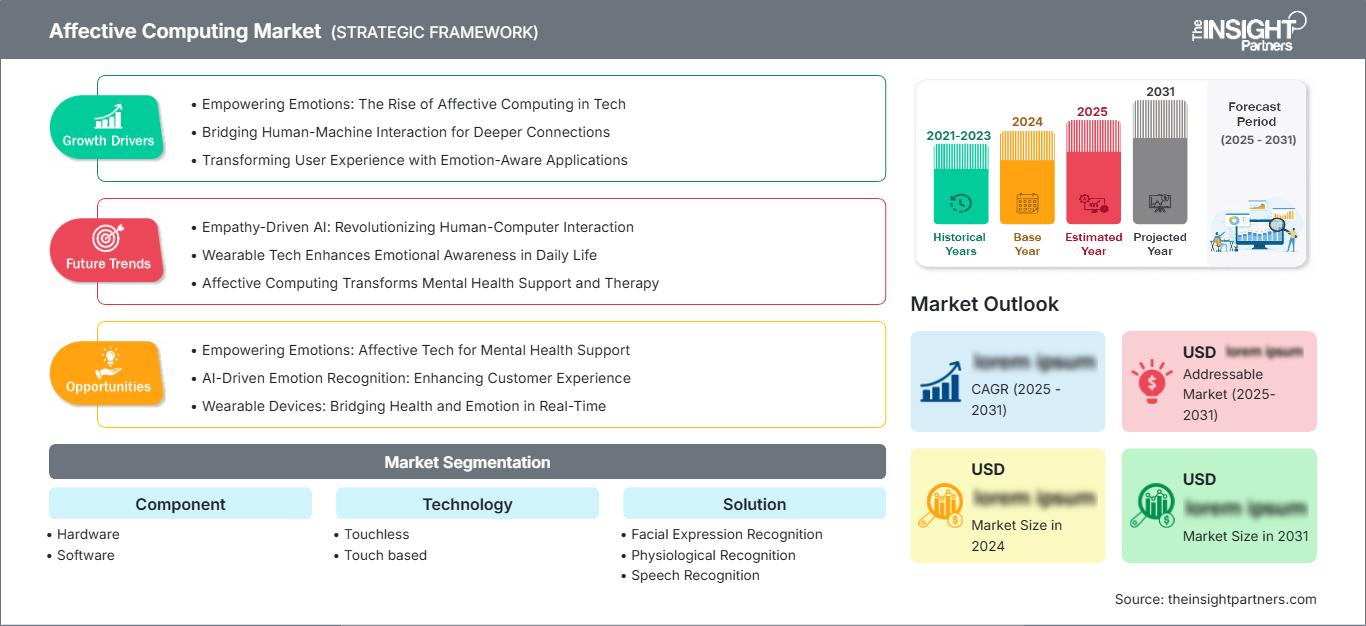
The affective computing market was valued at US$17.14 billion in 2025 and is projected to reach US$55.51 billion by 2034, expanding at a CAGR of 13.95% during 2026 to 2034. The market is gaining from the integration of technologies such as artificial intelligence, computer vision, multimodal analysis, and edge computing that allow machines to perceive, analyze, and react to human emotions. As these are being deployed more widely in healthcare diagnostics, customer experience management, automotive safety, and intelligent advertising solutions, the adoption is gaining momentum.
In North America, enterprise investments in emotional analytics solutions, conversational AI, and human-machine interface solutions are fostering a positive business environment. The affective computing market size in the region is supported by robust AI spending, advanced digital infrastructure, and strong participation from technology vendors. Market expansion is expected to remain within a CAGR range of 12.5–14.5% through 2034, driven by healthcare digitization and increasing adoption of behavioral intelligence tools across retail and financial services.
Affective Computing Market Assessment and Insights
- North America: Strong deployment of AI-powered customer engagement platforms and healthcare analytics supports leadership. Share in 2025: 36–40% and expected CAGR between 12.5–14.5% during 2026–2034.
- US: Advanced AI ecosystem, significant enterprise investments, and concentration of leading technology providers sustain dominance. Share of regional market in 2025: 80–85% and CAGR between 12.8–14.8% during 2026–2034.
- Europe: Adoption is supported by responsible AI initiatives and Industry 4.0 programs in Germany, the UK, and France. Share in 2025: 24–28% and CAGR between 12.0–14.0% during 2026–2034.
- Asia Pacific: Expanding digital transformation activities in China, Japan, South Korea, and India accelerate uptake. Share in 2025: 25–29% and CAGR between 15.0–17.0% during 2026–2034.
- Largest Segment: Software remains the leading segment, supported by scalable analytics platforms and AI model deployment. Market share in 2025: 56–60% and CAGR between 13.0–15.0% during 2026–2034.
- High Growth Segment: Facial Expression Recognition demonstrates rapid adoption across advertising, automotive, and healthcare environments. Market share in 2025: 29–33% and CAGR between 15.5–17.5% during 2026–2034.
- Key companies analyzed in detail: Affectiva, Inc.; Apple Inc.; Beyond Verbal Communication Ltd.; Eyeris Technologies, Inc.; GestureTek, Inc.; Google LLC; International Business Machines Corporation; Intel Corporation; Microsoft Corporation; Qualcomm Incorporated.
Source: The Insight Partners' analysis based on proprietary research, government publications, company annual reports, investor presentations, industry databases, and expert interviews.
There have been developments in machine perception technologies from the point of simple sentiment classification to multimodal intelligence systems that can process facial expressions, speech, hand motions, and body physiology at the same time. Neural network development, natural language processing capabilities, advances in edge artificial intelligence processors, and cloud architectures are boosting recognition efficiency and reducing implementation costs. The adoption scope of such technologies has expanded from scientific labs to commercial applications where companies strive for tangible benefits in customer experience, employee productivity, and human-centric automation.
In terms of the future, the market growth will be seen to move towards those emerging countries which are focusing on building up their artificial intelligence infrastructure and public services based on data. The regulatory focus on AI deployment, explainability, privacy protection, and ethical algorithms has become a strong driving factor for adoption in businesses. Venture investments, digitalization efforts by the public sector, and partnerships between software vendors, semiconductor companies, and cloud firms will support commercialization opportunities.
Affective Computing Market Report Scope
| Report Attribute | Details |
|---|---|
| Market size in 2025 | US$ 17.14 Billion |
| Market Size by 2034 | US$ 55.51 Billion |
| Global CAGR (2026 - 2034) | 13.95% |
| Historical Data | 2021-2024 |
| Forecast period | 2026-2034 |
Affective Computing Market Analysis
Growing demand for emotionally intelligent systems continues to support affective computing market growth across business and consumer applications. The application of emotion recognition technology has been steadily rising in companies for purposes such as understanding customers' behavior, improving the efficiency of marketing campaigns, better patient monitoring, and overall employee experience in the workplace. With improvements in machine learning algorithms, the ability to accurately detect emotions through facial expressions, voice tone, and physiological changes has grown rapidly, allowing for faster integration into businesses.
This ecosystem consists of semiconductor suppliers, sensor makers, algorithm designers, software platform companies, cloud computing providers, and domain-specific integrators. The hardware advances in the area of cameras, wearable technology, microphones, and biometric sensors are key enablers for collecting data accurately, whereas software helps turn the collected signals into usable insights. Availability of more edge computing capabilities is leading to higher efficiency and real-time decision making in automotive safety systems, health care, and retail applications.
An affective computing market analysis indicates that there is an intermediate consolidation in the competitive landscape, which is marked by technological innovations and developments of intellectual property. The key players have been continuously consolidating their presence in the market by undertaking various mergers and acquisitions, cloud partnerships, industry collaborations, and developing AI models.
Organizations like Microsoft Corporation, Google LLC, International Business Machines Corporation, Intel Corporation, Apple Inc., and Qualcomm Incorporated use large AI ecosystems to grow their emotional intelligence capabilities. Organizations that specialize in offering unique solutions for various fields include Affectiva, Inc., Eyeris Technologies, Inc., Beyond Verbal Communication Ltd., and GestureTek, Inc. The venture investment market as well as efforts towards digitizing enterprises attracts funding in technologies used in the interaction between humans and machines.
● REPORT CUSTOMIZATION
Tailor This Report To Align With Your Specific Business Requirements
This report can be customized to align precisely with your business objectives, scope, and target markets. Customization options include tailored segmentation, geography, competitive analysis, and strategic insights to support informed decision-making.
Customize This Report →WHAT YOU CAN ADJUST
- ● Segmentations
- ● Geography
- ● Competitive Analysis
- ● Language Preferences
Affective Computing Market: Strategic Insights
Regional Insights
North America affective computing market
North America accounted for approximately 36–40% of the affective computing market share in 2025, making it the largest regional marketplace. Growing artificial intelligence usage, abundant cloud computing infrastructure, and premature deployment of emotion recognition technology will help to maintain the region’s leading position. Demand from companies in the healthcare, retail, financial, and automotive sectors is especially high. Emotional analytics is being embedded in customer experience software, digital assistants, and workforce management tools by organizations.
The region is expected to record a CAGR of 12.5–14.5% during 2026–2034. The growth is driven by substantial spending on research and development, venture capitalism and the availability of key technology leaders. The increasing use of people-oriented artificial intelligence solutions in telemedicine platforms, smart contact centers and connectivity mobility solutions has boosted demand. The regulatory debates are moving towards the need for responsible development of AI, resulting in the investment in explainable emotion recognition systems.
U.S. affective computing market
The United States represented approximately 80–85% of the North American market in 2025, supported by a highly developed AI ecosystem and strong enterprise technology spending. The presence of innovative companies such as Microsoft Corporation, Intel Corporation, Google LLC, Apple Inc., Qualcomm Incorporated, and International Business Machines Corporation ensures constant product innovation and commercialization. Some of the major organizations that have adopted the technology of emotion-aware analytics include healthcare providers, financial organizations, and retailers.
The U.S. market is anticipated to grow at a CAGR of 12.8–14.8% during 2026–2034. The rise in the usage of conversation AI, behavioral intelligence software, biometrics authentication systems, and health monitoring digital devices is driving market growth. There is a rise in demand due to an increase in the need for adaptive interfaces that react based on the individual’s emotions. The continued developments in AI chips, edge computing, and enterprise automation provide a solid base for adoption.
Europe affective computing market
Europe captured approximately 24–28% of the global Affective computing market in 2025 and is projected to expand at a CAGR of 12.0–14.0% through 2034. The region gains from having policies in place to ensure trust in artificial intelligence and digital innovation. The lead national market is Germany, which is facilitated through automation of the automobile industry, use of artificial intelligence in industries, and superior engineering skills. Emotional intelligence technologies are being integrated in mobility, workplace, and customer interaction systems.
The United Kingdom continues to demonstrate substantial adoption across media analytics, digital advertising, and healthcare technology applications. France is benefiting from growing AI investments and digital transformation efforts across public and private sectors. Italy and Spain are witnessing expanding deployment of customer intelligence solutions, particularly in retail and financial services. Collectively, these countries are supporting broader European commercialization, while growing regulatory clarity regarding AI governance is improving confidence among enterprise users and technology providers alike.
APAC affective computing market
Asia Pacific represented approximately 25–29% of the global market in 2025 and is forecast to record the fastest regional expansion at a CAGR of 15.0–17.0% during 2026–2034. China's dominance in regional demand stems from extensive investments in artificial intelligence. Meanwhile, Japan and South Korea are advancing the development of emotion-based technologies in vehicles, robotics, and consumer electronics.
India is becoming an important growth hub owing to its fast-paced digitalization and enterprise use of AI technologies. There are signs of growing behavioral analysis applications in the health care and retail industry in Australia. Cloud adoption, AI initiatives by the government, and consumers’ digital engagement remain important factors for regional development in the future.
Middle East & Africa affective computing market
The Middle East & Africa Affective computing market is gaining traction as governments accelerate investments in digital infrastructure, intelligent public services, and AI-enabled economic diversification programs. Saudi Arabia and the UAE remain the leading adopters, supported by smart city projects, healthcare digitization initiatives, and growing investments in advanced analytics technologies.
The region is expected to expand at a CAGR of 11.0–13.0% during 2026–2034. South Africa continues to support adoption across financial services and customer experience management applications. Expanding technology ecosystems, infrastructure modernization programs, and increasing enterprise awareness of behavioral intelligence solutions are expected to strengthen regional demand over the forecast period.
Segmentation Analysis
Component
The Component segment remains fundamental to market development and is projected to expand at a CAGR of 13.0–15.0% during 2026–2034. The affective computing market scope continues to broaden as organizations deploy integrated hardware and software infrastructures to support emotion recognition applications. Increasing demand for scalable AI platforms, advanced sensors, cloud-based analytics, and edge processing capabilities is encouraging investments across both component categories.
- Hardware – Cameras, sensors, microphones, wearables, and specialized processors support data capture and real-time emotional analysis. Growing deployment across automotive safety systems, healthcare monitoring, and intelligent consumer devices reinforces strategic importance.
- Software – The largest sub-segment, driven by machine learning algorithms, analytics platforms, and emotion recognition engines. Enterprises increasingly adopt software-centric solutions to improve scalability, operational flexibility, and deployment efficiency across industries.
Technology
The Technology segment is anticipated to register a CAGR of 13.5–15.5% during 2026–2034. Advancements in sensor accuracy, machine learning capabilities, and user interaction models continue to influence adoption. Demand is shifting toward frictionless user experiences, encouraging investment in technologies capable of recognizing emotions without requiring direct physical interaction.
- Touchless – Adoption is increasing due to hygiene considerations, seamless user experiences, and integration into public environments. Facial analytics, gesture recognition, and voice-based interfaces support diverse commercial and institutional use cases.
- Touch based – Continues to maintain relevance in controlled environments where physiological data, biometric feedback, and device-based interactions provide enhanced accuracy and contextual understanding for emotion analysis.
Solution
The Solution segment is expected to grow at a CAGR of 14.0–16.0% during 2026–2034. Expanding enterprise requirements for human-centric analytics and contextual intelligence are encouraging broader deployment of specialized emotion recognition solutions. Organizations increasingly combine multiple modalities to improve interpretation accuracy and deliver actionable insights.
- Facial Expression Recognition – Maintains a leading position through extensive usage in advertising effectiveness measurement, driver monitoring systems, user experience optimization, and healthcare applications requiring behavioral observation.
- Physiological Recognition – Utilizes biometric signals such as heart rate, skin conductance, and neural activity to support objective emotional assessment across healthcare, wellness, and research settings.
- Speech Recognition – Growing adoption reflects increasing use of conversational AI and contact center analytics. Vocal tone, cadence, and speech patterns provide valuable indicators of customer sentiment and user engagement.
- Gesture Recognition – Supports human-machine interaction by interpreting physical movements and body language. Applications span gaming, automotive interfaces, workplace safety, and immersive digital experiences.
End User
The End User segment is forecast to expand at a CAGR of 13.5–15.5% during 2026–2034. Industry-specific implementations continue increasing as enterprises seek measurable improvements in engagement, decision-making, service quality, and operational efficiency. Healthcare, retail, and financial services emerge among the most commercially active deployment environments.
- Research – Academic institutions and commercial research organizations utilize emotion analytics to evaluate human behavior, cognitive response patterns, and product effectiveness across diverse investigative settings.
- Media and Advertising – Increasingly employs emotional intelligence tools to optimize campaign performance, audience engagement measurement, content testing, and consumer response evaluation before large-scale deployment.
- Healthcare – Applications include mental health assessment, remote patient monitoring, therapeutic support systems, and behavioral analysis that assist providers in improving patient outcomes and treatment quality.
- Automotive – Driver monitoring and cabin sensing technologies improve safety, reduce distraction-related risks, and enhance personalized mobility experiences through real-time emotional awareness.
- Retail – Businesses leverage behavioral insights to customize customer journeys, optimize store experiences, and improve merchandising effectiveness through emotion-informed decision-making.
- BFSI – Financial institutions integrate behavioral intelligence into customer service operations, fraud detection environments, digital banking platforms, and personalized engagement initiatives.
Opportunity Snapshot
| End User | Revenue Contribution | Trend Tag | Adoption Stage |
|---|---|---|---|
| Research | Medium | Behavioral Science | Mature |
| Media and Advertising | High | Ad Analytics | Mature |
| Healthcare | High | Digital Therapy | Scaling |
| Automotive | High | Driver Monitoring | Scaling |
| Retail | Medium | Shopper Insights | Scaling |
| BFSI | Medium | Emotion Banking | Emerging |
Affective Computing Market Growth Drivers and Impact Analysis
Expansion of Human-Centric Artificial Intelligence Platforms
Organizations are increasingly prioritizing human-centric artificial intelligence systems capable of understanding emotional context alongside traditional data inputs. The shift reflects growing demand for personalized services, adaptive digital experiences, and improved customer engagement outcomes. Emotion-aware platforms enable businesses to analyze sentiment, stress levels, engagement patterns, and behavioral responses in real time. In healthcare, this capability supports patient monitoring and mental wellness assessments. Retailers use emotional analytics to optimize customer experiences, while financial institutions apply behavioral insights to improve service interactions. As enterprises continue investing in AI-driven transformation programs, affective technologies are becoming a critical differentiator that enhances decision-making, strengthens user trust, and improves operational effectiveness. Continued algorithm improvements and broader cloud infrastructure availability will further support adoption across commercial environments.
Growing Integration of Emotion Recognition in Healthcare Systems
Healthcare providers increasingly deploy emotion recognition technologies to support patient engagement, clinical assessment, and remote care delivery. Rising mental health awareness, growing telehealth adoption, and an increasing focus on personalized medicine are creating favorable Affective computing market conditions. Emotion-sensitive systems assist clinicians by identifying behavioral indicators that may otherwise remain unnoticed during virtual consultations or ongoing monitoring programs. Healthcare organizations are also exploring the use of conversational AI and speech analytics to evaluate patient well-being and treatment adherence. As healthcare systems seek to improve efficiency while maintaining quality outcomes, emotion-aware technologies are expected to become an important component of digital care ecosystems. Regulatory acceptance of AI-assisted healthcare tools is further encouraging investment and product development activity.
Rising Adoption of Intelligent Automotive Safety Technologies
Automotive manufacturers are integrating advanced driver monitoring capabilities that evaluate emotional and cognitive conditions to improve road safety. Increasing regulatory attention on driver distraction, fatigue detection, and occupant safety is accelerating technology deployment. Cameras, biometric sensors, and machine learning systems can identify stress, drowsiness, inattentiveness, and behavioral abnormalities in real time. These capabilities support accident prevention efforts and enhance overall vehicle intelligence. As connected and autonomous vehicle technologies continue evolving, emotion recognition systems are expected to play a larger role in human-machine interaction and adaptive cabin environments. Investments by automotive OEMs and mobility technology providers continue to strengthen commercialization opportunities while expanding the practical value of emotional intelligence platforms across transportation ecosystems.
Affective Computing Market Future Trends
Multimodal Emotion Intelligence Becoming the Standard
Future Affective computing market trends are expected to shift from single-input emotion detection toward multimodal intelligence platforms that simultaneously interpret facial expressions, speech characteristics, physiological responses, and behavioral cues. This evolution will significantly improve accuracy and contextual understanding across enterprise environments. Organizations are increasingly recognizing the limitations of relying on a single emotional indicator, particularly in complex consumer and healthcare scenarios. Advanced multimodal systems will enable more reliable emotional context recognition while reducing false interpretations. As computational performance improves and edge AI becomes more accessible, businesses are expected to deploy comprehensive emotional intelligence frameworks that support adaptive customer experiences, smarter employee engagement tools, more responsive healthcare applications, and next-generation human-machine interaction models across multiple industries and geographic markets.
Expansion of Emotion-Aware Digital Assistants
Digital assistants and conversational interfaces are expected to evolve beyond language processing into emotionally responsive systems capable of adapting interactions according to user sentiment. Enterprises are increasingly investing in AI platforms that improve engagement through contextual communication. Future assistants will adjust recommendations, communication styles, escalation pathways, and support mechanisms based on detected emotional conditions. Healthcare providers, financial institutions, retailers, and educational organizations are expected to become early adopters of these capabilities. The adoption of emotion-aware assistants will also benefit from advances in generative AI, natural language understanding, and voice analytics technologies. As human-machine communication becomes increasingly sophisticated, emotionally adaptive interfaces are likely to emerge as a critical differentiator in customer service, digital health, and enterprise productivity environments.
Affective Computing Market Opportunities
Commercialization in Digital Healthcare and Mental Wellness Platforms
Healthcare represents one of the most attractive growth avenues for technology developers and investors. The increasing burden of mental health conditions, rising adoption of telemedicine services, and expansion of remote patient monitoring programs are creating favorable conditions for emotion recognition solutions. Providers are seeking technologies capable of identifying behavioral changes, emotional distress, treatment adherence concerns, and patient engagement patterns. These capabilities can improve clinical decision-making while supporting proactive interventions. As healthcare systems increasingly prioritize preventive care and personalized treatment pathways, emotional analytics technologies are expected to attract substantial investments. affective computing market Forecasts indicate that healthcare-focused solutions will remain among the most commercially attractive deployment areas, supported by expanding digital health ecosystems and rising demand for patient-centered technologies.
Emerging Demand Across Financial Services and Customer Experience Platforms
Financial institutions are increasingly exploring emotion-aware technologies to improve digital engagement, customer retention, fraud prevention, and service personalization. Enhanced understanding of customer sentiment can support better communication strategies while improving customer satisfaction outcomes. Banks, insurance providers, and wealth management firms are investing in artificial intelligence tools that provide deeper behavioral insights across digital channels. Simultaneously, customer experience platforms are incorporating emotional analytics to optimize interactions throughout the consumer journey. Vendors capable of delivering secure, explainable, and privacy-compliant solutions are expected to benefit from expanding enterprise demand. Increasing emphasis on personalized service delivery and digital relationship management creates attractive opportunities for software providers, platform developers, and analytics vendors operating within this evolving ecosystem.
Frequently Asked Questions

- Comprehensive Market Sizing and Forecast Analysis
- Detailed Segmentation Analysis
- In-Depth Market Dynamics Assessment
- Regional and Country-Level Insights
- Competitive Landscape and Company Benchmarking
- Strategic Business Intelligence
Recent Reports
Testimonials

The Insight Partners' SCADA System Market report is comprehensive, with valuable insights on current trends and future forecasts. The team was highly professional, responsive, and supportive throughout. We are very satisfied and highly recommend their services.
RAN KEDEM Partner, Reali Technologies LTDs
I requested a report on a very specific software market and the team produced the report in a few days. The information was very relevant and well presented. I then requested some changes and additions to the report. The team was again very responsive and I got the final report in less than a week.
JEAN-HERVE JENN Chairman, Future Analytica
We worked with The Insight Partners for an important market study and forecast. They gave us clear insights into opportunities and risks, which helped shape our plans. Their research was easy to use and based on solid data. It helped us make smart, confident decisions. We highly recommend them.
PIYUSH NAGPAL Sr. Vice President, High Beam Global
The Insight Partners delivered insightful, well-structured market research with strong domain expertise. Their team was professional and responsive throughout. The user-friendly website made accessing industry reports seamless. We highly recommend them for reliable, high-quality research services
YUKIHIKO ADACHI CEO, Deep Blue, LLC.
This is the first time I have purchased a market report from The Insight Partners.While I was unsure at first, I visited their web site and felt more comfortable to take the risk and purchase a market report.I am completely satisfied with the quality of the report and customer service. I had several questions and comments with the initial report, but after a couple of dialogs over email with their analyst I believe I have a report that I can use as input to our strategic planning process.Thank you so much for taking the extra time and making this a positive experience.I will definitely recommend your service to others and you will be my first call when we need further market data.
JOHN SUZUKI President and Chief Executive Officer, Board Director, BK Technologies
I wish to appreciate your support and the professionalism you displayed in the course of attending to my request for information regarding to infectious disease IVD market in Nigeria. I appreciate your patience, your guidance, and the fact that you were willing to offer a discount, which eventually made it possible for us to close a deal. I look forward to engaging The Insight Partners in the future, all thanks to the impression you have created in me as a result of this first encounter.
DR CHIJIOKE ONYIA MANAGING DIRECTOR, PineCrest Healthcare Ltd.Reason to Buy
- Informed Decision-Making
- Understanding Market Dynamics
- Competitive Analysis
- Identifying Emerging Markets
- Customer Insights
- Market Forecasts
- Risk Mitigation
- Boosting Operational Efficiency
- Strategic Planning
- Investment Justification
- Tracking Industry Innovations
- Aligning with Regulatory Trends





 Get Free Sample for