
AI Assistant Software Market Size, Share & Opportunities by 2031
AI Assistant Software Market Size and Forecast (2021 - 2031), Global and Regional Share, Trend, and Growth Opportunity Analysis Report Report Coverage : by Product Type (Virtual Assistants, Chatbots, Voice Assistants, and Conversational AI platforms), Deployment Mode (Cloud-based, On-premises), End‑User (SMEs and Large Enterprises), Industry (Healthcare, Finance, Retail, Education, Telecommunications, Manufacturing, and Others) and Geography
- Status : Data Released
- Report Code : TIPRE00042031
- Category : Technology, Media and Telecommunications
- No. of Pages : 150
- Available Report Formats :


- Last update date : December 01, 2025


2024 Market Size
US$ 8.7 Bn
Base year value
2031 Forecast
US$ 27.5 Bn
Projected by 2031
CAGR 2025-2031
17.9 %
Growth rate
Addressable Market
US$ 124.15 Bn
(2025-2031)
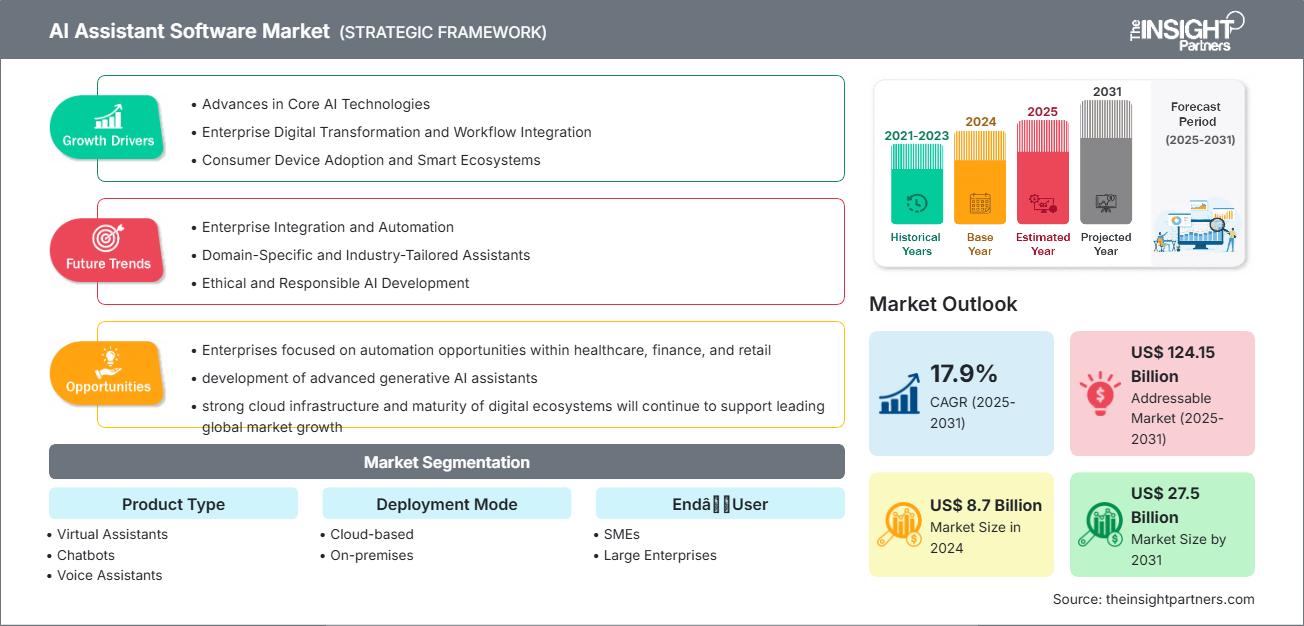
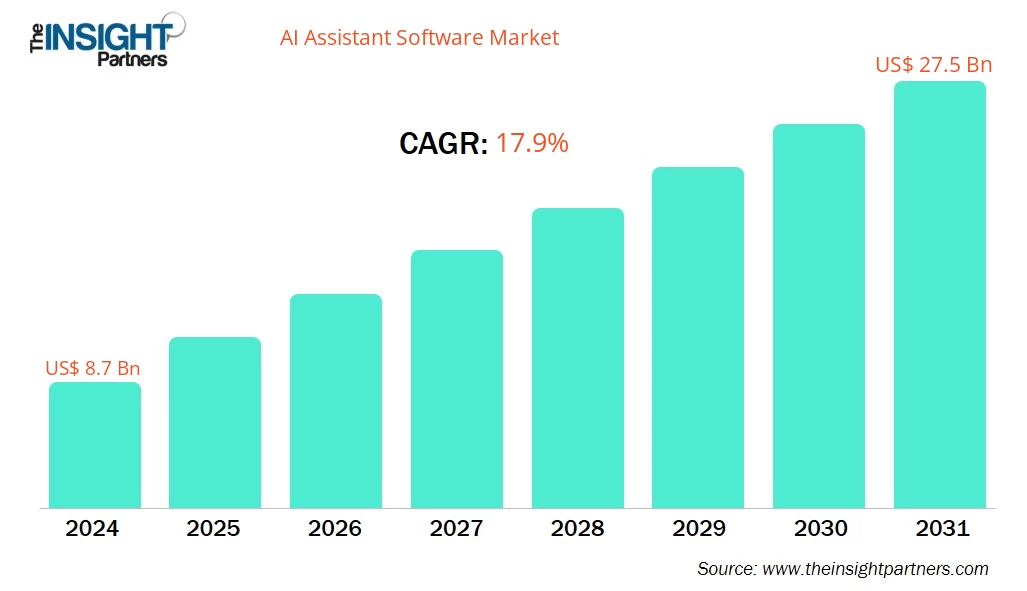
The AI assistant software market size is expected to reach US$ 27.5 billion by 2031 from US$ 8.7 billion in 2024. The market is anticipated to register a CAGR of 17.9% during 2025–2031.
AI Assistant Software Market Analysis
In the AI assistant software market, solutions are shifting toward multifunctional capabilities. Assistants are now integrated into a single platform and incorporate natural language interaction, reasoning, and task automation. The unified, multi-modal capabilities will enable the user to conduct all activities in an end-to-end capacity, including querying, planning, and execution of work, without switching tools. This unified platform can lead to improvement in efficiency across personal, enterprise, and industrial use cases. Market participants are now gravitating towards these unified systems to accommodate the increased volume of requests for intelligent, action-oriented assistants. Organizations are now developing integrated AI assistant platforms.
AI Assistant Software Market Overview
Artificial Intelligence (AI) applications are transitioning from rules-based applications to large language model-based applications. The next generation of AI assistants will facilitate the management of complex and open-ended business interactions, with increased accuracy and flexibility. Developing capabilities such as drafting emails, summarizing text, and completing multi-step queries. Businesses are embedding generative AI into enterprise applications to enable increased automation of complex work at scale. Generative AI enables AI assistants to understand natural language, create appropriate responses aligned to the context, and facilitate quick decisions. The next generation of AI assistants will use large language models, which have been designed on very broad datasets and then refined to meet the needs of organizations.
Market Assessment and Insights
- Global market for AI Assistant Software was valued at US$ 8.70 Billion in 2024
- Annual market size is expected to reach US$ 27.50 Billion by 2031
- Total addressable market (TAM) during 2025-2031 is projected to reach approximately US$ 124.15 Billion
- Market is anticipated to register a CAGR of 17.9% during the forecast period
- The United States represents a key market, supported by Advances in Core AI Technologies, Enterprise Digital Transformation and Workflow Integration, Consumer Device Adoption and Smart Ecosystems, as well as evolving industry dynamics
- Market analysis covers North America, Europe, Asia-Pacific, South and Central America, Middle East and Africa, with growth evaluated across the forecast period
- Market opportunities such as Enterprises focused on automation opportunities within healthcare, finance, and retail, development of advanced generative AI assistants, strong cloud infrastructure and maturity of digital ecosystems will continue to support leading global market growth are expected to influence market dynamics and addressable market
- Report profiles industry participants, including Google LLC- United States, Amazon Web Services (AWS)- United States, Microsoft- United States, Apple Inc.- United States, IBM Corporation- United States, Salesforce, Inc.- United States, Oracle Corporation- United States, SAP SE- Germany, Meta Platforms, Inc.- China, Aspire.io- United States, while analyzing competitive strategies and innovation developments
-
Source: The Insight Partners' analysis based on proprietary research, government publications, company annual reports, investor presentations, industry databases, and expert interviews.
● REPORT CUSTOMIZATION
Tailor This Report To Align With Your Specific Business Requirements
This report can be customized to align precisely with your business objectives, scope, and target markets. Customization options include tailored segmentation, geography, competitive analysis, and strategic insights to support informed decision-making.
Customize This Report →WHAT YOU CAN ADJUST
- ● Segmentations
- ● Geography
- ● Competitive Analysis
- ● Language Preferences
AI Assistant Software Market: Strategic Insights
-
Get Top Key Market Trends of this report.This FREE sample will include data analysis, ranging from market trends to estimates and forecasts.
AI Assistant Software Market Drivers and Opportunities
Market Drivers:
- Advances in Core AI Technologies: The speed of progress in natural language processing (NLP), machine learning and generative AI is making AI assistants (also known as chatbots) more intelligent and conversational. Advances in context, multilingual support, and response time are also enhancing their performance. Hybrid cloud-edge deployments and large language models (LLMs) are improving speed, reliability, and ease of use and further legitimizing AI assistants for enterprise and consumer applications.
- Enterprise Digital Transformation and Workflow Integration: Companies are embedding AI assistants into ERPs, CRMs, and internal applications to automate workflows, minimize manual work, and automate customer or employee support. AI assistants improve productivity, answer questions more quickly, and provide cost benefits. With digital transformation being a preeminent priority for organizations, AI assistants are proving to be indispensable tools for operational efficiency and effectiveness, particularly in the domains of sales, HR, finance, and IT service management.
- Consumer Device Adoption and Smart Ecosystems: The popularity of smartphones, smart speakers, and IoT-enabled devices in personal life has added to the increasing use and reliance on AI assistants. Primarily, users are utilizing personal devices in the aspects of voice search, home automation, calendaring, and shopping. As capabilities available with smart systems increase, assistants will become a centralized volume of voice interaction with the user, creating end-to-end experiences between devices and platforms again with a natural and conversational interface.
Market Opportunities:
- Enterprise Integration and Automation: One major opportunity is to further embed the capability of AI assistants in enterprise ecosystems such as Customer Relationship Management (CRM), Enterprise Resource Planning (ERP), and IT Service Management (ITSM) systems. Organizations are actively using AI assistants to streamline workflows, improve decision-making, and manage customer interactions across channels.
- Domain-Specific and Industry-Tailored Assistants: One of the main opportunities for growth stems from utilizing AI assistants built for specific use cases in a given domain. For example, Large Language Models (LLMs) specifically trained for use in specific industries, such as healthcare, financial services, and manufacturing, will provide the higher-level contextual understanding and compliance required. This development will lead to greater adoption across verticals that require greater levels of compliance, accuracy, and data privacy.
- Ethical and Responsible AI Development: Government agencies and other organizations are increasingly urging governments to regulate ethical AI. In connection to this increasing trend, trust-based innovation emerges as a marketplace possibility. This may involve transparency, watermarking, deepfake detection, or risk assessment tools that enable a new category of "safe and trusted" AI assistant solutions, which foster compliance and performance.
AI Assistant Software Market Report Segmentation Analysis
The AI assistant software market share is analyzed across various segments to provide a clearer understanding of its structure, growth potential, and emerging trends. Below is the standard segmentation approach used in most industry reports:
By Component:
- Software: Software in the AI assistant market provides natural language processing, automating tasks, personalized interactions, data analysis, and seamlessly connecting across platforms.
- Services: Services in the AI assistant market provide customization, support, training, cloud hosting, integration, maintenance, and continuous improvement for optimal user experience.
By Functionality:
- Intelligent Virtual Assistants (IVAs): Intelligent virtual assistants in the AI market can manage tasks, help with customer support, assist with real-time responses, and improve user engagement easily.
- Chatbots: Chatbots in the AI assistant market handle customer queries, automate support, provide 24/7 service, gather data, and enhance user interaction.
- Generative AI Assistants: Generative AI assistants create content, generate responses, assist creativity, automate writing, and provide personalized, context-aware support in the AI assistant market.
- Task‑specific Assistants: Task-specific assistants in the AI market automate specialized functions, improve efficiency, reduce errors, and deliver targeted support for distinct user needs.
- General‑purpose Assistants: General-purpose assistants in the AI market manage diverse tasks, facilitate communication, provide information, and enhance productivity across various industries and users.
By Organization Size:
- Customer Service & Support:
- IT Service Management (ITSM):
- Sales & Marketing:
- Human Resources (HR) & Talent Management:
- Personal Assistance:
- Others:
By Geography:
- North America
- Europe
- Asia-Pacific
- South & Central America
- Middle East & Africa
AI Assistant Software Market Report Scope
| Report Attribute | Details |
|---|---|
| Market size in 2024 | US$ 8.7 Billion |
| Market Size by 2031 | US$ 27.5 Billion |
| Global CAGR (2025 - 2031) | 17.9% |
| Historical Data | 2021-2023 |
| Forecast period | 2025-2031 |
| Segments Covered |
By Product Type
|
| Regions and Countries Covered |
North America
|
| Market leaders and key company profiles |
|
AI Assistant Software Market Players Density: Understanding Its Impact on Business Dynamics
The AI Assistant Software Market is growing rapidly, driven by increasing end-user demand due to factors such as evolving consumer preferences, technological advancements, and greater awareness of the product's benefits. As demand rises, businesses are expanding their offerings, innovating to meet consumer needs, and capitalizing on emerging trends, which further fuels market growth.
AI Assistant Software Market Share Analysis by Geography
North America dominated the AI assistant software market with a share in 2024. This is attributable to widespread enterprise adoption, strong tech infrastructure, and significant investment in AI research across the region. Emerging markets in South & Central America, the Middle East, and Africa also have many untapped opportunities for AI in social media providers to expand.
The AI assistant software market shows a different growth trajectory in each region due to factors such as technology adoption and high investment in AI infrastructure. Below is a summary of market share and trends by region:
1. North America
- Market Share: The North America AI assistant software market held the largest share.
- Key Drivers: Early adopters of technology, significant financial investment in AI infrastructure, home of major AI firms (Amazon, Microsoft, Google), substantial R&D, and supportive government regulation.
- Trends: Enterprises focused on automation opportunities within healthcare, finance, and retail; development of advanced generative AI assistants; strong cloud infrastructure and maturity of digital ecosystems will continue to support leading global market growth.
2. Europe
- Market Share: Europe is witnessing steady growth in AI assistant adoption across the public and private sectors.
- Key Drivers: Emphasis on ethical AI development, stringent data privacy regulations (GDPR), and government initiatives promoting digital transformation.
- Trends: Increased integration of AI assistants in customer support, IT operations, compliance, and healthcare; focus on responsible AI deployment; rise of multilingual and personalized AI solutions.
3. Asia Pacific
- Market Share: Asia Pacific is emerging as the fastest-growing region in the AI assistant software market.
- Key Drivers: Accelerated digital transformation, mobile penetration, localized AI assistants with multilingual function, strong government AI initiatives in China, India, and South Korea, and investment in AI infrastructure.
- Trends: Growth driven by regional customization, growing digital economies, and government-driven focus on AI ecosystem development..
4. South and Central America
- Market Share: Smaller but steadily growing markets.
- Key Drivers: Growing adoption of digital technologies, rising health consciousness, and increasing demand for personalized AI solutions tailored to cultural and demographic preferences are key drivers.
- Trends: Expansion driven by the growing tech-savvy population, increasing internet penetration, and development of tailored AI assistants for local languages and cultures.
5. Middle East and Africa
- Market Share: Smaller but steadily growing market supported by increasing smart device penetration and digital transformation initiatives.
- Key Drivers: Increasing government investment in digital infrastructure and smart city projects, rising demand for automated customer engagement tools, and greater mobile-first user adoption.
- Trends: Focus on cost-efficient and scalable AI solutions customized for regional contexts; growth is fostered by expanding internet infrastructure and rising digital literacy, but constrained by infrastructural and regulatory challenges.
AI Assistant Software Market Players Density: Understanding Its Impact on Business Dynamics
The AI assistant software market is witnessing intensified competition due to the presence of major global technology providers, alongside emerging niche players and specialized startups. Companies are actively innovating to strengthen their market position and meet the growing demand for intelligent decision-making platforms across industries.
The competitive landscape is driving vendors to differentiate through:
- Vendors set themselves apart using assistants that comprehend context, can navigate multi-turn conversations, and can provide complex responses based on generative AI.
- Leading vendors offer deep integration into enterprise platforms (CRM, ERP) to facilitate automated and effortless user adoption in user workflows.
- Vendors that customize the assistants to local languages and industry standards give vendors differentiation in regulated and regional markets.
Opportunities and Strategic Moves
- Enterprise AI integration automates workflows, boosts efficiency, and enhances customer service across industries.
- Microsoft enhances Copilot with memory features for personalized, integrated user experiences and reduced external AI reliance.
- Emerging markets like Latin America offer growth through localized AI adoption and talent development.
Major Companies Operating in the AI Assistant Software Market Are:
- Google LLC- United States
- Amazon Web Services (AWS)- United States
- Microsoft- United States
- Apple Inc.- United States
- IBM Corporation- United States
- Salesforce, Inc.- United States
- Oracle Corporation- United States
- SAP SE- Germany
- Meta Platforms, Inc.- China
- Aspire.io- United States
Disclaimer: The companies listed above are not ranked in any particular order.
AI Assistant Software Market News and Recent Developments
- Amazon introduces agentic AI across the seller experience, transforming how sellers manage their businesses.
- Microsoft Corp. unveiled AI innovations, leveraging ambient and generative technologies, to improve the patient journey, reduce the workflow burden across care teams, and enhance the financial integrity of healthcare provider organizations.
- Apple has announced Apple Intelligence, a personal intelligence system for iPhone, iPad, and Mac that combines the power of generative models with personal context to provide intelligence that’s as useful and relevant as it is incredibly powerful. Apple Intelligence is integrated into iOS 18, iPadOS 18, and macOS Sequoia.
- At IBM’s annual event for developers and technologists, the company unveiled new and upcoming product capabilities designed to help enterprises move beyond AI experimentation and unlock productivity gains across development, operations, and business workflows. Drawing thousands of attendees from around the world, TechXchange serves as a launchpad for IBM’s latest advancements in agentic AI, hybrid cloud, quantum computing, and intelligent infrastructure.
AI Assistant Software Market Report Coverage and Deliverables
The "AI Assistant Software Market Size and Forecast (2021–2031)" report provides a detailed analysis of the market covering below areas:
- AI Assistant Software Market size and forecast at global, regional, and country levels for all the key market segments covered under the scope
- AI Assistant Software Market trends, as well as market dynamics such as drivers, restraints, and key opportunities
- Detailed PEST and SWOT analysis
- AI Assistant Software Market analysis covering key market trends, global and regional framework, major players, regulations, and recent market developments
- Industry landscape and competition analysis covering market concentration, heat map analysis, prominent players, and recent developments in the AI Assistant Software Market. Detailed company profiles
Frequently Asked Questions

- Comprehensive Market Sizing and Forecast Analysis
- Detailed Segmentation Analysis
- In-Depth Market Dynamics Assessment
- Regional and Country-Level Insights
- Competitive Landscape and Company Benchmarking
- Strategic Business Intelligence
Recent Reports
Testimonials

The Insight Partners provided valuable market intelligence that supported our global go-to-market strategy. Their team was professional, responsive, and attentive to our feedback, providing thoughtful analysis and helpful methodological clarifications throughout the project.
Junmo Kim Chief Financial Officer (CFO), Enertech Co., Ltd.
The Insight Partners' SCADA System Market report is comprehensive, with valuable insights on current trends and future forecasts. The team was highly professional, responsive, and supportive throughout. We are very satisfied and highly recommend their services.
RAN KEDEM Partner, Reali Technologies LTDs
I requested a report on a very specific software market and the team produced the report in a few days. The information was very relevant and well presented. I then requested some changes and additions to the report. The team was again very responsive and I got the final report in less than a week.
JEAN-HERVE JENN Chairman, Future Analytica
We worked with The Insight Partners for an important market study and forecast. They gave us clear insights into opportunities and risks, which helped shape our plans. Their research was easy to use and based on solid data. It helped us make smart, confident decisions. We highly recommend them.
PIYUSH NAGPAL Sr. Vice President, High Beam Global
The Insight Partners delivered insightful, well-structured market research with strong domain expertise. Their team was professional and responsive throughout. The user-friendly website made accessing industry reports seamless. We highly recommend them for reliable, high-quality research services
YUKIHIKO ADACHI CEO, Deep Blue, LLC.
This is the first time I have purchased a market report from The Insight Partners.While I was unsure at first, I visited their web site and felt more comfortable to take the risk and purchase a market report.I am completely satisfied with the quality of the report and customer service. I had several questions and comments with the initial report, but after a couple of dialogs over email with their analyst I believe I have a report that I can use as input to our strategic planning process.Thank you so much for taking the extra time and making this a positive experience.I will definitely recommend your service to others and you will be my first call when we need further market data.
JOHN SUZUKI President and Chief Executive Officer, Board Director, BK Technologies
I wish to appreciate your support and the professionalism you displayed in the course of attending to my request for information regarding to infectious disease IVD market in Nigeria. I appreciate your patience, your guidance, and the fact that you were willing to offer a discount, which eventually made it possible for us to close a deal. I look forward to engaging The Insight Partners in the future, all thanks to the impression you have created in me as a result of this first encounter.
DR CHIJIOKE ONYIA MANAGING DIRECTOR, PineCrest Healthcare Ltd.Reason to Buy
- Informed Decision-Making
- Understanding Market Dynamics
- Competitive Analysis
- Identifying Emerging Markets
- Customer Insights
- Market Forecasts
- Risk Mitigation
- Boosting Operational Efficiency
- Strategic Planning
- Investment Justification
- Tracking Industry Innovations
- Aligning with Regulatory Trends





 Get Free Sample for