
AI for Drug Discovery Market Analysis, Size, Share, and Forecast by 2034
Coverage: By Drug Type (Small Molecule, Large Molecules); Technology (Deep Learning, Machine Learning); Application (Metabolic Disease, Cardiovascular Disease, Oncology, Neurodegenerative Diseases, Others); End User (Pharmaceutical and Biotechnological Companies, Academic and Research Institutes, Others) , and Geography (North America, Europe, Asia Pacific, and South and Central America)
- Status : Data Released
- Report Code : TIPRE00004177
- Category : Technology, Media and Telecommunications
- No. of Pages : 150
- Available Report Formats :


- Last update date : August 12, 2026


2025 Market Size
US$ 3.70 Bn
Base year value
2034 Forecast
US$ 20.84 Bn
Projected by 2034
CAGR 2026-2034
21.2 %
Growth rate
Addressable Market
US$ 98.22 Bn
(2026-2034)
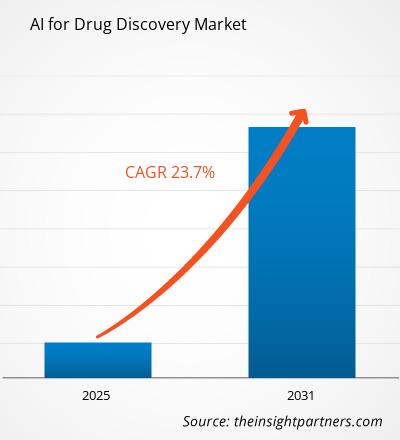
The AI for drug Discovery Market was valued at US$ 3.70 Billion in 2025 and is projected to reach US$ 20.84 Billion by 2034, expanding at a CAGR of 21.2% during 2026–2034. The increasing integration of artificial intelligence across target identification, lead optimization, biomarker discovery, and clinical candidate selection is reshaping pharmaceutical research workflows. Growing computational capabilities, rising biological data availability, and pressure to reduce development timelines continue to strengthen adoption across the global ecosystem.
Across North America, strong investment activity, advanced life sciences infrastructure, and widespread adoption of cloud-based computational platforms support continued market expansion. The AI for drug discovery market size in the region benefits from robust pharmaceutical R&D spending and expanding collaborations between biotechnology firms and AI technology providers. Regional growth is anticipated in the range of 19.5–22.5% CAGR through the forecast period.
AI for Drug Discovery Market Assessment and Insights
- North America: Share in 2025 estimated at 40–44%, supported by established biotechnology clusters, extensive AI deployment, and strong venture funding. CAGR between 2026–2034: 19.5–22.5%.
- US: Accounts for 76–80% of North American revenue in 2025, driven by pharmaceutical innovation and AI infrastructure. CAGR between 2026–2034: 20.0–23.0%.
- Europe: Share in 2025 stands at 26–30%, led by Germany, the UK, and France. CAGR between 2026–2034: 20.0–23.0%.
- Asia Pacific: Share in 2025 ranges between 22–26%, led by China, Japan, India, and South Korea. CAGR between 2026–2034: 23.0–26.0%.
- Largest Segment: Pharmaceutical and Biotechnological Companies hold 68–72% market share in 2025, supported by extensive drug pipelines. CAGR between 2026–2034: 20.5–23.5%.
- High Growth Segment: Deep Learning represents 44–48% market share in 2025 and is expanding at 24.0–27.0% CAGR through 2034.
- Key companies analyzed in detail: IBM Corporation, Exscientia plc, BenevolentAI Group, NVIDIA Corporation, Euretos B.V., BPGbio Inc., Owkin Inc., Cyclica Inc., Merck KGaA, Aurigene Pharmaceutical Services Limited.
Source: The Insight Partners' analysis based on proprietary research, government publications, company annual reports, investor presentations, industry databases, and expert interviews.
The evolution of multimodal AI models, generative chemistry platforms, and biologically oriented machine learning algorithms has transformed drug discovery in many ways. More and more drug developers leverage large-scale genomic data and predictive analytics for discovering new targets and developing new compounds faster than using traditional approaches. The wider deployment of HPC technologies and cloud computing is enhancing research efficiency while increasing candidate selection quality and reducing the risk of attrition.
Further growth is expected to be driven by accelerating investments into precision medicine, international collaboration in research, and regulators' endorsement of AI-powered drug discovery tools. Increasing deployment among pharmaceutical companies in emerging markets, including Asia Pacific and certain countries from the Middle East, is making drug discovery powered by AI more common. With the progress in data interoperability and digital research ecosystems, AI-based workflows will likely become an integral part of pharmaceutical innovation.
AI for Drug Discovery Market Report Scope
| Report Attribute | Details |
|---|---|
| Market size in 2025 | US$ 3.70 Billion |
| Market Size by 2034 | US$ 20.84 Billion |
| Global CAGR (2026 - 2034) | 21.2% |
| Historical Data | 2021-2024 |
| Forecast period | 2026-2034 |
AI for Drug Discovery Market Analysis
The AI for drug discovery market growth is being driven by rising pressure on pharmaceutical organizations to shorten development cycles while improving research productivity. Drug discovery continues to be expensive and time-consuming, usually entailing substantial screening and validation efforts. The use of AI helps scientists to work with complicated biological information sets, target prioritization, prediction of molecular interactions, and finding the best candidates at an early stage of drug discovery. The increasing availability of omics data, EHRs, and real-world evidence helps boost the efficiency of AI models and their adoption in business.
The value chain includes companies that collect data, software developers of AI, cloud technology providers, biotech companies, pharma firms, and research institutions. More cooperation between all these players contributes to the emergence of ecosystems for drug discovery. Advancements in computational power and automation technologies allow working with big data sets and complex models.
The AI for drug discovery market analysis indicates that competitive differentiation increasingly depends on proprietary datasets, model accuracy, and translational capabilities. The leading players continue to improve their standing through collaborations, mergers, and platform expansions. Businesses are aiming at developing comprehensive solutions for target discovery, compound optimization, biomarker discovery, and clinical development support.
IBM Corporation has been employing advanced analytics technologies. On the other hand, NVIDIA Corporation offers computing power for the training of complex models. Exscientia plc, BenevolentAI Group, Owkin Inc., and BPGbio Inc. have concentrated on developing AI-based drug discovery solutions. Merck KGaA and Aurigene Pharmaceutical Services Limited are incorporating the AI solutions into their pharmaceutical research operations.
● REPORT CUSTOMIZATION
Tailor This Report To Align With Your Specific Business Requirements
This report can be customized to align precisely with your business objectives, scope, and target markets. Customization options include tailored segmentation, geography, competitive analysis, and strategic insights to support informed decision-making.
Customize This Report →WHAT YOU CAN ADJUST
- ● Segmentations
- ● Geography
- ● Competitive Analysis
- ● Language Preferences
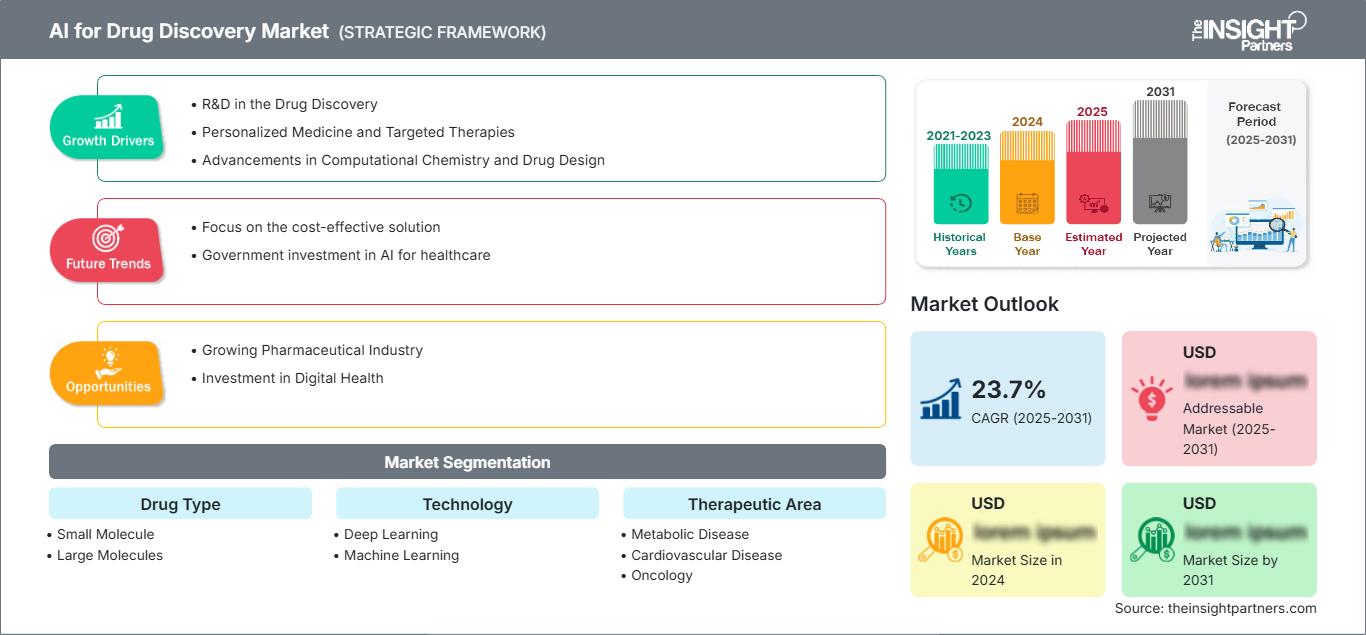
AI for Drug Discovery Market: Strategic Insights
Regional Insights
North America AI for Drug Discovery Market
North America accounted for 40–44% AI for drug discovery market share in 2025 and remains the largest regional contributor. A highly developed pharmaceutical industry, strong venture capital activity, and widespread deployment of AI platforms support regional leadership. Market expansion is expected at a 19.5–22.5% CAGR through 2034. Research institutions and biotechnology firms continue to generate large datasets suitable for machine-learning-driven discovery models.
The region also benefits from advanced cloud infrastructure and significant computational investment. Strategic partnerships among technology vendors, pharmaceutical companies, and academic institutions have accelerated adoption in oncology, metabolic disease, and neurological research. Continued support for precision medicine initiatives is expected to sustain strong commercial momentum.
U.S. AI for drug Discovery Market
The United States represents 76–80% of North American revenue and is projected to grow at a 20.0–23.0% CAGR. The concentration of global pharmaceutical leaders, biotechnology startups, and AI developers creates a favorable innovation environment. Extensive adoption of genomic research platforms and data-driven development methodologies supports ongoing market expansion.
The presence of companies such as IBM Corporation, NVIDIA Corporation, and leading pharmaceutical innovators contributes to rapid commercialization. Applications increasingly extend from target identification to molecule generation and clinical trial design. Growing use of foundation models and generative AI technologies further strengthens the country's position within the regional ecosystem.
Europe AI for drug Discovery Market
Europe accounted for 26–30% market share in 2025 and is forecast to expand at a 20.0–23.0% CAGR. Germany remains the leading regional market due to strong pharmaceutical manufacturing capacity and active digital health investments. The United Kingdom benefits from a mature biotech ecosystem and prominent AI-focused drug discovery companies, including BenevolentAI Group and Exscientia plc.
France, Italy, and Spain are expanding participation through public research initiatives, pharmaceutical innovation programs, and increasing investment in computational biology. Cross-border collaboration supported by European research frameworks enhances data-sharing capabilities and strengthens regional competitiveness. Continued growth in precision medicine and rare disease research is expected to support long-term adoption.
APAC AI for drug Discovery Market
Asia Pacific held 22–26% share in 2025 and is expected to record the fastest regional expansion at a 23.0–26.0% CAGR. China leads regional adoption owing to substantial AI investment, growing pharmaceutical innovation, and extensive healthcare data resources.
Japan, South Korea, India, and Australia are increasing the deployment of AI-powered drug research platforms. Government support for digital healthcare, expanding biotechnology sectors, and growing clinical research activity create favorable conditions for regional growth. International pharmaceutical partnerships further strengthen market development.
Middle East & Africa AI for drug Discovery Market
The Middle East & Africa market remains comparatively smaller but demonstrates increasing potential. Growth is projected at a 17.0–20.0% CAGR during the forecast period. Saudi Arabia and the UAE continue investing in digital transformation, life sciences infrastructure, and AI innovation initiatives.
South Africa leads research activity within Africa, while other MEA countries gradually expand biotechnology capabilities. Improved research infrastructure and healthcare modernization programs are expected to support future implementation of AI-assisted discovery technologies across selected therapeutic areas.
Segmentation Analysis
Drug Type
Drug Type is projected to grow at a 20.0–23.0% CAGR. AI tools are increasingly applied across molecule design, structure prediction, and optimization activities. Enhanced computational capabilities help improve candidate quality while reducing experimental iterations across different development programs.
- Small Molecule: Widely adopted because of established screening workflows, abundant datasets, and strong compatibility with predictive modeling and generative chemistry platforms.
- Large Molecules: Increasingly important for biologics development, where AI supports protein engineering, antibody optimization, and complex molecular interaction analysis.
Technology
Technology is expected to expand at a 22.0–25.0% CAGR. Continuous improvements in algorithms, computing infrastructure, and data availability are accelerating deployment across discovery workflows and increasing model reliability.
- Deep Learning: Supports advanced molecular design, image interpretation, and biological prediction tasks, making it a central technology for next-generation discovery platforms.
- Machine Learning: Extensively used for target validation, compound prioritization, toxicity prediction, and pattern recognition within large biomedical datasets.
Therapeutic Area
The therapeutic area is forecast to grow at a 21.0–24.0% CAGR. Diverse disease burdens and increasing precision medicine initiatives encourage use of AI to identify novel therapeutic opportunities and accelerate development timelines.
- Metabolic Disease: Benefits from extensive patient datasets and increasing focus on personalized interventions.
- Cardiovascular Disease: AI assists biomarker identification and risk-based therapeutic discovery strategies.
- Oncology: Remains a major application area because of high unmet needs and strong investment activity.
- Neurodegenerative Diseases: Growing interest stems from complex disease mechanisms requiring advanced analytical approaches.
End User
End User demonstrates a 20.5–23.5% CAGR. The AI for drug discovery market scope continues expanding as organizations seek improved efficiency, lower costs, and higher success rates across research pipelines.
- Pharmaceutical and Biotechnological Companies: Largest commercial adopters, leveraging AI for portfolio optimization, target discovery, and accelerated development programs.
- Academic and Research Institutes: Important contributors through algorithm innovation, dataset generation, and collaborative research partnerships.
Opportunity Snapshot
| End User | Revenue Contribution | Trend Tag | Adoption Stage |
| Pharmaceutical and Biotechnological Companies | High | Pipeline AI | Mature |
| Academic and Research Institutes | Medium | Omics Models | Scaling |
AI for Drug Discovery Market Growth Drivers and Impact Analysis
Rising Need to Reduce Drug Development Costs
The costs for drug development are rising in the major pharmaceutical markets, which has led to the use of data-centric strategies to boost efficiency. AI provides for an early indication of drug success potential and more efficient allocation of research effort. The predictive power of AI will help eliminate failed projects, as well as improve decision-making processes at all discovery levels. In light of the quest for higher returns on R&D, AI-powered systems are becoming a necessity.
Expansion of Biomedical Data Ecosystems
There is an abundance of genomic, proteomic, imaging, and clinical data generated by research studies and digital health projects. Artificial intelligence solutions turn the above datasets into valuable biological knowledge that helps researchers discover new connections and treatment possibilities. Enhanced data availability boosts the performance of models, broadens the scope of applications, and provides greater assurance of success in computer-based discovery. The above situation ensures a persistent demand for powerful analytics tools. Furthermore, the combination of varied sources of information makes it possible to do more detailed disease modeling and precision medicine approaches. Advanced machine learning algorithms can reveal new biomarkers, predict patient outcomes, and develop new treatments. Better quality and integration of data guarantee better results from AI-based discovery platforms.
Advances in High-Performance Computing Infrastructure
The fast pace of development of technologies such as cloud computing, graphics processing units, and AI-specific equipment helps create more advanced drug discovery algorithms. The increased power of computing reduces training time and allows simulating biological interactions more accurately. Enterprises are able to analyze larger sets of molecules and make more predictions faster. Investment in the computing infrastructure will stay important for market development in the long run. Moreover, the improvements in the field of high-performance computing and distributed AI allow the analysis of genomic, proteomic, and clinical data sets more quickly. With better scalability, it is possible to identify the targets more precisely and optimize leads.
AI for Drug Discovery Market Future Trends
Growth of Generative Biology Platforms
The AI for drug discovery market trends increasingly point toward generative biology systems capable of designing molecules, proteins, and therapeutic candidates with limited human intervention. These platforms combine large biological datasets, foundation models, and automated laboratory feedback loops. As validation capabilities improve, generative approaches are expected to support larger proportions of discovery pipelines and enhance drug design precision across multiple therapeutic areas. Additionally, advances in computational power, cloud-based research environments, and multimodal AI models are enabling faster hypothesis generation and experimental optimization. Pharmaceutical companies and biotechnology firms are increasingly investing in these technologies to reduce development timelines, improve candidate success rates, and accelerate innovation in areas with significant unmet medical needs.
Integration of Multimodal Research Data
Future development will involve combining genomic, clinical, imaging, and molecular information within unified AI environments. Multimodal systems can provide deeper biological understanding and improve target identification accuracy by uncovering complex relationships across diverse data sources. Organizations adopting integrated analytical frameworks are likely to gain competitive advantages through enhanced predictive capabilities and stronger translational outcomes. These platforms can also support more efficient biomarker discovery, patient stratification, and therapy optimization, helping researchers make better-informed decisions throughout the drug development process. As data integration technologies mature, multimodal AI is expected to play an increasingly important role in accelerating precision medicine and improving overall R&D productivity.
AI for Drug Discovery Market Opportunities
Expansion Across Emerging Pharmaceutical Regions
Emerging biotechnology hubs provide significant investment potential as governments strengthen healthcare innovation capabilities. Increasing research infrastructure, digital health programs, and skilled workforce availability create favorable conditions for adoption. AI for drug Discovery Market Forecasts indicate substantial opportunities for platform providers establishing regional partnerships and localized discovery ecosystems supporting pharmaceutical innovation. Furthermore, growing collaboration among academic institutions, biotechnology firms, healthcare providers, and government agencies is fostering innovation and accelerating technology adoption. Investments in data-sharing frameworks, advanced research facilities, and regulatory modernization are expected to enhance ecosystem maturity. These developments can support faster drug development, attract international investment, and strengthen the competitive position of emerging life sciences markets.
AI-Enabled Rare Disease Discovery Programs
Rare diseases remain underrepresented within traditional drug development models due to limited commercial incentives, small patient populations, and challenges in generating large-scale clinical datasets. AI-powered platforms are helping address these barriers by enabling efficient analysis of limited data, identifying novel biological mechanisms, and uncovering potential therapeutic targets that may otherwise be overlooked. Advanced machine learning techniques can also accelerate candidate prioritization and support more cost-effective research strategies. Organizations developing specialized AI-driven rare disease solutions may secure strategic advantages through faster discovery timelines, improved research efficiency, and differentiated capabilities that enable innovation in underserved therapeutic areas. As interest in precision medicine continues to grow, rare disease-focused AI applications are expected to attract increasing investment and strategic collaboration across the healthcare ecosystem.
Frequently Asked Questions

- Comprehensive Market Sizing and Forecast Analysis
- Detailed Segmentation Analysis
- In-Depth Market Dynamics Assessment
- Regional and Country-Level Insights
- Competitive Landscape and Company Benchmarking
- Strategic Business Intelligence
Recent Reports
Testimonials

The Insight Partners provided valuable market intelligence that supported our global go-to-market strategy. Their team was professional, responsive, and attentive to our feedback, providing thoughtful analysis and helpful methodological clarifications throughout the project.
Junmo Kim Chief Financial Officer (CFO), Enertech Co., Ltd.
The Insight Partners' SCADA System Market report is comprehensive, with valuable insights on current trends and future forecasts. The team was highly professional, responsive, and supportive throughout. We are very satisfied and highly recommend their services.
RAN KEDEM Partner, Reali Technologies LTDs
I requested a report on a very specific software market and the team produced the report in a few days. The information was very relevant and well presented. I then requested some changes and additions to the report. The team was again very responsive and I got the final report in less than a week.
JEAN-HERVE JENN Chairman, Future Analytica
We worked with The Insight Partners for an important market study and forecast. They gave us clear insights into opportunities and risks, which helped shape our plans. Their research was easy to use and based on solid data. It helped us make smart, confident decisions. We highly recommend them.
PIYUSH NAGPAL Sr. Vice President, High Beam Global
The Insight Partners delivered insightful, well-structured market research with strong domain expertise. Their team was professional and responsive throughout. The user-friendly website made accessing industry reports seamless. We highly recommend them for reliable, high-quality research services
YUKIHIKO ADACHI CEO, Deep Blue, LLC.
This is the first time I have purchased a market report from The Insight Partners.While I was unsure at first, I visited their web site and felt more comfortable to take the risk and purchase a market report.I am completely satisfied with the quality of the report and customer service. I had several questions and comments with the initial report, but after a couple of dialogs over email with their analyst I believe I have a report that I can use as input to our strategic planning process.Thank you so much for taking the extra time and making this a positive experience.I will definitely recommend your service to others and you will be my first call when we need further market data.
JOHN SUZUKI President and Chief Executive Officer, Board Director, BK Technologies
I wish to appreciate your support and the professionalism you displayed in the course of attending to my request for information regarding to infectious disease IVD market in Nigeria. I appreciate your patience, your guidance, and the fact that you were willing to offer a discount, which eventually made it possible for us to close a deal. I look forward to engaging The Insight Partners in the future, all thanks to the impression you have created in me as a result of this first encounter.
DR CHIJIOKE ONYIA MANAGING DIRECTOR, PineCrest Healthcare Ltd.Reason to Buy
- Informed Decision-Making
- Understanding Market Dynamics
- Competitive Analysis
- Identifying Emerging Markets
- Customer Insights
- Market Forecasts
- Risk Mitigation
- Boosting Operational Efficiency
- Strategic Planning
- Investment Justification
- Tracking Industry Innovations
- Aligning with Regulatory Trends





 Get Free Sample for