
AI Governance Market Trends, Size & Growth by 2034
Coverage: by Component (Solutions (Platforms and Software Tools), Services); Vertical (BFSI, Healthcare and Life Sciences, Government and Defense, Telecom, Retail, Automotive) , and Geography (North America, Europe, Asia Pacific, and South and Central America)
- Status : Data Released
- Report Code : TIPRE00008300
- Category : Technology, Media and Telecommunications
- No. of Pages : 150
- Available Report Formats :


- Last update date : August 11, 2026


2025 Market Size
US$ 443.63 Mn
Base year value
2034 Forecast
US$ 15,475.53 Mn
Projected by 2034
CAGR 2026-2034
48.39 %
Growth rate
Addressable Market
US$ 46,097.83 Mn
(2026-2034)
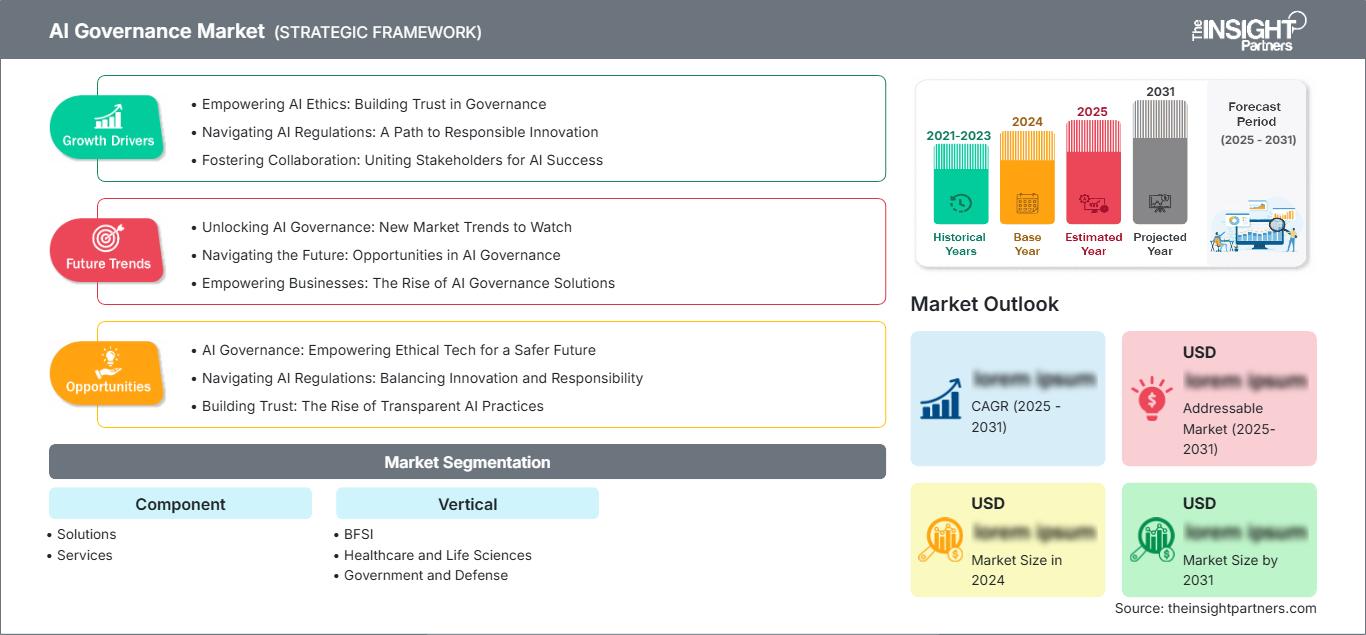
The AI governance market was valued at US$ 443.63 Million in 2025 and is projected to reach US$ 15,475.53 Million by 2034, expanding at a CAGR of 48.39% during 2026–2034. The market is being shaped by rising regulatory scrutiny of artificial intelligence deployments, enterprise demand for model transparency, and increasing requirements for explainability, bias mitigation, and auditability across business-critical AI systems. Organizations are integrating governance frameworks to align AI adoption with risk management and compliance objectives.
Across North America, adoption is accelerating due to expanding enterprise AI investments, maturing regulatory frameworks, and strong cloud ecosystem participation. The AI governance market size continues to benefit from growing implementation across finance, healthcare, and government sectors, where model accountability and decision transparency are becoming operational necessities. Regional growth is expected to remain among the highest globally, supported by innovation spending and governance-focused AI lifecycle management initiatives.
AI Governance Market Assessment and Insights
- North America: Strong enterprise AI deployment and regulatory preparedness support leadership. Share in 2025 estimated at 36–40% and CAGR between 46–50% during 2026–2034.
- US: Large concentration of cloud, AI, and governance vendors drives adoption. Share of North America in 2025 estimated at 80–84% and CAGR between 47–51% during 2026–2034.
- Europe: Regulatory alignment under AI oversight initiatives supports demand across Germany, the UK, and France. Share in 2025 estimated at 27–31% and CAGR between 45–49% during 2026–2034.
- Asia Pacific: Rapid digital transformation and sovereign AI initiatives in China, Japan, India, South Korea, and Australia drive expansion. Share in 2025 estimated at 22–26% and CAGR between 50–54% during 2026–2034.
- Largest Segment: Solutions account for a market share of 64–68% in 2025, supported by enterprise demand for monitoring, explainability, and compliance platforms. CAGR estimated at 47–51% during 2026–2034.
- High Growth Segment: Healthcare and Life Sciences holds a market share of 14–18% in 2025 and is projected to expand at a CAGR of 51–55% during 2026–2034 due to growing regulated AI deployments.
- Key companies analyzed in detail: Amazon Web Services, Inc.; Meta Platforms, Inc.; Fair Isaac Corporation (FICO); Alphabet Inc. (Google); International Business Machines Corporation; Microsoft Corporation; pymetrics, Inc.; Salesforce, Inc.; SAP SE; Oracle Corporation; SAS Institute Inc.
Source: The Insight Partners' analysis based on proprietary research, government publications, company annual reports, investor presentations, industry databases, and expert interviews.
With rapid progress in generative AI, large language models, and autonomous decision-making systems, enterprise use cases are becoming less experimental and more operational, thus leading to a higher demand for governance solutions that can help to control model explainability, fairness, accountability, and lifecycle management. In order to respond to the need for AI governance solutions, vendors have started integrating governance capabilities within cloud, analytics, and AI development platforms. Moreover, discussions in regulatory circles in developed economies are fostering the adoption of AI governance due to operational and reputational risks associated with AI.
As we move into the future, the market will be positively impacted by growing adoption in digital economies and increased investments from the government sector. Expanding AI use in healthcare diagnostics, financial decisioning, telecommunications automation, and defense applications will further stimulate demand for scalable governance platforms and specialized services supporting responsible AI implementation, driving growth in the AI Governance Market.
AI Governance Market Report Scope
| Report Attribute | Details |
|---|---|
| Market size in 2025 | US$ 443.63 Million |
| Market Size by 2034 | US$ 15,475.53 Million |
| Global CAGR (2026 - 2034) | 48.39% |
| Historical Data | 2021-2024 |
| Forecast period | 2026-2034 |
AI Governance Market Analysis
The AI governance market growth trajectory is closely linked to the accelerating deployment of artificial intelligence across regulated and high-risk environments. Enterprises increasingly require visibility into model behavior, data lineage, and automated decision outcomes. As AI systems become embedded within operational workflows, organizations are prioritizing governance mechanisms that enable compliance, fairness assessment, and continuous oversight. Demand is especially strong among financial institutions, healthcare providers, and government agencies, where transparency and accountability requirements are significant.
Technology providers, cloud operators, consulting firms, and compliance specialists collectively form a rapidly evolving ecosystem within the AI Governance Market. Solution providers are integrating governance capabilities into machine learning operations pipelines, enabling monitoring throughout model development and deployment stages. Growing use of generative AI has intensified interest in governance tools capable of identifying bias, detecting drift, and maintaining documentation standards. These capabilities are becoming critical as AI deployment scales across enterprises.
The AI governance market analysis indicates that competitive intensity is increasing as established software companies and cloud leaders expand governance portfolios. International Business Machines Corporation, Microsoft Corporation, Alphabet Inc., Amazon Web Services Inc., SAP SE, and Salesforce Inc. are embedding responsible AI solutions within their larger enterprise technology portfolios. Dedicated organizations like Pymetrics Inc. and Fair Isaac Corporation keep on differentiating through governance-oriented and domain-specific competencies.
Investments are increasingly going into explainability solutions, audit automation, compliance management solutions, and AI risk assessment. Strategic collaborations between cloud service providers, enterprises, and regulatory technology companies are becoming more important. Organizations are increasingly seeking end-to-end governance platforms rather than isolated monitoring tools, creating opportunities for integrated solution providers capable of supporting diverse AI environments and complex regulatory requirements in the AI Governance Market.
● REPORT CUSTOMIZATION
Tailor This Report To Align With Your Specific Business Requirements
This report can be customized to align precisely with your business objectives, scope, and target markets. Customization options include tailored segmentation, geography, competitive analysis, and strategic insights to support informed decision-making.
Customize This Report →WHAT YOU CAN ADJUST
- ● Segmentations
- ● Geography
- ● Competitive Analysis
- ● Language Preferences
AI Governance Market: Strategic Insights
Regional Insights
North America AI Governance Market
North America represents the leading regional market, supported by advanced AI adoption, strong cloud infrastructure, and evolving governance expectations. The region accounted for an estimated 36–40% AI governance market share in 2025 and is expected to expand at a CAGR of 46–50% through 2034. Enterprises across financial services, healthcare, retail, and public administration are investing in governance frameworks to address transparency, security, and compliance challenges associated with increasingly sophisticated AI deployments.
The US and Canada are making progress towards promoting responsible AI initiatives via enterprise policies, industry guidelines, and governance frameworks. Increased adoption of generative AI technology in customer service, analytics, and operations is fueling the demand for AI model auditing. The presence of established vendors, robust research and development investments, and growing awareness within enterprises is expected to help maintain their dominance during the forecast period.
U.S. AI Governance Market
The United States dominates regional demand, accounting for 80–84% of North American revenue in 2025. The market is projected to grow at a CAGR of 47–51% through 2034, supported by extensive adoption across BFSI, healthcare, government, and technology sectors. Major platform providers, software vendors, and AI innovators continue to prioritize governance functionality within enterprise AI environments.
Solutions that enable explainability, bias detection, documentation, and risk monitoring are on the rise. Corporate companies are using governance measures to enhance accountability in their AI implementations and ensure that they conform to internal and external requirements. The involvement of Microsoft Corporation, International Business Machines Corporation, Alphabet Inc., Amazon Web Services, Inc., and Salesforce, Inc. is critical in driving competitiveness and adoption in the enterprise environment.
Europe AI Governance Market
Europe accounted for an estimated 27–31% market share in 2025 and is expected to register a CAGR of 45–49% during the forecast period. The region benefits from a structured regulatory environment and a strong emphasis on ethical technology adoption. Germany retains the lead as the most dominant national market because of digitalization in industrial activities and the adoption of enterprise software. The United Kingdom is also continually making governance investments in areas related to financial services, analytics, and advanced AI programs.
France, Italy, and Spain have been increasingly focusing on implementing AI in the health sector, public sector services, and manufacturing settings. The regional companies are also realizing that governance is an imperative rather than an activity aimed at achieving compliance. Increased investment in AI and enterprise-level accountability will help maintain the momentum in the market.
APAC AI Governance Market
Asia Pacific represented approximately 22–26% of global revenue in 2025 and is forecast to expand at a CAGR of 50–54% through 2034. China takes the lead within this region due to AI development efforts and digital transformation efforts. Meanwhile, Japan and South Korea are making further investments in enterprise AI governance solutions.
India and Australia are witnessing an increased uptake of such solutions due to an increase in the use of AI by corporations within the banking, healthcare, telecommunication, and governmental sectors.
Middle East & Africa AI Governance Market
The Middle East & Africa market remains at an earlier stage of development but demonstrates strong long-term potential. Regional demand is being supported by digital modernization programs, smart government initiatives, and increasing AI investment. The market is expected to expand at a CAGR of 43–47% through 2034.
Saudi Arabia and the UAE lead adoption through national AI strategies and technology-driven economic diversification efforts. South Africa remains a key market within Africa, while broader regional investments in infrastructure, energy, and smart city projects create opportunities for governance solution deployment.
Segmentation Analysis
Component
The Component segment is central to the AI governance market scope, reflecting growing demand for technologies and expertise that ensure responsible AI deployment. Organizations increasingly require governance capabilities throughout the AI lifecycle, from development and validation to monitoring and auditing. The segment is projected to expand at a CAGR of 47–51% during 2026–2034.
- Solutions – The solutions have the biggest footprint because of the need for platforms that explain their algorithms, model monitoring tools, bias detection, policy management, and governance applications, which comply with AI policies.
- Services – The services are vital when it comes to implementing the governance process because they help organizations implement good governance frameworks and mechanisms of accountability.
Vertical
The Vertical segment reflects diverse adoption patterns across industries with varying compliance obligations and AI maturity levels. Increasing operational dependence on AI is encouraging investment in governance frameworks that address transparency, accountability, and risk management. The segment is anticipated to grow at a CAGR of 48–52% through 2034.
- BFSI – Financial institutions are among the earliest adopters, using governance tools to support credit decision transparency, fraud management oversight, regulatory compliance, and trustworthy customer-facing AI applications.
- Healthcare and Life Sciences – Healthcare organizations increasingly deploy governance systems to monitor clinical AI, ensure explainability, support patient safety objectives, and strengthen confidence in AI-enabled diagnostic and research processes.
- Government and Defense – Public-sector entities utilize governance frameworks to manage accountability, security, transparency, and policy compliance across critical national and administrative AI applications.
- Telecommunication – The telecommunication organizations utilize governance capabilities for overseeing automation processes, predictive maintenance, analytics of customers, and other AI-related optimization programs.
- Retail – The retail organizations focus on responsible AI for personalization, recommendation engines, inventory management, and customer engagement, where transparency is needed.
- Automotive – The automotive organizations are implementing governance control into autonomous vehicles, advanced driving assistance, manufacturing analytics, and connected mobility environments.
Opportunity Snapshot
| Vertical | Revenue Contribution | Trend Tag | Adoption Stage |
| BFSI | High | Risk Analytics | Mature |
| Healthcare and Life Sciences | High | Clinical AI | Scaling |
| Government and Defense | Medium | Trusted Automation | Scaling |
| Telecom | Medium | Network Intelligence | Scaling |
| Retail | Medium | Responsible Personalization | Scaling |
| Automotive | Medium | Autonomous Safety | Emerging |
AI Governance Market Growth Drivers and Impact Analysis
Expansion of Regulatory and Compliance Requirements
Since AI technology continues to be integrated into key operations in organizations, more focus is being put on transparency, fairness, and accountability by governments and industrial bodies. Enterprises are reacting through the deployment of governance solutions that can monitor, track model behavior and enable audit-readiness. These requirements are increasing in many sectors, including finance, healthcare, government and more, wherever AI decision making impacts customers, citizens, or patients. As a result, there has been an increased investment in governance solutions. Providers of explainability, documentation and compliance management solutions are enjoying growing market demand as companies look for scalable ways to mitigate risks while innovating with AI technology.
Rapid Enterprise Adoption of Generative AI Technologies
Adoption of generative AI has brought about unique challenges related to governance that are very different from those encountered in classical machine learning systems. There is a need for processes to be put in place for monitoring the generation of content, assessing the performance of models, dealing with IP issues and ensuring that best practices are maintained. There is growing use of governance platforms alongside the deployment of generative AI systems in order to help with governance processes. With the transition from pilot projects to production implementations, there is an increasing need for governance.
Growing Need for Trustworthy AI in High-Risk Industries
Industries that operate in highly regulated environments increasingly require trustworthy AI systems capable of supporting transparent and defensible decisions. Financial services firms, healthcare providers, and government agencies cannot rely solely on performance metrics when evaluating AI solutions. Governance frameworks enable organizations to assess fairness, traceability, accountability, and operational risk. As AI influences lending decisions, medical recommendations, public services, and security functions, stakeholders demand stronger oversight. This dynamic is expanding investment in governance technologies that support responsible deployment practices while improving confidence among regulators, customers, and internal decision-makers.
AI Governance Market Future Trends
Rise of Automated Governance Platforms
The AI governance market trends increasingly indicate movement toward automated governance architectures. Enterprises are seeking platforms capable of continuously monitoring models, identifying anomalies, generating audit trails, and enforcing policy requirements with limited manual intervention. Future solutions are expected to integrate governance directly into development pipelines, enabling real-time oversight across complex AI ecosystems. Automation will improve scalability as organizations deploy larger numbers of models and generative AI applications. Vendors that combine monitoring, explainability, risk analysis, and compliance reporting within unified platforms are likely to gain competitive advantages in increasingly sophisticated enterprise environments.
Convergence of Governance and AI Operations
Governance capabilities will become a mandatory element of the AI operations infrastructure going forward. Governance will not exist as an additional layer for compliance but rather will be incorporated into the processes of developing, deploying, and monitoring AI. Such integration will allow constant control over AI systems while simplifying the processes involved. The need for platforms that can handle all three aspects (performance, compliance, and accountability) at once will be seen by enterprises as a priority going forward.
AI Governance Market Opportunities
Healthcare Governance Platforms for Clinical Intelligence
Healthcare and life sciences represent one of the most attractive investment areas due to increasing AI adoption in diagnostics, clinical decision support, research, and patient management. Governance solutions capable of supporting transparency, documentation, and risk management are becoming essential. AI governance market Forecasts suggest that healthcare-focused governance platforms will benefit from rising regulatory scrutiny and increasing demand for explainable outcomes. Vendors that develop specialized capabilities for healthcare workflows, clinical validation, and patient safety requirements are well-positioned to capture long-term opportunities. Strategic partnerships with healthcare institutions and technology providers can strengthen market access and accelerate adoption across regulated care environments.
Governance Services Supporting Enterprise AI Transformation
Most companies do not have the know-how to develop effective governance strategies within their organizations. There exists room for consulting firms and managed service providers to step in by providing strategy development, risk assessment, integration, and monitoring services. The need for such services is anticipated to grow as organizations expand their use of AI technologies and look to achieve mature governance processes. Providers who are able to combine regulatory knowledge and technology know-how may distinguish themselves in the highly competitive landscape. The most prominent opportunities will be found in mid-sized enterprises.
Frequently Asked Questions

- Comprehensive Market Sizing and Forecast Analysis
- Detailed Segmentation Analysis
- In-Depth Market Dynamics Assessment
- Regional and Country-Level Insights
- Competitive Landscape and Company Benchmarking
- Strategic Business Intelligence
Recent Reports
Testimonials

The Insight Partners' SCADA System Market report is comprehensive, with valuable insights on current trends and future forecasts. The team was highly professional, responsive, and supportive throughout. We are very satisfied and highly recommend their services.
RAN KEDEM Partner, Reali Technologies LTDs
I requested a report on a very specific software market and the team produced the report in a few days. The information was very relevant and well presented. I then requested some changes and additions to the report. The team was again very responsive and I got the final report in less than a week.
JEAN-HERVE JENN Chairman, Future Analytica
We worked with The Insight Partners for an important market study and forecast. They gave us clear insights into opportunities and risks, which helped shape our plans. Their research was easy to use and based on solid data. It helped us make smart, confident decisions. We highly recommend them.
PIYUSH NAGPAL Sr. Vice President, High Beam Global
The Insight Partners delivered insightful, well-structured market research with strong domain expertise. Their team was professional and responsive throughout. The user-friendly website made accessing industry reports seamless. We highly recommend them for reliable, high-quality research services
YUKIHIKO ADACHI CEO, Deep Blue, LLC.
This is the first time I have purchased a market report from The Insight Partners.While I was unsure at first, I visited their web site and felt more comfortable to take the risk and purchase a market report.I am completely satisfied with the quality of the report and customer service. I had several questions and comments with the initial report, but after a couple of dialogs over email with their analyst I believe I have a report that I can use as input to our strategic planning process.Thank you so much for taking the extra time and making this a positive experience.I will definitely recommend your service to others and you will be my first call when we need further market data.
JOHN SUZUKI President and Chief Executive Officer, Board Director, BK Technologies
I wish to appreciate your support and the professionalism you displayed in the course of attending to my request for information regarding to infectious disease IVD market in Nigeria. I appreciate your patience, your guidance, and the fact that you were willing to offer a discount, which eventually made it possible for us to close a deal. I look forward to engaging The Insight Partners in the future, all thanks to the impression you have created in me as a result of this first encounter.
DR CHIJIOKE ONYIA MANAGING DIRECTOR, PineCrest Healthcare Ltd.Reason to Buy
- Informed Decision-Making
- Understanding Market Dynamics
- Competitive Analysis
- Identifying Emerging Markets
- Customer Insights
- Market Forecasts
- Risk Mitigation
- Boosting Operational Efficiency
- Strategic Planning
- Investment Justification
- Tracking Industry Innovations
- Aligning with Regulatory Trends





 Get Free Sample for