
AI in Medical Imaging Market Size, Growth & Trends by 2034
Coverage: By Product (Systems, Services and Software); Application (Cardiology, Oncology, Neurology, Gastroenterology, Musculoskeletal, Others); End User (Hospitals, Ambulatory Surgical Centers, Diagnostic Centers) , and Geography (North America, Europe, Asia Pacific, and South and Central America)
- Status : Data Released
- Report Code : TIPRE00003260
- Category : Technology, Media and Telecommunications
- No. of Pages : 150
- Available Report Formats :


- Last update date : August 12, 2026


2025 Market Size
US$ 1.92 Bn
Base year value
2034 Forecast
US$ 27.05 Bn
Projected by 2034
CAGR 2026-2034
34.14 %
Growth rate
Addressable Market
US$ 98.53 Bn
(2026-2034)
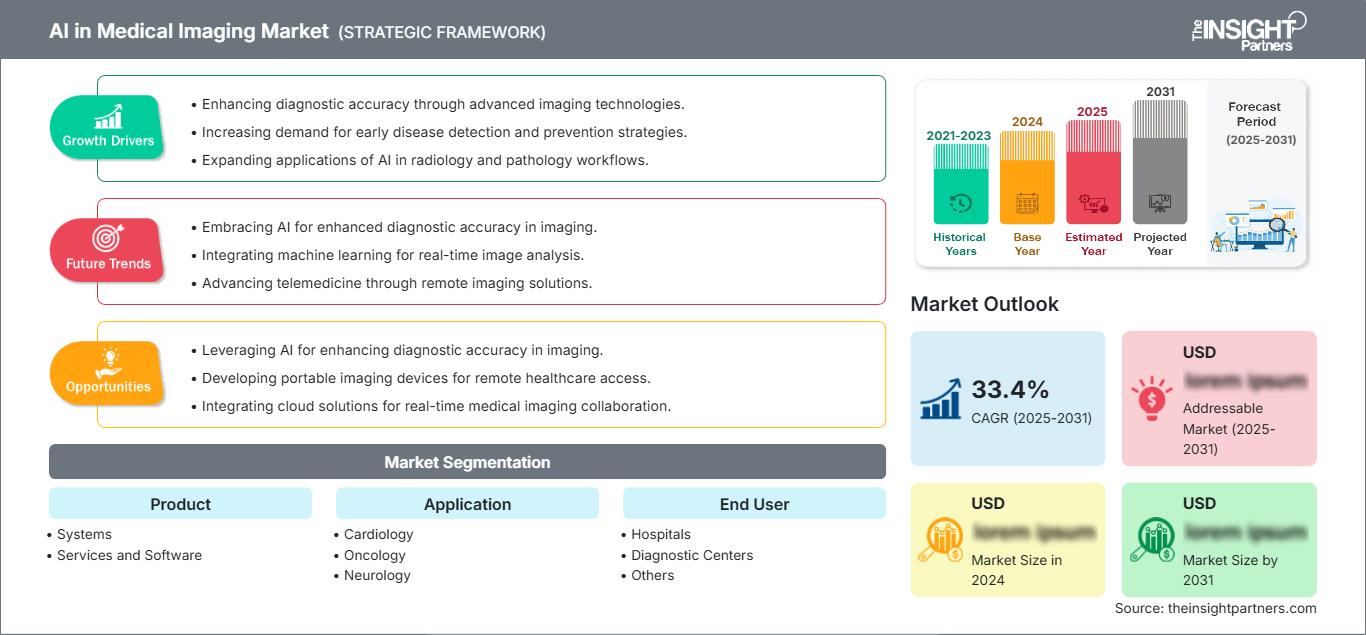
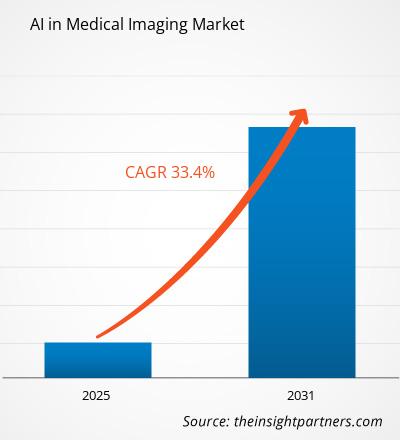
The AI in medical imaging market size was valued at US$ 1.92 Billion in 2025 and is anticipated to reach US$ 27.05 Billion by 2034, growing at a CAGR of 34.14% from 2026-2034. Driving factors include increasing volume of imaging studies, pressure on radiologists, better performance of algorithms, and increased adoption of artificial intelligence technology in radiology, oncology, neurology, cardiology, gastroenterology, and musculoskeletal imaging applications.
North America holds the lead in the development of AI in medical imaging market size expansion, owing to early regulatory approvals, enterprise imaging systems, cloud diagnostics, and robust vendor presence. North America is estimated to hold 39-42% of the market in 2025 and is likely to register a CAGR of 32-35% from 2026-2034, with hospitals implementing AI-enabled triaging and reporting solutions.
AI in Medical Imaging Market Assessment and Insights
- North America accounted for an estimated 39–42% share in 2025 and is expected to register a CAGR of 32–35% during 2026–2034, led by the U.S., enterprise PACS integration, and FDA-cleared imaging algorithms.
- U.S. represented 82–86% of North America in 2025 and is forecast to expand at a CAGR of 32–35%, driven by hospital AI pilots moving into production workflows.
- Europe held an estimated 24–27% share in 2025 and is expected to grow at a CAGR of 31–34%, with Germany, the UK, France, Italy, and Spain leading adoption.
- Asia Pacific captured 20–23% share in 2025 and is projected to advance at a CAGR of 36–39%, supported by China, Japan, South Korea, India, and Australia.
- Largest Segment was software, with 55–60% market share in 2025 and a CAGR of 34–37%, as algorithm licensing and workflow orchestration remain core revenue sources.
- High Growth Segment was services, with 18–22% share in 2025 and a CAGR of 37–40%, supported by implementation, validation, cybersecurity, and managed AI operations.
- Key companies analyzed in detail: GE HealthCare Technologies Inc., International Business Machines Corporation, Koninklijke Philips N.V., Samsung Electronics Co., Ltd., Advanced Micro Devices, Inc., EchoNous, Inc., Enlitic, Inc., Siemens Healthineers AG, Intel Corporation, NVIDIA Corporation, Butterfly Network, Inc., Prognos Health Inc., Nanox AI Ltd., Viz.ai, Inc., and Quibim S.L.
Source: The Insight Partners' analysis based on proprietary research, government publications, company annual reports, investor presentations, industry databases, and expert interviews.
Medical imaging has moved on from algorithm deployment into enterprise intelligence. The growth in AI for medical imaging markets is due to software being implemented in acquisition, reconstruction, prioritization, segmentation, measurement, and reporting levels. Medical imaging vendors are positioning themselves in a manner that will allow hospitals to cut down turnaround times, standardization of readings, and early diagnosis using high volume modality.
It is anticipated that the progress will be realized from new healthcare providers, payment pilots, foundation models, and increased post-market data. With the maturation of the regulatory environment, it is anticipated that hospitals will favor solutions offering workflow efficiencies, clinical precision, explainability, and integration with radiology information systems.
AI in Medical Imaging Market Report Scope
| Report Attribute | Details |
|---|---|
| Market size in 2025 | US$ 1.92 Billion |
| Market Size by 2034 | US$ 27.05 Billion |
| Global CAGR (2026 - 2034) | 34.14% |
| Historical Data | 2021-2024 |
| Forecast period | 2026-2034 |
AI in Medical Imaging Market Analysis
The adoption and market growth of AI in medical imaging are driven by the need for quick interpretation, early disease detection, and increased departmental throughput. Volumes of imaging have been increasing at a faster rate compared to the number of experts. There is therefore a need for an automated triage, lesion detection, organ segmentation, and structuring reporting.
The supply chain for medical imaging is becoming longer to include developers of the algorithms, the manufacturers of the scanners, the cloud services companies, PACS vendors, hospitals, and validation partners. The supply chain favors those platforms which provide regulatory compliance, interoperability, cybersecurity, and productivity metrics. Hospitals are adopting platforms that are not single application but are multi-application such as cardiology, oncology, neurology, and musculoskeletal cases.
Competitive positioning within AI in medical imaging market analysis now revolves around the ability to have a deep ecosystem. Companies such as GE HealthCare Technologies Inc., Siemens Healthineers AG, Koninklijke Philips N.V., NVIDIA Corporation, Intel Corporation, and Samsung Electronics Co., Ltd. offer assistance for hardware, computing, and workflow integrations whereas companies like Viz.ai, Inc., Quibim S.L., Enlitic, Inc., EchoNous, Inc., and Butterfly Network, Inc. target special applications.
Money will be invested in areas like cloud computing, edge inference, multimodal models, and orchestration of hospitals. International Business Machines Corporation, Advanced Micro Devices, Inc., Prognos Health Inc., and Nanox AI Ltd. provide advanced analytics, compute power, and more robust data management. It is believed that strategic partnerships will determine the market share as customers need solutions backed by evidence.
● REPORT CUSTOMIZATION
Tailor This Report To Align With Your Specific Business Requirements
This report can be customized to align precisely with your business objectives, scope, and target markets. Customization options include tailored segmentation, geography, competitive analysis, and strategic insights to support informed decision-making.
Customize This Report →WHAT YOU CAN ADJUST
- ● Segmentations
- ● Geography
- ● Competitive Analysis
- ● Language Preferences
AI in Medical Imaging Market: Strategic Insights
Regional Insights
North America AI in Medical Imaging Market
The North America AI in medical imaging market share is expected to be between 39-42% in 2025 with a CAGR of 32-35% between 2026-2034. Factors contributing to the adoption include higher numbers of imaging procedures, active reimbursement experimentation, support from academic medical centers, and quick deployment of AI solutions in stroke, cardiac, oncology, and emergency imaging workflows.
Regulatory clarity and abundance of vendors make the region favorable for the AI market as well. Hospitals start considering the algorithms on the basis of workflow performance, bias mitigation, post-deployment performance, and capability of working with enterprise imaging systems. The market share in the field of AI in medical imaging continues to be highest in the U.S.
U.S. AI in Medical Imaging Market
The United States AI in Medical Imaging Market is expected to hold 82-86% of North America’s share in 2025 and is estimated to witness CAGR of 32-35% in 2026-2034. The demand is dominated by big hospitals, integrated delivery networks, and imaging chains requiring automation, quantification, and decision making for large radiology worklist volumes.
There is a presence of many companies, such as GE HealthCare Technologies Inc., NVIDIA Corporation, Viz.ai, Inc., Enlitic, Inc., Butterfly Network, Inc., Intel Corporation, and Prognos Health Inc., that are fueling innovations within the region. There have been applications that have gone beyond just triaging to cancer, cardiology imaging, ultrasound guidance, and monitoring diseases longitudinally.
Europe AI in Medical Imaging Market
Europe's AI in Medical Imaging market share in 2025 stood at 24–27%, and is expected to grow at a rate of CAGR of 31–34%. Germany and UK lead the AI adoption because of imaging infrastructure, university hospital research, and procurement efforts that focus on productivity. France, Italy, and Spain are making strides in AI-enabled oncology, cardiovascular, and emergency radiology.
The demand for European AI in medical imaging market is influenced by data governance, CE marking of software, radiologists shortage, and modernization of national screenings. Other factors that drive adoption include cross-border research collaboration and digital transformation in public health, even though the procurement cycle might be slow compared to the US.
APAC AI in Medical Imaging Market
The APAC region accounted for a AI in Medical Imaging market share of 20–23%, which is anticipated to expand at a CAGR of 36–39%. China dominates volume in the region, while Japan, South Korea, India, and Australia fuel the growth due to hospital digitization, national AI initiatives, and high demand for quick diagnostics in the urban and semi-urban healthcare system.
The growth is most prevalent in markets characterized by imaging backlog, shortage of specialists, and increasing investments in the private healthcare sector. AI software for CT scans, X-rays, ultrasounds, oncology, and neurology are becoming increasingly popular, as such technology enables quality of interpretation to be standardized and improves productivity.
Middle East & Africa AI in Medical Imaging Market
Middle East & Africa AI in Medical Imaging Market is expected to grow at a CAGR of 28–31% during 2026–2034, led by Saudi Arabia, the UAE, and South Africa. Adoption is tied to hospital modernization, specialty care expansion, digital health investment, and partnerships with global imaging vendors.
Saudi Arabia and the UAE lead deployment through advanced hospital infrastructure and national healthcare transformation programs, while South Africa anchors demand in tertiary care and diagnostic networks. AI adoption remains selective but is increasing in radiology triage, oncology imaging, and ultrasound-supported clinical decision-making.
Segmentation Analysis
Product
Product segmentation includes systems, services, and software. The product category is expected to grow at a CAGR of 34–37% during 2026–2034 as hospitals combine embedded scanner intelligence, AI software platforms, and implementation services. AI in medical imaging market scope is broadening because buyers increasingly require interoperable solutions that cover acquisition, reconstruction, analysis, workflow management, and reporting.
- Systems are strategically important because scanner-integrated AI improves image acquisition, reconstruction, dose management, and workflow consistency across CT, MRI, ultrasound, and X-ray environments.
- Services support deployment, validation, user training, governance, cybersecurity, and post-market monitoring, making them essential as hospitals scale from pilots to enterprise AI operations.
- Software remains the largest revenue contributor because algorithms, orchestration layers, dashboards, and PACS-integrated applications directly support clinical interpretation and operational productivity.
Application
Application segmentation covers cardiology, oncology, neurology, gastroenterology, musculoskeletal, and others. This segment is projected to grow at a CAGR of 33–36% during 2026–2034. Demand is strongest where AI can shorten time-critical workflows, improve quantitative measurements, standardize follow-up, and support earlier detection in complex disease pathways.
- Cardiology benefits from AI-enabled echocardiography, cardiac CT, plaque assessment, and automated measurement tools that support risk stratification and faster reporting.
- Oncology uses AI for lesion detection, tumor segmentation, response assessment, radiomics, and longitudinal tracking across CT, MRI, mammography, and PET workflows.
- Neurology remains a high-priority area because stroke triage, hemorrhage detection, multiple sclerosis monitoring, and neurodegenerative imaging require fast, consistent interpretation.
- Gastroenterology adoption is rising as imaging AI supports liver lesion characterization, abdominal CT review, inflammatory disease monitoring, and endoscopy-linked image analytics.
- Musculoskeletal applications include fracture detection, bone age assessment, joint degeneration analysis, orthopedic planning, and workflow support for emergency and outpatient imaging.
End User
End User segmentation includes hospitals, diagnostic centers, and others. The end user segment is expected to expand at a CAGR of 32–35% during 2026–2034. Hospitals lead demand because they manage complex imaging networks, emergency workflows, and multidisciplinary care pathways where AI can improve triage, reporting speed, and resource utilization.
- Hospitals account for the largest adoption base due to enterprise imaging budgets, multidisciplinary use cases, clinical validation resources, and high procedure volumes.
- Diagnostic Centers use AI to improve throughput, standardize radiology reads, reduce turnaround time, and differentiate services in competitive outpatient imaging markets.
Opportunity Snapshot
| End User | Revenue Contribution | Trend Tag | Adoption Stage |
| Hospitals | High | Enterprise AI | Scaling |
| Diagnostic Centers | Medium | Fast Reporting | Scaling |
| Others | Low | Remote Access | Emerging |
AI in Medical Imaging Market Growth Drivers and Impact Analysis
Rising Imaging Volumes and Radiologist Capacity Pressure
According to the AI in Medical Imaging Market report, diagnostic imaging demand continues to increase across emergency care, oncology surveillance, cardiovascular disease, and neurological assessment. Radiology departments face growing interpretation queues while specialist availability remains uneven across regions. AI tools address this pressure by prioritizing urgent cases, automating measurements, flagging abnormalities, and supporting structured reporting. The market impact is strongest in hospitals and imaging networks where productivity, turnaround time, and quality consistency directly influence patient flow, clinician satisfaction, and operating margins.
Regulatory Clarity for AI-Enabled Medical Devices
Regulatory visibility is strengthening buyer confidence because authorized AI-enabled devices provide a clearer route from development to clinical use. The U.S. FDA maintains a public list of AI-enabled medical devices, and radiology represents a major share of cleared applications. This transparency helps hospitals assess safety, intended use, and evidence expectations. It also encourages vendors to invest in post-market monitoring, algorithm governance, and documentation that support enterprise purchasing decisions.
Integration of AI with Enterprise Imaging Platforms
Hospitals increasingly prefer AI solutions embedded into PACS, RIS, cloud archives, scanners, and reporting systems. This integration reduces workflow disruption and allows clinicians to receive AI outputs within familiar environments. The impact is commercially important because enterprise deployment supports multi-site licensing, repeatable implementation, centralized governance, and broader clinical coverage. Vendors that combine algorithms with orchestration, cybersecurity, and performance analytics are better positioned to win large health system contracts.
AI in Medical Imaging Market Future Trends
Foundation Models for Multimodal Imaging Intelligence
AI in medical imaging market trends are shifting toward foundation models that combine images, reports, clinical history, pathology, and longitudinal data. These models may support broader disease interpretation, automated report drafting, and predictive analytics across specialties. Adoption will depend on transparency, validation diversity, data security, and clinician oversight. Vendors that can convert multimodal intelligence into explainable, workflow-safe tools are likely to gain strategic advantage as hospitals seek fewer platforms with wider clinical coverage.
Edge AI and Scanner-Native Automation
Edge AI is expected to expand as imaging systems incorporate intelligence directly into acquisition and reconstruction workflows. Scanner-native tools can reduce scan time, improve image quality, lower radiation dose, and support operators during ultrasound, CT, MRI, and X-ray procedures. This trend is valuable for hospitals facing staff constraints and rising throughput expectations. It also strengthens competition among imaging equipment vendors as hardware, software, and AI services converge.
AI in Medical Imaging Market Opportunities
AI Deployment in Diagnostic Centers and Imaging Networks
AI in medical imaging market Forecasts point to significant opportunity in outpatient diagnostic centers and multi-site imaging networks. These organizations need faster reporting, consistent quality, and efficient radiologist allocation across distributed locations. AI can support preliminary triage, automated measurements, worklist prioritization, and quality checks. Vendors offering scalable pricing, simple integration, and measurable productivity gains can capture demand beyond academic hospitals and expand adoption in community-based diagnostic settings.
Specialty-Specific AI for Oncology and Neurology
Oncology and neurology offer strong commercial opportunities because imaging is central to diagnosis, staging, treatment planning, and follow-up. AI can quantify tumor burden, track lesion changes, detect acute stroke markers, and support disease progression monitoring. These applications create value for clinicians, pharmaceutical trials, and hospital systems. Companies that pair regulatory clearance with specialty workflow integration and real-world evidence will be well positioned for premium adoption.
Frequently Asked Questions

- Comprehensive Market Sizing and Forecast Analysis
- Detailed Segmentation Analysis
- In-Depth Market Dynamics Assessment
- Regional and Country-Level Insights
- Competitive Landscape and Company Benchmarking
- Strategic Business Intelligence
Recent Reports
Testimonials

The Insight Partners provided valuable market intelligence that supported our global go-to-market strategy. Their team was professional, responsive, and attentive to our feedback, providing thoughtful analysis and helpful methodological clarifications throughout the project.
Junmo Kim Chief Financial Officer (CFO), Enertech Co., Ltd.
The Insight Partners' SCADA System Market report is comprehensive, with valuable insights on current trends and future forecasts. The team was highly professional, responsive, and supportive throughout. We are very satisfied and highly recommend their services.
RAN KEDEM Partner, Reali Technologies LTDs
I requested a report on a very specific software market and the team produced the report in a few days. The information was very relevant and well presented. I then requested some changes and additions to the report. The team was again very responsive and I got the final report in less than a week.
JEAN-HERVE JENN Chairman, Future Analytica
We worked with The Insight Partners for an important market study and forecast. They gave us clear insights into opportunities and risks, which helped shape our plans. Their research was easy to use and based on solid data. It helped us make smart, confident decisions. We highly recommend them.
PIYUSH NAGPAL Sr. Vice President, High Beam Global
The Insight Partners delivered insightful, well-structured market research with strong domain expertise. Their team was professional and responsive throughout. The user-friendly website made accessing industry reports seamless. We highly recommend them for reliable, high-quality research services
YUKIHIKO ADACHI CEO, Deep Blue, LLC.
This is the first time I have purchased a market report from The Insight Partners.While I was unsure at first, I visited their web site and felt more comfortable to take the risk and purchase a market report.I am completely satisfied with the quality of the report and customer service. I had several questions and comments with the initial report, but after a couple of dialogs over email with their analyst I believe I have a report that I can use as input to our strategic planning process.Thank you so much for taking the extra time and making this a positive experience.I will definitely recommend your service to others and you will be my first call when we need further market data.
JOHN SUZUKI President and Chief Executive Officer, Board Director, BK Technologies
I wish to appreciate your support and the professionalism you displayed in the course of attending to my request for information regarding to infectious disease IVD market in Nigeria. I appreciate your patience, your guidance, and the fact that you were willing to offer a discount, which eventually made it possible for us to close a deal. I look forward to engaging The Insight Partners in the future, all thanks to the impression you have created in me as a result of this first encounter.
DR CHIJIOKE ONYIA MANAGING DIRECTOR, PineCrest Healthcare Ltd.Reason to Buy
- Informed Decision-Making
- Understanding Market Dynamics
- Competitive Analysis
- Identifying Emerging Markets
- Customer Insights
- Market Forecasts
- Risk Mitigation
- Boosting Operational Efficiency
- Strategic Planning
- Investment Justification
- Tracking Industry Innovations
- Aligning with Regulatory Trends





 Get Free Sample for