
AI Laptop Market Demand, Share & Growth by 2034
AI Laptop Market Size and Forecast (2021 - 2034), Global and Regional Share, Trend, and Growth Opportunity Analysis Report Report Coverage : by Processor Type (AI Optimized CPU, NPU, Integrated GPU, Discrete GPU), Sales Channel(Online sales and Offline Sales) and Geography
- Status : Data Released
- Report Code : TIPRE00042043
- Category : Technology, Media and Telecommunications
- No. of Pages : 150
- Available Report Formats :


- Last update date : August 12, 2026


2025 Market Size
US$ 6.09 Bn
Base year value
2034 Forecast
US$ 16.04 Bn
Projected by 2034
CAGR 2026-2034
11.36 %
Growth rate
Addressable Market
US$ 97.53 Bn
(2026-2034)
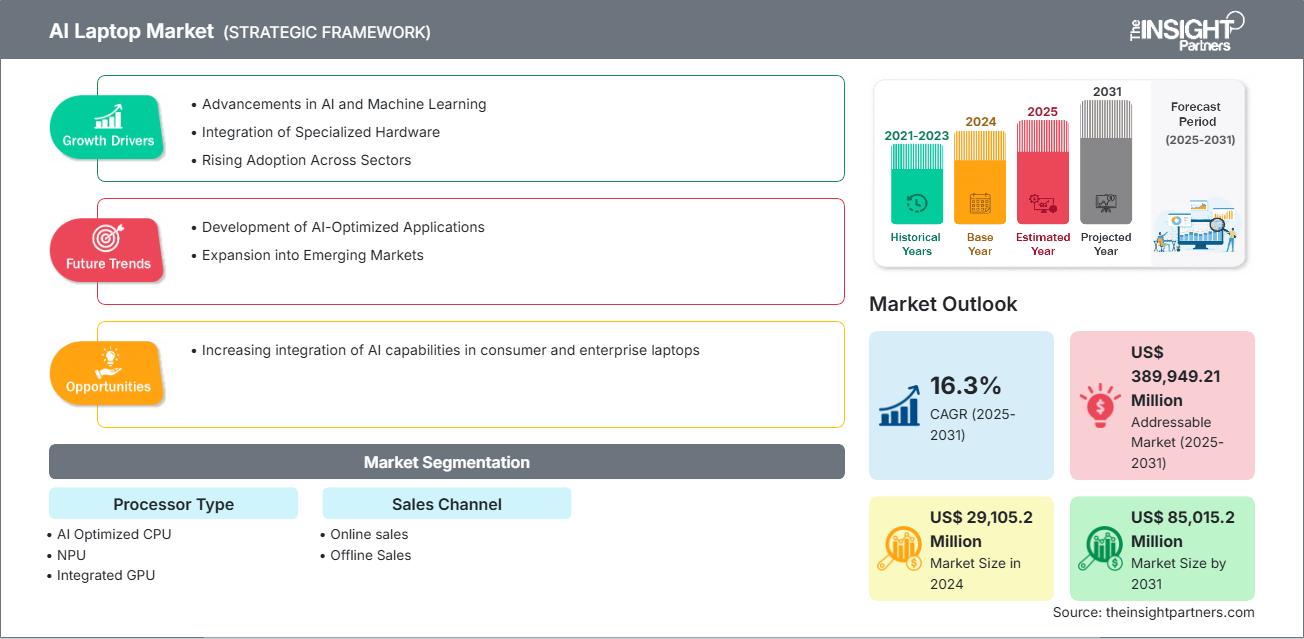
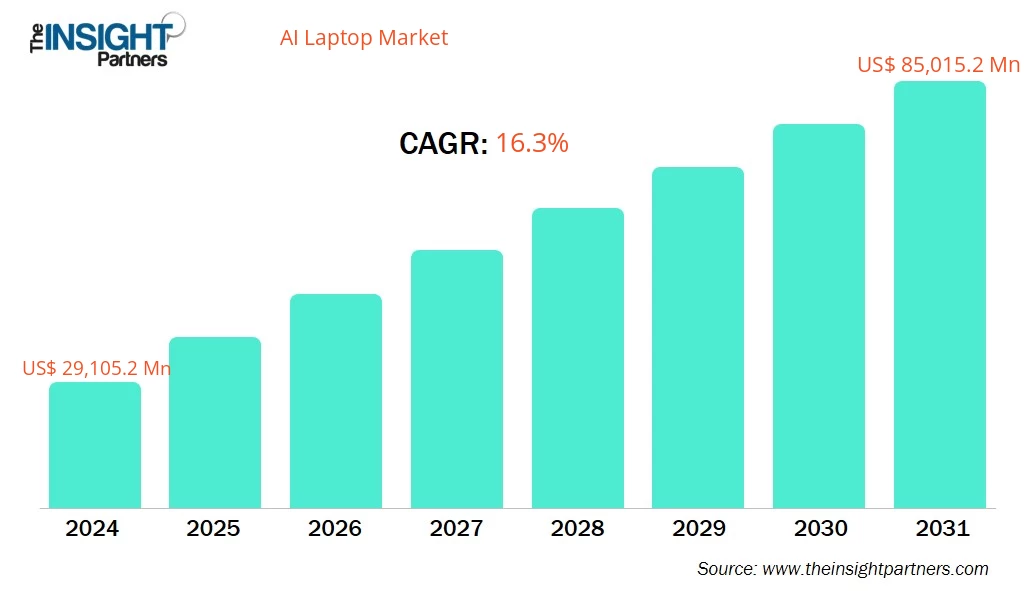
The AI laptop market is projected to grow from US$ 6.09 Billion in 2025 to US$ 16.04 Billion by 2034, registering a CAGR of 11.36% during 2026–2034. Demands are being driven by the emergence of laptops equipped with neural processing units, artificial intelligence optimized CPUs, graphics processing unit (GPU) integration, and discrete GPUs to provide inference, automation, creative computing, and privacy-oriented business applications.
North America continues to be a key source of revenues due to the increase in refresh rate of AI-enabled laptops, especially for professional services, software developers, education, and remote working environments. The AI laptop market size is driven by the demands for on-device co-pilot capabilities, enhanced endpoint security, video collaboration, and low latency AI computing, with region's growth to continue outpacing the global average..
AI Laptop Market Assessment and Insights
- North America: The region accounted for 34–37% share in 2025 and is expected to grow at a CAGR of 11.8–12.6% during 2026–2034, supported by enterprise refresh programs and software-led AI adoption.
- US: The US represented 78–82% of North America revenue in 2025 and is projected to expand at 12.0–12.8% CAGR as commercial buyers standardize AI-capable notebooks.
- Europe: Europe held 24–27% share in 2025 and is expected to grow at 10.1–10.9% CAGR, led by Germany, the UK, and France.
- Asia Pacific: APAC captured 28–31% share in 2025 and is projected to grow at 12.5–13.4% CAGR, led by China, Japan, South Korea, and India.
- Largest Segment: AI optimized CPU led with 32–35% market share in 2025 and is expected to grow at 10.6–11.4% CAGR due to broad OEM integration.
- High Growth Segment: NPU accounted for 24–27% share in 2025 and is forecast to grow at 13.2–14.1% CAGR as local inference becomes standard.
- Key companies analyzed in detail: Apple Inc.; Dell Technologies Inc.; HP Inc.; Lenovo Group Limited; ASUSTeK Computer Inc.; Acer Inc.; Micro-Star International Co., Ltd.; Samsung Electronics Co., Ltd.; Microsoft Corporation; Razer Inc.; Google LLC.
Source: The Insight Partners' analysis based on proprietary research, government publications, company annual reports, investor presentations, industry databases, and expert interviews.
The market has shifted from high-end experimental products to mainstream laptops through the embedding of dedicated AI capabilities within processors that work for commercial and consumer devices. Market development in AI laptops has been driven by the trend in AI deployment from cloud-only models to a hybrid and even on-device mode of operation, where privacy, low latency, battery efficiency, and application responsiveness are key considerations in purchases.
Further growth will depend on operating systems, enterprise security requirements, and applications that can leverage AI capabilities locally. Manufacturers are marketing laptops based on capabilities such as collaboration, creation of content, coding assistance, language translation, and meetings intelligence. Manufacturing strategy in regions and availability of semiconductors will affect pricing and configurations.
AI Laptop Market Report Scope
| Report Attribute | Details |
|---|---|
| Market size in 2025 | US$ 6.09 Billion |
| Market Size by 2034 | US$ 16.04 Billion |
| Global CAGR (2026 - 2034) | 11.36% |
| Historical Data | 2021-2024 |
| Forecast period | 2026-2034 |
AI Laptop Market Analysis
The demand for AI laptops is increasing with companies looking to procure laptops that can perform generative AI capabilities, video upscaling, summarization, and analytics at the edge. The profile of market growth includes a refresh cycle from Windows 11 transition, Copilot+PC requirements, Apple Intelligence, and overall developer support for neural processors.
On the supply side, the key influencers are the road maps of Intel, AMD, Qualcomm, Apple, and GPUs. OEMs are offering differentiation on factors such as battery endurance, thermal design, camera intelligence, security firmware, and manageability for enterprise.
The competitive analysis of the AI laptop market report reveals that leading PC manufacturers globally are utilizing AI capability for maintaining their premium pricing margins and also venturing into mid-range products. Some of the companies engaged in competition include Apple Inc., Dell Technologies Inc., HP Inc., Lenovo Group Limited, ASUSTeK Computer Inc., Acer Inc., Microsoft Corporation, Samsung Electronics Co., Ltd., Micro-Star International Co., Ltd., Razer Inc., and Google LLC.
Investment is concentrated in NPU-enabled platforms, discrete GPU creator notebooks, and enterprise deployment tools. Dell’s 2025 AI PC portfolio, HP’s commercial AI notebook launches, and Lenovo’s AI-powered ThinkPad and ThinkBook updates show how vendors are aligning product portfolios with hybrid work, local data processing, and secure productivity workflows.
● REPORT CUSTOMIZATION
Tailor This Report To Align With Your Specific Business Requirements
This report can be customized to align precisely with your business objectives, scope, and target markets. Customization options include tailored segmentation, geography, competitive analysis, and strategic insights to support informed decision-making.
Customize This Report →WHAT YOU CAN ADJUST
- ● Segmentations
- ● Geography
- ● Competitive Analysis
- ● Language Preferences
AI Laptop Market: Strategic Insights
Regional Insights
North America AI laptop market
North America held 34–37% AI laptop market share in 2025 and is projected to grow at 11.8–12.6% CAGR during 2026–2034. Enterprise refresh demand is strong because AI-enabled collaboration, endpoint security, and local productivity assistants are becoming standard requirements for professional users.
This area is favored due to early adoption by software, financial, consulting, educational, and media firms. In addition, channel partners are also marketing AI-ready solutions as future-proof gadgets, while cloud computing firms and OS providers are enhancing support for localized solutions to reduce latency and protect data privacy.
U.S. AI laptop Market
In 2025, the US held a market share of 78–82% in North America revenues and will witness a growth rate of 12.0–12.8% CAGR. The need for AI-enabled notebook upgrades by large businesses has been identified due to the ability of such devices to facilitate meeting intelligence, code completion, document handling, and on-device inference focused on privacy.
The vendor presence is another key strength. Apple Inc., Dell Technologies Inc., HP Inc., Microsoft Corporation, Google LLC, and Razer Inc. have considerable commercial and consumer awareness.
Europe AI laptop Market
Europe represented 24–27% share in 2025 and is projected to grow at 10.1–10.9% CAGR. Germany leads regional adoption because of manufacturing digitization and enterprise PC modernization, while the UK and France show demand from financial services, public administration, education, and creative industries.
Both Italy and Spain are expected to see consistent growth due to investments in hybrid work becoming normalized and companies upgrading old laptops with AI-capable systems. Privacy considerations mean that data protection is a priority and AI laptops have appeal in situations that require balancing privacy and productivity.
APAC AI laptop Market
APAC had a share of 28% to 31% in 2025 and is projected to have a CAGR growth rate of 12.5% to 13.4%. Countries like China, Japan, South Korea, India, and Australia are driving the demand with consumer electronics, education, IT services, games, and creative workloads.
The region is growing because of their manufacturing capability, growing online sales, and competitive pricing on AI optimized CPU and NPU designs. China leads in terms of countries, but India is emerging as a high growth country due to adoption of AI enabled notebook devices by firms and students.
Middle East & Africa AI laptop Market
MEA growth will be seen through an 8.9% to 9.7% CAGR from 2026 to 2034. Leading markets for adoption include the UAE and Saudi Arabia because of digital government initiatives, educational initiatives, financial services, and smart infrastructure.
South Africa contributes through enterprise and education procurement, while the rest of MEA remains channel-led and price-sensitive. Growth is supported by premium retail expansion, cloud adoption, and demand for secure mobile computing across distributed workforces.
Segmentation Analysis
Processor Type
Processor Type is expected to grow at 11.7–12.5% CAGR during 2026–2034. The market scope is defined by how OEMs balance CPU efficiency, NPU acceleration, integrated graphics, and discrete GPUs to match productivity, collaboration, gaming, creator, and enterprise requirements across different price bands.
- AI Optimized CPU: This sub-segment holds the broadest commercial base because AI-tuned CPUs support mainstream workloads while keeping costs manageable for enterprise fleets and education buyers.
- NPU: NPUs are strategically important for local inference, low-power AI tasks, privacy-sensitive processing, and Copilot-class features that require dedicated acceleration.
- Integrated GPU: Integrated GPUs support light creative workloads, media enhancement, and AI-assisted productivity while helping thin-and-light notebooks maintain battery efficiency.
- Discrete GPU: Discrete GPUs serve creators, engineers, gamers, developers, and AI professionals who need higher parallel processing performance for complex local workloads.
Sales Channel
Sales Channel is expected to grow at 10.9–11.8% CAGR during 2026–2034. Online and offline channels remain complementary as consumers compare specifications digitally, while enterprises rely on direct procurement, managed services, and reseller support for configuration, deployment, warranty, and lifecycle management.
- Online sales: Online sales benefit from specification transparency, promotional pricing, direct-to-consumer stores, and growing demand from students, creators, and remote professionals.
- Offline Sales: Offline sales remain important for enterprise procurement, retail demonstrations, service-led decisions, and premium notebook purchases requiring hands-on evaluation.
Opportunity Snapshot
| Segments | Revenue Contribution | Trend Tag | Adoption Stage |
|---|---|---|---|
| Processor Type | High | Local AI | Scaling |
| Sales Channel | Medium | Hybrid Retail | Mature |
AI Laptop Market Growth Drivers and Impact Analysis
Enterprise Refresh Cycles Shift Toward AI-Ready Devices
Enterprises are replacing older notebooks with AI-capable systems to prepare for local productivity features, secure collaboration, and endpoint intelligence. Gartner has indicated that AI PCs are moving rapidly into mainstream PC shipments, while commercial buyers increasingly view NPU-enabled laptops as a future-proof procurement choice. This driver supports premium configurations and managed deployment services.
On-Device AI Improves Privacy, Latency, and User Experience
Local AI processing reduces dependence on cloud inference for selected workloads, including transcription, background blur, summarization, image enhancement, and personal assistance. This matters for regulated sectors because sensitive data can be processed closer to the user. As software vendors optimize applications for NPUs and GPUs, AI laptop differentiation is shifting from hardware claims to measurable workflow gains.
OEM and Chipmaker Collaboration Accelerates Product Availability
Notebook vendors are coordinating closely with processor suppliers and operating system providers to launch certified AI-capable devices. Dell, HP, Lenovo, Microsoft, Apple, ASUS, Acer, Samsung, MSI, Razer, and Google are using AI features to refresh portfolios and simplify buyer messaging. Wider model availability lowers adoption barriers and expands the category from premium users to mainstream professionals.
AI Laptop Market Future Trends
Personalized On-Device AI Workspaces
AI laptop market trends will increasingly focus on role-specific personalization rather than generic performance claims. Future notebooks will adapt to user workflows, meeting behavior, coding patterns, security requirements, and creative preferences. This will make AI features more embedded in daily work, with local models assisting users continuously while preserving data privacy and reducing cloud dependency.
Midrange NPU Adoption Expands the Addressable Base
As NPUs become standard across more processor tiers, AI notebooks will move beyond premium segments into mainstream commercial and student devices. This transition will pressure vendors to differentiate through software experience, battery performance, display quality, device management, and ecosystem services. Broader availability should also strengthen online sales as buyers compare AI specifications more directly.
AI Laptop Market Opportunities
Enterprise AI Fleet Services
AI laptop market Forecasts indicate a strong opportunity for vendors that bundle devices with deployment tools, security management, AI application support, and lifecycle services. Enterprises need help selecting configurations, validating use cases, and managing mixed fleets. OEMs and channel partners can create higher-value offerings by combining hardware, consulting, endpoint management, and upgrade planning.
Creator and Developer Workstations in Portable Form Factors
Demand is rising for notebooks that support AI-assisted coding, local model experimentation, 3D creation, video editing, and design workflows. Discrete GPU and high-performance NPU systems can address users who need portability without sacrificing compute capability. Vendors can capture margin by targeting creators, engineers, data professionals, and independent developers with specialized configurations and software bundles.
Frequently Asked Questions

- Comprehensive Market Sizing and Forecast Analysis
- Detailed Segmentation Analysis
- In-Depth Market Dynamics Assessment
- Regional and Country-Level Insights
- Competitive Landscape and Company Benchmarking
- Strategic Business Intelligence
Recent Reports
Testimonials

The Insight Partners provided valuable market intelligence that supported our global go-to-market strategy. Their team was professional, responsive, and attentive to our feedback, providing thoughtful analysis and helpful methodological clarifications throughout the project.
Junmo Kim Chief Financial Officer (CFO), Enertech Co., Ltd.
The Insight Partners' SCADA System Market report is comprehensive, with valuable insights on current trends and future forecasts. The team was highly professional, responsive, and supportive throughout. We are very satisfied and highly recommend their services.
RAN KEDEM Partner, Reali Technologies LTDs
I requested a report on a very specific software market and the team produced the report in a few days. The information was very relevant and well presented. I then requested some changes and additions to the report. The team was again very responsive and I got the final report in less than a week.
JEAN-HERVE JENN Chairman, Future Analytica
We worked with The Insight Partners for an important market study and forecast. They gave us clear insights into opportunities and risks, which helped shape our plans. Their research was easy to use and based on solid data. It helped us make smart, confident decisions. We highly recommend them.
PIYUSH NAGPAL Sr. Vice President, High Beam Global
The Insight Partners delivered insightful, well-structured market research with strong domain expertise. Their team was professional and responsive throughout. The user-friendly website made accessing industry reports seamless. We highly recommend them for reliable, high-quality research services
YUKIHIKO ADACHI CEO, Deep Blue, LLC.
This is the first time I have purchased a market report from The Insight Partners.While I was unsure at first, I visited their web site and felt more comfortable to take the risk and purchase a market report.I am completely satisfied with the quality of the report and customer service. I had several questions and comments with the initial report, but after a couple of dialogs over email with their analyst I believe I have a report that I can use as input to our strategic planning process.Thank you so much for taking the extra time and making this a positive experience.I will definitely recommend your service to others and you will be my first call when we need further market data.
JOHN SUZUKI President and Chief Executive Officer, Board Director, BK Technologies
I wish to appreciate your support and the professionalism you displayed in the course of attending to my request for information regarding to infectious disease IVD market in Nigeria. I appreciate your patience, your guidance, and the fact that you were willing to offer a discount, which eventually made it possible for us to close a deal. I look forward to engaging The Insight Partners in the future, all thanks to the impression you have created in me as a result of this first encounter.
DR CHIJIOKE ONYIA MANAGING DIRECTOR, PineCrest Healthcare Ltd.Reason to Buy
- Informed Decision-Making
- Understanding Market Dynamics
- Competitive Analysis
- Identifying Emerging Markets
- Customer Insights
- Market Forecasts
- Risk Mitigation
- Boosting Operational Efficiency
- Strategic Planning
- Investment Justification
- Tracking Industry Innovations
- Aligning with Regulatory Trends





 Get Free Sample for