
AI Toolkit Market Share, Demand & Growth by 2034
AI Toolkit Market Size and Forecasts (2021 - 2034), Global and Regional Share, Trends, and Growth Opportunity Analysis Report Coverage : By Offering (Hardware, Software, Services), Technology Type (Natural Language Processing, Machine Learning, Computer Vision, RPA ),Vertical (BFSI, Retail & eCommerce, Healthcare & Life Sciences, Manufacturing, Telecom, IT & ITeS, Others)
- Status : Data Released
- Report Code : TIPRE00039704
- Category : Technology, Media and Telecommunications
- No. of Pages : 150
- Available Report Formats :


- Last update date : August 12, 2026


2025 Market Size
US$ 32.98 Bn
Base year value
2034 Forecast
US$ 168.59 Bn
Projected by 2034
CAGR 2026-2034
19.88 %
Growth rate
Addressable Market
US$ 818.08 Bn
(2026-2034)
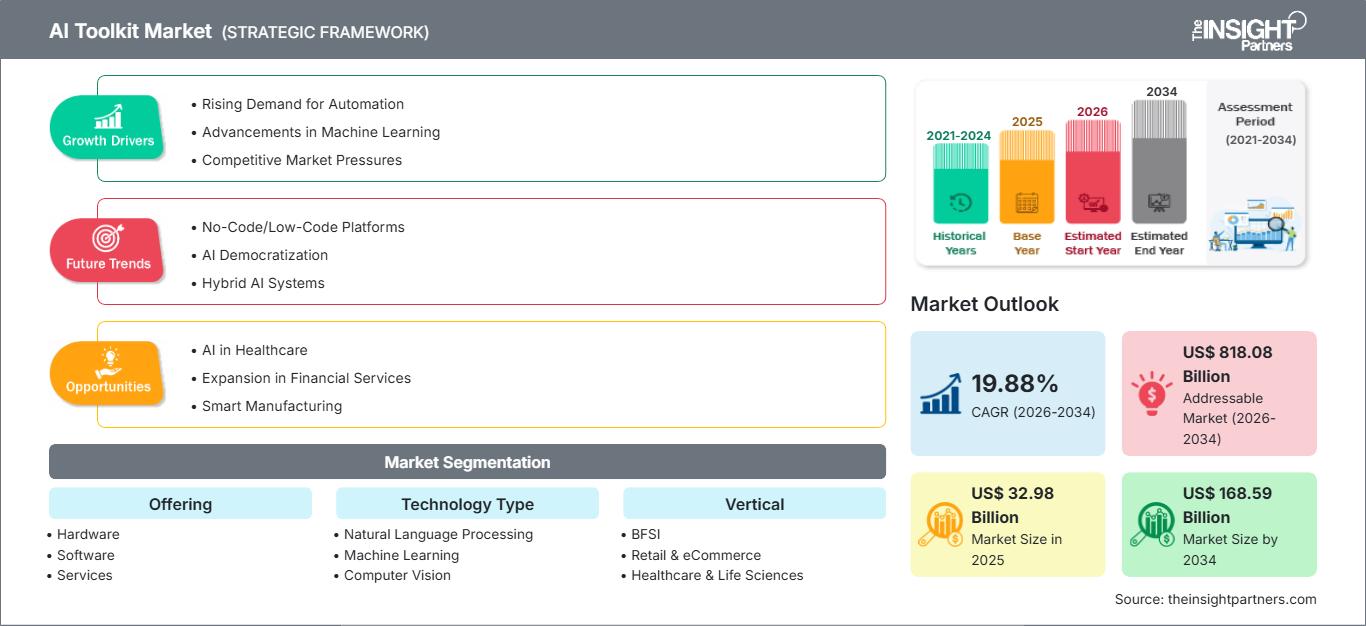
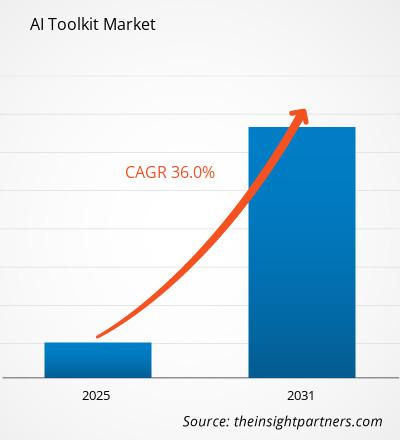
The AI Toolkit market was valued at US$ 32.98 Billion in 2025 and is projected to reach US$ 168.59 Billion by 2034, expanding at a CAGR of 19.88% during 2026–2034. The market is being shaped by accelerating enterprise adoption of generative AI, machine learning development environments, model governance platforms, and low-code AI deployment frameworks. Growing demand for scalable automation, decision intelligence, and real-time analytics continues to expand the commercial relevance of AI toolkits across industries.
Across North America, AI platform investments remain supported by advanced cloud infrastructure, extensive AI talent pools, and enterprise digital transformation budgets. The AI Toolkit market size in the region benefits from rising integration of foundation models into business workflows and increasing regulatory focus on responsible AI deployment. Strong adoption across BFSI, healthcare, and technology sectors is expected to support regional growth at approximately 18–21% through the forecast period.
AI Toolkit Market Assessment and Insights
- North America: Leading innovation ecosystem supported by hyperscalers, AI startups, and enterprise technology spending. Share in 2025 estimated at 38–42%, with CAGR between 18–21% during 2026–2034.
- US: Strong concentration of AI software vendors and infrastructure providers. Share of North America in 2025 estimated at 78–82%, growing at a CAGR of 18–21% during 2026–2034.
- Europe: Expanding adoption driven by Germany, the UK, and France, supported by responsible AI frameworks and industrial automation initiatives. Share in 2025 estimated at 24–28%, with CAGR of 17–20% during 2026–2034.
- Asia Pacific: Fast deployment across China, Japan, India, South Korea, and Australia. Share in 2025 estimated at 25–29%, with CAGR of 21–24% during 2026–2034.
- Largest Segment: Software remains dominant, accounting for 52–56% market share in 2025, supported by model development, orchestration, and deployment demand. CAGR estimated at 19–22%.
- High Growth Segment: Healthcare & Life Sciences demonstrates rapid adoption of clinical intelligence and research automation, holding 12–16% share in 2025 and expanding at 22–25% CAGR.
- Key companies analyzed in detail: Microsoft Corporation, International Business Machines Corporation, Oracle Corporation, Thales S.A., Salesforce, Inc., Intel Corporation, Adobe Inc., NVIDIA Corporation, Alteryx, Inc., DataRobot, Inc.
Source: The Insight Partners' analysis based on proprietary research, government publications, company annual reports, investor presentations, industry databases, and expert interviews.
Continuous advances in foundation models, multimodal AI, and cloud-native deployment architectures have transformed enterprise AI adoption patterns. Organizations increasingly implement integrated development environments that combine model creation, governance, monitoring, and deployment capabilities within unified ecosystems. AI Toolkit vendors have expanded from algorithm libraries toward comprehensive platforms supporting lifecycle management, security controls, and operational scalability across diverse workloads.
Future expansion is expected to be influenced by emerging AI investment hubs in Asia Pacific and the Middle East, alongside government-backed innovation programs. Regulatory frameworks emphasizing transparency, accountability, and explainability are likely to strengthen enterprise confidence. Growing capital allocation toward sovereign AI infrastructure and industry-specific AI applications should further stimulate adoption across both developed and developing economies.
AI Toolkit Market Report Scope
| Report Attribute | Details |
|---|---|
| Market size in 2025 | US$ 32.98 Billion |
| Market Size by 2034 | US$ 168.59 Billion |
| Global CAGR (2026 - 2034) | 19.88% |
| Historical Data | 2021-2024 |
| Forecast period | 2026-2034 |
AI Toolkit Market Analysis
Growing enterprise demand for intelligent automation remains a major catalyst for AI Toolkit market growth. Organizations increasingly require reusable development components, pretrained models, orchestration tools, and governance frameworks to accelerate AI implementation while reducing deployment complexity. Expansion of cloud computing environments has lowered entry barriers for AI adoption, enabling enterprises of varying sizes to access sophisticated capabilities without extensive internal infrastructure investment.
The market ecosystem encompasses semiconductor manufacturers, cloud providers, software developers, data engineering specialists, consulting firms, and systems integrators. Advancements in GPU performance, edge computing capabilities, and open-source frameworks have broadened deployment options. Supply dynamics increasingly favor integrated platform providers capable of delivering end-to-end functionality from data preparation and model training to inference management and performance monitoring.
The competitive environment reflects increasing platform consolidation and extensive investment activity. This AI Toolkit market analysis indicates that technology leaders are enhancing their portfolios through acquisitions, strategic partnerships, and proprietary foundation model development. Vendor differentiation increasingly depends on scalability, governance functionality, interoperability, and ease of deployment rather than standalone algorithm performance.
Microsoft Corporation, NVIDIA Corporation, International Business Machines Corporation, and Oracle Corporation continue strengthening enterprise AI ecosystems through cloud integration and developer productivity solutions. Adobe Inc. focuses on generative content applications, while Salesforce, Inc. expands AI-enabled customer engagement capabilities. Intel Corporation, Alteryx, Inc., DataRobot, Inc., and Thales S.A. pursue specialized opportunities involving automation, security, analytics, and regulated enterprise environments. Rising venture investments and sovereign AI initiatives continue supporting long-term market expansion.
● REPORT CUSTOMIZATION
Tailor This Report To Align With Your Specific Business Requirements
This report can be customized to align precisely with your business objectives, scope, and target markets. Customization options include tailored segmentation, geography, competitive analysis, and strategic insights to support informed decision-making.
Customize This Report →WHAT YOU CAN ADJUST
- ● Segmentations
- ● Geography
- ● Competitive Analysis
- ● Language Preferences
AI Toolkit Market: Strategic Insights
Regional Insights
North America AI Toolkit Market
North America represents the largest regional contributor, supported by advanced digital infrastructure, high AI research intensity, and widespread enterprise transformation initiatives. The region accounted for 38–42% AI Toolkit market share in 2025 and is expected to expand at a CAGR of 18–21% through 2034. Strong venture capital activity and cloud adoption continue strengthening commercial deployment across multiple industries.
Large-scale implementation is particularly evident in BFSI, healthcare, retail, and technology sectors seeking productivity gains and improved decision intelligence. Regional growth is supported by increasing demand for governance platforms, model monitoring capabilities, and responsible AI tools as organizations move from pilot programs to enterprise-wide deployments.
U.S. AI Toolkit Market
The United States maintained 78–82% of North American revenue in 2025, reflecting its concentration of hyperscale cloud operators, leading AI startups, and major software vendors. The market is expected to grow at a CAGR of 18–21% during the forecast period. Significant private and public investment continues supporting innovation across generative AI, machine learning, and automation technologies.
Enterprise adoption remains especially strong in financial services, healthcare, telecommunications, and government applications. The presence of Microsoft Corporation, NVIDIA Corporation, Oracle Corporation, Salesforce, Inc., and numerous specialist vendors enhances market maturity. Demand increasingly centers on scalable deployment frameworks, multilingual models, compliance tools, and secure enterprise AI environments.
Europe AI Toolkit Market
Europe accounted for around 24–28% in 2025 and is anticipated to register a 17–20% CAGR. The factors that impact adoption in the region include increasing industrial digitization and focus on transparency, accountability, and explainability. The market leader in Europe is Germany due to its robust manufacturing sector, industrial automation spend, and growth in the AI research ecosystem.
The United Kingdom has a thriving tech sector and a well-developed financial services sector, as well as an increasingly attractive landscape for funding AI startups. France, Italy, and Spain continue to accelerate adoption through digital transformation initiatives, manufacturing upgrades, and public-sector innovation. Increasing investment in sovereign AI infrastructure and trusted AI solutions is expected to enhance competitiveness throughout the forecast period.
APAC AI Toolkit Market
Asia-Pacific region had a market share of about 25–29% in 2025 and will grow at the fastest regional pace at a CAGR of 21-24%. China leads in deploying AI infrastructure, while Japan and South Korea focus on industrial and manufacturing automation.
India and Australia have witnessed growing enterprise adoption due to cloud adoption, startup presence, and digital transformation. Government initiatives and the growth of the technological ecosystem contribute to this regional momentum.
Middle East & Africa AI Toolkit Market
The Middle East & Africa market is gaining traction as governments increasingly favor digitized economies and AI-based public services. The region’s adoption is estimated to grow at a compound annual growth rate of 19-22% during the assessment period.
Saudi Arabia and the UAE have been leaders in applying AI strategies and developing smart infrastructure. South Africa has continued to be the innovation leader in enterprise analytics solutions. The factors driving regional development are energy optimization, government sector modernization, and infrastructure development.
Segmentation Analysis
Offering
The offering segment is an essential part of the market scope, as it influences how companies acquire and use AI technology. Increasingly, demand is favoring software ecosystems that come with advisory services and hardware infrastructure. This segment will grow at a CAGR of 19-22% until 2034.
- Hardware – Includes processors, accelerators, servers, and edge devices supporting AI workloads. Growing demand is linked to model training requirements, inferencing performance, and enterprise infrastructure modernization.
- Software – The dominant category supporting model development, deployment, monitoring, governance, orchestration, and analytics. Broad applicability across industries strengthens strategic importance and long-term revenue contribution.
- Services – Encompasses consulting, implementation, integration, maintenance, and training activities. Organizations increasingly rely on service providers to accelerate deployment and ensure operational effectiveness.
Technology Type
The Technology Type segment reflects the diverse capabilities enabling modern enterprise AI applications. Adoption is increasingly influenced by business requirements for automation, cognitive intelligence, predictive analytics, and computer-assisted decision-making. The segment is projected to grow at a CAGR of 20–23%.
- Natural Language Processing – Supports conversational AI, intelligent search, document understanding, content generation, and customer engagement initiatives across enterprise environments.
- Machine Learning – Enables predictive analytics, recommendations, forecasting, anomaly detection, and automated decision processes. Demand remains widespread across virtually every major industry.
- Computer Vision – Facilitates visual inspection, surveillance analytics, medical imaging, autonomous systems, and quality assurance applications requiring advanced image interpretation capabilities.
- RPA – Combines automation and intelligence for repetitive workflow execution. Integration with AI models enhances process optimization and operational efficiency initiatives.
Vertical
The Vertical segment brings into focus industry-oriented concerns about implementation and investments. Patterns of adoption depend on the availability of information, regulations, and the complexities of operations. This segment will grow at a CAGR of 21-24%.
- BFSI – Utilizes AI tools for fraud detection, credit assessment, risk management, compliance monitoring, and customer experience improvement across digital channels.
- Retail & eCommerce – Applies AI to personalization, pricing optimization, demand forecasting, inventory planning, and customer engagement enhancement initiatives.
- Healthcare & Life Sciences – Supports clinical intelligence, drug discovery, patient engagement, diagnostics, and research automation while addressing data-intensive operational requirements.
- Manufacturing – Deploys AI platforms for predictive maintenance, quality management, robotics optimization, and production planning across industrial environments.
- Telecom – Leverages AI for network optimization, customer service automation, fraud prevention, and resource utilization management.
- IT & ITeS – Relies on AI capabilities for application development, cybersecurity support, workflow automation, analytics, and managed service delivery.
Opportunity Snapshot
| Verticle | Revenue Contribution | Trend Tag | Adoption Stage |
| BFSI | High | Risk Models | Mature |
| Retail & eCommerce | High | Smart Merchandising | Scaling |
| Healthcare & Life Sciences | High | Clinical AI | Scaling |
| Manufacturing | Medium | Predictive Maintenance | Scaling |
| Telecom | Medium | Network Intelligence | Scaling |
| IT & ITeS | High | Code Automation | Mature |
AI Toolkit Market Growth Drivers and Impact Analysis
Enterprise Adoption of Generative AI Platforms
Generative AI functionalities are increasingly being incorporated into organizational processes such as content creation, software development, customer interactions, and decision-making. This development is driving increased demand for integrated development environments, model governance solutions, and workflow orchestration solutions. AI Toolkit suppliers stand to gain from growing enterprise demand to deploy these solutions in a secure, compliant, and scalable manner. The use of AI toolkits in finance, healthcare, manufacturing, and technology sectors continues to accelerate as organizations seek measurable productivity gains and operational efficiencies.
Expansion of Cloud-Native AI Infrastructure
The existence of cloud-native computing facilities has helped reduce implementation hurdles. Businesses have been able to use sophisticated training facilities, superior processing power, and AI services without making major investments. Such availability has increased the demand for Toolkit solutions that provide cross-cloud interoperability. The vendors have started concentrating on providing facilities for effective deployment, monitoring, and management. The ensuing scalability is encouraging wider adoption among both large enterprises and mid-sized organizations pursuing digital transformation initiatives.
Increasing Focus on Responsible AI Governance
As a result of the focus on transparency, security, bias mitigation, and accountability, there has been an increasing demand for governance toolkits. Organizations require solutions that help monitor model performance, support decision logging, and ensure regulatory compliance. With the increasing adoption of AI solutions in critical processes, more resources will be allocated to platforms with features such as explainability, auditability, and risk management, strengthening opportunities for vendors that can combine innovation with robust governance capabilities.
AI Toolkit Market Future Trends
Multimodal Development Ecosystems
The future AI Toolkit market trends are forecast to include rising adoption of multimodal solutions that can handle textual, imagery, voice, and video information. Companies will require all-around development environments for multiple data types and deployment scenarios simultaneously. The vendors may focus on flexibility in orchestration capabilities, improved model interoperability, and resource optimization. The trends will broaden the range of applications across healthcare, industrial operations, education, and customer engagement.
Edge AI Integration Across Industries
The edge deployment architecture is anticipated to become increasingly important as companies seek latency-sensitive processing and greater data privacy. The AI toolkit development will become increasingly adept at handling distributed computing architecture, real-time analytics, and local inferencing. Advances in processor architectures, optimization platforms, and lifecycle management software will enable effective deployments across industrial sites, telecommunications networks, healthcare infrastructure, and connected environments.
AI Toolkit Market Opportunities
Industry-Specific AI Platforms
There is a considerable investment opportunity in solutions built around regulatory and operational needs. Verticalized organizations in healthcare, BFSI, manufacturing, and telecoms now tend to favor solutions that simplify implementation and accelerate time to value. According to AI Toolkit Market Forecasts, solution vendors that offer industry-specific governance, components, and templates can distinguish themselves from competitors. Investors may find particular value in platforms combining domain expertise with scalable deployment capabilities.
Sovereign AI and National Infrastructure Programs
Governments worldwide are investing in domestic AI ecosystems, creating opportunities for Toolkit providers supporting localized deployment requirements. Demand is expected to increase for platforms that address data residency, security, language localization, and public-sector governance objectives. Organizations capable of supporting sovereign infrastructure development through secure and interoperable environments are positioned to benefit from expanding national AI investment programs and long-term digital transformation initiatives.
Frequently Asked Questions

- Comprehensive Market Sizing and Forecast Analysis
- Detailed Segmentation Analysis
- In-Depth Market Dynamics Assessment
- Regional and Country-Level Insights
- Competitive Landscape and Company Benchmarking
- Strategic Business Intelligence
Recent Reports
Testimonials

The Insight Partners' SCADA System Market report is comprehensive, with valuable insights on current trends and future forecasts. The team was highly professional, responsive, and supportive throughout. We are very satisfied and highly recommend their services.
RAN KEDEM Partner, Reali Technologies LTDs
I requested a report on a very specific software market and the team produced the report in a few days. The information was very relevant and well presented. I then requested some changes and additions to the report. The team was again very responsive and I got the final report in less than a week.
JEAN-HERVE JENN Chairman, Future Analytica
We worked with The Insight Partners for an important market study and forecast. They gave us clear insights into opportunities and risks, which helped shape our plans. Their research was easy to use and based on solid data. It helped us make smart, confident decisions. We highly recommend them.
PIYUSH NAGPAL Sr. Vice President, High Beam Global
The Insight Partners delivered insightful, well-structured market research with strong domain expertise. Their team was professional and responsive throughout. The user-friendly website made accessing industry reports seamless. We highly recommend them for reliable, high-quality research services
YUKIHIKO ADACHI CEO, Deep Blue, LLC.
This is the first time I have purchased a market report from The Insight Partners.While I was unsure at first, I visited their web site and felt more comfortable to take the risk and purchase a market report.I am completely satisfied with the quality of the report and customer service. I had several questions and comments with the initial report, but after a couple of dialogs over email with their analyst I believe I have a report that I can use as input to our strategic planning process.Thank you so much for taking the extra time and making this a positive experience.I will definitely recommend your service to others and you will be my first call when we need further market data.
JOHN SUZUKI President and Chief Executive Officer, Board Director, BK Technologies
I wish to appreciate your support and the professionalism you displayed in the course of attending to my request for information regarding to infectious disease IVD market in Nigeria. I appreciate your patience, your guidance, and the fact that you were willing to offer a discount, which eventually made it possible for us to close a deal. I look forward to engaging The Insight Partners in the future, all thanks to the impression you have created in me as a result of this first encounter.
DR CHIJIOKE ONYIA MANAGING DIRECTOR, PineCrest Healthcare Ltd.Reason to Buy
- Informed Decision-Making
- Understanding Market Dynamics
- Competitive Analysis
- Identifying Emerging Markets
- Customer Insights
- Market Forecasts
- Risk Mitigation
- Boosting Operational Efficiency
- Strategic Planning
- Investment Justification
- Tracking Industry Innovations
- Aligning with Regulatory Trends





 Get Free Sample for