
Ambient Computing Market Size, Trends & Growth by 2034
Ambient Computing Market Size and Forecast (2021 - 2034), Global and Regional Share, Trend, and Growth Opportunity Analysis Report Report Coverage : by Component (Hardware, Software, Services), Technology (Edge AI, NLP, Computer Vision, Voice & Gesture Recognition, Machine Learning, Deep Learning, and Others), End-use (Consumer Electronics, Healthcare, Automotive, Manufacturing, Residential, and Others)and Geography
- Status : Data Released
- Report Code : TIPRE00042047
- Category : Technology, Media and Telecommunications
- No. of Pages : 150
- Available Report Formats :


- Last update date : August 19, 2026


2025 Market Size
US$ 61.64 Bn
Base year value
2034 Forecast
US$ 448.71 Bn
Projected by 2034
CAGR 2026-2034
24.68 %
Growth rate
Addressable Market
US$ 1,955.78 Bn
(2026-2034)
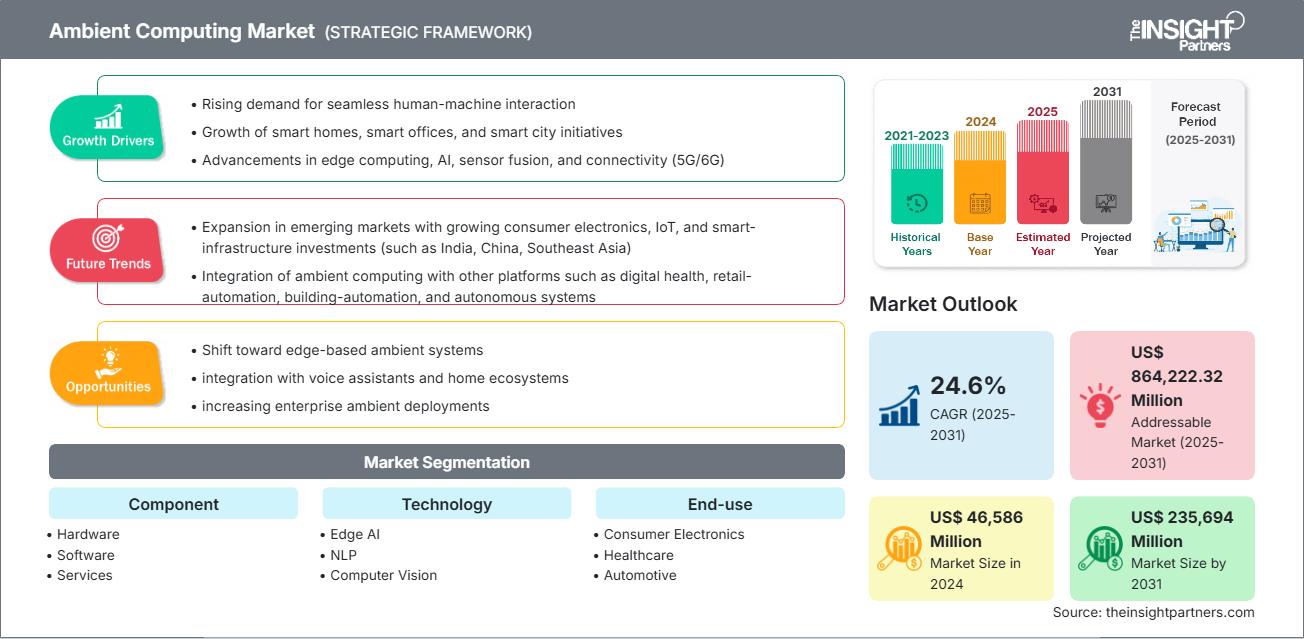
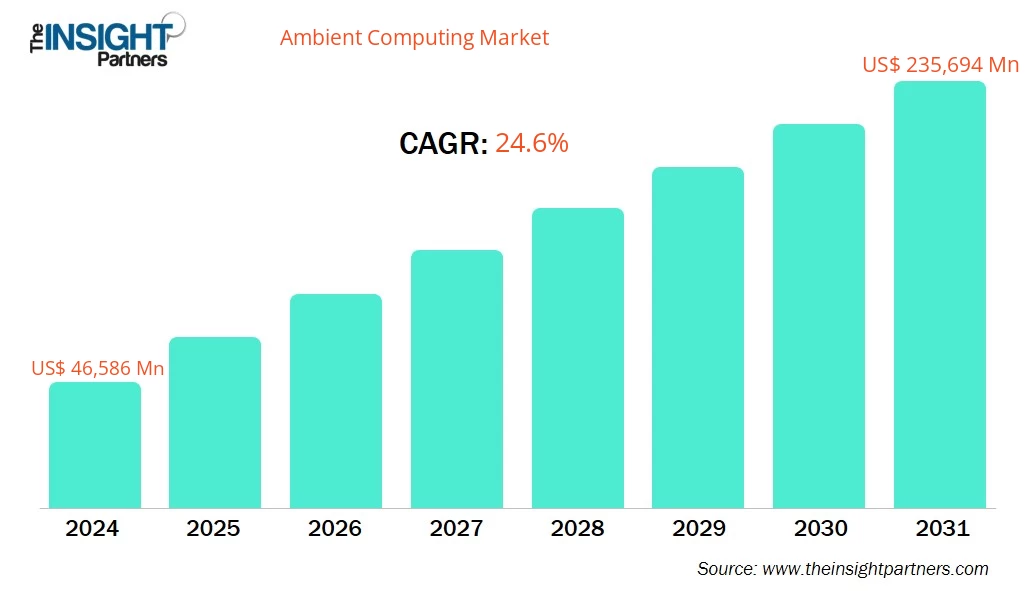
The ambient computing market was valued at US$ 61.64 Billion in 2025 and is projected to reach US$ 448.71 Billion by 2034, expanding at a CAGR of 24.68% during 2026–2034. The market is evolving through the integration of artificial intelligence, edge computing, context-aware systems, and sensor-rich environments that enable seamless human-machine interaction. The growing deployment of intelligent assistants, connected devices, and autonomous decision-making platforms continues to strengthen adoption across consumer and enterprise settings.
Across North America, accelerated digital transformation, large-scale AI investments, and widespread penetration of connected ecosystems are reinforcing long-term demand. The ambient computing market size in the region continues to benefit from enterprise cloud maturity, edge AI innovation, and increasing deployment of smart environments. Regional growth is expected to remain strong, supported by expanding intelligent device networks and advances in contextual computing applications.
Ambient Computing Market Assessment and Insights
- North America: Accounted for 34–38% Share in 2025 and is anticipated to expand at a CAGR between 23–26% during 2026–2034. Strong AI investments, advanced digital infrastructure, and smart device penetration support regional leadership.
- US: Represented 72–76% of North America in 2025 and is projected to grow at a CAGR between 24–27% during 2026–2034. Enterprise AI deployment and consumer adoption remain key demand contributors.
- Europe: Held 24–28% Share in 2025 and is expected to register a CAGR between 22–25% during 2026–2034. Germany, the UK, and France remain leading adoption hubs for intelligent computing ecosystems.
- Asia Pacific: Accounted for 28–32% Share in 2025 and is forecast to expand at a CAGR between 27–30% during 2026–2034. China, Japan, South Korea, and India continue driving technology investments and deployment.
- Largest Segment: Hardware represented 42–46% market share in 2025 and is expected to grow at a CAGR between 22–25% during 2026–2034 owing to sensors, processors, and connected-device demand.
- High Growth Segment: Machine Learning Technology held 14–18% market share in 2025 and is expected to register a CAGR between 29–32% during 2026–2034, supported by autonomous intelligence requirements.
- Key companies analyzed in detail: Amazon.com, Inc., Google LLC, Apple Inc., Microsoft Corporation, Samsung Electronics Co., Ltd., IBM Corporation, Qualcomm Incorporated, NVIDIA Corporation, Intel Corporation, Huawei Technologies Co., Ltd.
Source: The Insight Partners' analysis based on proprietary research, government publications, company annual reports, investor presentations, industry databases, and expert interviews.
The market has evolved from separate smart devices into networks of interconnected systems that can process contextual information and act upon it without any human intervention. Advancements in edge computing, low-power chipsets, cloud-based orchestration, and multimodal interfaces have opened up new avenues for the widespread use of AI.
Going forward, new areas where adoption of AI could flourish include emerging markets, digital infrastructure development, smart cities projects, and an increase in the number of connected devices. Government support for the development of AI technology, semiconductors, and advanced manufacturing capabilities will be crucial for further growth. As privacy standards and interoperability improve, the pace of adoption will pick up in currently underserved industries.
Ambient Computing Market Report Scope
| Report Attribute | Details |
|---|---|
| Market size in 2025 | US$ 61.64 Billion |
| Market Size by 2034 | US$ 448.71 Billion |
| Global CAGR (2026 - 2034) | 24.68% |
| Historical Data | 2021-2024 |
| Forecast period | 2026-2034 |
Ambient Computing Market Analysis
The ambient computing market growth trajectory is being supported by increasing demand for invisible computing experiences that minimize direct user interaction while maximizing contextual awareness. Companies are implementing AI-powered environments based on voice, image, gesture, and behavior inputs that help increase efficiency and enhance customer interactions. Growth in device connectivity and developments in edge intelligence further reinforce value creation in the ecosystem.
The value chain includes participants such as semiconductor firms, software companies, cloud services, AI platforms, systems integrators, and end users. Reductions in the cost of sensors and greater processing efficiency make it possible to implement systems on a large scale. Improved compatibility among connected devices increases the flexibility of deployment while facilitating adoption by enterprises and consumers.
The competitive environment remains shaped by technology leaders investing heavily in AI infrastructure, semiconductor advancements, and intelligent platform ecosystems. Amazon.com, Inc., Google LLC, Apple Inc., Microsoft Corporation, Samsung Electronics Co., Ltd., NVIDIA Corporation, and Qualcomm Incorporated continue expanding capabilities through product innovation, partnerships, and ecosystem integration. This ambient computing market analysis indicates that scale, data capabilities, and hardware-software optimization remain critical competitive differentiators.
Continued investment efforts remain centered on edge intelligence, multi-modal artificial intelligence (AI), AI-based assistants, and context-aware platforms. IBM Corporation, Intel Corporation, and Huawei Technologies Co., Ltd. continue concentrating on enterprise-level applications and infrastructure. Companies in the marketplace place greater importance on privacy-preserving architectures, low-latency processing, and industry-specific solutions.
● REPORT CUSTOMIZATION
Tailor This Report To Align With Your Specific Business Requirements
This report can be customized to align precisely with your business objectives, scope, and target markets. Customization options include tailored segmentation, geography, competitive analysis, and strategic insights to support informed decision-making.
Customize This Report →WHAT YOU CAN ADJUST
- ● Segmentations
- ● Geography
- ● Competitive Analysis
- ● Language Preferences
Ambient Computing Market: Strategic Insights
Regional Insights
North America ambient computing market
North America accounted for approximately 34–38% of the ambient computing market share in 2025 and is projected to expand at a 23–26% CAGR through 2034. This region enjoys its proximity to the world’s technology innovation centers, extensive deployment of AI, cloud infrastructure, and consumer acceptance of connected ecosystems. Smart home, intelligent workplace, and digital healthcare investments continue to be significant contributors.
Adoption of enterprise continues growing rapidly in areas like retail, healthcare, manufacturing, and transport. Cloud-native architecture, edge computing frameworks, and semiconductor ecosystems enable innovative developments. Government initiatives related to AI research and digital transformation boost future growth opportunities. Increasing demands for autonomous systems and intelligent experiences should keep driving growth in the region in the forecasted period.
U.S. ambient computing market
The United States represented approximately 72–76% of North America's market in 2025 and is expected to record a 24–27% CAGR through 2034. The economy is positively impacted by the availability of innovative companies such as Amazon.com, Inc., Apple Inc., Microsoft Corporation, Google LLC, NVIDIA Corporation, and Qualcomm Incorporated.
There is growing adoption of AI-powered environments among enterprises in the fields of healthcare, consumer electronics, banking, logistics, and the manufacturing industry. The investment in areas like generative AI, digital assistants, contextual computing systems, and intelligent automation remains a strong driver for future growth.
Europe ambient computing market
Europe captured approximately 24–28% market share in 2025 and is expected to grow at a 22–25% CAGR through 2034. The German market continues to lead in terms of its superior manufacturing, industrial automation, and intelligent factory technologies.
The United Kingdom enjoys the advantage of having excellent digital transformation programs, AI innovation centers, and growing implementations of intelligent customer experience software. France is making investments in AI ecosystems and smart infrastructure projects. Italy and Spain are experiencing a surge in the adoption of connected devices, smart buildings, and enterprise automation tools.
APAC ambient computing market
Asia Pacific accounted for approximately 28–32% of the market in 2025 and is projected to achieve a 27–30% CAGR through 2034. China leads adoption through extensive smart city investments, semiconductor development, and AI commercialization initiatives.
Japan, South Korea, India, and Australia continue expanding intelligent infrastructure and connected-device ecosystems. Strong manufacturing activity, increasing smartphone penetration, digitalization policies, and investments in AI research support regional expansion. The region is expected to remain the fastest-growing market globally.
Middle East & Africa ambient computing market
The Middle East & Africa market is expected to register a 21–24% CAGR during the forecast period. Saudi Arabia and the UAE are leading adoption through smart city programs, digital government initiatives, and investments in advanced technologies.
South Africa and other developing economies are gradually expanding connected infrastructure and enterprise automation capabilities. Growth is supported by modernization projects, infrastructure investments, and a greater focus on intelligent energy management and urban development.
Segmentation Analysis
Component
The Component segment is projected to expand at a 24–27% CAGR during 2026–2034. The ambient computing market scope continues to broaden as organizations combine hardware, software, and services to create intelligent environments. Hardware remains foundational due to sensors, processors, connectivity modules, and interface devices, while software and services support analytics, deployment, and lifecycle management.
- Hardware: Largest revenue contributor, supported by demand for sensors, processors, cameras, microphones, and edge computing modules that enable continuous contextual awareness and intelligent interactions.
- Software: Enables AI processing, orchestration, analytics, and decision-making functions across devices while enhancing scalability, interoperability, and user experience optimization.
- Services: Includes consulting, deployment, integration, maintenance, and managed services that help organizations implement and optimize intelligent computing environments.
Technology
The Technology segment is expected to record a 26–29% CAGR during 2026–2034. Rapid developments in artificial intelligence and contextual analytics continue transforming how systems interpret environmental, behavioral, and operational inputs. Organizations increasingly deploy integrated technology stacks to achieve seamless automation.
- Edge AI: Supports local data processing with reduced latency, improved security, and enhanced responsiveness, making it critical for industrial, healthcare, and mobility applications.
- NLP: Enables conversational interfaces and intelligent assistant capabilities through advanced language understanding and contextual communication functions.
- Computer Vision: Expands use cases involving image recognition, monitoring, surveillance, predictive maintenance, and automated decision support systems.
- Voice & Gesture Recognition: Improves natural interaction by enabling contactless control, accessibility enhancements, and personalized user experiences.
- Machine Learning: Supports adaptive intelligence, predictive modeling, behavioral analysis, and autonomous optimization across connected environments.
- Deep Learning: Delivers advanced pattern recognition and data interpretation capabilities for highly sophisticated AI applications.
End-use
The End-use segment is forecast to grow at a 25–28% CAGR through 2034. Expanding use cases across consumer and enterprise environments continue to increase deployment opportunities. Organizations seek intelligent systems capable of improving efficiency, safety, personalization, and operational intelligence.
- Consumer Electronics: Smart speakers, wearables, connected home devices, and intelligent assistants continue driving widespread user adoption and ecosystem expansion.
- Healthcare: Intelligent monitoring, diagnostics support, patient engagement systems, and connected medical devices enhance operational effectiveness and care delivery.
- Automotive: Advanced driver assistance, intelligent cockpit systems, contextual infotainment, and autonomous technology integration strengthen adoption.
- Manufacturing: Industrial monitoring, predictive maintenance, robotics, digital twins, and operational analytics support productivity improvements.
- Residential: Smart homes leverage integrated devices, energy management systems, and intelligent automation for enhanced convenience and efficiency.
Opportunity Snapshot
| End Use | Revenue Contribution | Trend Tag | Adoption Stage |
| Consumer Electronics | High | Smart Assistants | Mature |
| Healthcare | High | Remote Care | Scaling |
| Automotive | Medium | Intelligent Cockpit | Scaling |
| Manufacturing | High | Predictive Systems | Scaling |
| Residential | Medium | Connected Homes | Mature |
Ambient Computing Market Growth Drivers and Impact Analysis
Expansion of Edge Intelligence Infrastructure
The increasing use of edge computing infrastructure is allowing intelligent systems to analyze information closer to its source. Low latency, increased security, and real-time capability are among the factors that organizations are giving priority to. There is an immediate need to interpret contextual information from the surroundings provided by sensors, cameras, devices, and human interaction. Performance improvement of semiconductors and energy efficiency allows better implementation in a variety of sectors. This leads to less dependence on the cloud for better reliability and autonomy. These benefits are contributing to the growing use of the technology in factories, hospitals, transport systems, and retail sectors.
Rising Demand for Natural Human–Machine Interaction
There is a growing trend among consumers and businesses to adopt interfaces that make operations easier and more intuitive. Voice recognition, gesture-based controls, context-awareness and conversational artificial intelligence tools are helping make interactions more natural and effective. These tools are adopted by companies to enhance their customer interaction, boost employee efficiency and streamline workflows. Smart systems able to recognize environmental parameters and behavioral patterns become strategic assets for companies. This trend is facilitated by the progress in the development of language models, multimodal artificial intelligence and personalized technology solutions.
Growth of Connected Device Ecosystems
The increasing proliferation of connected devices is laying down the groundwork for intelligent computing ecosystems. Sensor data, wearable technologies, appliances, cars, and machines produce enormous amounts of data that can be analyzed to make context-driven decisions. Better wireless connections and compatibility standards lead to improved integration of devices and platforms. Companies are using these technologies for process automation, better resource utilization, and the provision of personalized services. With the growing complexity of the ecosystem, there is an increased need for intelligent coordination layers and smart analytics platforms.
Ambient Computing Market Future Trends
AI-Native Intelligent Environments
The ambient computing market trends indicate a transition toward AI-native environments where systems continuously learn from user preferences, context, and behavior. Future platforms will feature multi-modal perception, predictive intelligence, and autonomous orchestration. The use of generative AI technologies, along with sensors and edge infrastructures, will create proactive experiences compared to reactive ones. Businesses will be centered around personalization, automation, and context. As more processing power is available, intelligent environments will become more adaptive and will require less user intervention.
Privacy-Centric Architecture Development
Future technology solutions are bound to have privacy technology and decentralization of intelligence as their primary focus. There is an increasing need for architecture that exposes minimal data but provides superior functionality. It is anticipated that edge computing, federated learning, and other secure computation technologies will become popular. In addition, regulations and consumer awareness will affect platform design choices. Companies that are able to strike a balance between personalization and security will gain an edge.
Ambient Computing Market Opportunities
Industrial Context-Aware Automation Platforms
Industrial facilities are increasingly seeking intelligent platforms capable of monitoring environments, predicting operational anomalies, and automating decision processes. The adoption of connected assets and digital manufacturing initiatives creates demand for sophisticated contextual intelligence solutions. Investors can benefit from growing opportunities involving predictive maintenance, workforce augmentation, quality optimization, and real-time operational visibility. The ambient computing market Forecasts suggest continuing demand expansion as manufacturers prioritize productivity improvements and operational resilience. Vendors delivering scalable, interoperable, and secure industrial platforms are positioned to capture significant long-term value across global manufacturing ecosystems.
Healthcare Intelligence Ecosystem Expansion
Service delivery is constantly being transformed in the healthcare sector through the use of interconnected monitoring systems, smart diagnostic assistance and personalized patient engagement. Ambient technology has the potential to optimize clinical processes, improve patient results and ease administrative processes. Such an approach can be used in different institutions such as hospitals, outpatient centers, home-care settings and remote monitoring. Increasing digitalization in the healthcare industry and changing demographics have created a favorable environment for the adoption of this technology. Providers of health intelligence systems should expect growing demands in the future.
Frequently Asked Questions

- Comprehensive Market Sizing and Forecast Analysis
- Detailed Segmentation Analysis
- In-Depth Market Dynamics Assessment
- Regional and Country-Level Insights
- Competitive Landscape and Company Benchmarking
- Strategic Business Intelligence
Recent Reports
Testimonials

The Insight Partners provided valuable market intelligence that supported our global go-to-market strategy. Their team was professional, responsive, and attentive to our feedback, providing thoughtful analysis and helpful methodological clarifications throughout the project.
Junmo Kim Chief Financial Officer (CFO), Enertech Co., Ltd.
The Insight Partners' SCADA System Market report is comprehensive, with valuable insights on current trends and future forecasts. The team was highly professional, responsive, and supportive throughout. We are very satisfied and highly recommend their services.
RAN KEDEM Partner, Reali Technologies LTDs
I requested a report on a very specific software market and the team produced the report in a few days. The information was very relevant and well presented. I then requested some changes and additions to the report. The team was again very responsive and I got the final report in less than a week.
JEAN-HERVE JENN Chairman, Future Analytica
We worked with The Insight Partners for an important market study and forecast. They gave us clear insights into opportunities and risks, which helped shape our plans. Their research was easy to use and based on solid data. It helped us make smart, confident decisions. We highly recommend them.
PIYUSH NAGPAL Sr. Vice President, High Beam Global
The Insight Partners delivered insightful, well-structured market research with strong domain expertise. Their team was professional and responsive throughout. The user-friendly website made accessing industry reports seamless. We highly recommend them for reliable, high-quality research services
YUKIHIKO ADACHI CEO, Deep Blue, LLC.
This is the first time I have purchased a market report from The Insight Partners.While I was unsure at first, I visited their web site and felt more comfortable to take the risk and purchase a market report.I am completely satisfied with the quality of the report and customer service. I had several questions and comments with the initial report, but after a couple of dialogs over email with their analyst I believe I have a report that I can use as input to our strategic planning process.Thank you so much for taking the extra time and making this a positive experience.I will definitely recommend your service to others and you will be my first call when we need further market data.
JOHN SUZUKI President and Chief Executive Officer, Board Director, BK Technologies
I wish to appreciate your support and the professionalism you displayed in the course of attending to my request for information regarding to infectious disease IVD market in Nigeria. I appreciate your patience, your guidance, and the fact that you were willing to offer a discount, which eventually made it possible for us to close a deal. I look forward to engaging The Insight Partners in the future, all thanks to the impression you have created in me as a result of this first encounter.
DR CHIJIOKE ONYIA MANAGING DIRECTOR, PineCrest Healthcare Ltd.Reason to Buy
- Informed Decision-Making
- Understanding Market Dynamics
- Competitive Analysis
- Identifying Emerging Markets
- Customer Insights
- Market Forecasts
- Risk Mitigation
- Boosting Operational Efficiency
- Strategic Planning
- Investment Justification
- Tracking Industry Innovations
- Aligning with Regulatory Trends





 Get Free Sample for