
Ambient Intelligence Market Trends, Size & Growth by 2034
Coverage: by Component (Hardware, Software, Service); Application (Smart Home, Public Transport, and Education); End-User (Industrial, and Residential), and Geography (North America, Europe, Asia Pacific, and South and Central America)
- Status : Data Released
- Report Code : TIPTE00002328
- Category : Technology, Media and Telecommunications
- No. of Pages : 150
- Available Report Formats :


- Last update date : August 19, 2026


2025 Market Size
US$ 69.00 Bn
Base year value
2034 Forecast
US$ 413.49 Bn
Projected by 2034
CAGR 2026-2034
22.01 %
Growth rate
Addressable Market
US$ 1,909.34 Bn
(2026-2034)
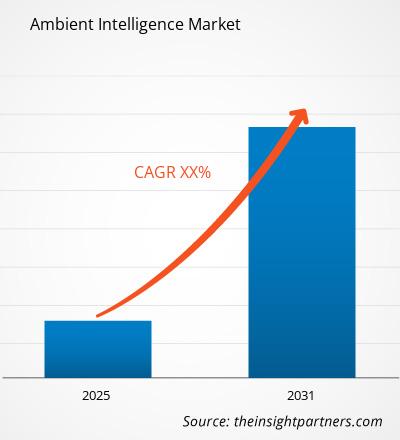
The ambient intelligence market was valued at US$ 69.00 Billion in 2025 and is projected to reach US$ 413.49 Billion by 2034, expanding at a CAGR of 22.01% during 2026–2034. The market is being shaped by the convergence of artificial intelligence, connected sensors, edge computing, and context-aware automation systems. Increasing deployment of intelligent environments across homes, educational institutions, transportation networks, and industrial facilities continues to accelerate adoption across developed and emerging economies.
Across North America, investment in smart infrastructure, intelligent building platforms, and AI-enabled automation remains substantial. The ambient intelligence market size in the region is supported by strong digital infrastructure, high smart device penetration, and enterprise spending on operational efficiency. Regional demand is expected to advance at a CAGR range of 20.5–22.5% during the forecast period, with the United States accounting for the majority of technology deployments.
Ambient Intelligence Market Assessment and Insights
- North America: Share in 2025 estimated at 34–36%, supported by building automation, smart home integration, and industrial digitalization initiatives. Market expected to grow at a 20.5–22.5% CAGR during 2026–2034.
- US: Accounts for approximately 78–82% of North American demand in 2025. Growth is projected at a 20.8–22.8% CAGR during 2026–2034, driven by AI, IoT, and smart infrastructure investments.
- Europe: Share in 2025 estimated at 26–28%, led by Germany, the UK, and France. Strong sustainability regulations and intelligent building investments support a 20.0–22.0% CAGR during 2026–2034.
- Asia Pacific: Share in 2025 estimated at 29–31%, with China, Japan, South Korea, and India leading adoption. The region is expected to register a 23.5–25.5% CAGR during 2026–2034.
- Largest Segment: Hardware holds an estimated 46–50% market share in 2025 and is expected to expand at a 20.5–22.5% CAGR during 2026–2034 owing to broad deployment of sensors, gateways, and intelligent devices.
- High Growth Segment: Smart Home represents roughly 38–42% share in 2025 and is forecast to grow at a 24.5–26.5% CAGR during 2026–2034 due to consumer demand for personalized automation.
- Key companies analyzed in detail: Schneider Electric SE, Honeywell International Inc., ABB Ltd., Siemens AG, Legrand SA, Ingersoll Rand Inc., Qualcomm Incorporated, AISense, Near Pte. Ltd., Assisted Living Technologies Inc.
Source: The Insight Partners' analysis based on proprietary research, government publications, company annual reports, investor presentations, industry databases, and expert interviews.
Technology convergence is making intelligent environments move away from being merely automated environments based on set rules to being adaptive and intelligent systems that can sense the environment and make decisions on their own. Sensor costs reduction, wireless connectivity improvements, edge computing developments, and AI analytics technologies have provided support to the commercialization of intelligent environments in residential, commercial, education and transportation areas.
The future expansion of the market is supposed to be fueled by investments in digital infrastructures in Asia Pacific, the Middle East and certain European countries. Smart cities programs, sustainability requirements, and industrial modernization are creating good opportunities for the development of the technology.
Ambient Intelligence Market Report Scope
| Report Attribute | Details |
|---|---|
| Market size in 2025 | US$ 69.00 Billion |
| Market Size by 2034 | US$ 413.49 Billion |
| Global CAGR (2026 - 2034) | 22.01% |
| Historical Data | 2021-2024 |
| Forecast period | 2026-2034 |
Ambient Intelligence Market Analysis
The ambient intelligence market growth trajectory is supported by increasing demand for intelligent environments capable of sensing, interpreting, and responding to human behavior in real time. Companies are incorporating AI algorithms into the IoT platform in order to increase their productivity and cut costs. Intelligent buildings, smart homes, and automation of industries still remain major sources of demand as companies look for decision support from information.
The supply chain consists of various stakeholders, including sensor makers, software developers, cloud services providers, system integrators, and platform providers. Developments in low-power devices, wireless networks, and embedded systems provide increased functionality as well as scalability of systems. With improvements in interoperability standards, the implementation process becomes simpler, thus stimulating the adoption of technologies.
The ambient intelligence market analysis indicates a competitive environment characterized by both global technology leaders and specialized innovators. Schneider Electric SE, Honeywell International Inc., ABB Ltd., and Siemens AG continue expanding portfolios focused on intelligent infrastructure, energy optimization, and building automation. Meanwhile, specialized firms such as AISense, Near Pte. Ltd., and Assisted Living Technologies Inc. target niche use cases, including location intelligence and assisted living applications.
Investment in venture funding and strategic partnerships continues to be relevant since companies have been putting money into AI-powered sensing systems and contextual computing solutions. The importance of cybersecurity, edge computing, predictive analysis, and cloud-native architecture becomes more pronounced among vendors. Competitiveness lies in ecosystem integration with tangible results for businesses.
● REPORT CUSTOMIZATION
Tailor This Report To Align With Your Specific Business Requirements
This report can be customized to align precisely with your business objectives, scope, and target markets. Customization options include tailored segmentation, geography, competitive analysis, and strategic insights to support informed decision-making.
Customize This Report →WHAT YOU CAN ADJUST
- ● Segmentations
- ● Geography
- ● Competitive Analysis
- ● Language Preferences
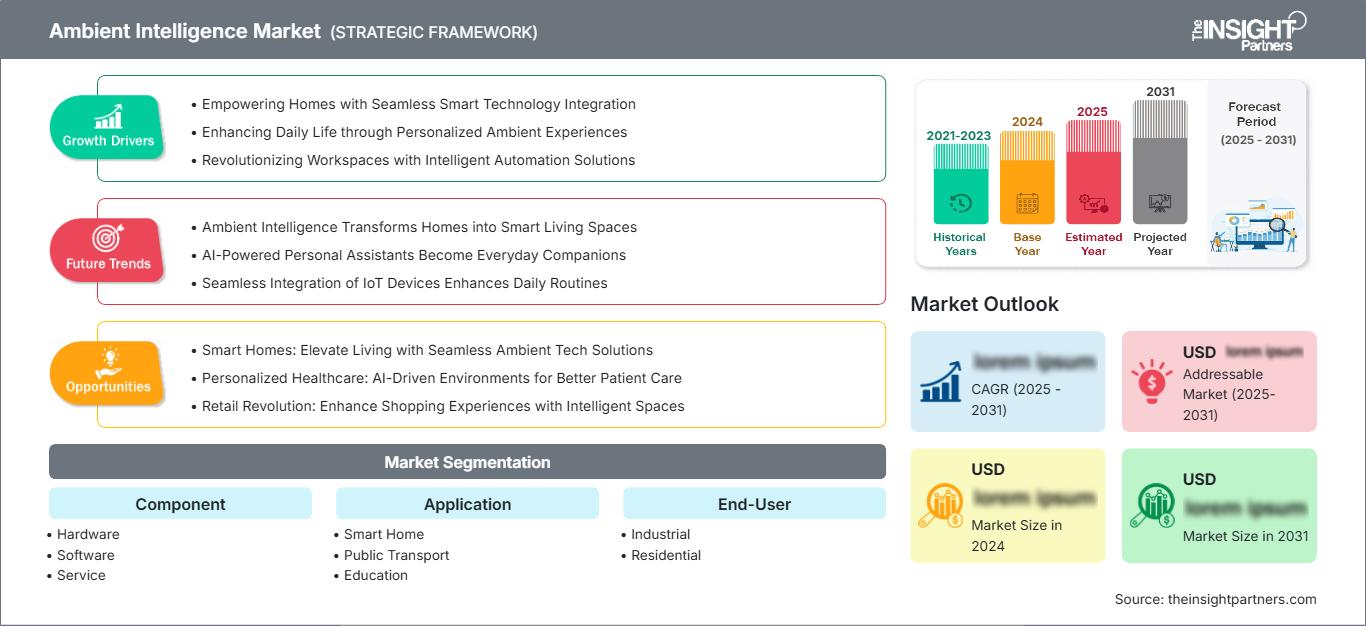
Ambient Intelligence Market: Strategic Insights
Regional Insights
North America Ambient Intelligence Market
North America accounted for approximately 34–36% of the global market in 2025 and is projected to expand at a 20.5–22.5% CAGR through 2034. The region benefits from widespread adoption of intelligent buildings, advanced communication networks, and strong investment in digital transformation. Public and private sector initiatives increasingly support the deployment of AI-enabled monitoring systems across transportation, healthcare, and commercial infrastructure.
The region's ambient intelligence market share remains the largest globally due to mature technology ecosystems and strong enterprise spending capabilities. Growth is further supported by sustainability objectives, connected infrastructure projects, and increasing demand for energy-efficient operations. Technology providers continue investing in advanced analytics, edge computing, and interoperable platforms.
U.S. Ambient Intelligence Market
The United States represented approximately 78–82% of North American demand in 2025 and is expected to advance at a 20.8–22.8% CAGR during the forecast period. High usage rates of smart home devices, intelligent workplace solutions, and automation systems help to expand the market. Heavy investment in technology makes the commercialization process easier for all industries.
Some of the biggest companies, such as Honeywell International Inc., Qualcomm Incorporated, Schneider Electric SE, and Siemens AG, operate in different parts of the country. The demand is especially high when it comes to intelligent buildings, transport systems, and intelligent homes. Increasing usage of edge computing makes scalability possible.
Europe Ambient Intelligence Market
Europe accounted for approximately 26–28% of global revenue in 2025 and is projected to register a 20.0–22.0% CAGR during 2026–2034. The region benefits from energy-efficiency regulations, digital infrastructure investments, and increasing adoption of intelligent building technologies.
Germany remains the leading European market due to strong industrial automation capabilities, extensive digitalization initiatives, and high adoption of Industry 4.0 technologies. Investment in intelligent manufacturing and connected infrastructure continues to support deployment growth.
The United Kingdom demonstrates growing demand for smart homes, connected public services, and digital urban infrastructure. France, Italy, and Spain are strengthening adoption through smart city programs, intelligent transportation modernization, and sustainability-focused construction projects, contributing to broader regional expansion.
APAC Ambient Intelligence Market
Asia Pacific held approximately 29–31% of global demand in 2025 and is forecast to achieve a 23.5–25.5% CAGR through 2034. China remains the largest market, supported by major investments in connected infrastructure, AI platforms, and smart city development.
Japan, South Korea, India, and Australia continue accelerating intelligent environment deployments across industrial and residential applications. Government digitalization programs, expanding IoT ecosystems, and rapid urbanization create substantial opportunities for future adoption.
Middle East & Africa Ambient Intelligence Market
The Middle East and Africa market is expected to register a 21.5–23.5% CAGR during the forecast period. Saudi Arabia and the UAE are investing heavily in smart urban infrastructure, intelligent buildings, and digital transformation projects designed to improve efficiency and sustainability.
South Africa and the wider MEA region are gradually adopting intelligent systems across commercial, educational, and industrial environments. Energy optimization requirements and infrastructure modernization efforts contribute to long-term market expansion.
Segmentation Analysis
Component
The Component segment is expected to register a 21.5–23.5% CAGR during 2026–2034. The segment forms the technological foundation of intelligent environments, combining physical infrastructure with software intelligence and deployment services. The market scope continues expanding as organizations adopt integrated platforms that combine sensing, analytics, and contextual decision-making capabilities.
- Hardware: Sensors, gateways, cameras, processors, and communication modules constitute the largest revenue contributor, enabling data acquisition and real-time environmental awareness across multiple applications.
- Software: AI engines, analytics platforms, orchestration tools, and contextual computing solutions drive decision-making capabilities and support intelligent automation across connected environments.
- Service: Consulting, implementation, maintenance, and managed services help organizations integrate and optimize intelligent systems while reducing deployment complexity.
Application
The Application segment is projected to grow at a 22.5–24.5% CAGR through 2034. Increasing demand for intelligent experiences, operational efficiency, safety enhancement, and energy optimization supports adoption across a wide range of end-use environments.
- Smart Home: Consumer demand for personalized automation, voice interaction, security monitoring, and energy management continues making smart homes a leading application category.
- Public Transport: Transit operators utilize intelligent systems to improve passenger flow, safety, predictive maintenance, and infrastructure utilization across connected transportation networks.
- Education: Educational institutions deploy intelligent platforms to enhance learning experiences, facility management, occupancy monitoring, and digital campus operations.
End-User
The End-User segment is anticipated to witness a 22.0–24.0% CAGR during the forecast period. Demand is supported by digital transformation strategies, sustainability goals, and increasing emphasis on connected experiences across industrial and residential environments.
- Industrial: Manufacturers and industrial operators adopt intelligent platforms to improve productivity, predictive maintenance, worker safety, and resource utilization efficiency.
- Residential: Residential adoption is driven by convenience, security, energy savings, and integration of AI-enabled connected devices within modern living environments.
Opportunity Snapshot
| Application | Revenue Contribution | Trend Tag | Adoption Stage |
| Smart Home | High | Voice AI | Mature |
| Public Transport | Medium | Smart Transit | Scaling |
| Education | Medium | Digital Campus | Scaling |
Ambient Intelligence Market Growth Drivers and Impact Analysis
Expansion of AI-Enabled Connected Infrastructure
Continuous investments made by governments and organizations in intelligent infrastructure create a conducive environment for intelligent systems implementation. More cities have started putting into place sensor networks that can monitor traffic, environmental conditions, energy usage, and public utilities. The real-time visibility provided by IoT solutions is beneficial to organizations since they get a better understanding of the situation in time to make decisions. The integration of AI into IoT systems makes them autonomous and able to adapt to changes. The current focus on sustainable infrastructure has contributed to the implementation of intelligent solutions as they minimize resource usage and cut costs.
Growing Demand for Energy-Efficient Buildings
The building owner faces growing pressures to perform better on sustainability and cut down the costs of operations. The smart environmental monitoring system facilitates automation of lighting, heating, ventilation, cooling, and occupancy management. Such systems are capable of analyzing data on an ongoing basis and thus provide for optimal energy usage while not sacrificing the level of comfort. More and more companies see the smart infrastructure as a strategically sound decision because of the efficiency and compliance gains. As the green building codes keep widening worldwide, the demand for ambient intelligence solutions will grow.
Advances in Edge Computing and Sensor Technology
With the fast pace of advancement in edge computing architecture and intelligent sensing technology, there is an improvement in responsiveness and scalability. Current systems operate on vast amounts of data near the point of origin, thereby cutting down latency times while at the same time ensuring that goals related to privacy and security are achieved. Increased cost-effectiveness of the hardware makes it possible to implement the technology in residential, education, industry, and transport sectors.
Ambient Intelligence Market Future Trends
Context-Aware Autonomous Environments
The ambient intelligence market trends increasingly indicate movement toward environments capable of autonomous adaptation without direct user interaction. Next-generation systems will rely on multimodal sensing, behavior analysis, and predictive insights to determine future needs. Intelligent environments will evolve from being reactive automation to proactive orchestration in the realm of private and public spaces. Contextual awareness will enable custom experiences, improved efficiencies, and improved outcomes from a safety perspective. Companies adopting intelligent systems through investment in next-generation AI algorithms and sensors will have an advantage.
Convergence of Digital Twins and Ambient Platforms
The use of digital twin technology will become more prevalent in ambient intelligence systems. The creation of virtual images of real assets will allow organizations to model processes, perform optimization, and schedule maintenance tasks. Real-world data obtained by sensors combined with digital models will enhance infrastructure planning and resource allocation. The development of this technology will benefit the following domains: transportation, industrial plants, educational establishments, and cities. The increase in computational power and the availability of interoperability standards will contribute to its implementation.
Ambient Intelligence Market Opportunities
Expansion Across Emerging Smart City Programs
Emerging economies continue allocating significant resources toward intelligent urban development. The ambient intelligence market Forecasts remain favorable as governments seek solutions that enhance mobility, sustainability, public safety, and infrastructure utilization. Vendors can capitalize on demand for integrated platforms spanning transportation, utilities, buildings, and public services. Strategic partnerships with municipal authorities and infrastructure developers may create long-term revenue opportunities. Investments in scalable and interoperable architectures are expected to support successful participation in large-scale deployment projects.
Growth of Assisted Living and Aging-in-Place Solutions
Population trends are leading to an increasing need for intelligent assisted living spaces. The use of smart technology can help to track activities and identify unusual behavior, enabling independent living within aging communities. The healthcare industry is becoming increasingly aware of the importance of having such proactive monitoring capabilities. Organizations that have the ability to provide intelligent solutions that protect patient privacy will likely find opportunities in the growing demand.
Frequently Asked Questions

- Comprehensive Market Sizing and Forecast Analysis
- Detailed Segmentation Analysis
- In-Depth Market Dynamics Assessment
- Regional and Country-Level Insights
- Competitive Landscape and Company Benchmarking
- Strategic Business Intelligence
Recent Reports
Testimonials

The Insight Partners provided valuable market intelligence that supported our global go-to-market strategy. Their team was professional, responsive, and attentive to our feedback, providing thoughtful analysis and helpful methodological clarifications throughout the project.
Junmo Kim Chief Financial Officer (CFO), Enertech Co., Ltd.
The Insight Partners' SCADA System Market report is comprehensive, with valuable insights on current trends and future forecasts. The team was highly professional, responsive, and supportive throughout. We are very satisfied and highly recommend their services.
RAN KEDEM Partner, Reali Technologies LTDs
I requested a report on a very specific software market and the team produced the report in a few days. The information was very relevant and well presented. I then requested some changes and additions to the report. The team was again very responsive and I got the final report in less than a week.
JEAN-HERVE JENN Chairman, Future Analytica
We worked with The Insight Partners for an important market study and forecast. They gave us clear insights into opportunities and risks, which helped shape our plans. Their research was easy to use and based on solid data. It helped us make smart, confident decisions. We highly recommend them.
PIYUSH NAGPAL Sr. Vice President, High Beam Global
The Insight Partners delivered insightful, well-structured market research with strong domain expertise. Their team was professional and responsive throughout. The user-friendly website made accessing industry reports seamless. We highly recommend them for reliable, high-quality research services
YUKIHIKO ADACHI CEO, Deep Blue, LLC.
This is the first time I have purchased a market report from The Insight Partners.While I was unsure at first, I visited their web site and felt more comfortable to take the risk and purchase a market report.I am completely satisfied with the quality of the report and customer service. I had several questions and comments with the initial report, but after a couple of dialogs over email with their analyst I believe I have a report that I can use as input to our strategic planning process.Thank you so much for taking the extra time and making this a positive experience.I will definitely recommend your service to others and you will be my first call when we need further market data.
JOHN SUZUKI President and Chief Executive Officer, Board Director, BK Technologies
I wish to appreciate your support and the professionalism you displayed in the course of attending to my request for information regarding to infectious disease IVD market in Nigeria. I appreciate your patience, your guidance, and the fact that you were willing to offer a discount, which eventually made it possible for us to close a deal. I look forward to engaging The Insight Partners in the future, all thanks to the impression you have created in me as a result of this first encounter.
DR CHIJIOKE ONYIA MANAGING DIRECTOR, PineCrest Healthcare Ltd.Reason to Buy
- Informed Decision-Making
- Understanding Market Dynamics
- Competitive Analysis
- Identifying Emerging Markets
- Customer Insights
- Market Forecasts
- Risk Mitigation
- Boosting Operational Efficiency
- Strategic Planning
- Investment Justification
- Tracking Industry Innovations
- Aligning with Regulatory Trends





 Get Free Sample for