
Ancient and Specialty Grain Flour Market Size, Growth & Demand by 2034
Coverage: by Source (Cereals, Legumes); Product Type (Teff Flour, Tigernut Flour, Cassava Flour, Arrowroot Flour, Others); Nature (Organic, Conventional); End Use (Food and Beverage Processing, Soups, Sauces, and Gravies, Household, Bakery and confectionery, Breakfast Solutions, HoReCa, Others); Distribution Channel (Hypermarkets and Supermarkets, Convenience Stores, Specialty Stores, Online) , and Geography (North America, Europe, Asia Pacific, and South and Central America)
- Status : Data Released
- Report Code : TIPRE00011268
- Category : Food and Beverages
- No. of Pages : 150
- Available Report Formats :


- Last update date : August 19, 2026


2025 Market Size
US$ 14.2 Bn
Base year value
2034 Forecast
US$ 19.42 Bn
Projected by 2034
CAGR 2026-2034
3.54 %
Growth rate
Addressable Market
US$ 152.69 Bn
(2026-2034)
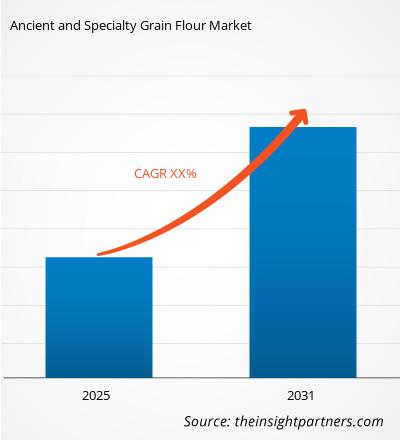
The global Ancient and Specialty Grain Flour market was valued at US$ 14.2 billion in 2025 and is expected to reach US$ 19.42 billion by 2034; it is estimated to record a CAGR of 3.54% during 2026-2034.
Ancient and Specialty Grain Flour Market Assessment and Insights
- North America: The region accounted for an estimated 31–34% share in 2025 and is expected to grow at a CAGR of 4.1–4.6% during 2026–2034, supported by gluten-free bakery and clean-label packaged food demand.
- U.S.: The U.S. represented 78–82% of North America demand in 2025, with a CAGR of 4.2–4.7% driven by retail baking mixes and specialty foodservice.
- Europe: Europe held 25–28% share in 2025 and may expand at 3.6–4.1%, led by the UK, Germany, France, Italy, and Spain through organic bakery and premium flour adoption.
- Asia Pacific: Asia Pacific represented 22–25% share in 2025 and is expected to grow at 4.5–5.1%, with China, India, Japan, South Korea, and Australia supporting diversified consumption.
- Largest Segment: Food and beverage processing held 34–38% market share in 2025 and may grow at 3.8–4.3% through industrial bakery, sauces, and ready-to-eat formulations.
- High Growth Segment: Organic flour represented 24–28% share in 2025 and may grow at 4.8–5.4% as certification, traceability, and clean-label claims influence procurement.
- Key companies analyzed in detail: Associated British Foods plc, Cargill Incorporated, Enjoy Life Foods LLC, General Mills, Inc., The Hain Celestial Group, Inc., Limagrain, Parrish & Heimbecker, Limited, SunOpta Inc., The Scoular Company, Bob’s Red Mill Natural Foods, Inc.
Source: The Insight Partners' analysis based on proprietary research, government publications, company annual reports, investor presentations, industry databases, and expert interviews.
The development of specialty flours is moving away from milling into more complex systems of ingredients for baking, breakfast solutions, sauces, soups, and home uses. Market growth is associated with advancements in milling, blending, and allergen control technologies that allow manufacturers to optimize nutrition, textures, and formulations while maintaining the differentiation of grains.
Looking into the future, the need for traceability of sourcing, organic grain supply, and investments in gluten-free processing lines will play an important role in demand formation. Emerging markets in the Asia Pacific and the Middle East represent smaller but still significant opportunities, especially in premium baking, hotel food service, and breakfast solutions packaging.
Ancient and Specialty Grain Flour Market Report Scope
| Report Attribute | Details |
|---|---|
| Market size in 2025 | US$ 14.2 Billion |
| Market Size by 2034 | US$ 19.42 Billion |
| Global CAGR (2026 - 2034) | 3.54% |
| Historical Data | 2021-2024 |
| Forecast period | 2026-2034 |
Ancient and Specialty Grain Flour Market Analysis
Market growth is driven by demand for nutrient-rich alternatives to milled wheat flour and formulations based on fiber, minerals, and allergy-friendly labeling. Manufacturers are using teff flour, tigernut flour, cassava flour, and arrowroot flour to create greater product differentiation in bakery, sauce, gravy, and breakfast items.
Supply dynamics are determined by factors including grain source, extraction rate, logistics, and certification costs. Cereals provide a steady supply volume, whereas legume and tuber flours are good for expanding functionality in gluten-free mixes. Retail-packed flours benefit from home baking applications, whereas industrial customers require uniform granule size, taste-neutral nature, and reliability of performance.
According to the Ancient and Specialty Grain Flour Market Report, the competitive market analysis shows a mixed landscape of global ingredient companies and specialist millers. Companies like Cargill Incorporated, General Mills, Inc., Associated British Foods plc, and Limagrain have been successful in gaining scale in procurement. In addition, companies such as Bob’s Red Mill Natural Foods, Inc. and The Scoular Company have built their specialty position because of their knowledge about grains and ability to formulate products specific to their clients' needs. Supply chain reliability, grain traceability, product innovation, and the capability to manage increasing demand for clean-label, nutrient-rich, and specialty baking ingredients are becoming more important factors for competition in the industry.
Investment in clean-label processing, dedicated gluten-free plants, and application support for bakery and food service clients will continue. Companies that can couple sourcing expertise with milling and formulation capabilities will be in a better position to serve the needs of manufacturers working under cost, texture, shelf-life, and labeling limitations.
● REPORT CUSTOMIZATION
Tailor This Report To Align With Your Specific Business Requirements
This report can be customized to align precisely with your business objectives, scope, and target markets. Customization options include tailored segmentation, geography, competitive analysis, and strategic insights to support informed decision-making.
Customize This Report →WHAT YOU CAN ADJUST
- ● Segmentations
- ● Geography
- ● Competitive Analysis
- ● Language Preferences
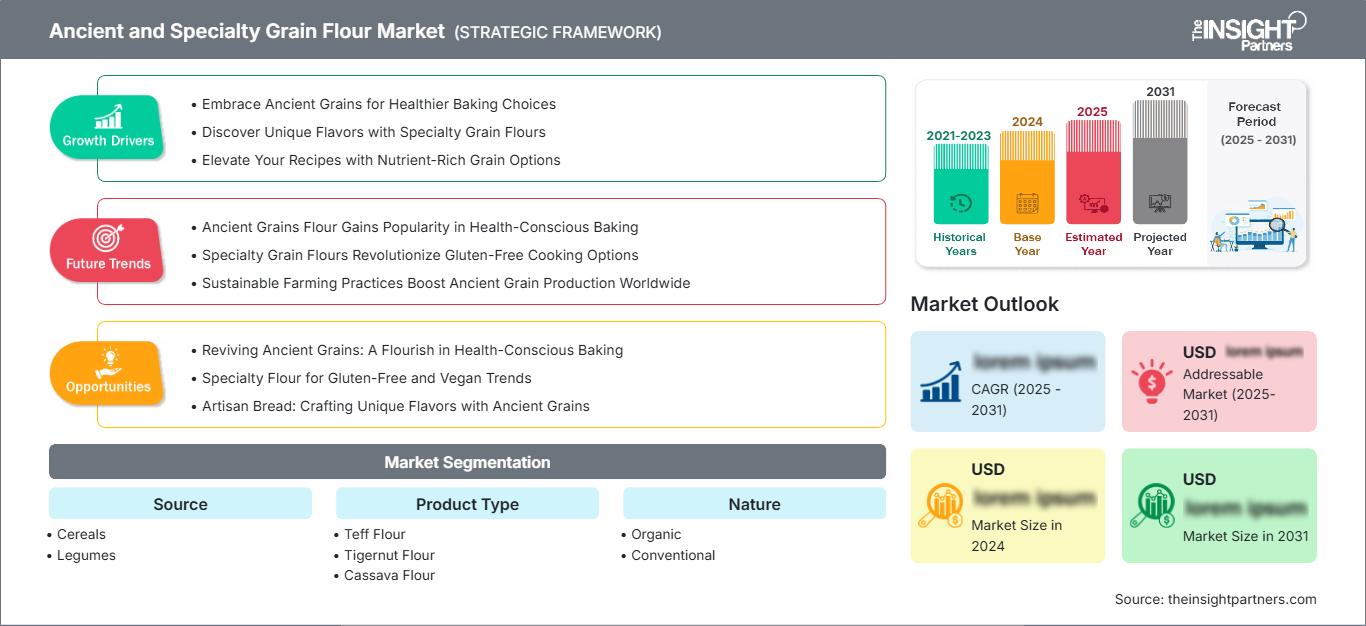
Ancient and Specialty Grain Flour Market: Strategic Insights
Regional Insights
North America ancient and specialty grain flour market
North America held an estimated 31–34% ancient and specialty grain flour market share in 2025 and may grow at 4.1–4.6% during 2026–2034. Demand is anchored in gluten-free bakery, clean-label snacks, and retail flour blends that allow brands to improve nutrition without relying only on conventional wheat alternatives.
Foodservice and packaged food manufacturers are increasing the use of cassava, arrowroot, and tigernut flour for texture management, thickening, and allergen-friendly claims. The region’s higher specialty retail penetration also supports premium pricing, especially for organic and non-GMO positioned products.
U.S. ancient and specialty grain flour Market
The U.S. accounted for 78–82% of North America's demand in 2025 and is projected to grow at 4.2–4.7%. Commercial bakeries, natural food retailers, and household baking consumers drive adoption through gluten-free mixes, high-fiber breakfast products, and clean-label sauces.
Company presence from General Mills, Inc., Cargill Incorporated, The Scoular Company, and Bob’s Red Mill Natural Foods, Inc. supports supply availability and product education. Application trends are strongest in bakery and breakfast solutions, where flour blends must deliver taste, structure, and repeatable performance.
Europe ancient and specialty grain flour Market
Europe held 25–28% share in 2025 and may expand at 3.6–4.1%. The UK and Germany lead adoption through organic bakery, gluten-free retail shelves, and specialty foodservice, while France, Italy, and Spain support demand through premium bread, confectionery, and clean-label culinary applications.
Regulatory emphasis on ingredient transparency encourages manufacturers to use recognizable grains and certified inputs. Organic and conventional formats coexist, but premium retailers increasingly favor traceable ancient grain positioning, especially for bakery mixes, breakfast products, and household flour packs.
APAC ancient and specialty grain flour Market
APAC represented 22–25% share in 2025 and is projected to grow at 4.5–5.1%. China and India support scale through packaged food expansion, while Japan, South Korea, and Australia show stronger demand for premium gluten-free and health-positioned bakery formats.
Policy support for food processing, expanding middle-class consumption, and urban retail penetration are improving adoption. The region’s growth is also linked to cassava and cereal-based flour availability, which helps local manufacturers balance cost, nutrition, and formulation flexibility.
Middle East & Africa ancient and specialty grain flour Market
The Middle East & Africa is expected to grow at 3.2–3.8% during 2026–2034. Saudi Arabia and the UAE lead premium foodservice demand, while South Africa supports retail gluten-free products and clean-label bakery innovation.
Growth is constrained by import dependence and price sensitivity, but hotel dining, premium grocery, and urban bakery chains are creating targeted opportunities. Arrowroot, cassava, and cereal flour blends are attractive where texture, shelf stability, and allergen-friendly positioning matter.
Segmentation Analysis
Source
Source includes cereals and legumes, with the segment expected to grow at 3.7–4.3% during 2026–2034. The market scope across source types reflects demand for both familiar cereal functionality and protein-rich legume inclusion in blended products.
- Cereals: Cereal-based specialty flour supports broad usage in bakery, breakfast, and packaged foods because manufacturers can achieve familiar taste profiles, reliable milling quality, and scalable procurement.
- Legumes: Legume flour contributes protein, fiber, and formulation diversity, making it relevant for clean-label snacks, breakfast solutions, and plant-forward bakery products requiring nutritional differentiation.
Product Type
Product Type is expected to grow at 3.9–4.6% as manufacturers combine root, tuber, and grain flours to achieve texture, thickening, and gluten-free performance. Teff and tigernut flours support premium nutrition, while cassava and arrowroot improve functional versatility.
- Teff Flour: Teff flour is valued for mineral content, distinctive flavor, and use in premium gluten-free bakery, where brands seek ancient grain credibility and nutritional differentiation.
- Tigernut Flour: Tigernut flour supports paleo, allergen-friendly, and high-fiber claims, making it attractive in cookies, breakfast products, and specialty retail baking blends.
- Cassava Flour: Cassava flour offers neutral taste and strong gluten-free utility, supporting bakery, sauces, gravies, and household cooking where texture and affordability are priorities.
- Arrowroot Flour: Arrowroot flour is widely used as a clean-label thickener in soups, sauces, and gravies, while also supporting delicate bakery textures.
Nature
Nature is expected to grow at 4.0–4.8%, with organic formats expanding faster than conventional products. Certification, sustainability claims, and premium retail positioning strengthen organic demand, while conventional flour remains important for cost-sensitive food processing and HoReCa use.
- Organic: Organic specialty flour benefits from clean-label expectations, traceable sourcing, and premium grocery penetration, especially in bakery mixes, household packs, and health-positioned breakfast products.
- Conventional: Conventional flour remains essential for scale applications because it offers wider availability, lower costs, and consistent supply for food processing, sauces, and foodservice.
End Use
End Use is expected to grow at 3.8–4.5%, led by food and beverage processing. Industrial users require consistent functionality, while household and HoReCa channels create demand for smaller packs, premium blends, and chef-friendly thickening or baking solutions.
- Food and Beverage Processing: Processors use specialty flour to support clean-label reformulation, gluten-free product development, and differentiated nutrition across packaged bakery, snacks, sauces, and breakfast foods.
- Soups, Sauces, Gravies: Arrowroot and cassava flour strengthen viscosity, stability, and label appeal in thickened foods where neutral flavor and smooth texture are commercially important.
- Household: Household demand is shaped by home baking, dietary experimentation, and consumer interest in gluten-free or grain-diverse pantry staples.
- Bakery and confectionery: Bakery and confectionery applications use teff, cassava, and tigernut flour to improve flavor, nutrition, and allergen-friendly positioning.
- Breakfast Solutions: Breakfast products benefit from ancient grain cues, fiber claims, and premium blends used in pancakes, cereals, porridges, and mixes.
- HoReCa: HoReCa users adopt specialty flour for menu differentiation, gluten-free alternatives, and consistent thickening across sauces, gravies, and baked products.
Opportunity Snapshot
| End Use | Revenue Contribution | Trend Tag | Adoption Stage |
| Food and Beverage Processing | High | Clean Label | Mature |
| Soups, Sauces, Gravies | Medium | Texture Control | Scaling |
| Household | Medium | Home Baking | Scaling |
| Bakery and confectionery | High | Gluten Free | Mature |
| Breakfast Solutions | Medium | Fiber Claims | Scaling |
| HoReCa | Low | Menu Premium | Emerging |
Ancient and Specialty Grain Flour Market Growth Drivers and Impact Analysis
Rising Demand for Gluten-Free and Allergen-Friendly Formulations
Gluten-free bakery, sauce, and breakfast foods are driving consistent growth in cassava, arrowroot, tigernut, and teff flours. Formulators require components that allow the development of structure and texture without depending on wheat-based systems. The trend is particularly applicable in North America and Europe, owing to consumer awareness regarding the benefits of flour alternatives due to specialty retailing and bakery packaging. It enables premium pricing because the products offer health, allergy-friendly, and clean-label attributes simultaneously.
Premiumization of Clean-Label Bakery and Breakfast Products
Manufacturers of bakery products and breakfast foods are leveraging heritage grain differentiation within crowded product categories. Teff flour provides heritage and mineral benefits; tigernut flour offers a fiber and paleo benefit, and cassava flour enhances gluten-free formulation in traditional formats. This trend drives business opportunity as companies can make premium positioning claims while adding product diversity to their offerings. With the increased availability of specialty flours through large-scale ingredient suppliers, mid-sized manufacturers have an easier time creating niche offerings without the complexity of sourcing programs.
Expansion of Organic and Traceable Ingredient Sourcing
Certification of products as being organic and traceability of sources have started to become key procurement considerations in high-end packaged food items and retail flour products. In the specialty grains flours segment, having source traceability, farming process verification, and separation from non-organic products becomes a boon to the industry. This helps in increased acceptance among natural foods retailers and clean label brands. Even though organic products may be costlier and offer limited flexibility, they provide manufacturers with a good value proposition.
Ancient and Specialty Grain Flour Market Future Trends
Multi-Flour Blends for Better Texture and Nutrition
Ancient and specialty grain flour market trends increasingly point toward blended systems that combine the strengths of cereals, legumes, roots, and tubers. One single flour cannot solve all the formulation challenges that may come along; this is particularly true for gluten-free bakery. The use of blends made from cassava, teff, arrowroot, and legume flours is likely to enhance elasticity, water absorption properties, nutritional value, and flavors. The future will see the supply of such mixes ready to apply by the suppliers instead of just individual components.
Greater Use of Specialty Flour in Foodservice Menus
The adaptation of food services is going to go beyond mere gluten-free substitution to include the differentiation of menus by chefs. There will be an incorporation of tigernut, cassava, and teff flours in cooking pancakes, coatings, sauces, pastries, and local dishes at hotels, cafés, and restaurants. The rationale behind this is the positioning of the product line for the premium category due to the potential for specialty flour to offer both nutrition and cuisine.
Ancient and Specialty Grain Flour Market Opportunities
Application-Specific Flour Systems for Industrial Buyers
The ancient and specialty grain flour market Forecasts show a strong opportunity in application-specific blends for bakery, sauces, gravies, and breakfast products. Industrial purchasers prefer products that minimize risks in formulating their products, cut down on development time, and provide reliable performance on a mass scale. There is potential for suppliers to add value through providing tested systems of flour, including information on particle size, hydration characteristics, flavors, and allergies. Margins will be higher due to the added value.
Premium Household Packs for Health-Oriented Consumers
Household customers are trying out gluten-free, organic, and diverse-grain cooking, hence opening up avenues for packaging that is smaller in size and includes directions on how to use the product. Companies can distinguish themselves by providing information on how best to use the teff flour, tigernut flour, cassava flour, and arrowroot flour. This avenue is profitable since consumers are willing to pay higher prices when there is a health reason attached to the purchase.
Frequently Asked Questions

- Comprehensive Market Sizing and Forecast Analysis
- Detailed Segmentation Analysis
- In-Depth Market Dynamics Assessment
- Regional and Country-Level Insights
- Competitive Landscape and Company Benchmarking
- Strategic Business Intelligence
Recent Reports
Testimonials

The Insight Partners provided valuable market intelligence that supported our global go-to-market strategy. Their team was professional, responsive, and attentive to our feedback, providing thoughtful analysis and helpful methodological clarifications throughout the project.
Junmo Kim Chief Financial Officer (CFO), Enertech Co., Ltd.
The Insight Partners' SCADA System Market report is comprehensive, with valuable insights on current trends and future forecasts. The team was highly professional, responsive, and supportive throughout. We are very satisfied and highly recommend their services.
RAN KEDEM Partner, Reali Technologies LTDs
I requested a report on a very specific software market and the team produced the report in a few days. The information was very relevant and well presented. I then requested some changes and additions to the report. The team was again very responsive and I got the final report in less than a week.
JEAN-HERVE JENN Chairman, Future Analytica
We worked with The Insight Partners for an important market study and forecast. They gave us clear insights into opportunities and risks, which helped shape our plans. Their research was easy to use and based on solid data. It helped us make smart, confident decisions. We highly recommend them.
PIYUSH NAGPAL Sr. Vice President, High Beam Global
The Insight Partners delivered insightful, well-structured market research with strong domain expertise. Their team was professional and responsive throughout. The user-friendly website made accessing industry reports seamless. We highly recommend them for reliable, high-quality research services
YUKIHIKO ADACHI CEO, Deep Blue, LLC.
This is the first time I have purchased a market report from The Insight Partners.While I was unsure at first, I visited their web site and felt more comfortable to take the risk and purchase a market report.I am completely satisfied with the quality of the report and customer service. I had several questions and comments with the initial report, but after a couple of dialogs over email with their analyst I believe I have a report that I can use as input to our strategic planning process.Thank you so much for taking the extra time and making this a positive experience.I will definitely recommend your service to others and you will be my first call when we need further market data.
JOHN SUZUKI President and Chief Executive Officer, Board Director, BK Technologies
I wish to appreciate your support and the professionalism you displayed in the course of attending to my request for information regarding to infectious disease IVD market in Nigeria. I appreciate your patience, your guidance, and the fact that you were willing to offer a discount, which eventually made it possible for us to close a deal. I look forward to engaging The Insight Partners in the future, all thanks to the impression you have created in me as a result of this first encounter.
DR CHIJIOKE ONYIA MANAGING DIRECTOR, PineCrest Healthcare Ltd.Reason to Buy
- Informed Decision-Making
- Understanding Market Dynamics
- Competitive Analysis
- Identifying Emerging Markets
- Customer Insights
- Market Forecasts
- Risk Mitigation
- Boosting Operational Efficiency
- Strategic Planning
- Investment Justification
- Tracking Industry Innovations
- Aligning with Regulatory Trends





 Get Free Sample for