
Android Kiosk Software Market Growth, Size & Forecast by 2034
Coverage: by Deployment Type (Cloud, On-premise); End-user (BFSI, Retail, Healthcare, Government, Logistics, Others) , and Geography (North America, Europe, Asia Pacific, and South and Central America)
- Status : Data Released
- Report Code : TIPRE00010788
- Category : Technology, Media and Telecommunications
- No. of Pages : 150
- Available Report Formats :


- Last update date : August 26, 2026


2025 Market Size
US$ 30.38 Bn
Base year value
2034 Forecast
US$ 44.20 Bn
Projected by 2034
CAGR 2026-2034
4.26 %
Growth rate
Addressable Market
US$ 338.79 Bn
(2026-2034)
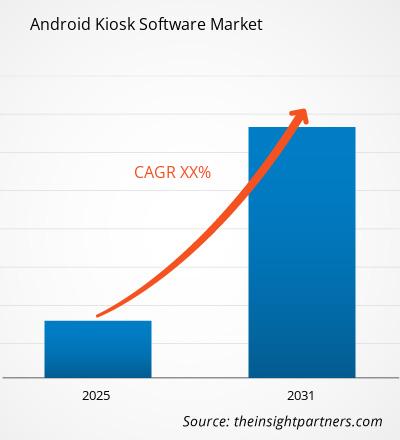
The Android kiosk software market is projected to grow from US$ 30.38 billion in 2025 to US$ 44.20 billion by 2034, registering a CAGR of 4.26% during 2026–2034. Adoption is supported by enterprise demand for secure device lockdown, remote fleet administration, application whitelisting, and controlled user access across customer-facing and employee-facing Android endpoints.
North America remains a mature adoption hub, supported by large retail chains, healthcare networks, airport operators, financial institutions, and public agencies, modernizing self-service infrastructure. Cloud deployment, remote monitoring, and Android Enterprise controls are strengthening the Android kiosk software market size outlook as enterprises seek lower support costs and standardized user experiences.
Android Kiosk Software Market Assessment and Insights
- North America accounted for an estimated 34–37% share in 2025 and is expected to grow at a CAGR of 3.8–4.4% during 2026–2034, supported by self-service retail, healthcare check-in, and government service kiosks.
- US represented nearly 78–82% of North America in 2025, with growth at 3.9–4.5% due to enterprise mobility programs and contactless service modernization.
- Europe held 24–27% share in 2025 and is expected to grow at 3.5–4.1%, led by the UK, Germany, France, Italy, and Spain.
- Asia Pacific captured 27–31% share in 2025 and is projected to expand at 4.9–5.6%, led by China, Japan, South Korea, India, and Australia.
- Largest Segment: Cloud deployment held 60–64% market share in 2025 and is forecast to grow at 4.7–5.3% as distributed device fleets require centralized configuration.
- High Growth Segment: Healthcare accounted for 16–19% share in 2025 and is expected to grow at 5.1–5.8% as hospitals expand patient check-in, wayfinding, queue management, and secure tablet use.
- Key companies analyzed in detail: 42Gears Mobility Systems Pvt. Ltd., Esper, KioWare, Meridian Kiosks, Mitsogo Inc., NoviSign Digital Signage Inc., Photo Booth Solutions, LLC, PROVISIO GmbH, Scalefusion, Zoho Corporation Pvt. Ltd., Hexnode, and ManageEngine.
Source: The Insight Partners' analysis based on proprietary research, government publications, company annual reports, investor presentations, industry databases, and expert interviews.
The market has evolved from basic device lockdown utilities into integrated endpoint control platforms that combine policy enforcement, remote troubleshooting, content scheduling, peripheral management, and analytics, as highlighted in the Android Kiosk Software Market Report. Android adoption benefits from hardware affordability and broad device availability, while kiosk software vendors differentiate through enterprise-grade security, multi-app controls, browser restrictions, and compatibility with payment, printer, scanner, and signage peripherals.
Forward-looking demand will be shaped by multi-location rollouts, public-sector digitization, and service automation in emerging economies. The android kiosk software market growth path is steady rather than speculative, with enterprises prioritizing reliability, lifecycle management, and centralized compliance over stand-alone kiosk applications. Cloud-managed products will continue gaining preference where fleets are geographically dispersed.
Android Kiosk Software Market Report Scope
| Report Attribute | Details |
|---|---|
| Market size in 2025 | US$ 30.38 Billion |
| Market Size by 2034 | US$ 44.20 Billion |
| Global CAGR (2026 - 2034) | 4.26% |
| Historical Data | 2021-2024 |
| Forecast period | 2026-2034 |
Android Kiosk Software Market Analysis
Demand is rising as organizations convert Android tablets, kiosks, and signage displays into dedicated-use endpoints. The Android kiosk software market growth is linked to retail self-checkout, banking service terminals, healthcare registration, logistics proof-of-delivery, and government citizen-service portals. There is increasing demand among buyers for remote firmware upgrades, app versioning control, usage tracking, and device diagnostics to lower the need for on-site maintenance.
Supply factors include mobile device management players, kiosk systems suppliers, digital signage solution providers, and Android Enterprise ecosystem participants. Players like 42Gears Mobility Systems Pvt. Ltd., Esper, Scalefusion, Hexnode, and Mitsogo Inc. compete on scale, capabilities and support of unattended installations, whereas KioWare, PROVISIO GmbH, Meridian Kiosks, and NoviSign Digital Signage Inc. offer specialization in interactive kiosks and digital signage applications.
The industry fragmentation is moderate as deployment needs vary across industries. Retailers prioritize fast content updates and peripheral reliability, hospitals emphasize privacy and workflow stability, and government agencies require secure session control. Android kiosk software market analysis also shows that vendors are positioning around cloud orchestration, no-code policy templates, and integration with UEM suites.
Investment priorities are moving toward device observability, remote remediation, and automated provisioning. Esper emphasizes DevOps-style Android fleet management, ManageEngine and Zoho Corporation Pvt. Ltd. leverage broader IT management ecosystems, and Scalefusion focuses on unified endpoint controls. This creates room for specialized software and integrated device-management platforms to coexist.
● REPORT CUSTOMIZATION
Tailor This Report To Align With Your Specific Business Requirements
This report can be customized to align precisely with your business objectives, scope, and target markets. Customization options include tailored segmentation, geography, competitive analysis, and strategic insights to support informed decision-making.
Customize This Report →WHAT YOU CAN ADJUST
- ● Segmentations
- ● Geography
- ● Competitive Analysis
- ● Language Preferences
Android Kiosk Software Market: Strategic Insights

Regional Insights
North America android kiosk software market
North America is expected to retain a 34–37% android kiosk software market share in 2025, supported by significant use of Android endpoints in retail, healthcare, BFSI, logistics, and public-service environments. The region is projected to grow at a 3.8–4.4% CAGR as enterprises modernize customer-facing infrastructure while controlling device misuse, data exposure, and support costs.
Large chains and service providers are adopting cloud-managed kiosk platforms for device lockdown, content control, session reset, and remote diagnostics. Growth is strongest where kiosks must operate across multi-site networks, including pharmacies, banks, hospitals, quick-service restaurants, and municipal offices that need standardized interface behavior.
U.S. android kiosk software market
The US represented 78–82% of North America in 2025 and is expected to grow at a CAGR of 3.9–4.5%. Adoption is driven by self-service retail lanes, digital patient intake, airport kiosks, banking terminals, and enterprise mobility projects that require Android devices to remain limited to approved applications.
Vendor presence is broad, with 42Gears Mobility Systems Pvt. Ltd., KioWare, Esper, Scalefusion, Hexnode, and ManageEngine supporting deployments across commercial and public settings. Application trends indicate rising demand for browser lockdown, payment-peripheral compatibility, secure guest sessions, and over-the-air policy changes.
Europe android kiosk software market
Europe held a 24–27% share in 2025 and is forecast to grow at a 3.5–4.1% CAGR. The UK and Germany lead adoption, supported by retail automation, transportation ticketing, healthcare check-in, and digital public-service access. France, Italy, and Spain are progressing through tourism, banking, and municipal-service kiosk programs.
European buyers emphasize data protection, controlled browser sessions, and reliable device recovery. Vendors with strong compliance controls and on-premise or hybrid options benefit from regulated sectors. Cloud adoption is still expanding, particularly among retailers and service providers operating multiple branches.
APAC android kiosk software market
APAC accounted for 27–31% share in 2025 and is expected to grow at a 4.9–5.6% CAGR. China leads in self-service retail and smart-city installations, while Japan and South Korea emphasize service automation, transport terminals, and digital signage networks.
India and Australia are expanding deployments in banking, healthcare, government services, and logistics. Lower Android hardware costs and growing managed mobility programs increase the Android kiosk software market scope across small and large enterprises seeking scalable device control.
Middle East & Africa android kiosk software market
The Middle East & Africa is projected to grow at a 4.2–4.9% CAGR, supported by smart-city programs, retail modernization, airport infrastructure, and public-service digitization. Government portals, hospitality, and transport hubs in Saudi Arabia and the UAE have led regional adoption.
South Africa and the rest of MEA have seen gradual adoption in the banking, logistics, and health sectors. This growth is driven by connectivity and managed service availability as well as software capable of handling multilingual interfaces and ruggedized Android endpoints.
Segmentation Analysis
Deployment Type
Deployment Type is expected to grow at a 4.4–5.1% CAGR as enterprises balance scalability, control, and integration needs. Cloud deployment leads because it supports distributed kiosk fleets, rapid provisioning, policy synchronization, and reduced maintenance. On-premise deployment remains relevant for regulated environments requiring local control and stricter data handling.
- Cloud enables centralized policy updates, device monitoring, app publishing, and troubleshooting across dispersed locations, making it preferred for retail, logistics, healthcare, and multi-branch enterprise fleets.
- On-premise supports organizations with strict internal governance, sensitive operations, or limited external connectivity, particularly in financial institutions, government agencies, and high-security facilities.
End-user
End-user demand is expected to grow at a 4.2–5.0% CAGR, reflecting wider use of Android devices for secure self-service and controlled workflows. The android kiosk software market trends point to stronger uptake among hospitals, banks, retailers, logistics operators, and government service centers aiming to improve service consistency.
- BFSI uses kiosk controls for digital banking terminals, queue systems, customer onboarding, and secure self-service interactions, where session reset and restricted access are operational priorities.
- Retail relies on kiosk software for product lookup, order placement, loyalty enrollment, signage, self-checkout support, and staff-facing inventory tools across distributed store networks.
- Healthcare deploys Android kiosks for patient check-in, appointment confirmation, wayfinding, visitor registration, and controlled tablet workflows that require privacy-aware device restrictions.
- Government adopts kiosk platforms for citizen-service portals, queue management, registration, public information access, and multilingual self-service terminals in municipal offices and transport facilities.
- Logistics uses controlled Android endpoints for proof-of-delivery, driver check-in, warehouse scanning, dispatch visibility, and rugged workflow terminals operating in high-volume environments.
Opportunity Snapshot
Market Opportunity Snapshot
| End-user | Revenue Contribution | Trend Tag | Adoption Stage |
| BFSI | High | Secure Banking | Mature |
| Retail | High | Self Checkout | Scaling |
| Healthcare | Medium | Patient Intake | Scaling |
| Government | Medium | Citizen Access | Scaling |
| Logistics | Medium | Fleet Workflow | Emerging |
Android Kiosk Software Market Growth Drivers and Impact Analysis
Rising self-service automation across customer-facing operations
Companies have been spending on self-service kiosks to cut down the waiting time, increase operating hours, and provide consistent user experiences. The hardware available with Android gives flexibility in terms of costs for big installations, while the kiosk software makes sure that users do not have access to any application that is not authorized. Locations like retail stores, healthcare facilities, banks, transportation hubs, and government agencies can gain through the predictability, updatability, and reduced on-site support needs.
Enterprise focus on secure dedicated-use Android devices
The use of Android devices as business-oriented tools, not as general-purpose tablets, is becoming more common. The kiosk mode software enables companies to configure the Android device in such a way that it would be able to operate in either one app or multi-app mode, restrict browsers, prohibit using the system settings and control the usage of peripherals. The effect of this becomes very apparent in BFSI, healthcare and governmental use cases.
Cloud fleet management reducing operational complexity
Cloud-based kiosk software enables IT staff to register, configure, update, manage, and support the devices remotely, which is particularly valuable for businesses, transportation companies, hospitals, and public organizations that have to manage multiple kiosks located in different places. It helps to save time on maintenance because diagnostics can be done remotely, and it guarantees consistency in policy distribution across different locations. As businesses grow and deploy more regions, cloud management becomes a critical selling point.
Android Kiosk Software Market Future Trends
AI-assisted device monitoring and predictive support
Android kiosk software market trends increasingly point toward analytics-led fleet operations. The vendors should consider implementing AI-driven alerts when the devices show any irregularities, applications crash, there are problems with batteries, network issues, and frequent session failures. The predictive maintenance will enable organizations to avoid downtime by taking preventive measures before the kiosks go down. The above functions will be highly useful in retail, health care, transportation, and logistics scenarios.
Deeper integration with unified endpoint management platforms
Future rollouts will require kiosk management capabilities in the context of greater endpoint management solutions environments. Corporations will seek a single platform for their Android kiosk, rugged devices, tablets, smartphones, and PCs. That will foster greater cooperation between kiosk experts and the UEM software, along with the development of new products from companies that are currently active in mobility management.
Android Kiosk Software Market Opportunities
Healthcare workflow digitization beyond reception areas
Hospitals and clinics are also extending the use of their Android devices to applications beyond just front desk check-in. These opportunities include information kiosks at patient beds, workflow tablets for healthcare workers, pick-up kiosks in the pharmacy, consent station kiosks, and visitor management kiosks. Software companies that develop kiosks can distinguish themselves with privacy features, session clearing, remote assistance, and system integrations with scheduling systems.
Public-sector service modernization in emerging markets
Self-service systems for various tasks such as registration, payment, permitting, public information, and feedback from citizens are being implemented by governmental organizations in developing countries. The hardware platform is provided by Android devices at low costs, and kiosk software guarantees controlled access and a common user interface. Vendors offering multilingual capabilities, offline capabilities, remote monitoring, and secure session management could serve municipalities, transportation sites, and other public places. The Android kiosk software market Forecasts remain positive, where digital inclusion and service automation are policy priorities.
Frequently Asked Questions

- Comprehensive Market Sizing and Forecast Analysis
- Detailed Segmentation Analysis
- In-Depth Market Dynamics Assessment
- Regional and Country-Level Insights
- Competitive Landscape and Company Benchmarking
- Strategic Business Intelligence
Recent Reports
Testimonials

The Insight Partners provided valuable market intelligence that supported our global go-to-market strategy. Their team was professional, responsive, and attentive to our feedback, providing thoughtful analysis and helpful methodological clarifications throughout the project.
Junmo Kim Chief Financial Officer (CFO), Enertech Co., Ltd.
The Insight Partners' SCADA System Market report is comprehensive, with valuable insights on current trends and future forecasts. The team was highly professional, responsive, and supportive throughout. We are very satisfied and highly recommend their services.
RAN KEDEM Partner, Reali Technologies LTDs
I requested a report on a very specific software market and the team produced the report in a few days. The information was very relevant and well presented. I then requested some changes and additions to the report. The team was again very responsive and I got the final report in less than a week.
JEAN-HERVE JENN Chairman, Future Analytica
We worked with The Insight Partners for an important market study and forecast. They gave us clear insights into opportunities and risks, which helped shape our plans. Their research was easy to use and based on solid data. It helped us make smart, confident decisions. We highly recommend them.
PIYUSH NAGPAL Sr. Vice President, High Beam Global
The Insight Partners delivered insightful, well-structured market research with strong domain expertise. Their team was professional and responsive throughout. The user-friendly website made accessing industry reports seamless. We highly recommend them for reliable, high-quality research services
YUKIHIKO ADACHI CEO, Deep Blue, LLC.
This is the first time I have purchased a market report from The Insight Partners.While I was unsure at first, I visited their web site and felt more comfortable to take the risk and purchase a market report.I am completely satisfied with the quality of the report and customer service. I had several questions and comments with the initial report, but after a couple of dialogs over email with their analyst I believe I have a report that I can use as input to our strategic planning process.Thank you so much for taking the extra time and making this a positive experience.I will definitely recommend your service to others and you will be my first call when we need further market data.
JOHN SUZUKI President and Chief Executive Officer, Board Director, BK Technologies
I wish to appreciate your support and the professionalism you displayed in the course of attending to my request for information regarding to infectious disease IVD market in Nigeria. I appreciate your patience, your guidance, and the fact that you were willing to offer a discount, which eventually made it possible for us to close a deal. I look forward to engaging The Insight Partners in the future, all thanks to the impression you have created in me as a result of this first encounter.
DR CHIJIOKE ONYIA MANAGING DIRECTOR, PineCrest Healthcare Ltd.Reason to Buy
- Informed Decision-Making
- Understanding Market Dynamics
- Competitive Analysis
- Identifying Emerging Markets
- Customer Insights
- Market Forecasts
- Risk Mitigation
- Boosting Operational Efficiency
- Strategic Planning
- Investment Justification
- Tracking Industry Innovations
- Aligning with Regulatory Trends





 Get Free Sample for