
Anomaly Detection Market Size, Share, and Growth Analysis by 2034
Coverage: By Component (Software, Service); Deployment (On-Premises, Cloud, Hybrid); Technology (Big Data Analytics, Data Mining and Business Intelligence, Machine Learning and Artificial Intelligence); Industry (BFSI, Retail, Manufacturing, IT and Telecom, Defence, Healthcare, Others) , and Geography (North America, Europe, Asia Pacific, and South and Central America)
- Status : Data Released
- Report Code : TIPRE00003059
- Category : Technology, Media and Telecommunications
- No. of Pages : 150
- Available Report Formats :


- Last update date : August 27, 2026


2025 Market Size
US$ 8.88 Bn
Base year value
2034 Forecast
US$ 31.03 Bn
Projected by 2034
CAGR 2026-2034
14.9 %
Growth rate
Addressable Market
US$ 170.54 Bn
(2026-2034)
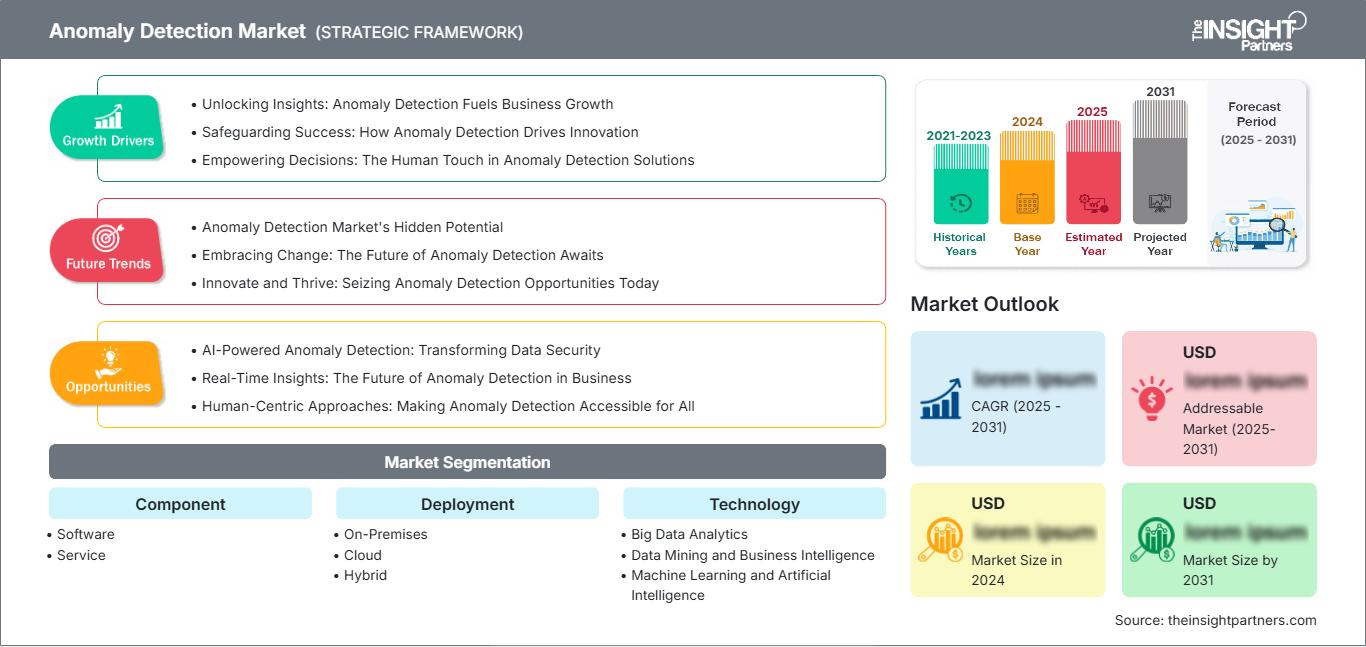
The Anomaly detection market was valued at US$ 8.88 Billion in 2025 and is projected to reach US$ 31.03 Billion by 2034, expanding at a CAGR of 14.9% during 2026–2034. Rising volumes of machine-generated data, accelerating cloud adoption, and increasing use of artificial intelligence across enterprise operations are strengthening demand for anomaly identification platforms that improve operational resilience, security monitoring, and real-time decision support across multiple industries.
Across North America, enterprise investments in cybersecurity analytics, cloud-native observability platforms, and automated business monitoring continue to support adoption. The anomaly detection market size in the region benefits from strong technology spending, mature digital infrastructure, and widespread deployment of machine learning tools in BFSI, healthcare, and telecom sectors. Regional growth is expected to remain within the 13.5–15.5% range through the forecast period.
Anomaly Detection Market Assessment and Insights
- North America: Share in 2025 estimated at 36–40%, supported by advanced AI deployment, cybersecurity spending, and cloud migration initiatives. CAGR between 13.5–15.5% during 2026–2034.
- US: Represents 75–80% of North American demand in 2025, supported by strong enterprise software ecosystems and federal cybersecurity programs. CAGR between 13.5–15.5% during 2026–2034.
- Europe: Share in 2025 estimated at 25–29%, led by Germany, the UK, and France. AI governance frameworks and industrial automation support CAGR of 13.0–15.0% during 2026–2034.
- Asia Pacific: Share in 2025 estimated at 24–28%, led by China, Japan, India, and South Korea. Rapid digitalization supports CAGR of 16.0–18.0% during 2026–2034.
- Largest Segment: Software segment holds 66–70% market share in 2025, benefiting from enterprise-scale deployments and API integration capabilities. CAGR of 14.0–16.0% during 2026–2034.
- High Growth Segment: Cloud deployment accounts for 44–48% share in 2025 and is projected to record CAGR of 16.0–18.0% through 2034 due to scalability and lower infrastructure requirements.
- Key companies analyzed in detail: Anodot Ltd., Cisco Systems, Inc., Guardian Analytics, Happiest Minds Technologies Limited, Hewlett Packard Enterprise Company, International Business Machines Corporation, SAS Institute Inc., Broadcom Inc. (Symantec), Trustwave Holdings, Inc., Wipro Limited, TIBCO Software Inc., CrunchMetrics, Dynatrace LLC, Anomaly Inc., KNIME AG, Microsoft Corporation, Prophix Software Inc., Zoho Corporation Pvt. Ltd., SolarWinds Worldwide, LLC, Flowmon Networks a.s., Accenture plc, Avora Limited, Mechademy Incorporated, Intel Corporation, Profit Software Ltd., icetana Limited, Crosser Technologies AB, DataCamp, Inc., NVIDIA Corporation.
Source: The Insight Partners' analysis based on proprietary research, government publications, company annual reports, investor presentations, industry databases, and expert interviews.
Innovations in technology have led to the evolution of anomaly detection from rule-based systems to autonomous systems, which can learn on their own and be able to analyze structured and unstructured data streams. Machine learning algorithms have been incorporated by firms into their operational workflows, allowing them to carry out monitoring in cybersecurity, industrial assets, customer transactions, and application performance environments.
Going forward, investments are anticipated to increase in Asia Pacific, the Middle East, and some countries in Latin America, where there will be expansion in digital transformation projects. The government AI plans in the region, increased interest in the issue of fraud management, and the drive for modernization in enterprises will contribute to the adoption of predictive monitoring technologies.
Anomaly Detection Market Report Scope
| Report Attribute | Details |
|---|---|
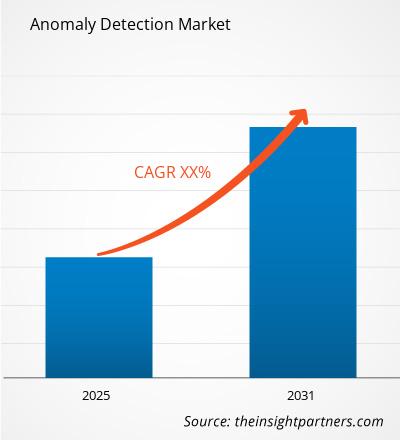
| Market size in 2025 | US$ 8.88 Billion |
| Market Size by 2034 | US$ 31.03 Billion |
| Global CAGR (2026 - 2034) | 14.9% |
| Historical Data | 2021-2024 |
| Forecast period | 2026-2034 |
Anomaly Detection Market Analysis
This market’s growth pattern is fueled by the growing need for real-time detection of fraud, security breaches, equipment failures, and anomalies in the process. Companies create an abundance of operational and transactional data that surpasses the capabilities of traditional methods of analysis. Hence, there is a growing investment in analytics tools able to detect abnormalities before problems arise.
A variety of partners, including software providers, cloud computing service providers, AI platforms providers, and systems integrators, help create comprehensive solutions. Improvements in computing power, access to more data, and integration with ERP and CRM tools contribute to the adoption rate. BFSI and healthcare companies continue to be the heaviest users of analytics tools.
Market analysis suggests that the current market is becoming highly competitive with the use of product innovation and ecosystem collaboration. Some of the leading firms involved in increasing the power of AI include International Business Machines Corporation, Microsoft Corporation, Dynatrace LLC, Cisco Systems, Inc., and SAS Institute Inc.
Current investment trend favors explainable AI, cloud observability, cybersecurity analytics, and industrial monitoring tools. Some of the key firms involved in such initiatives include Anodot Ltd., TIBCO Software Inc., Wipro Limited, Accenture plc, Hewlett Packard Enterprise Company, and NVIDIA Corporation.
● REPORT CUSTOMIZATION
Tailor This Report To Align With Your Specific Business Requirements
This report can be customized to align precisely with your business objectives, scope, and target markets. Customization options include tailored segmentation, geography, competitive analysis, and strategic insights to support informed decision-making.
Customize This Report →WHAT YOU CAN ADJUST
- ● Segmentations
- ● Geography
- ● Competitive Analysis
- ● Language Preferences
Anomaly Detection Market: Strategic Insights
Regional Insights
North America Anomaly Detection Market
North America accounted for approximately 36–40% anomaly detection market share in 2025 and remains the largest regional contributor. Enterprise technology expenditure, cloud adoption, and cybersecurity spending indicate steady growth. Companies are making use of anomaly detection systems for threat intelligence, transaction monitoring, operational resiliency, and infrastructure management. Growth of the region is estimated to be between 13.5–15.5% CAGR up until 2034.
The US and Canada are still making investments in artificial intelligence-enabled analytics in the financial sector, healthcare, military, and telecommunications industry. The increasing demand for predictive maintenance and digital risk management solutions offers a good environment for vendors. Investment in AI, along with a strong software landscape, ensures regional dominance during the forecast period.
U.S. Anomaly Detection Market
The United States represents roughly 75–80% of North American demand and is projected to grow at a CAGR of 13.5–15.5% through 2034. Highly concentrated software vendors, hyperscale cloud service providers, and cybersecurity firms can increase the pace of implementing solutions within business and governmental organizations.
Institutions such as banks, hospitals, retail stores, manufacturing enterprises, and government organizations implement sophisticated monitoring solutions for detecting fraud, cybersecurity issues, and process problems. Market players like Microsoft Corporation, Cisco Systems, Inc., International Business Machines Corporation, Dynatrace LLC, SolarWinds Worldwide, LLC, and NVIDIA Corporation hold notable market positions. The future growth can be further driven by the implementation of AI governance models and automation within enterprises.
Europe Anomaly Detection Market
Europe held an estimated 25–29% share in 2025 and is expected to achieve a CAGR of 13.0–15.0% through 2034. Germany is still considered the leader owing to industrial automation and digitalization of manufacturing.
The UK is driven by an active fintech scene, cybersecurity investments, and cloud usage in finance. The demand shifts to the analysis of fraud cases, regulatory compliance, and risk assessment of customers.
Germany, France, Italy, and Spain together contribute to regional development with the help of Industry 4.0, smart manufacturing, and healthcare modernization projects. Companies start adopting machine learning platforms for better business visibility and identification of new risks.
APAC Anomaly Detection Market
Asia Pacific accounted for roughly 24–28% of global demand in 2025 and is expected to generate the fastest regional growth at a CAGR of 16.0–18.0% through 2034. China leads adoption, supported by AI investment and industrial digitalization programs.
India, Japan, South Korea, and Australia continue increasing deployment across banking, telecommunications, healthcare, and manufacturing sectors. Expanding cloud infrastructure and national AI strategies contribute to rapid market development.
Middle East & Africa Anomaly Detection Market
The Middle East & Africa market is projected to expand at a CAGR of 14.0–16.0% through 2034. Saudi Arabia and the UAE remain primary adopters due to smart city projects, digital government programs, and growing cybersecurity requirements.
South Africa and other regional economies are investing in analytics-enabled infrastructure management and financial crime prevention systems. Energy sector modernization and large-scale infrastructure developments further support adoption.
Segmentation Analysis
Component
The component segment is projected to grow at a CAGR of 14.0–16.0%. The market scope continues expanding as enterprises deploy integrated software environments supported by specialized implementation and managed services. Demand is driven by growing automation requirements and enterprise-wide monitoring needs.
- Software: Dominant category supporting real-time data analysis, predictive monitoring, automated alerting, and integration with enterprise platforms across multiple industries.
- Service: Includes consulting, implementation, maintenance, and managed support activities that improve deployment effectiveness and operational performance.
Deployment
The deployment segment is expected to expand at a CAGR of 15.0–17.0%. Organizations increasingly evaluate deployment models based on scalability, security requirements, compliance considerations, and infrastructure flexibility.
- On-Premises: Preferred by organizations requiring direct infrastructure control, strict governance policies, and localized data management environments.
- Cloud: Expanding rapidly through subscription models, scalability advantages, and simplified integration with advanced analytics capabilities.
- Hybrid: Supports organizations balancing regulatory obligations with cloud-enabled flexibility and distributed operational environments.
Technology
The technology segment is projected to grow at a CAGR of 15.0–17.0%. Technology innovation remains central to solution effectiveness as enterprises seek greater accuracy and lower false-positive rates.
- Big Data Analytics: Enables large-scale processing of structured and unstructured datasets for operational intelligence and predictive insights.
- Data Mining and Business Intelligence: Supports pattern discovery, risk identification, and performance assessment using historical and real-time information.
- Machine Learning and Artificial Intelligence: Provides advanced anomaly recognition, model adaptation, and automated decision support capabilities.
Industry
The industry segment is expected to achieve a CAGR of 14.0–16.0%. Adoption is expanding as organizations prioritize operational efficiency, cybersecurity resilience, and predictive monitoring.
- BFSI: Major user segment focused on fraud detection, transaction monitoring, and regulatory compliance management.
- Retail: Applies analytics to inventory, customer behavior, and payment risk monitoring.
- Manufacturing: Utilizes predictive maintenance and production optimization applications.
- IT and Telecom: Deploys solutions for network performance and service reliability monitoring.
- Defense: Uses advanced analytics for surveillance and threat identification.
- Healthcare: Employs anomaly monitoring to support diagnostics, cybersecurity, and operational effectiveness.
Opportunity Snapshot
| Segment Name | Revenue Contribution | Trend Tag | Adoption Stage |
| BFSI | High | Fraud Analytics | Mature |
| Retail | Medium | Payment Monitoring | Scaling |
| Manufacturing | High | Predictive Maintenance | Scaling |
| IT and Telecom | High | Network Visibility | Mature |
| Defence | Medium | Threat Intelligence | Scaling |
| Healthcare | Medium | Clinical Monitoring | Emerging |
Anomaly Detection Market Growth Drivers and Impact Analysis
Expansion of Enterprise AI and Automation
There is an increasing need for businesses to automate decision-making processes through tools that continuously validate the outputs produced during operations. The use of anomaly detection tools is beneficial in the identification of anomalies in transactions, applications, industrial machines, and customer interactions that could grow into more serious problems. There has been a rapid adoption of these technologies due to the incorporation of AI in business processes. The increased investment in machine learning tools provides new opportunities to platform developers.
Rising Cybersecurity and Fraud Prevention Requirements
Cyberattacks have been increasing in number and complexity, which has created an even stronger need for behavioral analytics technology. Conventional means of cybersecurity protection are usually incapable of dealing with such attack patterns and threat environments. Anomaly detection uses behavioral analysis of a user, network, and systems to find anomalies and detect malicious actions. Financial organizations, hospitals, and government agencies have been deploying artificial intelligence-based cybersecurity monitoring systems to protect their information.
Growth of Industrial IoT and Connected Infrastructure
Manufacturers, utilities, logistics providers, and energy companies deploy growing numbers of connected devices generating continuous operational data streams. Detecting abnormal equipment behavior before failure occurs supports maintenance optimization and operational continuity. Advanced analytics platforms improve asset utilization while reducing unplanned downtime. Increasing deployment of industrial sensors and edge computing technologies strengthens demand for monitoring solutions capable of processing high-volume, real-time information across geographically distributed environments.
Anomaly Detection Market Future Trends
Generative AI Integration with Monitoring Platforms
The anomaly detection market trends increasingly point toward the integration of generative AI with predictive monitoring systems. Future platforms are expected to deliver natural-language explanations, automated root-cause analysis, and guided remediation recommendations. Enterprises are prioritizing transparency and explainability alongside detection performance. As AI governance requirements become more rigorous, vendors will develop solutions that provide interpretable outcomes while maintaining high analytical accuracy across expanding data environments.
Growth of Real-Time Streaming Analytics
Continuous analysis of live data streams will become a defining capability across next-generation platforms. Organizations are moving beyond batch processing toward immediate event evaluation. Telecommunications providers, banks, retailers, and manufacturers increasingly demand instant identification of unusual behaviors. Improvements in cloud computing, edge processing, and distributed architectures are expected to enhance scalability, lower latency, and support broader enterprise deployment of predictive monitoring technologies.
Anomaly Detection Market Opportunities
Untapped Demand Across Mid-Sized Enterprises
Mid-sized organizations increasingly pursue digital transformation, yet often lack advanced monitoring infrastructure. Vendors can capitalize through flexible subscription models, managed services, and simplified deployment architectures. The growing availability of cloud-native platforms reduces implementation barriers and expands accessibility. According to current anomaly detection market Forecasts, demand from small and medium enterprises is expected to represent a substantial incremental revenue opportunity as adoption broadens beyond large enterprises.
Sector-Specific Vertical Solutions
Industry-focused offerings present attractive growth potential. Healthcare, manufacturing, defense, and utilities require specialized analytical models aligned with operational realities and compliance obligations. Companies capable of delivering purpose-built solutions supported by domain expertise can improve adoption outcomes. Verticalized platforms help reduce implementation complexity while enhancing detection effectiveness. Strategic partnerships with industry stakeholders may further strengthen market penetration and long-term customer retention.
Frequently Asked Questions

- Comprehensive Market Sizing and Forecast Analysis
- Detailed Segmentation Analysis
- In-Depth Market Dynamics Assessment
- Regional and Country-Level Insights
- Competitive Landscape and Company Benchmarking
- Strategic Business Intelligence
Recent Reports
Testimonials

The Insight Partners provided valuable market intelligence that supported our global go-to-market strategy. Their team was professional, responsive, and attentive to our feedback, providing thoughtful analysis and helpful methodological clarifications throughout the project.
Junmo Kim Chief Financial Officer (CFO), Enertech Co., Ltd.
The Insight Partners' SCADA System Market report is comprehensive, with valuable insights on current trends and future forecasts. The team was highly professional, responsive, and supportive throughout. We are very satisfied and highly recommend their services.
RAN KEDEM Partner, Reali Technologies LTDs
I requested a report on a very specific software market and the team produced the report in a few days. The information was very relevant and well presented. I then requested some changes and additions to the report. The team was again very responsive and I got the final report in less than a week.
JEAN-HERVE JENN Chairman, Future Analytica
We worked with The Insight Partners for an important market study and forecast. They gave us clear insights into opportunities and risks, which helped shape our plans. Their research was easy to use and based on solid data. It helped us make smart, confident decisions. We highly recommend them.
PIYUSH NAGPAL Sr. Vice President, High Beam Global
The Insight Partners delivered insightful, well-structured market research with strong domain expertise. Their team was professional and responsive throughout. The user-friendly website made accessing industry reports seamless. We highly recommend them for reliable, high-quality research services
YUKIHIKO ADACHI CEO, Deep Blue, LLC.
This is the first time I have purchased a market report from The Insight Partners.While I was unsure at first, I visited their web site and felt more comfortable to take the risk and purchase a market report.I am completely satisfied with the quality of the report and customer service. I had several questions and comments with the initial report, but after a couple of dialogs over email with their analyst I believe I have a report that I can use as input to our strategic planning process.Thank you so much for taking the extra time and making this a positive experience.I will definitely recommend your service to others and you will be my first call when we need further market data.
JOHN SUZUKI President and Chief Executive Officer, Board Director, BK Technologies
I wish to appreciate your support and the professionalism you displayed in the course of attending to my request for information regarding to infectious disease IVD market in Nigeria. I appreciate your patience, your guidance, and the fact that you were willing to offer a discount, which eventually made it possible for us to close a deal. I look forward to engaging The Insight Partners in the future, all thanks to the impression you have created in me as a result of this first encounter.
DR CHIJIOKE ONYIA MANAGING DIRECTOR, PineCrest Healthcare Ltd.Reason to Buy
- Informed Decision-Making
- Understanding Market Dynamics
- Competitive Analysis
- Identifying Emerging Markets
- Customer Insights
- Market Forecasts
- Risk Mitigation
- Boosting Operational Efficiency
- Strategic Planning
- Investment Justification
- Tracking Industry Innovations
- Aligning with Regulatory Trends





 Get Free Sample for