
Antimony Market Growth, Trends & Forecast by 2034
Coverage: By Product type (Trioxides, Alloys, Others); Applications (Flame retardant, Plastic additives, Lead acid batteries, Glass and ceramics, Others); End-use (Chemical, Automotive, Electrical and electronics, Defense, Others) , and Geography (North America, Europe, Asia Pacific, and South and Central America)
- Status : Data Released
- Report Code : TIPRE00004847
- Category : Chemicals and Materials
- No. of Pages : 150
- Available Report Formats :


- Last update date : September 01, 2026


2025 Market Size
US$ 2.51 Bn
Base year value
2034 Forecast
US$ 3.45 Bn
Projected by 2034
CAGR 2026-2034
3.60 %
Growth rate
Addressable Market
US$ 27.07 Bn
(2026-2034)
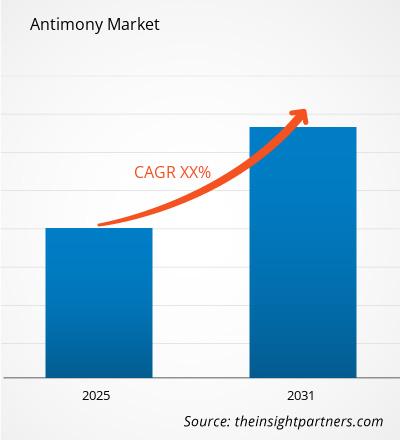
The antimony market was valued at US$ 2.51 Billion in 2025 and is projected to reach US$ 3.45 Billion by 2034, expanding at a 3.60% CAGR from 2026 to 2034. Demand remains anchored in antimony trioxide for flame retardancy, antimonial lead alloys for batteries, and specialty applications in glass and ceramics. Supply-chain concentration, critical-mineral policies, and investment in alternative mining and refining capacity are increasingly influencing procurement strategies across industrial markets.
North America is expected to record an estimated 4.2–4.8% CAGR during 2026–2034, supported by defense-oriented stockpiling, domestic mine development, and efforts to reduce dependence on concentrated overseas supply. The antimony market size in the region is also influenced by battery materials, flame-retardant applications, and strategic investment in domestic processing. The US Geological Survey identifies antimony as a critical mineral because of supply disruption exposure and its importance to defense and industrial systems.
Antimony Market Assessment and Insights
- North America: North America is estimated to account for 18–22% share in 2025 and expand at a 4.2–4.8% CAGR between 2026–2034, supported by defense procurement, domestic mining initiatives, and investment in refining resilience.
- US: The US represents approximately 75–80% of North America's 2025 share and is projected to grow at a 4.4–5.0% CAGR between 2026–2034, led by defense and critical-mineral security.
- Europe: Europe holds an estimated 16–20% share in 2025 and is expected to grow at a 3.0–3.6% CAGR between 2026–2034, with Germany, Italy, France, the UK, and Spain supporting industrial consumption.
- Asia Pacific: Asia Pacific commands approximately 50–54% share in 2025 and is expected to expand at a 3.5–4.1% CAGR between 2026–2034, with China, India, Japan, and South Korea representing major demand centers.
- Largest Segment: Trioxides represent an estimated 60–65% market share in 2025, expanding at a 3.7–4.2% CAGR between 2026–2034, reflecting extensive flame-retardant and industrial applications.
- High Growth Segment: Electrical and electronics account for approximately 12–16% market share in 2025 and are expected to grow at a 4.8–5.6% CAGR between 2026–2034, supported by specialty materials demand.
- Key companies analyzed in detail: AMG Advanced Metallurgical Group N.V.; Belmont Metals Inc.; Huachang Antimony Industry; Hunan ChenZhou Mining Group Co., Ltd.; Korea Zinc Company Ltd.; Nihon Seiko Co., Ltd.; Recylex S.A.; United States Antimony Corporation; Village Main Reef Limited; Yunnan Muli Antimony Industry Co., Ltd.
Source: The Insight Partners' analysis based on proprietary research, government publications, company annual reports, investor presentations, industry databases, and expert interviews.
Increasingly, the production economics of antimony are being influenced by issues such as geographic concentration, the quality of the ore, processing complexity, and the availability of associated metal feedstocks. Antimony trioxide continues to play a major role in non-metal applications, whereas antimonial lead is required for battery alloys. Export controls have elevated the strategic significance of non-Chinese supplies, leading to investments in mine reclamation projects, secondary processing, refinement, and offtake arrangements.
Over the forecast period, supply diversification will be a more pronounced investment theme in North America, Australia, and some African countries. Government-funded financial support, critical minerals policies, and defense procurements may help to make projects financially viable in cases where normal commercial demand cannot do so on its own. Recycled antimony will become increasingly important, especially where the material can be recovered from lead-acid batteries and metallurgical slags, without requiring additional primary mining.
Antimony Market Report Scope
| Report Attribute | Details |
|---|---|
| Market size in 2025 | US$ 2.51 Billion |
| Market Size by 2034 | US$ 3.45 Billion |
| Global CAGR (2026 - 2034) | 3.60% |
| Historical Data | 2021-2024 |
| Forecast period | 2026-2034 |
Antimony Market Analysis
Demands for antimony are driven by chemical companies, alloy makers, battery makers, glass companies, plastics companies, and electronic companies. Antimony ore mining firms or those who recover antimony as a by-product carry out extraction activities while concentrates are roasted, reduced, volatilized or processed using hydrometallurgy method. Antimony metals and oxides products are distributed to compounders and industrial manufacturers via distributors and specialty processors.
Supply is structurally concentrated, thus making it susceptible to factors such as export policy, transport issues, energy costs and treatment capabilities. As per USGS data on 2025, it can be stated that China was the largest mined producer of antimony with an output of roughly 40,000 metric tons whereas global mined production was approximately 110,000 tons.
The competition is made up of primary miners, refiners, alloy producers, chemical processors, and firms that create supply chains from raw materials to final products. In terms of antimony market analysis, companies such as AMG Advanced Metallurgical Group N.V., Korea Zinc Company Ltd., United States Antimony Corporation, and Yunnan Muli Antimony Industry Co., Ltd. have different competitive positions in terms of processing and material supply. Huanchang and Hunan Chenzhou mining Group Co., Ltd. improve the ecosystem of China in upstream and processing segments.
Firms have started focusing on secure supply of feedstocks over capacity building. The firm called Perpetua Resources is working on an antimony resource in the US, whereas other firms not part of the current producer group have started evaluating projects in North America and Australia. Belmont Metals Inc., Nihon Seiko Co., Ltd., and Village Main Reef Limited increase the diversity of competition through metals processing, specialty materials, and mining business.
● REPORT CUSTOMIZATION
Tailor This Report To Align With Your Specific Business Requirements
This report can be customized to align precisely with your business objectives, scope, and target markets. Customization options include tailored segmentation, geography, competitive analysis, and strategic insights to support informed decision-making.
Customize This Report →WHAT YOU CAN ADJUST
- ● Segmentations
- ● Geography
- ● Competitive Analysis
- ● Language Preferences
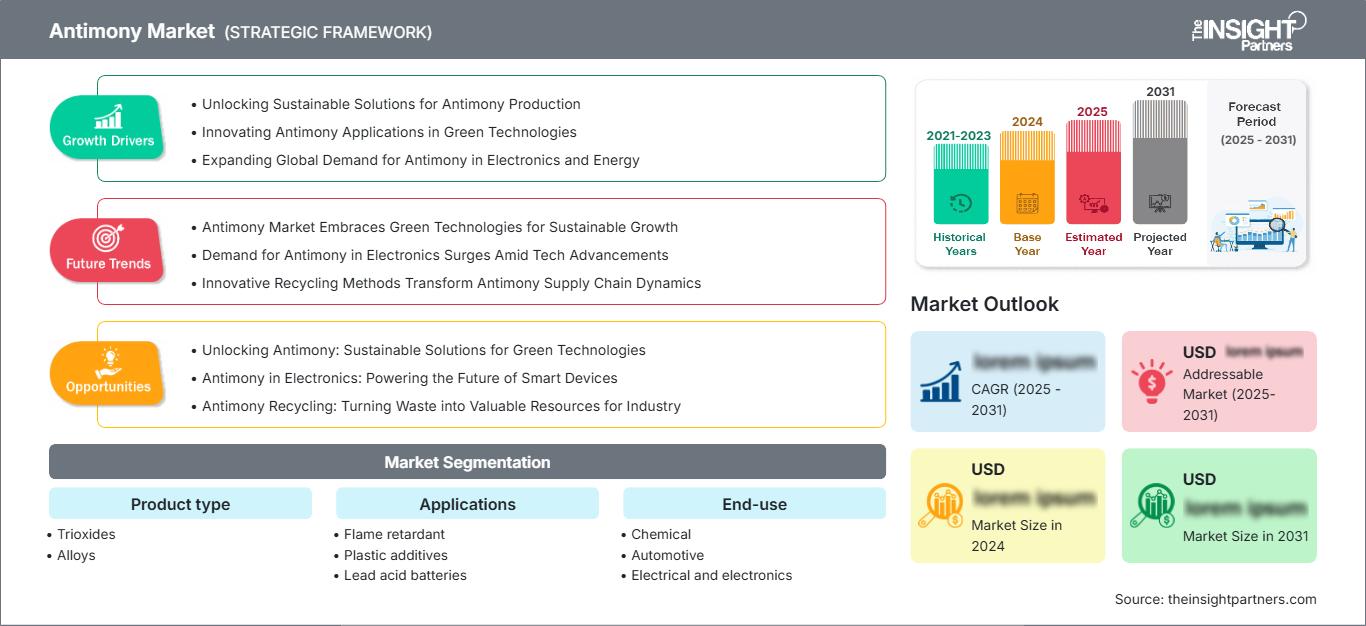
Antimony Market: Strategic Insights
Regional Insights
North America antimony market
North America is estimated to represent 18–22% share in 2025 and expand at a 4.2–4.8% CAGR through 2034. Positioning of the region is becoming more powerful as antimony becomes an important mineral associated with the issues of defense preparedness, battery reliability, and supply chain security. Critical minerals in the United States have become strategic infrastructure for federal government policies that promote domestic exploration, processing, inventory building, and securing procurement of minerals. Metallurgical experience and access to recycling streams add up to the strengths of the region.
United States is the dominant consumer and developer of projects in the region, and Canada makes its contribution by developing polymetallic resources and conducting exploration activities. Demand is diversified into flame retardant systems, lead-acid batteries, ammunition materials, and specialty alloys. The combination of import dependency and geopolitical risks is a justification for domestic investment, although permitting, financing, processing capacity, and environmental requirements are significant barriers.
U.S. antimony Market
The US represents approximately 75–80% of North America's 2025 antimony market share and is expected to grow at a 4.4–5.0% CAGR through 2034. Defense procurement is especially critical in demand for antimony as it is applied in materials for ammunition and fire retardants. Battery applications give another industrial foundation for demand, whereas electronics and specialty materials account for small but strategically significant streams of demand.
There is also considerable potential to increase domestic supply sources. Perpetua Resources is developing the Stibnite Gold Project in Idaho, whereas Americas Gold and Silver has already shown capability for antimony production at the Galena Complex. United States Antimony Corporation also participates in the process of domestic sourcing. Thus, the US market moves from being dependent on imports to having a portfolio of mining, by-product sourcing, recycling, government-led projects and strategic reserves.
Europe antimony Market
Europe accounts for an estimated 16–20% share in 2025 and is projected to expand at a 3.0–3.6% CAGR, with Germany serving as a leading industrial demand center. Regional market dynamics include chemical production, automotive materials, electronics, glass, and flame retardants. The security of supply has led to increased diversification and analysis of critical minerals.
The UK and Germany continue to be industrial markets, with the UK being advantaged due to its specialty materials and defense uses, whereas Germany’s automotive, electrical, chemical, and manufacturing industry helps it use large amounts of antimony. France, Italy, and Spain add via automotive parts, building materials, glass, electronics, and chemical processing. Increasing emphasis on traceability and recycling is seen in Europe.
APAC antimony Market
APAC represents approximately 50–54% share in 2025 and is expected to grow at a 3.5–4.1% CAGR. China is still the top nation with well-established infrastructure for mining and processing. Japan and South Korea have significant demand for specialty materials and electronics; India is working on developing its industrial and battery value chain. Australia offers an important source of raw materials.
Industrial production, electronics manufacturing, demand for flame retardants, and batteries drive consumption. Increasing policy focus is placed on critical minerals security and processing capabilities within domestic boundaries. The export controls imposed by China have also prompted end-users in Japan, South Korea, India, and Australia to seek additional suppliers and explore recycling options.
Middle East & Africa antimony Market
Middle East and Africa is expected to record a 2.5–3.1% CAGR, with South Africa representing a leading regional market through its mining and metallurgical ecosystem. Saudi Arabia and UAE utilize diversification in industry, infrastructure development, and downstream processing, while Rest of MEA provides possibilities in resource development.
Availability of energy sources, mineral processing facilities, and industrial investments will be key factors in supply participation in the future. South Africa already possesses the required facilities for mining, which can be used for polymetallic extraction, while Gulf countries are developing their facilities for the whole chain of minerals and metals. Nevertheless, lack of specialized facilities for antimony refining and complicated project development hinder participation.
Segmentation Analysis
Product type
The Product type segment is projected to expand at a 3.5–4.1% CAGR from 2026–2034. Trioxides remain the dominant commercial form because of their role in flame-retardant formulations and specialty chemical systems. Alloys remain important for lead-acid batteries and selected metal applications. Demand increasingly depends on product purity, particle characteristics, downstream specifications, and regional availability. Supply disruptions can affect both forms differently depending on processing routes and inventories.
- Trioxides: Trioxides maintain the strongest position because antimony trioxide functions as a synergist in flame-retardant systems across plastics, textiles, coatings, and industrial materials.
- Alloys: Alloys remain strategically important for lead-acid batteries and specialized metal products, where antimony contributes hardness, strength, casting behavior, and cycling performance.
Applications
The Applications segment is forecast to grow at a 3.6–4.2% CAGR from 2026–2034. Flame retardants represent a substantial consumption base, while lead-acid batteries provide established metal demand. Glass and ceramics require antimony compounds for selected refining and optical functions. Plastic additives increasingly depend on regulatory-compliant formulations and material-performance requirements, creating opportunities for higher-purity products.
- Flame retardant: Flame retardants remain a core application because antimony compounds work synergistically with halogenated systems, improving fire performance in plastics, textiles, electrical products, and industrial components.
- Plastic additives: Plastic additives use antimony compounds where fire resistance, processing performance, and formulation compatibility are required, particularly in engineered polymer systems and demanding industrial applications.
- Lead acid batteries: Lead acid batteries remain an established application because antimonial alloys provide mechanical strength and casting characteristics, although battery manufacturers increasingly optimize alloy formulations for maintenance and efficiency.
- Glass and ceramics: Glass and ceramics use antimony compounds in selected formulations requiring fining, optical characteristics, or specialty performance, supporting stable demand from technical and architectural material producers.
End-use
The End-use segment is expected to grow at a 3.4–4.0% CAGR from 2026–2034. Chemical applications remain significant because antimony is converted into oxides, salts, and specialty intermediates. Automotive demand is linked to batteries and material systems, while electrical and electronics applications benefit from flame-retardant requirements. Defense remains strategically important because supply assurance can outweigh conventional price considerations.
- Chemical: Chemical end uses provide the broadest processing base, covering antimony oxides, compounds, catalysts, pigments, and intermediate materials used in downstream industrial formulations.
- Automotive: Automotive demand is linked to lead-acid batteries, flame-retardant components, coatings, and specialty materials where durability and thermal or fire performance are required.
- Electrical and electronics: Electrical and electronics applications depend on fire-safe polymers, cable systems, circuit-related materials, and specialty components, making compliance and material reliability important procurement criteria.
- Defense: Defense demand is strategically significant because antimony supports flame protection, ammunition-related materials, alloys, and other systems where dependable access can be prioritized over conventional commercial economics.
Opportunity Snapshot
| Application | Revenue Contribution | Trend Tag | Adoption Stage |
|---|---|---|---|
| Flame retardant | High | Fire safety | Mature |
| Plastic additives | Medium | Polymer safety | Scaling |
| Lead acid batteries | High | Battery alloys | Mature |
| Glass and ceramics | Medium | Optical refining | Scaling |
Antimony Market Growth Drivers and Impact Analysis
Critical-mineral policies are accelerating supply-chain diversification
Governments are increasingly treating antimony as a strategic input rather than a conventional industrial commodity. The US has included antimony in their list of critical minerals up until 2025, and Australia has also declared it to be both critical and strategic mineral. Such an approach helps in improving financing, reaching offtake agreements, stocking minerals, and reducing the challenges of setting up domestic processing facilities. For producers, such an approach will help achieve long-term contracts and funding from government sources. Downstream users benefit by diversifying their sourcing strategy and building safety stocks. It has more value for alternatives with traceability, defensive purposes, and valid process chains. In the future, such an approach is expected to result in lower dependence on concentrated sources and higher premiums for reliability.
Flame-retardant requirements sustain chemical consumption
Demand for antimony compounds continues to be driven by regulations concerning fire safety in areas such as construction, transport, electrical equipment, consumer goods, and industrial materials. Antimony trioxide is extensively used in conjunction with halogenated flame retardant formulations to allow required properties to be met without depending exclusively on additive loading. In this way, regulatory trends affecting fire safety and product compliance will influence consumption through the demands that these place on formulation. Demand is greatest when it is necessary to meet conflicting requirements for ignition protection, physical properties, processability, and economics. The influence is not restricted to plastics, extending also to textiles, paints, cables, and certain composites.
Battery and alloy applications provide a durable demand foundation
Lead acid batteries are still an important application channel for antimony since lead alloys with antimony provide better mechanical properties and casting properties. Despite the fact that other battery technologies are developing, lead acid batteries are still used for the start-up systems of automobiles, backup purposes, telecommunications industry, industrial equipment, and some energy storage applications. Moreover, antimony is used in the manufacture of special-purpose alloys where hardening and strengthening properties play an important role. Such a solid industrial base guarantees demand stability despite volatility of separate application sectors. In addition, recycling plays an important role due to the fact that there is an advanced system of lead acid batteries collection and processing, which allows using antimony-containing products via well-established secondary metal streams.
Antimony Market Future Trends
Greater integration of mining, refining, and downstream processing
The antimony market trends are moving toward integrated supply chains that connect mineral extraction with concentration, refining, oxide conversion, and customer-specific product manufacturing. The commercial risks involved in projects that have been designed on the basis of a particular mining stage may become higher in cases where there are restrictions imposed on the export of materials as well as constraints on third party processing capacity. The use of integrated systems may help in overcoming such risks through the control of quality of the feedstock and scheduling of processing operations. Projects that will come up in future would most probably focus on modular refining plants, regional stockpiles, and downstream processing capacity through contracting.
Secondary recovery will become a larger strategic supply source
The antimony Market report shows that secondary recovery is expected to gain importance as buyers seek supply resilience without relying exclusively on new mines. Antimony can enter recycling streams through lead-acid batteries, metallurgical residues, industrial scrap, and selected end-of-life products. Improved separation technologies could increase recovery from materials that were previously treated mainly for their lead, copper, silver, or other metal content. This approach is particularly relevant in countries with established recycling infrastructure and limited primary resources. Over the long term, recyclers may develop dedicated antimony recovery circuits, while refiners could use hydrometallurgical techniques to separate antimony from complex concentrates. Increased secondary production would diversify supply and potentially reduce exposure to geopolitical disruptions affecting mined material.
Antimony Market Opportunities
Develop regional refining hubs outside concentrated supply centers
The antimony market Forecasts indicate an expanding strategic case for regional refining hubs in North America, Australia, and selected European or African locations. Investors can target facilities capable of converting concentrates into metal, trioxides, sulfides, and customer-specific intermediates rather than relying solely on mine development. Such facilities can process imported or locally produced feedstock, creating flexibility when individual mines experience disruptions. Attractive opportunities exist where governments offer critical-mineral incentives and where ports, power, skilled labor, and downstream consumers are available. Investors should prioritize projects with multiple feedstock sources, established environmental controls, and long-term offtake commitments. Refining hubs could capture value from supply-chain bottlenecks while providing manufacturers with greater certainty over product availability, specifications, and delivery schedules.
Commercialize antimony recovery from polymetallic resources
A second opportunity involves recovering antimony from deposits historically valued primarily for gold, silver, copper, lead, or other metals. Modern separation technologies can improve recovery from complex mineral assemblages and potentially transform previously penalized antimony into a saleable by-product. The antimony market scope therefore extends beyond dedicated antimony mines to polymetallic operations with suitable mineralogy and existing processing infrastructure. Investors can reduce development risk by adding recovery circuits to producing mines rather than constructing entirely new operations. Commercial evaluation should focus on metallurgical recoveries, concentrate quality, impurity management, processing costs, and potential offtake specifications. Projects capable of producing multiple metals can also benefit from diversified revenue streams, improving resilience during periods of commodity-price volatility.
Recent Developments
- September 8, 2025: Americas Gold and Silver Corporation announced metallurgical testing at its Galena Complex achieved more than 99% antimony extraction from copper concentrate using alkaline selective leaching. The result supports potential production of saleable antimony products from material historically treated as a by-product, strengthening the commercial case for domestic US antimony recovery.
- October 1, 2025: Nova Minerals Limited announced that its US subsidiary received US$43.4 million in Defense Production Act Title III funding to accelerate antimony trisulfide production at the Estelle Project in Alaska. The funding supports an integrated domestic supply chain covering extraction, concentration, and refining for military-grade material.
Frequently Asked Questions

- Comprehensive Market Sizing and Forecast Analysis
- Detailed Segmentation Analysis
- In-Depth Market Dynamics Assessment
- Regional and Country-Level Insights
- Competitive Landscape and Company Benchmarking
- Strategic Business Intelligence
Recent Reports
Testimonials

The Insight Partners provided valuable market intelligence that supported our global go-to-market strategy. Their team was professional, responsive, and attentive to our feedback, providing thoughtful analysis and helpful methodological clarifications throughout the project.
Junmo Kim Chief Financial Officer (CFO), Enertech Co., Ltd.
The Insight Partners' SCADA System Market report is comprehensive, with valuable insights on current trends and future forecasts. The team was highly professional, responsive, and supportive throughout. We are very satisfied and highly recommend their services.
RAN KEDEM Partner, Reali Technologies LTDs
I requested a report on a very specific software market and the team produced the report in a few days. The information was very relevant and well presented. I then requested some changes and additions to the report. The team was again very responsive and I got the final report in less than a week.
JEAN-HERVE JENN Chairman, Future Analytica
We worked with The Insight Partners for an important market study and forecast. They gave us clear insights into opportunities and risks, which helped shape our plans. Their research was easy to use and based on solid data. It helped us make smart, confident decisions. We highly recommend them.
PIYUSH NAGPAL Sr. Vice President, High Beam Global
The Insight Partners delivered insightful, well-structured market research with strong domain expertise. Their team was professional and responsive throughout. The user-friendly website made accessing industry reports seamless. We highly recommend them for reliable, high-quality research services
YUKIHIKO ADACHI CEO, Deep Blue, LLC.
This is the first time I have purchased a market report from The Insight Partners.While I was unsure at first, I visited their web site and felt more comfortable to take the risk and purchase a market report.I am completely satisfied with the quality of the report and customer service. I had several questions and comments with the initial report, but after a couple of dialogs over email with their analyst I believe I have a report that I can use as input to our strategic planning process.Thank you so much for taking the extra time and making this a positive experience.I will definitely recommend your service to others and you will be my first call when we need further market data.
JOHN SUZUKI President and Chief Executive Officer, Board Director, BK Technologies
I wish to appreciate your support and the professionalism you displayed in the course of attending to my request for information regarding to infectious disease IVD market in Nigeria. I appreciate your patience, your guidance, and the fact that you were willing to offer a discount, which eventually made it possible for us to close a deal. I look forward to engaging The Insight Partners in the future, all thanks to the impression you have created in me as a result of this first encounter.
DR CHIJIOKE ONYIA MANAGING DIRECTOR, PineCrest Healthcare Ltd.Reason to Buy
- Informed Decision-Making
- Understanding Market Dynamics
- Competitive Analysis
- Identifying Emerging Markets
- Customer Insights
- Market Forecasts
- Risk Mitigation
- Boosting Operational Efficiency
- Strategic Planning
- Investment Justification
- Tracking Industry Innovations
- Aligning with Regulatory Trends





 Get Free Sample for