
Application Gateway Market Share, Size & Demand by 2034
Coverage: by Component (Solution, Services); Enterprise Size (Large Enterprises, Small and Medium-Sized Enterprises); Industry Vertical (BFSI, IT and Telecom, Manufacturing, Retail, Government and Public Sector, Healthcare, Others) , and Geography (North America, Europe, Asia Pacific, and South and Central America)
- Status : Data Released
- Report Code : TIPRE00006445
- Category : Technology, Media and Telecommunications
- No. of Pages : 150
- Available Report Formats :


- Last update date : August 26, 2026


2025 Market Size
US$ 2.92 Bn
Base year value
2034 Forecast
US$ 5.76 Bn
Projected by 2034
CAGR 2026-2034
7.84 %
Growth rate
Addressable Market
US$ 39.06 Bn
(2026-2034)
The global Application Gateway market was valued at US$ 2.92 billion in 2025 and is expected to reach US$ 5.76 billion by 2034; it is estimated to record a CAGR of 7.84% during 2026-2034.
Application Gateway Market Assessment and Insights
- North America accounted for an estimated 37–40% share in 2025 and is expected to grow at a CAGR of 8.3–9.1% during 2026–2034, led by cloud security modernization, API traffic growth, and enterprise compliance programs.
- US represented an estimated 78–82% of North America demand in 2025 and is expected to grow at a CAGR of 8.4–9.2% during 2026–2034.
- Europe held an estimated 24–27% share in 2025 and is expected to grow at a CAGR of 7.8–8.6%, with the UK, Germany, France, Italy, and Spain leading adoption.
- Asia Pacific accounted for 21–24% share in 2025 and is expected to grow at a CAGR of 9.4–10.4%, led by China, Japan, South Korea, India, and Australia.
- Largest Segment: Solutions held an estimated 60–64% market share in 2025 and are expected to grow at a CAGR of 8.4–9.2% through 2034.
- High Growth Segment: Services held an estimated 36–40% market share in 2025 and are expected to grow at a CAGR of 9.1–10.1% through 2034.
- Key companies analyzed in detail: Aculab, Barracuda Networks, Inc., Cloud Software Group, Inc., F5, Inc., Forcepoint LLC, Imperva, Inc., Microsoft Corporation, Orange Business Services, SAP SE, Zscaler, Inc.
Source: The Insight Partners' analysis based on proprietary research, government publications, company annual reports, investor presentations, industry databases, and expert interviews.
Enterprise application delivery has shifted from hardware-centric traffic appliances toward software-defined, cloud-managed, and security-integrated platforms. The application gateway market growth is tied to workloads moving across data centers, public cloud, and edge locations, where traffic routing, SSL termination, bot mitigation, and web application firewall functions must operate together. Vendors are increasingly aligning gateway capabilities with DevSecOps workflows, API visibility, and policy automation.
Investments are likely to be made in areas like financial services, telecom, healthcare, retail, and infrastructure projects in the public sector. Application gateways are being used to manage the implementation of security policies, identity-aware access, and compliance-based traffic monitoring. New emerging economies from the Asia Pacific and Middle East regions are also driving demand for the solutions.
Application Gateway Market Report Scope
| Report Attribute | Details |
|---|---|
| Market size in 2025 | US$ 2.92 Billion |
| Market Size by 2034 | US$ 5.76 Billion |
| Global CAGR (2026 - 2034) | 7.84% |
| Historical Data | 2021-2024 |
| Forecast period | 2026-2034 |
Application Gateway Market Analysis
There is an increased need for solution deployment as firms deploy web applications, APIs, and mobile services to the outside world through governance within their organizations. Application Gateway solutions have proven highly relevant when there is a need for secure request routing, load balancing, TLS management, and application-layer threat filtration. This requirement has become even more important considering hybrid work, digital banking, increased transactions in e-commerce, and distributed enterprise architectures.
The ecosystem comprises cloud service providers, cybersecurity firms, application delivery service providers, telecom service providers, and managed security providers. There is a high need for solution demand in large enterprises, whereas service demands have been growing as companies integrate, monitor, tune, and manage these solutions. The supply side is increasingly inclined towards subscription, cloud, and virtualized solutions.
Positioning among competitors will depend on the breadth of the platform, cloud integration, threat intelligence, and automation capabilities. Microsoft Corporation is favored by gateway usage that is integrated into the Azure platform, but F5, Inc., Barracuda Networks, Inc., Imperva, Inc., and Zscaler, Inc. can compete on application security and delivery product lines. Cloud Software Group, Inc., Forcepoint LLC, Orange Business Services, SAP SE, and Aculab address particular enterprise needs.
Investment trends point toward convergence between application delivery controllers, web application firewalls, API gateways, and zero-trust enforcement. Vendors that simplify deployment across Kubernetes, multi-cloud, and hybrid data centers are better positioned. Buyers increasingly evaluate scalability, policy orchestration, managed service availability, latency performance, and integration with identity, SIEM, and cloud security tools.
● REPORT CUSTOMIZATION
Tailor This Report To Align With Your Specific Business Requirements
This report can be customized to align precisely with your business objectives, scope, and target markets. Customization options include tailored segmentation, geography, competitive analysis, and strategic insights to support informed decision-making.
Customize This Report →WHAT YOU CAN ADJUST
- ● Segmentations
- ● Geography
- ● Competitive Analysis
- ● Language Preferences
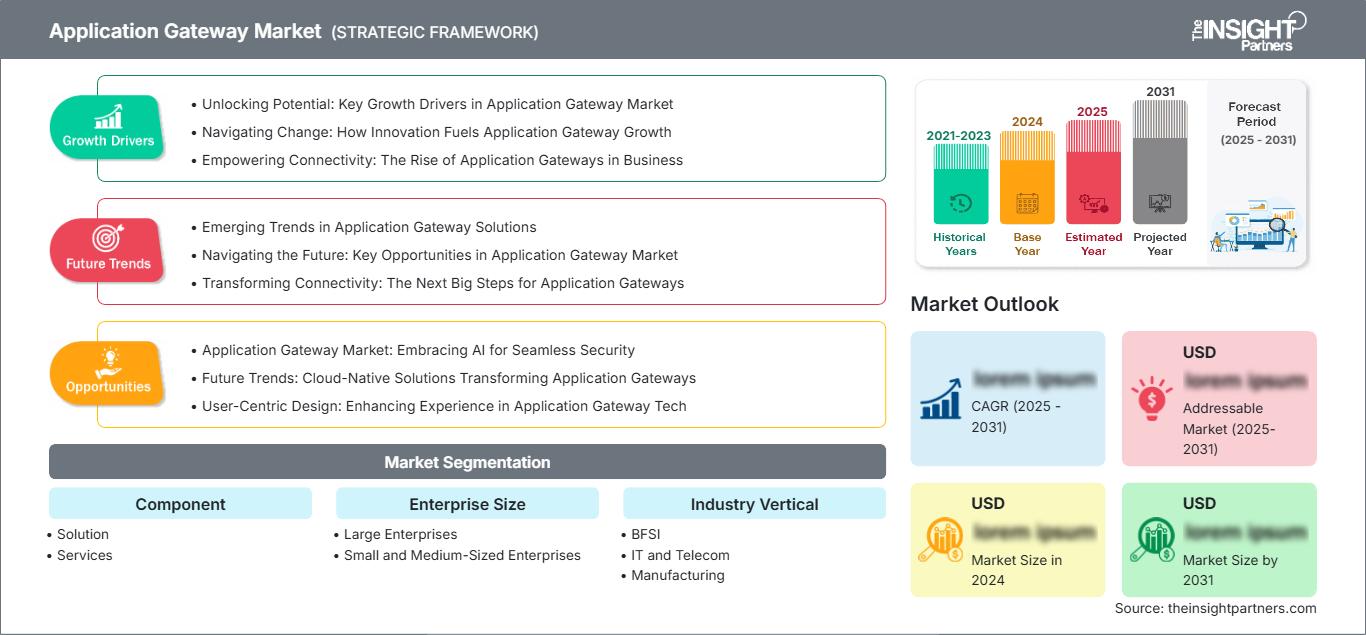
Application Gateway Market: Strategic Insights
Regional Insights
North America application gateway market
North America is estimated to account for 37–40% of the global application gateway Market revenue in 2025, with a CAGR of 8.3–9.1% during 2026–2034. The gateway share is bolstered through massive cloud footprints, well-established cyber budgets, and an emphasis on API-based digital service usage in the financial sector, healthcare, retail, telecommunications, and government.
Further, the regional uptake is enabled by federal cybersecurity guidelines, zero trust strategies, and the vendor footprint. The organizations have implemented gateways for examining encrypted traffic, ensuring remote access, boosting web application availability, and minimizing downtime risk exposure.
U.S. application gateway Market
The US represented an estimated 78–82% of North America application gateway Market demand in 2025 and is expected to grow at a CAGR of 8.4–9.2%. Large enterprises, cloud-native software firms, banks, insurers, healthcare networks, and government agencies are major adopters due to high application traffic intensity and compliance requirements.
Company presence is strong across Microsoft Corporation, F5, Inc., Barracuda Networks, Inc., Imperva, Inc., Zscaler, Inc., and Forcepoint LLC. Application trends center on API protection, web application firewalls, intelligent routing, DDoS mitigation, and identity-aware application access across hybrid and multi-cloud environments.
Europe application gateway Market
Europe accounted for an estimated 24–27% Application Gateway Market share in 2025 and is expected to grow at a CAGR of 7.8–8.6%. The UK leads regional adoption due to advanced financial services digitization, cloud migration, and cybersecurity modernization, while Germany follows with manufacturing, automotive, industrial cloud, and public-sector security demand.
France, Italy, and Spain are expanding deployments as enterprises modernize customer-facing applications and comply with data protection obligations. European buyers prioritize secure traffic management, regional data governance, and resilient application performance. Demand is strongest where hybrid cloud, online banking, digital government, and e-commerce services require application-layer controls.
APAC application gateway Market
According to the Application Gateway Market report, APAC accounted for an estimated 21–24% share in 2025 and is projected to grow at a CAGR of 9.4–10.4% during the forecast period. China leads regional demand, followed by Japan, South Korea, India, and Australia, driven by expanding cloud infrastructure, fintech platform adoption, telecom modernization initiatives, and digital government programs. Growing investments in cybersecurity and enterprise application delivery solutions continue to support market growth across the region.
High application gateway trends in APAC include cloud-native deployment, managed security services, API monetization, and edge application routing. Industrial digitization, rising mobile transaction volumes, and national cybersecurity policies are encouraging enterprises to adopt scalable gateways that improve traffic visibility and reduce application-layer exposure.
Middle East & Africa application gateway Market
The Middle East & Africa market is expected to grow at a CAGR of 8.0–8.8% during 2026–2034, in line with emerging Application Gateway Market trends. Saudi Arabia and the UAE lead adoption through smart government, finance, aviation, energy, and cloud infrastructure projects, while South Africa supports demand through banking and telecom modernization.
Enterprises in the region use gateways to secure online services, protect APIs, support customer portals, and manage traffic across hybrid environments. Energy, infrastructure, and public-sector digitization create long-term demand for resilient application delivery, particularly where uptime, data security, and regulatory oversight are operational priorities.
Segmentation Analysis
Component
According to the Application Gateway Market forecast, the component segment, comprising Solutions and Services, is expected to grow at a CAGR of 8.7–9.5% during 2026–2034. Application gateway adoption across both components is expanding as organizations increasingly combine scalable gateway platforms with deployment, monitoring, optimization, consulting, and managed security services to enhance application performance, visibility, and protection across complex digital environments.
- Solution remains the largest sub-segment, supported by demand for secure routing, web application firewall features, load balancing, TLS termination, bot control, and API traffic management in cloud and hybrid environments.
- Services are gaining importance as enterprises require consulting, integration, deployment, policy configuration, support, maintenance, and managed gateway operations to reduce internal complexity and improve service reliability.
Enterprise Size
Enterprise Size is expected to grow at a CAGR of 8.6–9.4% during 2026–2034. Large enterprises dominate revenue because complex application portfolios require advanced traffic routing and security orchestration, while small and medium-sized enterprises increasingly adopt cloud-based gateway services.
- Large Enterprises account for the majority of demand due to multi-cloud operations, high transaction volumes, distributed users, compliance requirements, and the need for centralized control over application delivery.
- Small and Medium-Sized Enterprises are adopting gateways through subscription and managed service models that reduce capital costs while improving web security, uptime, and application performance.
Industry Vertical
Industry Vertical demand is expected to grow at a CAGR of 8.8–9.6% during 2026–2034. BFSI leads adoption because digital banking and payment systems require resilient application protection, while telecom, healthcare, retail, manufacturing, and public-sector users expand use cases.
- BFSI remains the largest vertical as institutions secure customer portals, mobile banking, payment APIs, fraud-sensitive applications, and compliance-driven digital channels.
- IT and Telecom adoption is driven by cloud services, SaaS platforms, API connectivity, network modernization, and high-volume user traffic requiring low-latency delivery.
- Manufacturing uses gateways to protect industrial portals, partner platforms, supplier applications, and connected systems as factories adopt digital operations.
- Retail demand is supported by e-commerce traffic, customer identity systems, inventory applications, promotions, and seasonal transaction spikes.
- Government and Public Sector adoption reflects digital citizen services, secure portals, regulatory compliance, and modernization of legacy application access.
- Healthcare uses gateways to secure patient portals, telehealth applications, claims systems, and clinical platforms that require reliable and protected access.
Opportunity Snapshot
| Industry Vertical | Revenue Contribution | Trend Tag | Adoption Stage |
|---|---|---|---|
| BFSI | High | API Security | Mature |
| IT and Telecom | High | Cloud Routing | Scaling |
| Manufacturing | Medium | Industrial Access | Scaling |
| Retail | Medium | Traffic Spikes | Scaling |
| Government and Public Sector | Medium | Secure Portals | Scaling |
| Healthcare | Medium | Patient Access | Scaling |
Application Gateway Market Growth Drivers and Impact Analysis
Rising Need for Application-Layer Security
Businesses are seeing an increasing trend of application-layer attacks owing to the growth of customer portals, API integration, software as a service (SaaS) applications, and mobile applications. The application gateway facilitates the inspection of HTTP/HTTPS requests, enforces access rules, blocks malicious attacks, and provides web application firewall functionalities. The effect is significant in industries like BFSI, healthcare, retail, and government because there is a financial risk involved. With more traffic getting encrypted, there will be an increased demand for TLS termination gateways.
Cloud-Native and Hybrid Infrastructure Expansion
Cloud migration has created the need for scalable gateway platforms that will be able to function in on-premise data centers, public cloud, private cloud, and edge infrastructure. Application gateways offer intelligent traffic routing, load balancing, service discovery, and traffic management. The effect of this trend can be seen among large corporations where there are thousands of workloads and uniform policies in different infrastructures are required. This trend also addresses the requirement for services because it involves integration and managed services.
Growth of API-Driven Digital Services
APIs are currently utilized for banking operations, e-commerce processes, healthcare sites, telecom service provision, and government functions. Application gateways give organizations the ability to manage request flow, authentication, abuse, latency measurement, and protection of their backend services. This enhances the experience of users while lowering the risk for business operations. The market effect is pronounced for companies that design their microservices and partner networks because the platforms of the gateways enable standardized access and protection of interfaces from vulnerabilities.
Application Gateway Market Future Trends
AI-Assisted Traffic and Threat Management
Application gateway trends are moving toward AI-assisted anomaly detection, adaptive policy tuning, and automated threat prioritization. As traffic patterns become more dynamic, static rules are less effective for identifying abuse, bots, credential attacks, and unusual API behavior. AI-enabled gateways can help security teams detect deviations faster, reduce false positives, and tune controls based on live application behavior. This trend should increase value for large enterprises with high-volume digital channels and limited security operations capacity.
Convergence of Gateway, WAF, and Zero-Trust Controls
Expectations are for the market to consolidate on unified platforms offering combined capabilities such as application delivery, web application firewall, API Gateway, identity aware access, and zero trust policy enforcement. Buyers will increasingly want integrated control points because using different products leads to operational challenges and inconsistent policy implementation. Future gateway products will probably focus on centralized management, cloud-based deployment, policy portability, and integration with identity providers and security analytics systems.
Application Gateway Market Opportunities
Managed Gateway Services for Mid-Market Enterprises
Mid-market enterprises often need application security and reliable traffic management but lack specialist teams to configure and monitor complex gateway environments. Managed gateway services create an opportunity for telecom providers, cloud partners, and cybersecurity firms to package deployment, tuning, threat monitoring, reporting, and lifecycle support. This model lowers adoption barriers for small and medium-sized enterprises and supports recurring revenue for providers. It is especially relevant in retail, healthcare, regional banking, and digital services businesses.
API Protection for Regulated Digital Ecosystems
Regulated sectors are building partner APIs, customer self-service portals, and data exchange platforms that require strong authentication, traffic inspection, and policy control. Application gateways can become strategic enforcement points for API security, especially where organizations must balance user experience with compliance. Vendors can capture opportunities by offering API discovery, schema validation, abuse prevention, rate limiting, and integrated reporting. BFSI, healthcare, government, and telecom provide the most attractive adoption environments.
Frequently Asked Questions

- Comprehensive Market Sizing and Forecast Analysis
- Detailed Segmentation Analysis
- In-Depth Market Dynamics Assessment
- Regional and Country-Level Insights
- Competitive Landscape and Company Benchmarking
- Strategic Business Intelligence
Recent Reports
Testimonials

The Insight Partners' SCADA System Market report is comprehensive, with valuable insights on current trends and future forecasts. The team was highly professional, responsive, and supportive throughout. We are very satisfied and highly recommend their services.
RAN KEDEM Partner, Reali Technologies LTDs
I requested a report on a very specific software market and the team produced the report in a few days. The information was very relevant and well presented. I then requested some changes and additions to the report. The team was again very responsive and I got the final report in less than a week.
JEAN-HERVE JENN Chairman, Future Analytica
We worked with The Insight Partners for an important market study and forecast. They gave us clear insights into opportunities and risks, which helped shape our plans. Their research was easy to use and based on solid data. It helped us make smart, confident decisions. We highly recommend them.
PIYUSH NAGPAL Sr. Vice President, High Beam Global
The Insight Partners delivered insightful, well-structured market research with strong domain expertise. Their team was professional and responsive throughout. The user-friendly website made accessing industry reports seamless. We highly recommend them for reliable, high-quality research services
YUKIHIKO ADACHI CEO, Deep Blue, LLC.
This is the first time I have purchased a market report from The Insight Partners.While I was unsure at first, I visited their web site and felt more comfortable to take the risk and purchase a market report.I am completely satisfied with the quality of the report and customer service. I had several questions and comments with the initial report, but after a couple of dialogs over email with their analyst I believe I have a report that I can use as input to our strategic planning process.Thank you so much for taking the extra time and making this a positive experience.I will definitely recommend your service to others and you will be my first call when we need further market data.
JOHN SUZUKI President and Chief Executive Officer, Board Director, BK Technologies
I wish to appreciate your support and the professionalism you displayed in the course of attending to my request for information regarding to infectious disease IVD market in Nigeria. I appreciate your patience, your guidance, and the fact that you were willing to offer a discount, which eventually made it possible for us to close a deal. I look forward to engaging The Insight Partners in the future, all thanks to the impression you have created in me as a result of this first encounter.
DR CHIJIOKE ONYIA MANAGING DIRECTOR, PineCrest Healthcare Ltd.Reason to Buy
- Informed Decision-Making
- Understanding Market Dynamics
- Competitive Analysis
- Identifying Emerging Markets
- Customer Insights
- Market Forecasts
- Risk Mitigation
- Boosting Operational Efficiency
- Strategic Planning
- Investment Justification
- Tracking Industry Innovations
- Aligning with Regulatory Trends





 Get Free Sample for