
Application Performance Management Market Size, Trends & Demand by 2034
Coverage: by Component (Software, Service); Deployment (On-premises, Cloud); Organization Size (Small and Medium Enterprises, Large Enterprise); Access Type (Web, Mobile); Vertical (BFSI, Manufacturing, Government, Retail, IT and Telecom, Media and Entertainment, Education, Others) , and Geography (North America, Europe, Asia Pacific, and South and Central America)
- Status : Data Released
- Report Code : TIPRE00011344
- Category : Technology, Media and Telecommunications
- No. of Pages : 150
- Available Report Formats :


- Last update date : August 26, 2026


2025 Market Size
US$ 7.63 Bn
Base year value
2034 Forecast
US$ 19.09 Bn
Projected by 2034
CAGR 2026-2034
10.73 %
Growth rate
Addressable Market
US$ 118.31 Bn
(2026-2034)
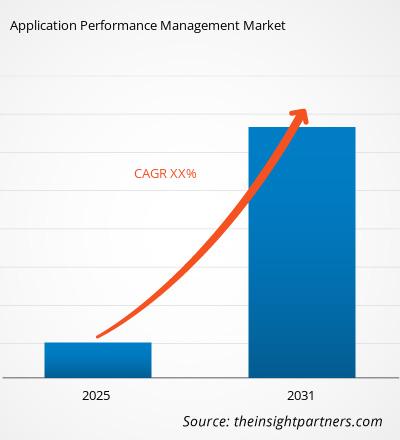
The application performance management market was valued at US$ 7.63 Billion in 2025 and is projected to reach US$ 19.09 Billion by 2034, registering a CAGR of 10.73% during 2026–2034. Demand is expanding as enterprises prioritize digital experience assurance, distributed application visibility, and faster incident resolution across hybrid IT estates, cloud-native services, mobile channels, and customer-facing web platforms.
North America remains the most mature adoption base, with the application performance management market size supported by high cloud migration intensity, dense enterprise software spending, and regulated-sector reliance on uptime assurance. The region is estimated to grow at a CAGR of 9.8–10.4% during 2026–2034, driven by observability platform consolidation, growing AI workload monitoring needs, and enterprise modernization across banking, healthcare, retail, and digital public services.
Application Performance Management Market Assessment and Insights
- North America: North America held 39–41% share in 2025 and is expected to grow at a CAGR of 9.8–10.4% between 2026–2034, supported by cloud-native engineering, financial services digitization, and early observability adoption.
- US: The U.S. accounted for 78–82% of North America in 2025 and is projected to grow at a CAGR of 9.7–10.3% between 2026–2034.
- Europe: Europe held 25–27% share in 2025 and is expected to grow at a CAGR of 9.2–9.8% between 2026–2034, led by the UK, Germany, France, Italy, and Spain.
- Asia Pacific: Asia Pacific held 22–24% share in 2025 and is projected to grow at a CAGR of 12.1–12.8% between 2026–2034, with China, India, Japan, South Korea, and Australia leading adoption.
- Largest Segment: Software led with 63–67% market share in 2025 and is expected to grow at a CAGR of 10.2–10.8% during 2026–2034.
- High Growth Segment: Cloud held 48–52% market share in 2025 and is expected to grow at a CAGR of 12.4–13.1% during 2026–2034.
- Key companies analyzed in detail: International Business Machines Corporation, AppDynamics LLC, BMC Software, Inc., Broadcom Inc., Compuware Corporation, Dell Technologies Inc., Microsoft Corporation, New Relic, Inc., Riverbed Technology LLC, Splunk LLC.
Source: The Insight Partners' analysis based on proprietary research, government publications, company annual reports, investor presentations, industry databases, and expert interviews.
Enterprise monitoring has shifted from isolated server and application checks toward telemetry-rich observability ecosystems. The application performance management market is evolving around distributed tracing, OpenTelemetry alignment, digital experience monitoring, AI-assisted incident correlation, and automated remediation. The production process itself is also undergoing a transformation due to the supply of APM along with infrastructure management, logging, synthetic monitoring, Kubernetes observability, database visibility, and adjacent security processes.
In terms of future perspectives, there will be an increase in demand from not only tech giants but also new digital economies that will require robust performance from applications used for banking, government, telecom services, and online retail channels. Investments will also go to regulated cloud, sovereign data systems, and AI operations.
Application Performance Management Market Report Scope
| Report Attribute | Details |
|---|---|
| Market size in 2025 | US$ 7.63 Billion |
| Market Size by 2034 | US$ 19.09 Billion |
| Global CAGR (2026 - 2034) | 10.73% |
| Historical Data | 2021-2024 |
| Forecast period | 2026-2034 |
Application Performance Management Market Analysis
Application modernization remains the principal demand engine, as enterprises convert monolithic software estates into microservices, APIs, containers, and serverless functions. This transition is accelerating application performance management market growth because failure points multiply across code, cloud infrastructure, databases, networks, and third-party services. Consumers are leaning towards solutions that are able to make sense of telemetry data throughout the entire buying process, thereby minimizing mean time to detect and enhancing release readiness.
There are supply dynamics that are influenced by a multilayered ecosystem comprising hyperscale cloud platforms, independent observability solution vendors, IT services firms, managed service partners, and open source telemetry groups. There is an increased differentiation through cost-efficiency in data ingestion, root cause analysis using artificial intelligence, integrations into developer workflows, and hybrid deployments.
The competitive environment is concentrated but fluid, and application performance management market analysis shows clear movement toward platform convergence. IBM, Microsoft, Broadcom, BMC Software, and Dell Technologies operate by way of enterprise IT partnerships, whereas New Relic, Inc., AppDynamics LLC, Riverbed Technology LLC, Splunk LLC, and Compuware Corporation continue to maintain their strength through specialized solutions for monitoring, transactions, and observability workflows.
The investment strategies are becoming increasingly aligned with AI-enabled operations. Splunk LLC and AppDynamics LLC are working on observability within hybrid applications monitoring, IBM is concentrating on AI-assisted incident response with IBM Instana, while New Relic Inc. is working on unified telemetry and intelligent observability, and Microsoft Corporation enjoys native Azure usage. The strategic positioning is determined by the variety of telemetry, flexibility of implementation, cost management, and translation of performance information into business risks.
● REPORT CUSTOMIZATION
Tailor This Report To Align With Your Specific Business Requirements
This report can be customized to align precisely with your business objectives, scope, and target markets. Customization options include tailored segmentation, geography, competitive analysis, and strategic insights to support informed decision-making.
Customize This Report →WHAT YOU CAN ADJUST
- ● Segmentations
- ● Geography
- ● Competitive Analysis
- ● Language Preferences
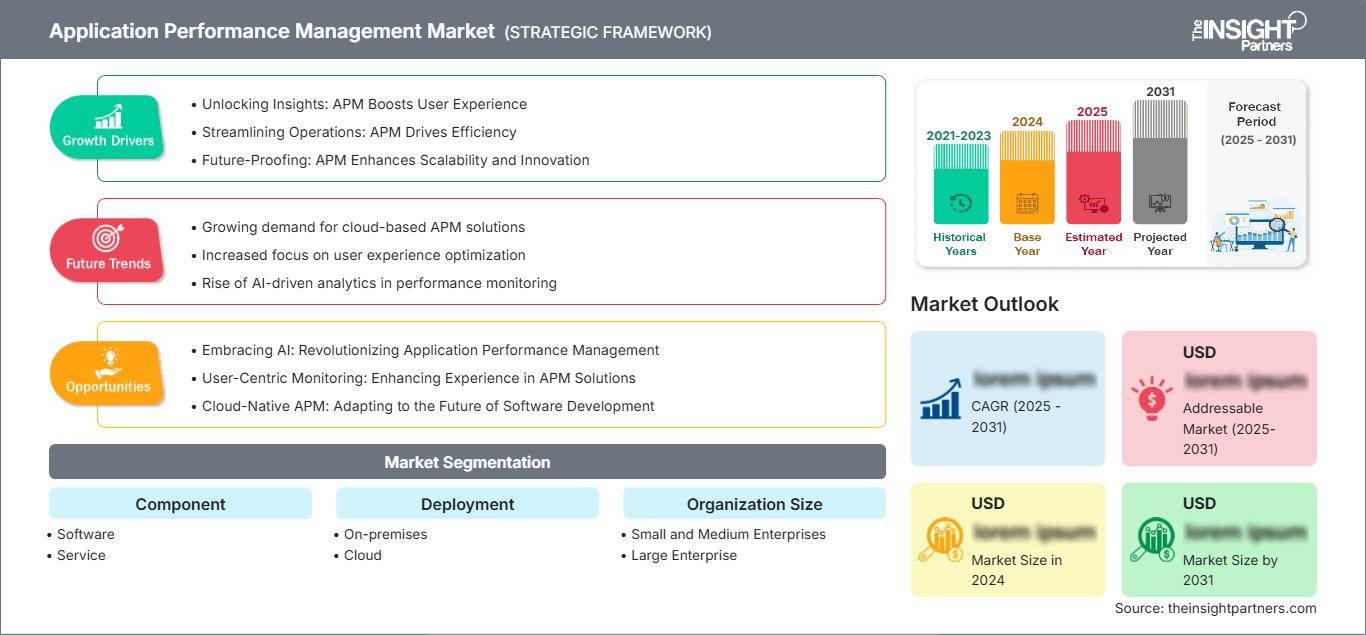
Application Performance Management Market: Strategic Insights
Regional Insights
North America application performance management market
North America accounted for 39–41% share of the Application Performance Management Market in 2025 and is expected to grow at a CAGR of 9.8–10.4% during 2026–2034. The region leads because enterprises operate complex multi-cloud estates, high-volume digital channels, and mature DevOps pipelines that require continuous application visibility. Demand is strongest in financial services, healthcare, retail, media, and cloud software businesses.
The regional application performance management market share is reinforced by vendor concentration, hyperscale cloud adoption, and early investment in AIOps. Enterprises are rationalizing fragmented monitoring tools into telemetry platforms that support distributed tracing, log correlation, synthetic testing, and business transaction monitoring. Procurement increasingly favors solutions that reduce downtime risks while aligning engineering teams around shared service reliability metrics.
U.S. application performance management Market
The U.S. represented 78–82% of the North America Application Performance Management Market in 2025 and is projected to grow at a CAGR of 9.7–10.3% through 2034. Large enterprises are prioritizing performance assurance for digital banking, e-commerce, healthcare portals, SaaS products, insurance platforms, and public cloud workloads. This creates recurring demand for APM software that can support high transaction volumes and rapid release cycles.
Company presence is a major differentiator. Microsoft Corporation, New Relic, Inc., Splunk LLC, AppDynamics LLC, International Business Machines Corporation, Broadcom Inc., and BMC Software, Inc. all operate substantial U.S. customer, product, and partner ecosystems. Adoption is moving from infrastructure-centric monitoring toward application journey analytics, API performance tracking, Kubernetes observability, and AI-assisted incident workflows that improve operational resilience.
Europe application performance management Market
Europe held 25–27% share in 2025 and is expected to grow at a CAGR of 9.2–9.8% during 2026–2034. The UK is the leading country, supported by financial technology, online retail, public-sector cloud programs, and advanced digital banking infrastructure. Buyers emphasize secure observability, data residency, and service-level accountability.
Germany follows closely as manufacturing, automotive, software, industrial IoT, and enterprise resource planning platforms become more connected. Demand is rising for on-premises and hybrid APM deployments that can monitor mission-critical applications while supporting compliance-sensitive data flows. France, Italy, and Spain are expanding through telecom modernization, digital public services, and e-commerce growth, with mid-market cloud adoption creating new vendor opportunities.
APAC application performance management Market
APAC accounted for 22–24% share of the Application Performance Management Market in 2025 and is expected to grow at a CAGR of 12.1–12.8% through 2034. China is the leading country, with India, Japan, South Korea, and Australia also contributing materially. Growth is tied to mobile-first services, digital payments, 5G applications, and cloud infrastructure buildouts.
Policy-led digitization and industrial automation are expanding the need for real-time application monitoring. Indian banks, Chinese internet platforms, Japanese manufacturers, Korean technology firms, and Australian public agencies are investing in observability to improve uptime and customer experience. Vendors with regional cloud integrations, language support, and cost-efficient telemetry controls are positioned well.
Middle East & Africa application performance management Market
The Middle East & Africa Application Performance Management Market is forecast to grow at a CAGR of 8.6–9.3% during 2026–2034, with Saudi Arabia as the leading country. The UAE, South Africa, and the rest of MEA are also adopting APM tools as digital government, fintech, telecom, logistics, and smart infrastructure programs scale.
Energy and infrastructure modernization create distinctive demand. Oil and gas operators, utilities, airlines, banks, and government platforms require high-reliability software for operational continuity. Cloud adoption is rising, but hybrid deployment remains important due to sovereignty, latency, and cybersecurity requirements. Managed observability services are gaining relevance where internal SRE talent remains limited.
Segmentation Analysis
Component
Component is expected to grow at a CAGR of 10.4–11.0% during 2026–2034. This segment defines the application performance management market scope because buyers evaluate both platform functionality and service support when designing monitoring architecture. Software remains central for telemetry correlation and incident workflows, while services support integration, migration, tuning, managed operations, and governance across complex enterprise environments.
- Software: Software holds the strongest position because enterprises need persistent visibility across applications, infrastructure, databases, cloud services, APIs, and user journeys. Strategic importance is rising as buyers consolidate monitoring tools into unified observability platforms.
- Service: Service demand is tied to implementation complexity, telemetry strategy, dashboard design, and managed operations. Enterprises use services to accelerate deployment, reduce configuration errors, and align APM outputs with reliability engineering goals.
Deployment
Deployment is projected to grow at a CAGR of 10.8–11.4% during 2026–2034. Demand is split between controlled on-premises environments and scalable cloud deployments. Cloud adoption is accelerating as enterprises prioritize faster onboarding, elastic telemetry ingestion, and lower infrastructure management overhead, while on-premises remains relevant for regulated workloads and legacy application estates.
- On-premises: On-premises deployment remains important for banking, defense, industrial, and public-sector workloads requiring strict control over data, latency, and integration. It supports legacy application visibility and compliance-sensitive performance monitoring.
- Cloud: Cloud deployment is expanding rapidly because digital teams need flexible telemetry capacity, faster feature access, and integration with cloud-native architectures. It supports distributed applications, Kubernetes environments, and remote operations.
Organization Size
Organization Size is expected to grow at a CAGR of 10.1–10.7% during 2026–2034. Large enterprises drive depth of spending due to complex application portfolios and strict uptime expectations. Small and medium enterprises are increasing adoption as SaaS-based APM lowers entry barriers and makes performance management more accessible without heavy internal infrastructure.
- Small and Medium Enterprises: SMEs adopt APM to protect digital revenue channels, customer portals, and business-critical SaaS workflows. Demand is strongest for affordable, cloud-delivered platforms with simple dashboards and automated alerts.
- Large Enterprise: Large enterprises require advanced observability across hybrid infrastructure, multi-cloud services, and high-volume transactions. They prioritize integration depth, governance, role-based access, and correlation across business and technical indicators.
Access Type
Access Type is projected to grow at a CAGR of 10.6–11.2% during 2026–2034. Web remains foundational because enterprise applications and customer portals continue to carry high transaction volumes. Mobile access is gaining strategic importance as financial services, retail, travel, healthcare, and government channels shift toward app-first customer engagement.
- Web: Web access dominates mature enterprise monitoring because customer portals, e-commerce platforms, SaaS applications, and internal business systems depend on browser-based performance. It is strategically important for transaction monitoring and digital experience assurance.
- Mobile: Mobile access is increasingly critical as digital services become app-led. Enterprises monitor crashes, latency, API calls, device conditions, and user journeys to protect retention, revenue conversion, and brand experience.
Opportunity Snapshot
| Segments | Revenue Contribution | Trend Tag | Adoption Stage |
| Software | High | Unified Telemetry | Mature |
| Service | Medium | Managed SRE | Scaling |
| On-premises | Medium | Sovereign Control | Mature |
| Cloud | High | Elastic Observability | Scaling |
| Small and Medium Enterprises | Medium | SaaS Monitoring | Scaling |
| Large Enterprise | High | Platform Consolidation | Mature |
| Web | High | Journey Analytics | Mature |
| Mobile | Medium | App Reliability | Scaling |
Application Performance Management Market Growth Drivers and Impact Analysis
Rising Complexity of Distributed Application Architectures
Modern businesses are increasingly running in a microservices, API, container, serverless function, edge, and third-party dependency environment. This leads to performance blind spots that cannot be fixed using conventional monitoring approaches promptly. APM solutions are now becoming increasingly necessary due to the need for trace visibility on every service interaction, user interaction, and any dependency on the infrastructure side by the engineering team. The business impact is most profound in cases where the applications have a direct impact on revenue generation, for instance, in banks, retail, travel, healthcare, and SaaS industries. Due to shrinking release cycles, buyers are now incorporating monitoring in DevOps processes.
Enterprise Shift Toward AI-Assisted IT Operations
The use of artificial intelligence for enterprise IT operations will bring about changes in anomaly detection, prioritization, and remediation recommendations. In APM software tools, artificial intelligence technology has been incorporated to minimize alert fatigue and cut down on the time taken to respond to incidents. This driver has a significant effect since huge amounts of telemetry data are collected from large IT environments and cannot be analyzed manually. Today’s buyers expect tools which will correlate alerts, determine the likely cause, and highlight the effect of such incidents on the business before entering war room discussions.
Expansion of Digital Customer Experience Accountability
For financial institutions, insurance companies, retail establishments, health care organizations, telcos, and governments, digital touchpoints have emerged as the main point of engagement for their services. Application performance is thus no longer just an IT metric but becomes linked to conversions, customer retention, trust, and service obligation compliance. Increasing APM adoption results from the need to monitor the effects of application performance on end-user experience. Market effects include increased demand for real user monitoring, synthetic testing, session intelligence, and business transaction analysis. Application performance management vendors who can provide insight into how technical telemetry translates into customer experience outcomes will be increasingly important to both the technology and business executives.
Application Performance Management Market Future Trends
Convergence of Observability and Business Operations Intelligence
A major direction for application performance management market trends is the convergence of technical observability with business operations intelligence. Future platforms will move beyond identifying slow services to explaining how incidents affect revenue, customer retention, release success, and operational risk. This shift will require stronger integration between telemetry systems, customer analytics, IT service management, and financial impact models. Vendors able to translate application events into executive-level service indicators will gain traction, especially in sectors where digital uptime affects regulated service delivery. Over time, performance teams will be measured less by dashboard coverage and more by business continuity outcomes.
Open Telemetry Standards Reshaping Vendor Differentiation
Open telemetry standards are supposed to reduce reliance on proprietary agents and make buyers more flexible. As businesses move towards standardized data ingestion for logs, metrics, traces, and events, differentiation will come through analytics capabilities, workflow automation, efficient storage, and insights from particular domains. This scenario will work to the advantage of buyers in terms of reduced switching costs and interoperability within multiple vendor IT infrastructures. In addition, it will make vendors prove value in their platforms beyond just ingesting data. During the forecast period, winning vendors will be those that provide standards-based ingestion together with anomaly detection, topology mapping, governance, and cost management to avoid costly telemetry explosion.
Application Performance Management Market Opportunities
Cloud-Native Monitoring for Regulated Industries
Regulated industries offer a strong investment opportunity because banks, insurers, healthcare providers, utilities, and government agencies are modernizing applications while maintaining strict compliance controls. Vendors can expand by offering secure cloud or hybrid deployment models with data residency, audit trails, role-based controls, encryption, and integration with existing service management platforms. The application performance management market Forecasts indicate stronger demand for solutions that combine cloud scalability with regulatory assurance. Providers should prioritize industry templates, compliance-ready dashboards, and risk-based alerting. Channel partnerships with managed service providers can also help address skills gaps among institutions that need advanced observability but lack mature internal SRE teams.
Performance Management for AI-Enabled Applications
Applications using AI come with their own performance challenges, such as model latency, inference cost variations, prompt orchestration errors, vector databases, and unanticipated user demand cycles. This offers an opportunity for APM providers to extend monitoring into AI pipelines, model serving architecture, and agentive application flows. Companies applying generative AI for customer service, software development, data analytics, and knowledge management purposes will have to monitor both legacy application tiers as well as AI-related pieces. APM providers that develop AI observability packages, GPU workload management, token cost analysis, and model responses tracking will be able to capitalize on emerging demands.
Frequently Asked Questions

- Comprehensive Market Sizing and Forecast Analysis
- Detailed Segmentation Analysis
- In-Depth Market Dynamics Assessment
- Regional and Country-Level Insights
- Competitive Landscape and Company Benchmarking
- Strategic Business Intelligence
Recent Reports
Testimonials

The Insight Partners provided valuable market intelligence that supported our global go-to-market strategy. Their team was professional, responsive, and attentive to our feedback, providing thoughtful analysis and helpful methodological clarifications throughout the project.
Junmo Kim Chief Financial Officer (CFO), Enertech Co., Ltd.
The Insight Partners' SCADA System Market report is comprehensive, with valuable insights on current trends and future forecasts. The team was highly professional, responsive, and supportive throughout. We are very satisfied and highly recommend their services.
RAN KEDEM Partner, Reali Technologies LTDs
I requested a report on a very specific software market and the team produced the report in a few days. The information was very relevant and well presented. I then requested some changes and additions to the report. The team was again very responsive and I got the final report in less than a week.
JEAN-HERVE JENN Chairman, Future Analytica
We worked with The Insight Partners for an important market study and forecast. They gave us clear insights into opportunities and risks, which helped shape our plans. Their research was easy to use and based on solid data. It helped us make smart, confident decisions. We highly recommend them.
PIYUSH NAGPAL Sr. Vice President, High Beam Global
The Insight Partners delivered insightful, well-structured market research with strong domain expertise. Their team was professional and responsive throughout. The user-friendly website made accessing industry reports seamless. We highly recommend them for reliable, high-quality research services
YUKIHIKO ADACHI CEO, Deep Blue, LLC.
This is the first time I have purchased a market report from The Insight Partners.While I was unsure at first, I visited their web site and felt more comfortable to take the risk and purchase a market report.I am completely satisfied with the quality of the report and customer service. I had several questions and comments with the initial report, but after a couple of dialogs over email with their analyst I believe I have a report that I can use as input to our strategic planning process.Thank you so much for taking the extra time and making this a positive experience.I will definitely recommend your service to others and you will be my first call when we need further market data.
JOHN SUZUKI President and Chief Executive Officer, Board Director, BK Technologies
I wish to appreciate your support and the professionalism you displayed in the course of attending to my request for information regarding to infectious disease IVD market in Nigeria. I appreciate your patience, your guidance, and the fact that you were willing to offer a discount, which eventually made it possible for us to close a deal. I look forward to engaging The Insight Partners in the future, all thanks to the impression you have created in me as a result of this first encounter.
DR CHIJIOKE ONYIA MANAGING DIRECTOR, PineCrest Healthcare Ltd.Reason to Buy
- Informed Decision-Making
- Understanding Market Dynamics
- Competitive Analysis
- Identifying Emerging Markets
- Customer Insights
- Market Forecasts
- Risk Mitigation
- Boosting Operational Efficiency
- Strategic Planning
- Investment Justification
- Tracking Industry Innovations
- Aligning with Regulatory Trends





 Get Free Sample for